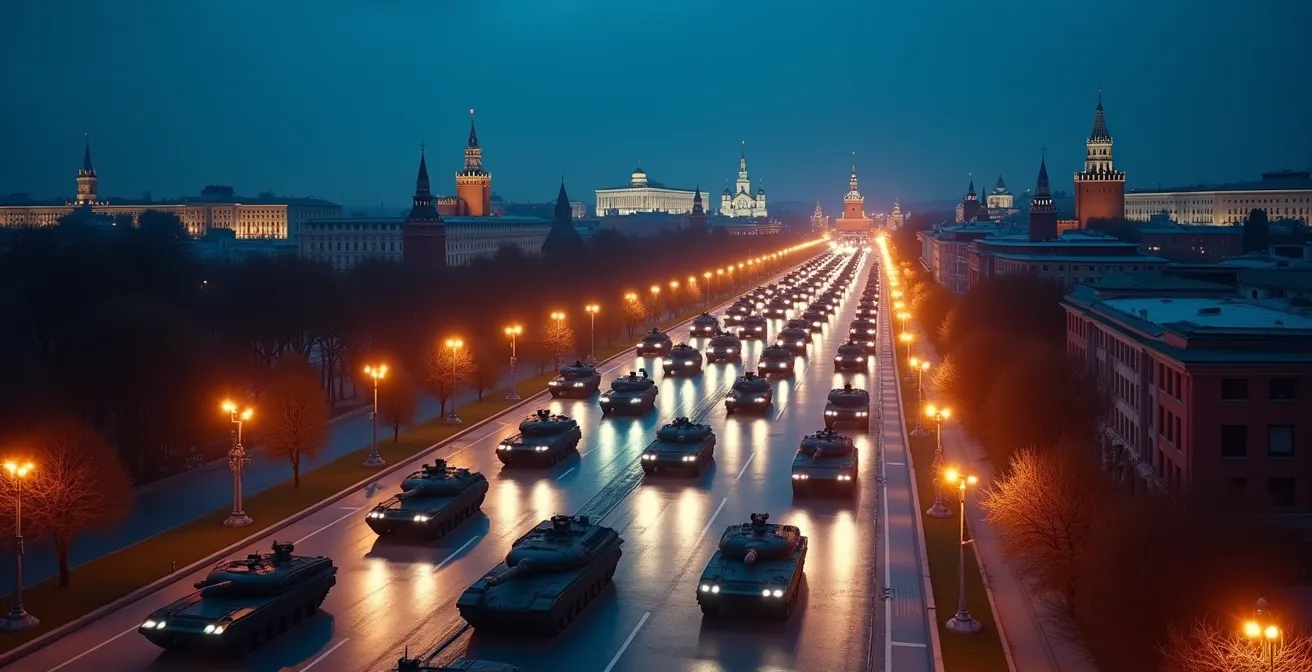
Successfully experiencing Moscow’s Victory Day as a military enthusiast is a logistical operation, not a sightseeing tour.
- Key hardware viewing occurs during night rehearsals and the morning deployment, not at the inaccessible Red Square parade.
- Alternative sites like Victory Park and VDNKh offer more rewarding, less crowded experiences with direct access to military history.
Recommendation: Adopt a strategic mindset: prioritize mobility via the Metro and MCC, plan for logistical dead zones, and focus on secondary events for the highest experience-to-friction ratio.
For the military enthusiast, Moscow on May 9th presents a paradox. The world’s most impressive display of military hardware is on full view, yet tantalizingly out of reach behind cordons and invitation-only stands at Red Square. The common advice—find a spot on Tverskaya Street and wait—often leads to hours of frustration amid crushing crowds, with only a fleeting glimpse of the main column. The real opportunity isn’t just watching the parade; it’s about understanding the city’s rhythm and deploying a strategy to secure optimal viewing positions for the hardware, from the night rehearsals mentioned in the main title to the daytime festivities.
This guide discards the conventional wisdom. We will treat Victory Day not as a tourist event, but as a complex logistical environment. The key to success lies not in getting closer to Red Square, but in strategically positioning yourself at key junctures before, during, and after the main event. It’s about leveraging the city’s transport network to outmaneuver the crowds and understanding the cultural subtext of the symbols you will encounter. This approach transforms the day from a passive viewing experience into an active, rewarding mission.
We will deconstruct the day’s key events, providing a strategic framework to navigate everything from the poignant “Immortal Regiment” march to the chaotic but spectacular fireworks. By analyzing crowd flow dynamics and identifying tactical alternatives, you can craft an itinerary that maximizes your access to military history while minimizing the operational friction that traps most visitors.
This article provides a complete operational briefing. We will cover the key events, logistical challenges, and cultural context to help you build a successful and memorable Victory Day experience in Moscow.
Table of Contents: A Strategic Guide to Moscow’s Victory Day
- What is the march with portraits and can a foreigner participate?
- Vorobyovy Gory: Is it the best spot for Victory Day fireworks?
- The St. George Ribbon: What does it symbolize and should you wear one?
- How to get to the airport on May 9th when the city center is blocked?
- Victory Park: Is the museum open to the public on the holiday itself?
- Borodino Panorama: Visualizing the battle against Napoleon from a Russian perspective
- Worker and Kolkhoz Woman: Why is this statue an icon of Mosfilm?
- Where to find authentic Soviet heritage beyond the Red Square crowds?
What Is the March with Portraits and Can a Foreigner Participate?
Following the military parade, Moscow’s central arteries transform to host the “Immortal Regiment” (Bessmertny Polk), a massive civilian procession. Participants carry portraits of their relatives who fought in World War II, creating a deeply personal and visually striking river of memory that flows through the city. The scale is immense; in recent years, police data confirmed that over 1 million people participated in Moscow alone. This is not a military display, but a powerful expression of collective memory and national identity.
For a foreign observer, direct participation is culturally complex. The march is deeply personal, and joining with a generic or fabricated portrait would be inappropriate. The strategic approach is to observe respectfully from the sidelines. The march’s spread to over 80 countries, including France, highlights its use as a tool of cultural diplomacy. In France, local marches organized by diaspora communities often focus on preserving family memory, whereas the event in Moscow is intrinsically tied to the state’s official narrative of the Great Patriotic War.
As a non-participant, your goal is to find a good vantage point that doesn’t obstruct the flow. Tverskaya Street is the main axis, but positioning yourself on a less crowded side street can offer better viewing angles and a less overwhelming experience. Understand that the march follows the main parade, effectively extending the city center lockdown for 4-6 hours. This is a key logistical factor for planning your day’s movements.
Observing the Immortal Regiment provides a profound insight into the modern Russian soul, but it requires patience and respectful distance rather than active participation.
Vorobyovy Gory: Is It the Best Spot for Victory Day Fireworks?
Vorobyovy Gory (Sparrow Hills) is consistently touted as the premier location for watching the Victory Day fireworks. Its elevated, panoramic view over the Moscow River and Luzhniki Stadium seems ideal. However, from a logistical standpoint, it presents a classic case of a low experience-to-friction ratio. The very features that make it attractive also make it one of the most challenging spots in the city on May 9th.
The primary issue is extreme crowd density. Thousands of people converge on the viewing platforms, leading to saturated mobile networks, limited personal space, and a heightened risk of pickpocketing. The biggest challenge, however, is the exit. The post-show exodus creates a massive bottleneck, overwhelming the nearby Vorobyovy Gory metro station. What should be a quick departure can turn into an hour-long ordeal of shuffling through packed crowds.
A strategic analysis reveals both the strengths and critical weaknesses of this location. While the view is undeniably iconic, the operational costs are exceptionally high.
| Aspect | Details |
|---|---|
| Strengths | Iconic panoramic view over Moscow River, elevated position provides clear sightlines |
| Weaknesses | Extreme crowds (thousands expected), mobile network saturation, limited exits |
| Opportunities | Can combine with Moscow State University visit, multiple viewing terraces |
| Threats | Pickpocketing risk in dense crowds, post-show transport chaos with metro overcrowding |
For the strategic traveler, several alternatives offer a better balance. Booking a spot at a rooftop bar along the river provides comfort and a clear view for a price. Bridges across the Moscow River, while still popular, are often less densely packed than Sparrow Hills. If you do choose Vorobyovy Gory, have a clear exit strategy: plan to walk 15-20 minutes to the Universitet metro station instead of the closer one. A final, culturally immersive option is to watch the live broadcast in a local bar outside the center, sharing the experience with Muscovites in a more relaxed atmosphere.
Ultimately, the “best” spot is not the one with the most famous view, but the one that aligns with your tolerance for logistical friction.
The St. George Ribbon: What Does It Symbolize and Should You Wear One?
During the Victory Day celebrations, you will see the black-and-orange striped St. George ribbon everywhere: pinned to lapels, tied to car antennas, and distributed by volunteers in metro stations. Historically, the ribbon is a symbol of military valor, dating back to an order established by Catherine the Great. For many Russians, particularly the older generation, it remains a powerful and respected emblem of the sacrifice made during the Great Patriotic War.

However, the ribbon has acquired a potent and controversial second meaning in recent years. Its adoption by pro-Russian separatists in Ukraine has transformed it into a symbol of modern Russian nationalism and military assertiveness. As the Ukrainian World Congress notes, this has created a complex dual symbolism. Acknowledging this is crucial for any visitor.
Since 2014, the St. George ribbon has also become a symbol of Russia’s aggression against Ukraine.
– Ukrainian World Congress, Russia’s May 9 ‘Immortal Regiment’ march: what to know
So, should you wear one? From a strategic and culturally sensitive perspective, the most prudent approach is to decline politely or accept it as a souvenir rather than wearing it prominently. For a French visitor, the ribbon might seem analogous to the Bleuet de France, a symbol of remembrance. However, the St. George ribbon carries a much stronger and more contested political charge in the current geopolitical climate. If a volunteer offers you a ribbon, accepting it graciously is a polite gesture. You can simply put it in your pocket. This acknowledges the historical significance for the person offering it without you taking a political stance you may not fully understand or support.
In essence, treat the ribbon as a complex cultural artifact to be observed and understood, not necessarily adopted.
How to Get to the Airport on May 9th When the City Center Is Blocked?
Navigating Moscow on May 9th is a serious logistical challenge, but attempting to reach one of the city’s airports (Sheremetyevo, Domodedovo, or Vnukovo) requires a military-grade operational plan. The city center effectively becomes a logistical dead zone due to a multi-hour city center lockdown for the parade and subsequent events. Surface transport, including taxis and ride-sharing services, becomes highly unreliable, with extreme detours and surge pricing that can be two to three times the normal rate.
Your single most reliable asset is the Aeroexpress train. These trains offer a direct link to the airports from terminals located outside the most restricted areas, bypassing all surface-level chaos. The key is planning your access *to* the Aeroexpress terminals (Paveletsky, Belorussky). The Moscow Central Circle (MCC) line is invaluable here, as it orbits the city center and intersects with metro lines that can take you to the required terminal without entering the blocked-off parade route.
Your digital toolkit is also critical. While Google Maps is useful, on May 9th, local apps like Yandex Maps and Yandex Go provide far more accurate, real-time data on street closures and traffic. Download them in advance. The ultimate strategic move, however, is avoidance. If your travel plans are flexible, book a hotel for the night of May 9th that is either located near an Aeroexpress terminal or situated entirely outside the Garden Ring, thus bypassing the logistical nightmare altogether.
Treating your airport transfer as a primary mission objective, with the Aeroexpress as your main line of effort, is the only way to guarantee success.
Victory Park: Is the Museum Open to the Public on the Holiday Itself?
While Red Square is the ceremonial heart of Victory Day, Victory Park (Park Pobedy) on Poklonnaya Hill is its living, breathing soul. For the military enthusiast seeking an authentic and accessible experience, this is arguably the best place to be in Moscow on May 9th. The entire park transforms into an open-air festival, offering a far more interactive and less restrictive environment than the city center. It’s an excellent alternative to the parade, with its own unique atmosphere.
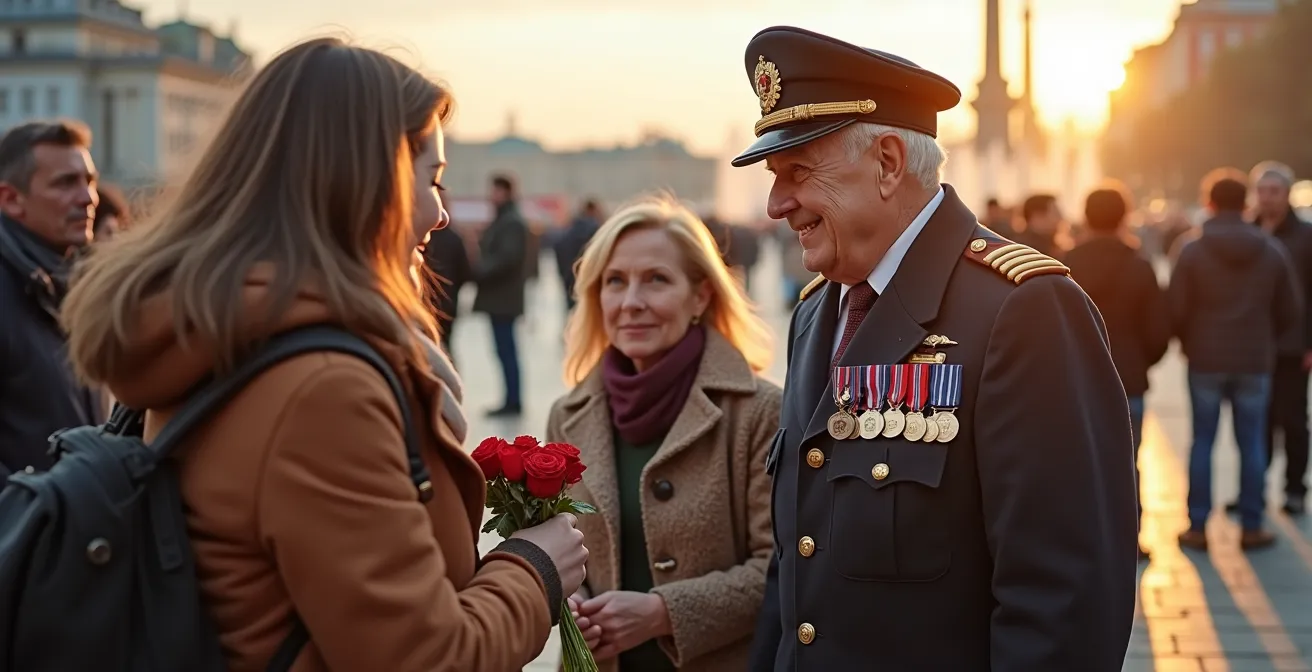
On the holiday itself, the park is not only open but becomes a central hub of activity. You’ll find open-air concerts, public displays of historical and modern military hardware that you can actually touch, and even field kitchens serving free buckwheat kasha, a traditional military meal. Veterans are the guests of honor, treated as celebrities by families, creating countless poignant moments. The main Museum of the Great Patriotic War within the park is typically open, housing the impressive Hall of Glory, with the names of every Hero of the Soviet Union, and the somber Hall of Remembrance.
The park offers a full day’s worth of activities that are both historically significant and emotionally resonant. Building an itinerary around this location is a highly effective strategy for a rewarding May 9th.
Action Plan: A Half-Day Itinerary for Victory Park
- 15:00 – Arrival and Positioning: Arrive at Poklonnaya Hill to witness the gathering for the local Immortal Regiment procession around 16:00. Find a good spot near the main monument.
- 16:00 – Hardware Exploration: Once the crowds thin slightly, explore the outdoor military vehicle exhibition. This is your best chance for up-close photos with touchable displays.
- 17:30 – Monument and Memorials: Visit the main obelisk monument and the impressive fountain complex. This is an ideal time for wide-shot photography as the afternoon light softens.
- 18:30 – Cultural Immersion: Experience the field kitchens. Sampling the traditional ‘soldier’s kasha’ is a core part of the authentic Victory Day experience.
- 19:30 – Festival Atmosphere: Mingle with the crowds, observe the interactions with veterans, and soak in the unique festival atmosphere before planning your exit for the city-wide fireworks.
By shifting your focus from the inaccessible parade to the vibrant celebration at Victory Park, you trade a frustrating spectator role for an engaging participant experience.
Borodino Panorama: Visualizing the Battle Against Napoleon from a Russian Perspective
To fully grasp the depth of military pride on display during Victory Day, one must understand its historical roots, which run far deeper than World War II. A visit to the Borodino Panorama museum provides essential context, particularly for a French visitor. This immense 360-degree painting depicts the pivotal 1812 battle against Napoleon’s army, a conflict known in Russia as the “Patriotic War.”
The museum’s narrative framing is a lesson in historical perspective. The Battle of Borodino is often viewed in France as a brutal, costly, and ultimately indecisive engagement that weakened both sides. However, the Russian interpretation, powerfully conveyed by the panorama, is starkly different.
The Battle of Borodino, often seen as a costly and indecisive battle in France, is portrayed in Russia as a moral victory that sealed Napoleon’s fate.
– Museum interpretation analysis, Historical perspective comparison France-Russia
Visiting the museum *before* May 9th serves as a cultural and historical primer. It helps you understand the deep-seated narrative of repelling a powerful European invader against all odds—a narrative that directly fuels the patriotic fervor of Victory Day. This “moral victory” at Borodino set a precedent for the national sacrifice and eventual triumph celebrated on May 9th. A short walk from the panorama is Kutuzov’s Hut, a reconstruction of the cottage where the Russian generals made the fateful decision to abandon Moscow to save their army, a masterstroke of strategic retreat.
This visit acts as a cultural appetizer, allowing you to see the military hardware on May 9th not just as machines, but as symbols in a long and proud history of national defense.
Worker and Kolkhoz Woman: Why Is This Statue an Icon of Mosfilm?
Moving from military history to ideological art, the monumental “Worker and Kolkhoz Woman” statue is one of the most powerful symbols of the Soviet era. While many tourists might overlook it, the statue has a fascinating and direct connection to France. Its original purpose was to crown the Soviet Pavilion at the 1937 Paris International Exposition, where it stood on Trocadéro hill, directly facing the Eiffel Tower and, in a poignant twist of history, the pavilion of Nazi Germany.
This Parisian debut cemented its status as a masterpiece of socialist realism, a dynamic and optimistic vision of the new Soviet man and woman striding into the future. After its time in Paris, the statue was moved back to Moscow. It could have faded into obscurity, but it was given a second, even more iconic life. It was adopted as the official logo for Mosfilm, the largest and most prolific film studio in the Soviet Union. Every Mosfilm production began with the image of this towering sculpture against a Kremlin backdrop, searing it into the popular culture of Russia and the entire Eastern Bloc.
Today, the statue is located at the VDNKh park (Exhibition of Achievements of the National Economy), making it an excellent destination to visit on May 9th. VDNKh’s vast open spaces and stunning Soviet architecture offer a compelling alternative to the dense crowds of the city center. Here, you can appreciate the statue not just as a Soviet relic, but as a piece of shared Parisian history hidden in plain sight in Moscow.
A visit here allows you to trace the arc of Soviet ambition, from its international projection in Paris to its central role in domestic cultural propaganda.
Key Takeaways
- Strategic Positioning: The key to seeing military hardware is not Red Square, but the night rehearsals and morning deployment routes on streets like Tverskaya.
- Logistical Planning: May 9th requires a mission-based mindset. Rely on the Metro and MCC, use Yandex Maps for real-time data, and treat the airport transfer as a primary objective.
- Alternative Hubs: Victory Park (Park Pobedy) and VDNKh offer more authentic, interactive, and less crowded experiences than the city center, with direct access to hardware and heritage.
Where to Find Authentic Soviet Heritage Beyond the Red Square Crowds?
On a day when the city center is a logistical quagmire, the wise enthusiast looks for authentic Soviet heritage in more accessible locations. Moscow itself is a living museum, and some of its most impressive artifacts are located far from the parade route. Your most valuable asset for this exploration is the Moscow Metro, a destination in its own right.
Often called “the underground palaces,” many central stations are masterpieces of Soviet art and architecture, and they remain fully operational on May 9th. A self-guided tour offers a perfect way to immerse yourself in Soviet history while navigating the city efficiently. Key stations to include are:
- Komsomolskaya (Circle Line): Famous for its opulent baroque-style yellow ceilings and grand mosaics depicting Russian military victories.
- Mayakovskaya: A stunning example of pre-war Art Deco design, featuring stainless steel columns and 34 ceiling mosaics on the theme of “A Day in the Soviet Sky.”
- Ploshchad Revolyutsii (Revolution Square): Known for its 76 life-sized bronze statues of Soviet people, from soldiers to farmers. Rubbing the dog’s nose on the border guard statue is a famous good-luck tradition.
Beyond the Metro, several other sites offer a deep dive into different facets of the Soviet experience. The key is to choose based on your interest and check May 9th accessibility in advance, as some may require prior booking.
| Interest | Recommended Sites | May 9th Accessibility |
|---|---|---|
| Architecture | Stalin’s Seven Sisters skyscrapers | Viewable from distance, less crowded |
| Modern History | GULAG History Museum, Bunker-42 Cold War Museum | Open with advance booking |
| Urban Art | Muzeon Park of Fallen Monuments | Open air, dispersed crowds |
| Soviet Cuisine | Stolovaya No. 57 in GUM, Cafe Pushkin (basement pharmacy hall) | Reserve in advance |
By leveraging the city’s transport infrastructure and focusing on these distributed sites, you can transform a day of potential frustration into a rich and multi-layered historical exploration. Start planning your logistical approach to build a truly unique and insightful Victory Day experience.