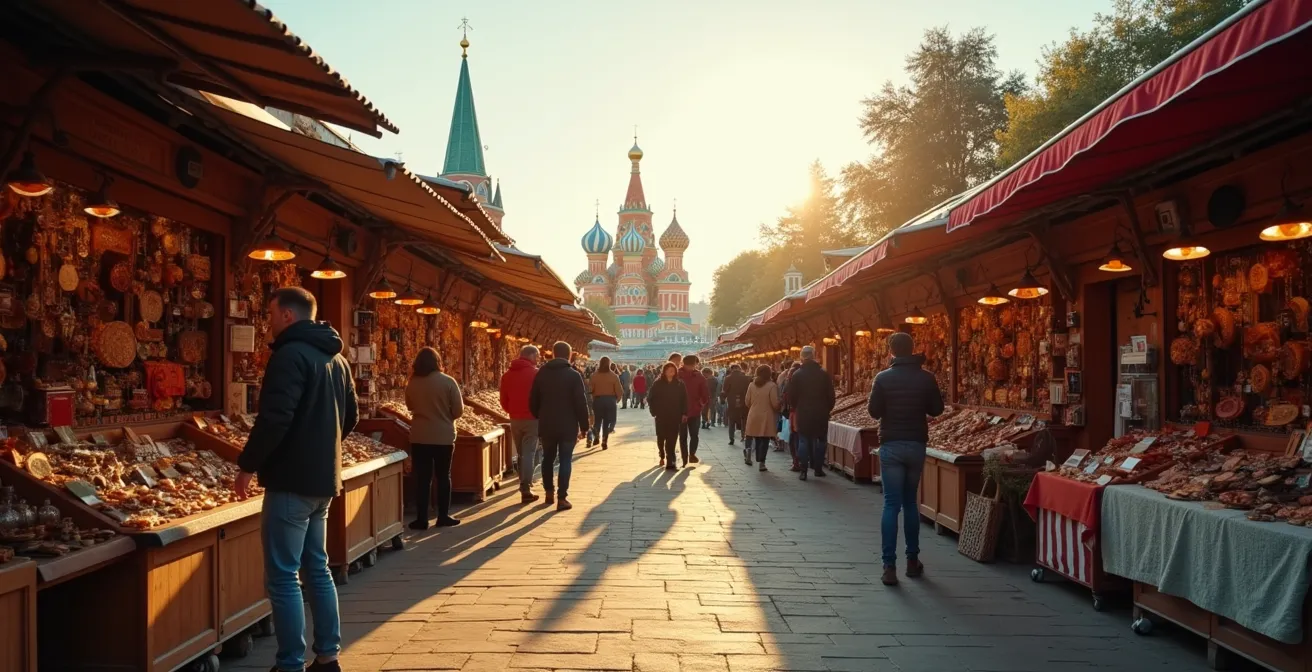
The secret to a 30% discount at Izmailovo isn’t your Russian vocabulary; it’s the crisp Euros in your wallet.
- Vendors often prefer stable, hard currency like Euros, giving you instant psychological leverage over local Ruble prices.
- Scouting the market on a Wednesday (wholesale day) gives you an unbeatable price baseline to use in your weekend negotiations.
Recommendation: Combine the currency advantage with strategic timing and specific product knowledge to transform from a tourist into a master negotiator.
Walking into Moscow’s Izmailovo Market is an assault on the senses. The fairy-tale Kremlin towers loom over a sprawling maze of stalls overflowing with Matryoshka dolls, Soviet-era military coats, amber jewelry, and lacquered boxes. For the unprepared traveler, it’s a bewildering paradise where the line between treasure and tourist tat is blurry, and every price tag is merely a suggestion. The common advice you’ll hear is to smile, learn a few Russian words, and offer half the asking price. This is the tourist’s playbook, and it rarely gets you more than a token discount.
The real game at Izmailovo is played on a different level. It’s less about charm and more about strategy. The vendors are seasoned professionals who can spot a novice from a hundred paces. But they also have their pressures and preferences. What if the key to unlocking a real discount—a substantial 30% or more—wasn’t about haggling harder, but smarter? What if the currency in your pocket was more persuasive than any words you could say? This guide throws out the generic tips and gives you the street-smart playbook. We’re going to focus on a powerful, often overlooked tool: using Euro cash.
This approach isn’t just a gimmick; it’s based on the market’s internal economy and the psychology of the sale. By understanding vendor motivations, timing your visit, and knowing exactly what to look for in a product, you can shift the power dynamic. You stop being a passive buyer and become a strategic player. This article will break down how to use this leverage, from identifying a working Soviet camera to knowing which day to scout prices and which day to buy.
This guide provides a complete framework for navigating Izmailovo’s unique ecosystem. You’ll learn not just how to bargain, but how to see the market through the eyes of an insider, ensuring you walk away with authentic souvenirs at a price that feels like a victory.
Summary: Bargaining at Izmailovo: The Euro Cash Strategy to Save 30% on Souvenirs
- How to tell if that Soviet camera at the flea market is actually working?
- Wednesday vs. Weekend: When do the wholesale sellers arrive at Izmailovo?
- Is the street food at Izmailovo Market safe for Western stomachs?
- Real fur vs. Synthetic: Which Ushanka should you buy for French winters?
- Metro Partizanskaya: The step-by-step guide to finding the market entrance
- Dry Bridge vs. Vernissage: Where to find real Soviet watches?
- Raketa or Poljot: Which vintage watch brand is a better investment?
- Where to find Soviet couture fashion in Moscow’s vintage boutiques?
How to tell if that Soviet camera at the flea market is actually working?
Among the endless nesting dolls and fur hats, the gleaming chrome of a vintage Soviet camera like a Zorki or a FED can be an irresistible find. These are beautiful mechanical objects, but buying one at a flea market is a gamble. The key to a good deal isn’t just the price, but ensuring you’re not buying a pretty paperweight. You need to develop a bit of “mechanical empathy” to feel out the camera’s health. Forget asking the seller; you need to perform your own quick, hands-on audit.
Start with the most critical component: the shutter. Fire it at three distinct speeds. A slow speed (like 1/30s) should have a discernible, longer “zzzz-click” sound. A medium speed (1/125s) and a fast speed (1/500s) should sound progressively sharper and quicker. What you’re listening for is consistency and a clean mechanical sound. Any grinding, hesitation, or if the speeds sound identical, is a major red flag. Next, test the film advance lever. It should have a smooth, firm action through its entire stroke and reset crisply. If it feels loose, gritty, or requires brute force, the internal gearing is likely damaged.
Finally, check the lens. The aperture ring should click into each f-stop. Look through the front of the lens while turning the ring and confirm that the aperture blades are opening and closing smoothly and symmetrically. Be warned that camera repair experts warn that over 50% of Soviet cameras found at flea markets have issues with old, gummy lubricant that can seize up these mechanisms. A camera that passes these three tests has a strong chance of being a functional piece of history, not just a shelf ornament.
Wednesday vs. Weekend: When do the wholesale sellers arrive at Izmailovo?
Timing is a weapon in negotiation, and at Izmailovo, the day of the week you visit fundamentally changes the game. Most tourists flock to the market on Saturday and Sunday. This is when the market is at its most vibrant and every stall is open. The selection is vast, the crowds are thick, and the prices are set for tourists. This is not when you find the best deals. The real opportunity for a strategic shopper lies in understanding the market’s weekly rhythm.
The insider’s secret is Wednesday. This is the unofficial wholesale day. Many vendors from across the region come to Izmailovo to sell their stock in bulk to the Moscow-based stallholders. The atmosphere is more business-like, less performative, and not all stalls are open. However, this is your golden opportunity. This is the day for the “Wednesday Scout” mission. Your goal is not to buy, but to gather intelligence. You can observe transactions between vendors and see the true baseline prices of items. As sources like Russia Beyond note, on Wednesdays, prices can be two to three times lower than on the weekend.
Your strategy should be a two-day approach. Go on Wednesday morning, identify the items you’re interested in, and discreetly note the wholesale prices. Take a photo if you can. Then, return on Saturday morning when the selection is at its peak. When you begin to negotiate for that lacquered box or amber necklace, you’re no longer guessing. You’re armed with a real-world price anchor. Starting your negotiation based on this knowledge, combined with the leverage of your Euro cash, gives you an almost unbeatable advantage.
Is the street food at Izmailovo Market safe for Western stomachs?
As you navigate the market, the smoky, savory aroma of grilling meat is bound to catch your attention. Near the main entrance, you’ll find a gauntlet of food stalls, their grills heavy with glistening skewers of shashlik (kebabs). For a hungry negotiator, grabbing a quick, hot meal is tempting, but the question of food safety naturally arises. Can a traveler with a “Western stomach” indulge without regrets? The short answer is yes, with a dose of street smarts.
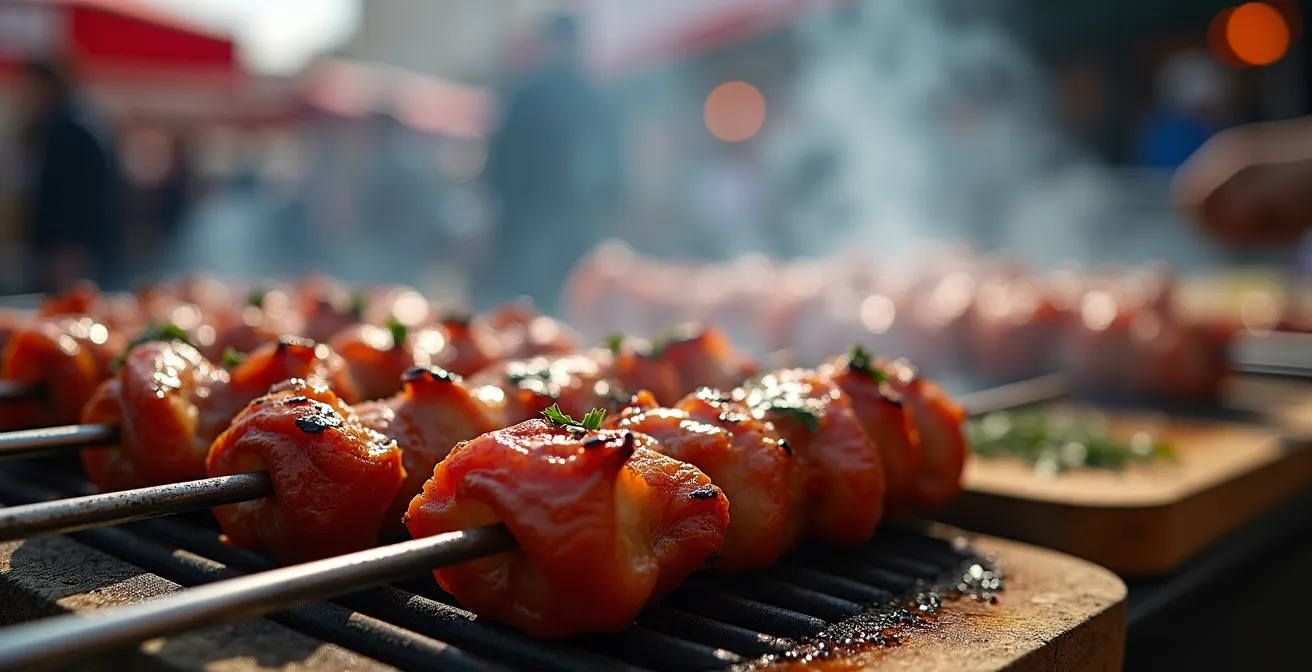
The food at these stalls is a core part of the Izmailovo experience and is generally safe, as it’s cooked to order over high heat. However, not all stalls are created equal. The most important rule of street food anywhere in the world applies here: follow the locals. Look for the stall with the longest queue, especially if it’s made up of other vendors or Russian families, not just tourists. A high turnover of customers means the ingredients are fresh and not sitting around for hours.
Secondly, use your eyes and nose. The meat should look fresh and be cooked thoroughly in front of you. You want to see it coming directly off a hot, smoky grill onto your plate. Avoid anything that looks like it’s been sitting in a bain-marie or under a heat lamp for an extended period. Stick to the basics like pork or chicken shashlik, which are simple, popular, and cooked at high temperatures. These stalls are a business, and a reputation for making customers sick is bad for their bottom line. By choosing a busy stall and ensuring your food is piping hot, you can enjoy this delicious part of the market culture with confidence.
Real fur vs. Synthetic: Which Ushanka should you buy for French winters?
The Ushanka, the iconic Russian fur hat with ear flaps, is a top-selling souvenir. It promises warmth and a piece of Russian identity. But when you’re buying one with the practical goal of surviving a cold French winter, the choice between real and synthetic fur is crucial. While a genuine rabbit or mink fur hat offers unparalleled warmth, the reality of the market is complex. As one local guide bluntly puts it:
Most of the items sold there are made in China, I believe most merchants no longer make genuine Russian ushanka since early 2000s.
– Local Moscow Guide, WanderBoat AI Trip Planner Review
This insight is your first filter. The vast majority of the cheaper, perfectly uniform Ushankas are synthetic and mass-produced. They’ll work for a costume party but might disappoint in a damp, chilly Paris. A real fur hat will have slight imperfections, a softer texture, and a much higher price tag. To tell the difference, part the hairs and look at the base. Real fur grows out of a leather hide, while synthetic fur is woven into a fabric mesh.
However, for a traveler returning to France, there’s a more critical consideration than authenticity: customs. Many types of fur are from protected species. While rabbit is generally fine, anything more exotic could be a serious problem. As a rule, French customs regulations state that protected species listed by CITES are completely prohibited from import. Without official documentation proving the species and origin (which a flea market vendor will never have), buying a real fur Ushanka is a significant risk. For a practical purchase for a French winter, a high-quality, modern synthetic Ushanka is the smarter, safer, and more ethical choice.
Metro Partizanskaya: The step-by-step guide to finding the market entrance
Izmailovo Market isn’t directly on a main square; finding it from the metro requires a short but specific walk. Getting lost before you even start negotiating is a bad way to begin. Luckily, the path is straightforward once you know the landmarks. You’ll be arriving at Partizanskaya station, which is on the dark blue line (Line 3). The station itself, with its grand statues of Soviet partisans, is worth a look.
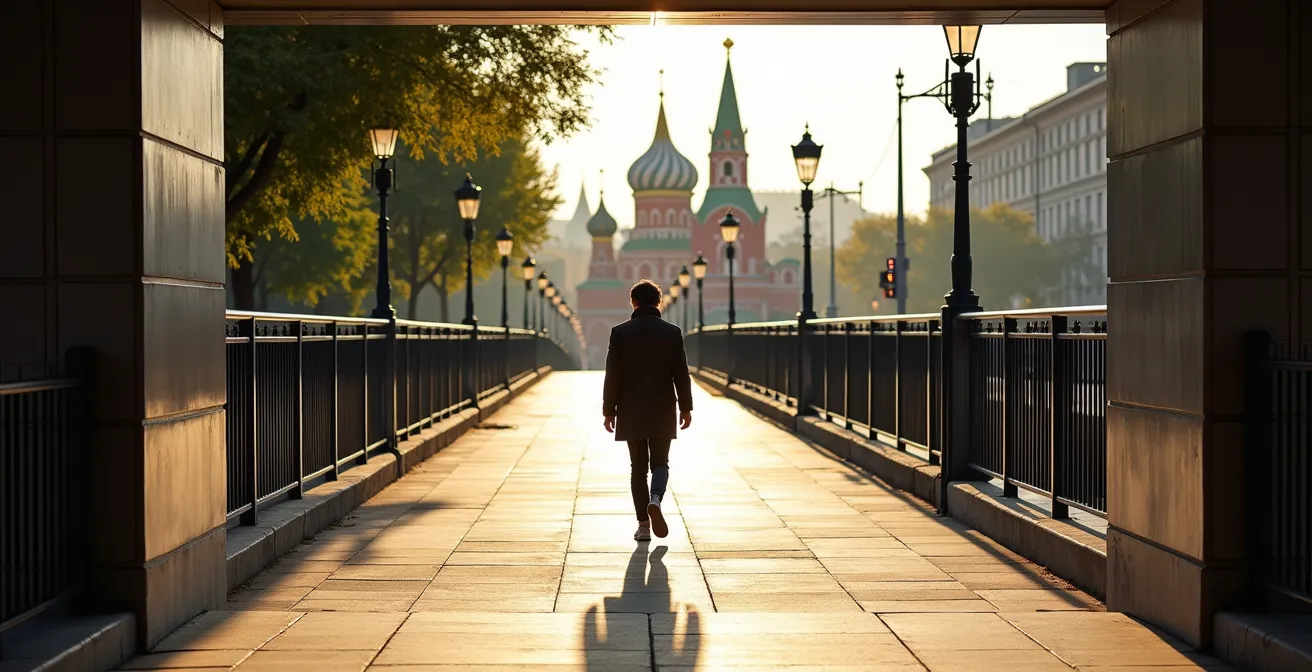
Once you’re through the ticket barriers, follow this simple visual guide to get to the market entrance without a single wrong turn. The entire walk should take no more than 10 minutes at a relaxed pace.
- Exit the main glass doors of Partizanskaya metro station and turn left immediately.
- Your first major landmark will be a cluster of four enormous, slightly dated hotel buildings. These were built for the 1980 Moscow Olympics. You can’t miss them.
- Walk straight for about 5-10 minutes, keeping this massive hotel complex on your right-hand side.
- As you walk, the colorful, fairy-tale towers of the Izmailovo Kremlin will come into view ahead of you. This is your target.
- Head directly towards the towers and you will arrive at a large, decorative wooden bridge. Cross this bridge to enter the main tourist and souvenir section of the market.
This short walk is part of the experience, building anticipation as the whimsical, onion-domed towers get closer. Following these simple steps ensures you arrive at the entrance feeling confident and ready to put your negotiation strategy into action, rather than frustrated and disoriented.
Dry Bridge vs. Vernissage: Where to find real Soviet watches?
For collectors, Soviet-era watches are a major draw. Brands like Raketa, Poljot, and Vostok represent a unique piece of horological history. While Tbilisi’s Dry Bridge market is famous for these finds, the Vernissage section of Izmailovo is Moscow’s prime hunting ground. The Vernissage is the more “serious” flea market within the larger Izmailovo complex, where you’re more likely to find genuine antiques and collectibles rather than just souvenirs.
However, you need to adjust your expectations. The vendors here are often specialists. They know the difference between a common Vostok and a rare Poljot 3133 chronograph. Your “30% off with Euros” strategy won’t work the same way here. These are not low-margin souvenirs. As experienced collectors recommend, the best antiques are often found on the second floor of the market building, away from the main tourist flow. The vendors there are less likely to be impressed by your haggling and more interested in dealing with someone who appreciates the item.
Bargaining is still expected, but it’s a more nuanced conversation. You won’t get 30-50% off. A successful negotiation here might be a modest 10% discount, often achieved through showing genuine knowledge and respect for the product. The goal of the negotiation shifts from pure price savings to building a rapport that might unlock a better deal or a more interesting story about the watch’s provenance. For real Soviet watches at Vernissage, your expertise is your best currency, with Euros serving as a respectful way to close the deal on a price you’ve both agreed is fair.
Raketa or Poljot: Which vintage watch brand is a better investment?
Once you’re standing at a stall in the Vernissage, faced with a tray of gleaming, Cyrillic-inscribed watch dials, the big question arises: which one is a good buy? While any Soviet watch is a great souvenir, if you’re thinking in terms of a long-term investment or a piece with genuine horological value, you need to look past the dial and consider the brand and, more importantly, the movement inside. The two names you’ll see most are Raketa and Poljot.
Raketa watches are the workhorses. They were produced in massive quantities and are known for their reliability. A classic Raketa “Big Zero” is an iconic design, but it’s more of a “nostalgia grade” purchase than a serious investment. Poljot, on the other hand, was the premier Soviet watch factory, producing more complex and highly regarded movements. A Poljot watch, especially one with a chronograph movement like the 3133, is considered “investment grade.” This movement is a robust and celebrated piece of engineering, and collectors universally value it. Finding a working Poljot 3133 is the equivalent of finding a real treasure.
When you find a potential investment piece, you need to switch from a souvenir shopper to an auditor. You must verify its potential value before even thinking about price. A beautiful dial can hide a ruined movement, so a pre-purchase check is essential.
Your Pre-Purchase Audit for Soviet Watches
- Focus on the movement: Ask the seller to open the case back. The condition of the mechanical movement is far more important than cosmetic scratches on the case or crystal.
- Identify key movements: Specifically look for the Poljot 3133 chronograph movement. It is the most universally valued and sought-after Soviet movement.
- Verify authenticity: Check serial numbers if possible to verify production dates. Be wary of “Frankenwatches” cobbled together from different parts.
- Consider future servicing: Before buying, consider if you have a watchmaker in your home country who is willing and able to service a vintage Soviet movement.
- Document everything: Take clear photos of the dial, case back, and movement before you finalize the purchase. This is your proof of what you bought.
Key takeaways
- Leverage Currency: Use crisp Euro notes as a psychological tool for better discounts than you’d get with Rubles.
- Master Timing: Visit on a Wednesday to scout wholesale prices, but return on a Saturday or Sunday morning for the best selection and to use your pricing knowledge.
- Know Your Target: For general souvenirs, aim for a 30% discount. For high-value antiques like watches, focus on authenticity checks and expect a more modest 10% negotiation.
Where to find Soviet couture fashion in Moscow’s vintage boutiques?
While Izmailovo is the king of souvenirs and Soviet kitsch, the term “couture” might seem out of place. If your quest is for high-end, unique Soviet-era fashion—beyond military greatcoats and tracksuits—you need to know where to look within Moscow’s vintage scene. Izmailovo is still your starting point, but not in the main, polished aisles. The real gems are found in the “suitcase rummage” style sections, where you can find truly unique and authentic Russian products away from the mass-produced goods.
Here, you might uncover a handmade dress from the 1960s or a beautifully tailored coat that tells a story. This is treasure hunting in its purest form, requiring patience and a good eye. The items are one-of-a-kind, and the negotiation is more personal. This is where your appreciation for the item, more than your cash, will get you a fair price. However, if your search for “Soviet couture” means finding more curated, art-level pieces, you may need to look beyond Izmailovo.
For the serious collector, Moscow hosts a market called Tishinka. This is not a daily flea market but a major, pop-up art project that runs only a few times a year. It’s one of the oldest and most prestigious events for antique and vintage design, attracting vendors from all over Russia and Europe. Here you can find everything from vintage perfume bottles to exquisite embroidery and clothing once owned by famous Russian actors. It’s less of a market and more of a curated gallery. If your trip aligns with a Tishinka event, it is a must-visit for anyone serious about finding top-tier vintage fashion that truly qualifies as “couture.”
Now that you have the complete playbook, the next step is to put it into practice. Approach Izmailovo not just as a tourist on a shopping trip, but as a strategic player in a fascinating game. Go with confidence, seek out the authentic treasures, and bring back not just a souvenir, but a story of a deal well-made.