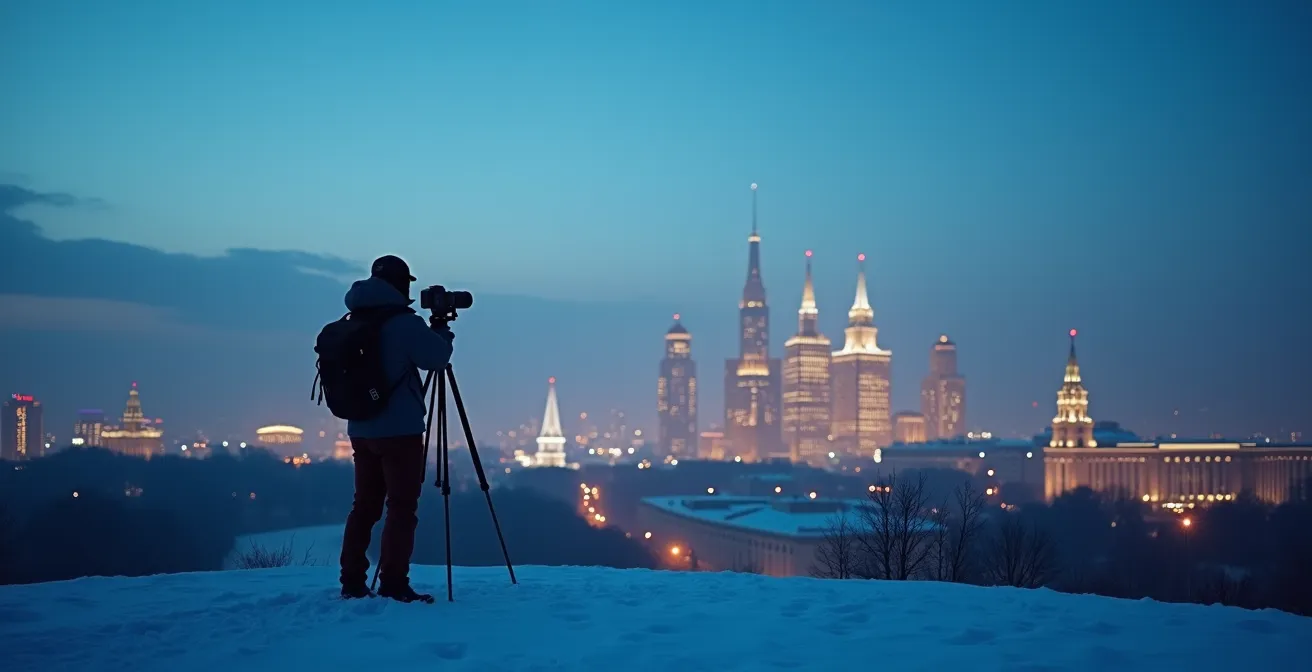
In summary:
- Photographing Moscow’s epic architecture in winter is less about documentation and more about telling a story of scale, history, and light.
- Success depends on moving beyond obvious viewpoints and mastering technical skills like telephoto compression and low-light interior shooting.
- The low winter sun is not a hindrance; it is a creative tool for sculpting monumental forms and revealing textural details from Soviet Baroque to Constructivist decay.
- Strategic planning, from choosing the right observation deck to booking museum tickets online, is essential to maximizing your shooting time.
Photographing Moscow in winter presents a unique challenge that daunts many visual artists. The city’s monumental scale, dominated by the imposing silhouettes of Stalinist skyscrapers, can feel overwhelming. Combined with the fleeting, low-angled light of winter, it’s easy to return with images that feel flat, grey, and fail to convey the immense presence of these structures. Many guides will offer generic winter photography tips about keeping batteries warm or simply list the famous “Seven Sisters” as a checklist. This approach often misses the soul of the subject, treating these complex buildings as mere tourist landmarks.
But what if the key wasn’t just to document these buildings, but to interpret them? What if the low, dramatic light of winter was actually the perfect tool for an artist? This guide shifts the perspective. We will move beyond the platitudes to explore an artistic and technical approach. The goal is to capture the monumental narrative of Moscow’s architecture, treating the soft winter light not as a limitation, but as a sculptor’s chisel. We will delve into specific locations, compositional strategies, and camera settings designed to translate the city’s historical weight and architectural ambition into powerful, atmospheric photographs.
This article provides a structured path for the discerning photographer. We will dissect the history behind the city’s most iconic structures, compare key vantage points for dramatic cityscapes, and uncover the technical secrets to capturing everything from crumbling modernist masterpieces to the sun glinting off gilded domes. Get ready to see Moscow’s winter landscape not as an obstacle, but as your canvas.
Summary: A Photographer’s Guide to Moscow’s Architectural Monuments
- Why did Stalin build 7 identical skyscrapers across the city?
- Sparrow Hills or Panorama360: Where is the best view of the city?
- VDNKh: How to navigate this massive architectural park without getting lost?
- The Narkomfin Building: Why is this crumbling block a masterpiece of design?
- Where to stand to see a church, a skyscraper, and a palace in one frame?
- Eliseevsky Store: Is the most beautiful grocery store in the world closing down?
- The best angle to capture the sun reflecting off golden domes
- How to enter the Kremlin Armory without queuing for 2 hours?
Why did Stalin build 7 identical skyscrapers across the city?
The first step in photographing these giants is to understand their purpose. After World War II, Stalin initiated a project to project an image of Soviet strength and prosperity, directly competing with American skyscrapers. However, the central premise of the question—that the seven skyscrapers are identical—is a common misconception and a crucial artistic point. While they share a unified style, often called Soviet Baroque or Stalinist Empire, they are not clones. Each of the ‘Stalinskie Vysotki’ (Stalin’s High-rises) was designed by a different architect for a specific purpose, resulting in unique silhouettes, materials, and photographic potential. The project’s scale was immense; construction from 1947 to 1957 consumed over 500,000 square meters, a massive undertaking that deeply impacted the city’s development.
For a photographer, their differences are their strengths. You are not shooting one idea seven times; you are capturing seven distinct personalities born from a single, powerful vision. This controversial legacy, seen by some as a grim reminder of repression and by others as a proud symbol of an era, provides a rich narrative tension. Your lens can explore this duality. To do so, you must appreciate their individuality:
- Moscow State University: The tallest and most iconic, its 240-meter height and tiered structure offer classic, symmetrical compositions from afar.
- Ministry of Foreign Affairs: Note its stone-clad, Gothic-inspired façade. The lack of a five-pointed star on its spire (it was too heavy for the structure) is a key distinguishing detail.
- Hotel Ukraina (Radisson Collection Hotel): Its “wedding-cake” shape is a direct nod to American art deco, making it a great subject for studying the fusion of architectural styles.
- Kotelnicheskaya Embankment Building: Its position at the confluence of two rivers allows for powerful waterside reflections, especially in the calm, cold air of winter.
- Red Gates Administrative Building: Famous for being built at a deliberate angle to compensate for settling ground due to simultaneous subway construction, its story adds a fascinating conceptual layer to your shots.
By seeing them as individuals, you move from architectural documentation to portraiture, capturing the unique character of each “sister.”
Sparrow Hills or Panorama360: Where is the best view of the city?
Choosing your vantage point is a critical artistic decision that will define the mood of your cityscapes. Moscow offers two premier but fundamentally different options: the natural elevation of Sparrow Hills (Vorobyovy Gory) and the modern, high-altitude Panorama360 observation deck. Neither is objectively “better”; they serve different photographic intentions. Sparrow Hills offers an organic, atmospheric perspective, while Panorama360 provides a clean, almost clinical graphic view of the city’s geometry. Your choice depends entirely on the story you wish to tell.
For low winter light, each has its merits. At Sparrow Hills, the low sun can create long, dramatic shadows across the landscape, with the Moscow State University building often acting as a powerful anchor in the frame. The presence of snow-covered trees in the foreground adds depth and a natural, almost romantic texture. Panorama360, on the other hand, lifts you above the atmospheric haze, offering a crystal-clear view of the urban layout, perfect for minimalist or abstract compositions focusing on the patterns of the city. A polarizing filter is non-negotiable here to cut through the glass reflections. The following table breaks down the key photographic considerations.
This decision is best made by consulting a direct comparison of their photographic potential, as shown in this recent analysis of Moscow’s best viewpoints.
| Viewpoint | Best For | Advantages | Photography Tips |
|---|---|---|---|
| Sparrow Hills | Classic atmospheric shots | Perfect spot to capture the cityscape with the iconic Moscow State University building in the background. The changing colors of the sky during sunset create a magical backdrop. | Natural foregrounds with snow, ‘Montmartre’ vibe. |
| Panorama360 | Clean, graphic cityscapes | 360-degree panorama from height, modern perspective. | Use polarizing filter to shoot through glass without reflection. |
When shooting in winter, remember to adjust your settings. For crisp architectural shots, use a shutter speed of at least 1/250s and an aperture of f/11 or higher to ensure deep focus. You may need to slightly increase your ISO to compensate, but a sturdy tripod is your best friend, especially during the golden or blue hour when light is scarce but beautiful.
VDNKh: How to navigate this massive architectural park without getting lost?
The All-Russian Exhibition Center, known as VDNKh, is not just a park; it’s a sprawling open-air museum of Soviet architectural ambition. Originally conceived as the All-Union Agricultural Exhibition in 1939, it evolved into a monumental complex of pavilions, each representing a Soviet republic or industry, adorned with ornate decorations, golden statues, and vast mosaics. For a photographer, it’s an almost overwhelming treasure trove of details, textures, and compositions. Its sheer size, however, is its biggest challenge. Navigating it without a plan, especially in the disorienting snow-covered landscape of winter, can lead to frustration and missed opportunities.
The key is to treat VDNKh not as a park to be wandered, but as a series of planned shots. Before you go, study a map and identify 3-4 key pavilions you want to capture, such as the grand Central Pavilion, the ornate Ukraine Pavilion, or the cosmic-themed Kosmos Pavilion. The visual below captures the monumental scale and dramatic lighting you can achieve by focusing on a single pavilion, using the low winter sun to highlight its intricate façade against a snowy backdrop.
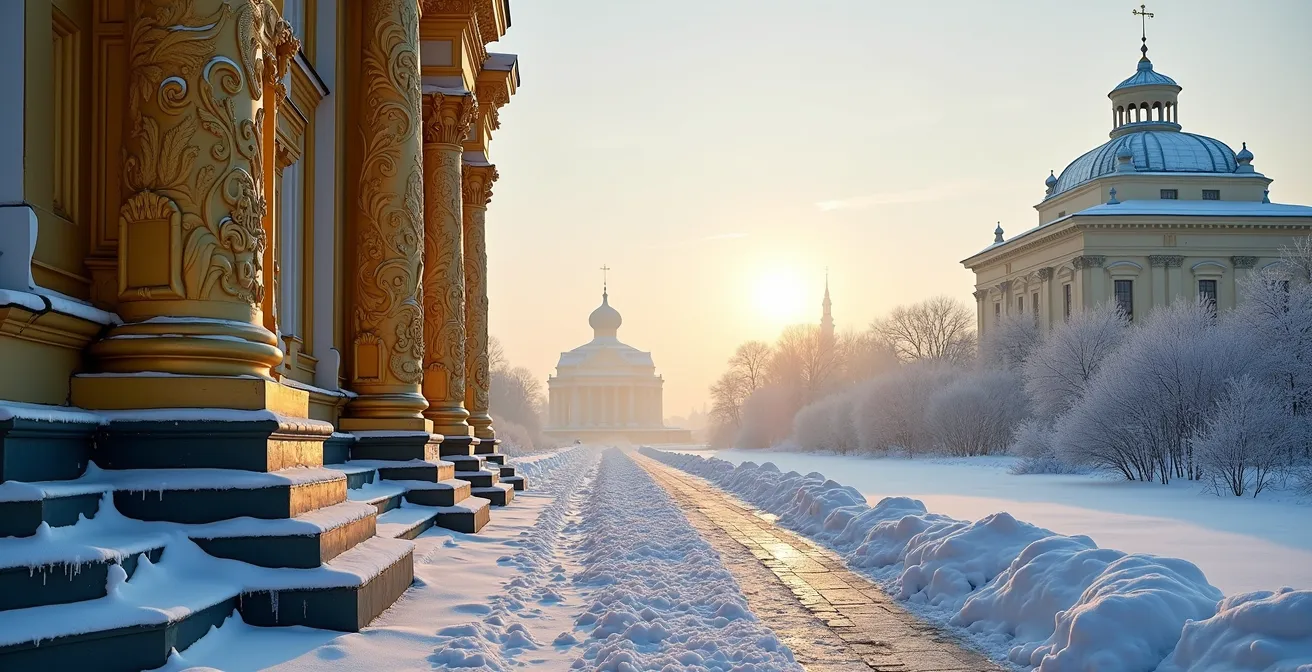
As this image demonstrates, the low angle of a winter shot emphasizes the structure’s grandeur, with leading lines created by snow-covered paths drawing the viewer’s eye. To navigate effectively between these points of interest, a few basic Russian words are invaluable, as signage can be inconsistent. Don’t rely solely on your phone’s map, which can struggle with GPS among the large buildings. Knowing these terms will help you ask for directions or read the primary signs:
- Павильон (Pavilion) – Pavilion
- Фонтан (Fontan) – Fountain
- Главный вход (Glavniy vkhod) – Main Entrance
- Выставка (Vystavka) – Exhibition
- Карта (Karta) – Map
Approaching VDNKh with a clear shot list and these basic navigational tools will transform a potentially confusing experience into a highly productive and artistically rewarding shoot.
The Narkomfin Building: Why is this crumbling block a masterpiece of design?
At first glance, the Narkomfin Building seems like the antithesis of Moscow’s ornate grandeur. It’s a crumbling, starkly functional block that appears to be in a state of decay. Yet, for architects and designers, it is one of the most important buildings in the city—a world-renowned masterpiece of Constructivist architecture. Designed by Moisei Ginzburg and Ignaty Milinis in 1928, it was a radical social and architectural experiment in communal living. Its significance lies in its pioneering design principles, which were revolutionary for their time. For the photographer with an eye for narrative, this building offers a chance to capture the concept of ‘heroic decay’—the beauty found in the ambition of a faded utopia.
The building’s global importance is best understood through its connection to one of architecture’s greatest names. As one expert notes in an analysis of Soviet-era design:
The Narkomfin’s design principles directly connect to Le Corbusier’s concepts – pilotis, roof garden, communal spaces – making it the Soviet cousin of the Unité d’Habitation in Marseille.
– Architecture Studies Expert, Museum Studies Abroad Analysis
Photographing Narkomfin is an exercise in texture, light, and contrast. The low, soft winter light is perfect for this, as it gently reveals the peeling paint, cracked concrete, and rusting metal without harsh shadows. Your goal is not to hide the decay but to celebrate it as part of the building’s story. To do this effectively, focus on specific techniques:
- Focus on Textures: Use a prime lens with a wide aperture (like f/2.8) to get close and isolate the rich textures of the aging materials. The contrast between the original, high-quality construction and its current state is a powerful visual narrative.
- Play with Light: The diffused light of an overcast winter day is ideal. It brings out a palette of soft, subtle colors in the crumbling surfaces. During the “blue hour” after sunset, the contrast between the cold exterior tones and any warm interior lights can be particularly dramatic.
- Frame Old and New: The building has undergone partial restoration. Frame your shots to create a dialogue between the original, weathered constructivist elements and the clean lines of modern renovations. This juxtaposition tells a story of survival and rediscovery.
Where to stand to see a church, a skyscraper, and a palace in one frame?
One of the most powerful ways to photograph Moscow is to capture its layered history in a single, dense composition. The city offers a unique opportunity to frame centuries of architectural and political ideology against one another: the imperial past (palaces), the spiritual heart (churches), and the Soviet ambition (skyscrapers). Finding the perfect spot to align these three “ages” of Moscow is a prime objective for any serious photographer. The definitive location to achieve this trifecta is Zaryadye Park, specifically from its boomerang-shaped “floating bridge” that cantilevers over the Moscow River.
From this single vantage point, your camera can capture an unparalleled historical panorama. This specific composition is so iconic it has become a case study in urban landscape design and photography.
The Three Ages Shot from Zaryadye Park
As detailed in a study of the park’s design, the viewpoints are intentionally curated. From the overlook, visitors can frame the candy-colored cupolas of Saint Basil’s Cathedral (the church), the formidable walls of the Kremlin (the palace/fortress), and the looming tower of the Kotelnicheskaya Embankment Building (the skyscraper) in one compressed, powerful image. The park’s own modern landscaping acts as a fourth, contemporary layer, creating a dialogue across more than 400 years of Russian history.
Achieving this shot, however, is not as simple as pointing and shooting. The secret is a technique known as telephoto compression. By using a longer lens (70-200mm or more), you can make distant objects appear closer together, effectively stacking these historical layers into a cohesive frame. This technique is essential for conveying the density of Moscow’s history.
Your Audit Plan for Historical Layering
- Compositional Elements: Identify all historical layers available from your viewpoint (e.g., medieval church, Soviet skyscraper, modern park). Are they all present?
- Lens & Focal Length: Are you using a telephoto lens (70mm+) to compress the scene? Inventory your available lenses and select the appropriate one.
- Coherence & Alignment: Check your position. Do you need to move left/right or find higher ground to prevent layers from awkwardly overlapping?
- Light & Shadow: Evaluate the light. Does it define each layer, or does it flatten the scene? Note whether golden hour or blue hour would create better separation.
- Action Plan: Based on the audit, either take the shot, or create a plan to return at a better time of day with the correct equipment.
Shooting at f/8-f/11 will ensure sharpness across all planes, from the foreground of the bridge to the distant skyscraper. The golden hour is the ideal time, as the low sun will cast a different quality of light on the varied materials of each era, making them glow with distinct character.
Eliseevsky Store: Is the most beautiful grocery store in the world closing down?
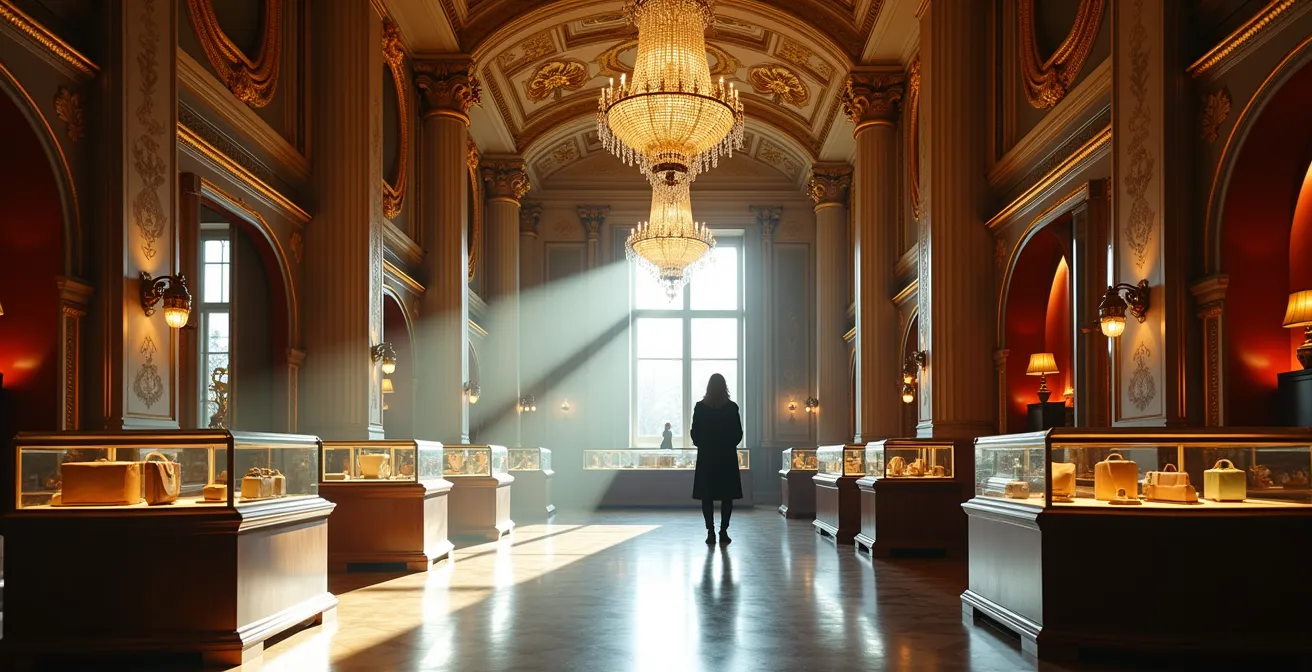
While rumors of its permanent closure have circulated, the Eliseevsky Store on Tverskaya Street remains one of Moscow’s most breathtaking interiors and a critical subject for any architectural photographer. Whether it operates as a full-scale grocery or a more limited venue, its historical significance and visual splendor are undiminished. Known in the Soviet era as Gastronom No. 1, this space is far more than a store; it is a palace of commerce. Its neo-baroque interior, with soaring ceilings, intricate gold leaf, massive crystal chandeliers, and polished wood, feels more like an opera house than a retail space. This opulence represents a fascinating slice of history, symbolizing both the lavishness of the pre-revolutionary elite who built it and the Soviet Union’s attempt to co-opt that luxury for its own narrative.
For the photographer, the primary challenge is not composition but logistics and light. Tripods are strictly forbidden, and the interior is relatively dim, even during the day. Capturing the grandeur without introducing camera shake or excessive digital noise is the main technical hurdle. The image below hints at the atmosphere you’re aiming for: the sheer scale of the space, the warmth of the lighting, and the richness of the detail.
To overcome the low light and tripod ban, you need to employ specific techniques for handheld shooting:
- Brace Yourself: Use the building itself as a tripod. Lean firmly against one of the massive columns or brace your arm against a wall to create a stable shooting platform.
- Use a Fast Prime Lens: A prime lens with a wide maximum aperture, such as a 35mm or 50mm f/1.8 or f/1.4, is your most valuable tool. It allows you to gather the maximum amount of light, keeping your shutter speed up and ISO down.
- Manage Your ISO: Don’t be afraid to push your ISO to 3200 or even 6400. Modern full-frame cameras handle this level of sensitivity remarkably well, and a little bit of grain is far preferable to a blurry, unusable shot.
- Set White Balance Manually: The interior is filled with warm, artificial light. Auto white balance will often try to “correct” this, resulting in a cold, bluish tint. Set your white balance manually to a ‘Tungsten’ or ‘Incandescent’ preset, or dial in a specific Kelvin temperature (around 3200K) to preserve the scene’s warm, golden ambiance.
The best angle to capture the sun reflecting off golden domes
Photographing the sun reflecting off Moscow’s iconic golden church domes is a quintessential shot, but achieving a brilliant, crisp sunburst rather than a blown-out highlight requires precise technical control. The “best angle” is less about a physical location and more about your position relative to the sun and your camera settings. The low-hanging winter sun is a significant advantage here, as it provides opportunities for this shot throughout more of the day compared to the high overhead sun of summer. As professional photography guides often note, winter’s unique light offers a palette of softer colors and dramatic angles that are perfect for this kind of work.
The goal is to capture a “starburst” or “sunstar” effect, where the sun appears as a star with radiating points of light. This effect is created by using a narrow aperture. The number of points on the star is determined by the number of blades in your lens’s aperture diaphragm. An odd number of blades produces double the number of points, while an even number produces the same number of points. Regardless of your lens, the technique remains the same. Here is a technical recipe for achieving the perfect dome reflection:
- Use a Narrow Aperture: This is the most critical setting. Set your camera to Aperture Priority mode (A or Av) and choose an aperture between f/11 and f/16. This small opening is what forces the light to diffract and create the starburst effect.
- Keep ISO Low: To maximize image quality and prevent blowing out the bright highlights of the sun and its reflection, set your ISO as low as possible, ideally at ISO 100 or 200.
- Use Spot Metering: Change your camera’s metering mode to ‘Spot’. Place the small spot meter directly on the bright reflection on the dome. This tells the camera to expose for the brightest part of the frame, ensuring the sunburst is well-defined and not a washed-out white blob.
- Partially Obscure the Sun: The best sunbursts often happen when the sun is partially hidden behind an object. Position yourself so the sun is just peeking out from behind the edge of the dome or a cross. This contains the light and intensifies the star effect.
- Shoot in RAW: This is non-negotiable. Shooting in RAW format gives you the maximum dynamic range to recover details from the deep shadows and bright highlights during post-processing.
By following this technical recipe, you transform a potentially difficult lighting situation into a stunning creative effect that brings Moscow’s spiritual architecture to life.
Key Takeaways
- The monumental scale of Moscow’s architecture is best conveyed through techniques like telephoto compression and low-angle shots, not just wide-angle views.
- Low winter light is an artistic asset; use it to sculpt forms, reveal textures, and create dramatic moods during golden and blue hours.
- Beyond the famous landmarks, exploring lesser-known sites like the Narkomfin Building adds immense narrative depth to a photographic portfolio of the city.
How to enter the Kremlin Armory without queuing for 2 hours?
After days spent shooting outdoors in the cold, the Kremlin Armoury Chamber offers a spectacular indoor respite, housing a world-class collection of treasures from Fabergé eggs to royal regalia. However, its popularity means that simply showing up often leads to waiting in a notoriously long queue, sometimes for hours in the freezing cold—a terrible waste of a photographer’s precious time and energy. The entire Kremlin complex, including the Armoury, operates on a strict timed entry system known as ‘seansy’ (сеансы), with visiting slots available every couple of hours. The key to a seamless visit is to bypass the on-site ticket office entirely.
The only reliable way to avoid the queue is by booking your tickets online in advance. This process may seem intimidating due to the official website being primarily in Russian, but it’s a straightforward procedure that will save you an immense amount of time. You can book a specific date and ‘seans’ (entry time), allowing you to walk straight to the entrance at your allotted time. This transforms the experience from a frustrating ordeal into a well-planned, efficient part of your itinerary. Follow these steps for a hassle-free booking:
- Visit the Official Website: The only place to get tickets at face value is the official Moscow Kremlin Museums website (kreml.ru). Avoid third-party resellers who add significant markups.
- Use Browser Translation: Use your web browser’s built-in translation feature (e.g., Google Chrome’s “Translate to English”) to navigate the site. The translation is generally sufficient for the booking process.
- Select the Armoury Chamber: Be sure to select tickets specifically for the “Armoury Chamber,” as tickets for the Cathedral Square are sold separately.
- Book the First Slot (10:00): For the best photographic experience with the fewest people, always book the earliest time slot of the day at 10:00.
- Prepare for Payment: Historically, some non-Russian credit cards have faced issues. Have a couple of different cards ready, or use a service like PayPal if it’s offered as an option.
- Save Your Tickets: Once purchased, you will receive your tickets as a PDF. You can either print them or save them to your phone. Digital tickets are widely accepted at the entrance.
By investing ten minutes in this online process, you reclaim hours of valuable time that can be better spent capturing the city.
Now that you are equipped with the technical, artistic, and logistical knowledge, you are ready to move beyond simple tourism. You have the tools to create a compelling, nuanced portfolio of Moscow’s architecture that tells a story of its past and present. Start planning your photographic journey today to capture the soul of Moscow’s winter landscape.