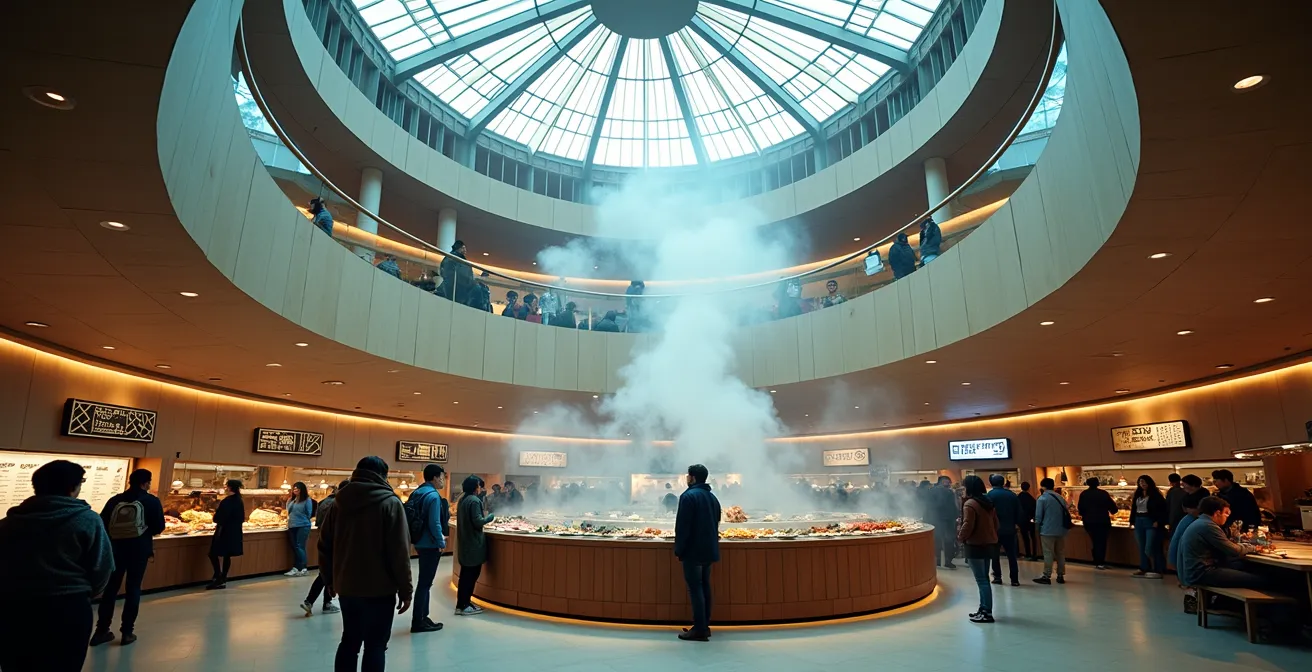
Danilovsky Market is more than a food court; it’s a live snapshot of Moscow’s new culinary identity, and navigating it is an art.
- Discover why global dishes like Vietnamese Pho and Georgian khachapuri have become local obsessions that act as a barometer for the city’s tastes.
- Learn the insider strategy to taste premium Russian caviar and Arctic sea urchins, understanding the price arbitrage that makes them cheaper here than in Paris.
Recommendation: Use the strategic timing guide in this article to avoid the chaotic lunch rush and focus on a multi-course tasting journey across different stalls.
The moment you step under the vast, fluted concrete dome of Danilovsky Market, the senses ignite. It’s a whirlwind of sizzling woks, the rich aroma of baking cheese, the chatter of a hundred conversations, and a kaleidoscope of colors from exotic fruits to glistening seafood. It’s easy to see why it’s often labeled a “hipster food court,” a simple description for a place buzzing with such complex energy. Many guides will tell you it’s a place where you can find food from all over the world, housed in a masterpiece of Soviet modernist architecture.
But this description barely scratches the surface. What if the real secret to Danilovsky isn’t just *what* to eat, but understanding *why* Moscow is obsessed with these specific foods right now? This market isn’t just a collection of stalls; it’s a living, breathing culinary map of the modern Russian palate. It tells a story of shifting tastes, new supply chains, and the city’s embrace of global flavors with a uniquely local twist. The challenge isn’t just finding a good lunch; it’s about learning to read this map.
This guide is your decoder. We’ll go beyond the obvious to explore why Vietnamese pho is a surprising bestseller, how to access luxury items like caviar and sea urchins on a budget, and what makes Georgian khachapuri the undisputed king of Moscow snacks. This is your strategy to transform a simple visit into a targeted culinary mission, all while staying within a €15 budget.
To help you navigate this foodie paradise, we’ve structured this guide to answer the key questions every curious eater has. Follow this table of contents to jump directly to the section that piques your interest or read on to build your perfect tasting itinerary.
Summary: Your Culinary Map to Danilovsky Market
- Why is Vietnamese Pho the surprising bestseller at a Russian market?
- How to taste caviar samples at Danilovsky before buying a tin?
- Can tourists buy fruits at Danilovsky or is it just a food court?
- The scenic tram route to Danilovsky: Seeing the quiet south of Moscow
- Lunch rush vs. Evening vibes: When is the market too crowded to sit?
- Adjarian vs. Imeretian: Which cheese boat suits your appetite?
- Why are Murmansk sea urchins cheaper in Moscow than in Paris?
- Why is Georgian khachapuri the most popular snack in Moscow today?
Why is Vietnamese Pho the surprising bestseller at a Russian market?
In a city known for borsch and pelmeni, the runaway success of a Vietnamese noodle soup seems unlikely. Yet, at Danilovsky, the queue for Bò’s pho is consistently one of the longest. This isn’t an accident; it’s a perfect indicator of the New Russian Palate. Muscovites have enthusiastically embraced Asian flavors, and pho, with its complex, aromatic broth and comforting quality, has become a staple. The trend was solidified as Vietnamese restaurants began differentiating their offerings, moving beyond generic pan-Asian menus to perfect signature dishes. Pho bo (beef pho) became the breakout star.
The quality at Danilovsky is so high that it has created its own legend. Regulars and foodies whisper that it’s the best in the city, a claim backed up by enthusiastic testimonials. As one local customer, Pavel, told The Moscow Times:
My friend went to Vietnam and said there isn’t anything as good as this over there.
– Pavel, Danilovsky Market customer, The Moscow Times
To truly understand this phenomenon, you have to experience it like an insider. It’s not just about ordering a bowl; it’s about timing, customization, and pairing it correctly. This simple plan ensures you get the full, authentic experience without the hassle.
Your Action Plan: Experience Pho Like a Moscow Local
- Visit Danilovsky Market’s Bò stand before 1 PM to avoid the intense office lunch rush and secure a seat.
- Order the classic beef pho (around 350 RUB) and ask for extra fresh herbs and bean sprouts for added texture and aroma.
- Customize your broth: use the provided chili, garlic, and hoisin sauces on the counter to adjust the spice and sweetness to your preference.
- Pair your pho with an order of “nem” (crispy Vietnamese spring rolls) for the perfect combination of soft and crunchy textures.
- Complete the experience with a mango smoothie blended with sweet condensed milk, a beloved local favorite that balances the savory soup.
How to taste caviar samples at Danilovsky before buying a tin?
For many visitors, Russian caviar is the ultimate culinary souvenir, but the high price tag can be intimidating. Danilovsky Market offers a unique opportunity to demystify this luxury product. The secret is simple: just ask. Approach a reputable-looking vendor at one of the dedicated seafood stalls and politely ask for a ‘degustatsiya’ (tasting). Most high-end vendors are happy to offer a small sample, usually served on the back of your hand or a tiny mother-of-pearl spoon to preserve its delicate flavor.
This allows you to appreciate the subtle differences between varieties like the nutty Ossetra or the more intense Sevruga before committing. Visually, the experience is just as important; the perfect pearls should be firm, glistening, and separate, not mushy or oily. The close-up view reveals the true quality.

The real ‘insider’s hack’ here is the price arbitrage. By buying directly from a market with strong domestic supply chains, you bypass the multiple markups common in Western European luxury food shops. A direct comparison with prices in Paris, for example, reveals just how significant the savings can be, turning an extravagant purchase into a smart acquisition.
This table illustrates the potential value you can unlock by purchasing caviar at a Moscow market versus a typical Parisian delicatessen. The savings are not just a few euros; they can be substantial, making the tasting experience a financially savvy move.
| Caviar Type | Paris Price (Petrossian) | Moscow Market Estimate | Potential Savings |
|---|---|---|---|
| Ossetra (50g) | €150 | €90-€110 | 25-40% |
| Baeri (50g) | €150 | €85-€100 | 33-43% |
| Sevruga (50g) | €200 | €120-€150 | 25-40% |
Can tourists buy fruits at Danilovsky or is it just a food court?
Absolutely. While the trendy food stalls circling the dome get most of the attention, at its heart, Danilovsky is still a functioning ‘rynok’ (traditional market). The central rings of the market are dedicated to fresh produce, meat, and dairy, reaffirming its origins. Food critics have noted that there are over 30+ produce vendors, showcasing the best of Russia’s agricultural bounty. This dual identity is what makes the market so special: you can have a gourmet lunch and do your grocery shopping in the same place.
For a tourist, the fruit section is a treasure trove. You’ll find pyramids of perfect berries, fragrant melons from Astrakhan, and seasonal specialties you won’t see back home. Shopping here is an experience in itself, and with a few tips, you can navigate it like a local and discover some incredible flavors.
- Look for seasonal Caucasian fruits like juicy persimmons and delicate white mulberries, often found near the main entrance.
- Don’t be shy: ask vendors for a ‘degustatsiya’ (tasting), especially for more exotic or unfamiliar items before you buy.
- For berries, consider buying by the ‘stakan’ (a small glass measure) instead of by weight. It’s a traditional method and often offers better value.
- Seek out vendors specializing in exotic imports alongside regional Russian fruits for a fascinating comparison of flavors.
- Create an impromptu picnic: combine your fruit purchases with some local cheeses and bread from the market for an authentic, delicious, and affordable meal.
This blend of a modern food hall and a traditional farmers’ market is what gives Danilovsky its unique soul. It’s a place of consumption and provision, a true center of community life.
The scenic tram route to Danilovsky: Seeing the quiet south of Moscow
While the metro is the fastest way to get to Tulskaya station, the journey to Danilovsky can be an experience in itself. For a more scenic and atmospheric approach, take the tram. Specifically, routes like the 3, 38, or 39 will take you through the quiet, leafy streets of southern Moscow, offering a glimpse into a side of the city most tourists miss. This journey sets the stage for the market visit, swapping the subterranean rush for a gentle glide through history.
The area around Danilovskaya Square is an open-air museum of Soviet architectural ambition. As your tram ambles along, you’ll see a unique concentration of different eras, telling the story of 20th-century Moscow. The ride becomes a visual appetizer for the market’s own modernist design.

Along the route, keep an eye out for architectural landmarks that trace the USSR’s history. According to a review on Food Perestroika, you’ll pass the Khavsko-Shabolovsky residential block, a prime example of Soviet avant-garde design from the late 1920s. Nearby, the iconic Shabolovka radio tower still stands as a symbol of early communist technological optimism. The journey also takes you past the imposing Moscow Mint and the colossal 400-meter-long ‘ship-building’, a residential block that exemplifies the grand-scale modernism of the 1950s. This tram ride transforms a simple commute into a compact architectural tour, arriving at the market with a richer context of your surroundings.
Lunch rush vs. Evening vibes: When is the market too crowded to sit?
Timing your visit to Danilovsky is the most crucial insider’s hack you can learn. Get it wrong, and you’ll spend more time hunting for a seat than eating. The market’s rhythm is dictated by the city’s work schedule. The absolute peak time is the weekday lunch rush, roughly from 1 PM to 2 PM, when the surrounding office buildings empty out. During this hour, finding a table is a competitive sport, and queues at popular stalls like Bò or Dagestanskaya Lavka can be daunting.
Conversely, the late afternoon (after 2:30 PM) is significantly calmer, offering a more relaxed experience. The evening brings a different energy altogether. While you might expect it to quiet down, it’s quite the opposite. The market transforms into a popular after-work spot, with a lively, social atmosphere. As The Moscow Times notes, even at 8 PM, an hour before closing, enthusiastic crowds of twenty-somethings still gather, creating a vibe similar to a Parisian ‘apéro’ hour. It’s busy, but in a fun, bustling way rather than a frantic, hungry way.
To master the market’s flow and guarantee a comfortable spot, follow this strategic timing guide:
- For a peaceful lunch: Arrive around 12:30 PM to grab a table before the main rush hits at 1 PM.
- For a calm afternoon: Visit between 2:15 PM and 5:00 PM for the shortest queues and ample seating.
- For social evening vibes: Target 6 PM to 8 PM on weekdays to experience Moscow’s vibrant after-work culture.
- Solo dining strategy: During peak hours, aim for counter seats at stalls like the Vietnamese or Georgian spots, which are often easier to secure for one person.
- Weekend family tip: Utilize the outdoor summer terrace area for more space, especially if you’re visiting with children.
Adjarian vs. Imeretian: Which cheese boat suits your appetite?
When you approach a Georgian bakery stall, you’ll be faced with a critical choice: which khachapuri is for you? The two most famous varieties, Adjarian and Imeretian, offer completely different experiences. The Adjarian is the showstopper, an open-faced, boat-shaped pastry filled with molten, salty sulguni cheese and crowned with a semi-raw egg yolk and a pat of butter. It’s a rich, decadent, and interactive meal. As one Moscow food blogger from Spotted by Locals passionately describes:
Get adjarian khachapuri… Pinch a piece of dough, dip it into the egg and cheese mixture, enjoy. Heaven.
– Moscow food blogger, Spotted by Locals Moscow
The Imeretian, on the other hand, is a round, enclosed pie, with the cheese baked inside. It’s less of a spectacle but is arguably more versatile. It’s typically cut into slices like a pizza, making it perfect for sharing. Its flavor is more straightforwardly cheesy and bready, without the creamy richness of the egg and butter. Choosing between them depends entirely on your hunger and mood.
To help you decide, think of it this way: the Adjarian is a full, hearty meal in itself, while the Imeretian is a more moderate, shareable snack. This table breaks down the key differences, even offering a French culinary equivalent to help you visualize the experience.
| Feature | Adjarian (Open boat) | Imeretian (Enclosed) |
|---|---|---|
| Shape | Boat-shaped, open | Round, enclosed |
| Egg | Yes, raw on top | No egg |
| Serving style | Individual portion | Shareable slices |
| Richness | Very rich, full meal | Moderate, versatile |
| French equivalent | Like Tartiflette | Like Quiche Lorraine |
Why are Murmansk sea urchins cheaper in Moscow than in Paris?
Finding fresh sea urchins (‘morskiye yezhi’) on a platter in the middle of Moscow, priced more affordably than in a Parisian bistro, can be baffling. The answer lies in geography and logistics. These urchins are harvested from the cold, clean waters of the Barents Sea near Murmansk, in the Russian Arctic. From there, they are transported directly south to Moscow via an efficient domestic supply chain. This direct route minimizes transport time, costs, and the need for international customs, which are all factors that drive up the price of seafood in landlocked European capitals like Paris.
This is another prime example of price arbitrage at Danilovsky Market. You are tapping into Russia’s vast natural resources almost at the source. The vendors at stalls like “Oysters and Sea Urchins” can offer this delicacy at a fraction of the international price because their costs are significantly lower. For a foodie, this is a golden opportunity to indulge in a luxury product without the luxury price tag. A serving of several fresh urchins, briny and sweet, can easily fit within a modest budget, an experience that would cost double or triple elsewhere.
Case Study: The Arctic-to-Moscow Supply Chain
International food journals highlight how Danilovsky’s vendors leverage Russia’s internal resources. By establishing direct relationships with fisheries in the Arctic north, they can fly in fresh products like Murmansk sea urchins and Kamchatka crab daily. This “farm-to-table” or rather “sea-to-table” efficiency cuts out international middlemen, drastically reducing the final cost to the consumer compared to importing the same products into the EU. This model demonstrates how Moscow’s food scene benefits from the country’s immense geographical scale.
The seafood offering at Danilovsky extends well beyond urchins. The same principle of domestic sourcing applies to other prized items. A quick survey of the stalls reveals an impressive variety, with vendors selling King Crab, wild salmon, and multiple caviar varieties, all sourced from Russia’s extensive coastlines in the Pacific and Arctic. This makes the market a premier destination for seafood lovers in the know.
Key Takeaways
- The market’s most popular foods, like Vietnamese Pho and Georgian Khachapuri, serve as a reliable barometer of Moscow’s modern, globalized palate.
- Strategic timing (avoiding the 1-2 PM lunch rush) and knowledge of local supply chains (for urchins and caviar) are the keys to unlocking the market’s best value.
- The Danilovsky experience extends beyond food, with the scenic tram journey to the market offering a compact tour of Moscow’s 20th-century architectural history.
Why is Georgian khachapuri the most popular snack in Moscow today?
While pho is a rising star, khachapuri is the reigning king. Georgian cuisine has woven itself into the fabric of Moscow’s daily life, and the cheese-filled bread is its most famous ambassador. This is not just a fleeting trend; it represents a deep, long-standing cultural and culinary connection. The popularity is so immense that it has reshaped the city’s casual dining scene. As a recent report bluntly stated:
Georgian cuisine has surpassed Italian cuisine, which has held the palm for a long time. Now, not pizza and pasta, but khinkali and khachapuri have become the main characters of culinary reviews.
– Pravda Georgia Report, Statistical Analysis October 2025
This dramatic shift is backed by hard numbers. The same report highlights a 32% increase in Georgian chain restaurants across Russia by the end of 2024, with Moscow being one of the epicenters of this growth. Khachapuri is the perfect food for the fast-paced Muscovite lifestyle: it’s hearty, delicious, relatively inexpensive, and deeply satisfying. It’s the ultimate comfort food, Russian-style.
Furthermore, Georgian food has successfully captured the “hipster” zeitgeist. Restaurant chains have perfected a “Caucasian-meets-hipster” aesthetic, combining traditional recipes with trendy, modern interiors featuring rustic wood, exposed metal, and quirky decor. This has made Georgian restaurants the go-to spots for casual dinners, dates, and friendly gatherings, and Danilovsky’s Georgian stalls are the market’s vibrant, beating heart. They offer an authentic taste of this phenomenon in its most direct and democratic form.
Now that you have the map and have decoded the key trends, your culinary expedition is ready to begin. Plan your route, pick your first tasting, and go discover the real, vibrant, and delicious flavor of modern Moscow for yourself.