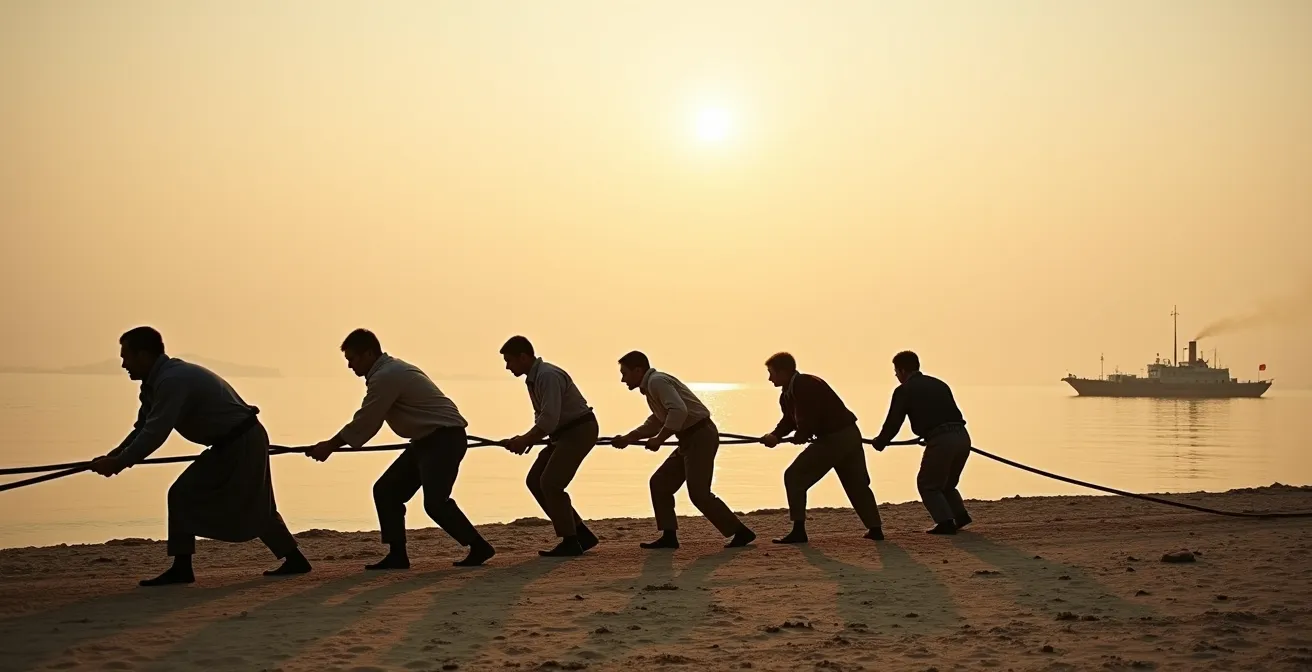
Russian Realist paintings are more than just depictions of suffering; they are psychological ‘X-rays’ of an empire about to collapse.
- They reveal profound political dissent and social critique disguised as everyday genre scenes.
- They use the humble Russian landscape to forge a new national identity at a time of spiritual crisis.
Recommendation: To truly understand these works, learn to spot the ‘narrative dissonance’—the gap between the subject’s dignified suffering and the failing imperial narrative that caused it.
To stand before a 19th-century Russian Realist painting is to feel the weight of a story untold. You see the sun-baked backs of barge haulers, the haunted eyes of a tsar who has murdered his son, or the profound stillness of a birch forest. It’s easy to see the surface-level narrative: a raw, often brutal depiction of life in the Russian Empire. Many viewers stop there, appreciating the technical skill but missing the explosive political and social commentary simmering just beneath the paint.
The common understanding is that these artists, known as the Peredvizhniki or “The Wanderers,” simply wanted to paint real life. But this simplifies their radical mission. They weren’t just journalists with brushes; they were social diagnosticians. This guide moves beyond the platitudes of “painting suffering” to offer a new lens. We will treat these artworks as a social X-ray, a tool for seeing the hidden fractures, spiritual anxieties, and political time bombs within a society on the brink of cataclysmic change. You will learn to read these canvases not just as images, but as historical documents and psychological profiles of a nation in turmoil.
We will begin with the rebellion that started it all, exploring the movement’s core tenets. We will then analyze how artists like Repin, Levitan, and Vrubel used their art to perform a kind of spiritual anatomy on the Russian soul. Finally, we’ll bridge the historical with the practical, offering guidance on where to see these masterpieces and how to continue your studies. This journey will equip you to see what the original viewers saw: a revolution in art that foretold a revolution in life.
This article provides a structured exploration of the key movements, artists, and concepts essential to understanding the depth of Russian art. The following summary outlines the path we will take, from the origins of Realism to its lasting impact and how you can experience it today.
Summary: A Journey Through Russian Art and Its Meanings
- Who were the Peredvizhniki and why did they rebel against the Academy?
- Why is Repin’s painting of Ivan killing his son constantly attacked by vandals?
- Levitan’s landscapes: Why are simple birches considered the soul of Russia?
- The Demon Seated: How Vrubel’s obsession led to the birth of Russian Symbolism?
- Where to buy high-quality English catalogs of Russian Realism in Moscow?
- Tretyakov or Pushkin Museum: Which one should art lovers prioritize?
- What is “Toska” and can you experience this specific melancholia as a tourist?
- Why is Malevich’s “Black Square” at the New Tretyakov worth €10?
Who were the Peredvizhniki and why did they rebel against the Academy?
The birth of Russian Realism was not a gradual evolution; it was a detonation. The fuse was lit on November 9, 1863, within the hallowed halls of the Imperial Academy of Arts in St. Petersburg. The event, known as the “Revolt of the Fourteen,” saw the institution’s top students refuse to paint the assigned topic for the prestigious Gold Medal competition—”The Feast of the Gods in Valhalla.” They demanded the freedom to choose their own subjects, ones that reflected the pressing reality of Russian life. When the Academy refused, the revolt that birthed Russian realism began when 14 students walked out, severing ties with the state-sponsored art world.
These artists, led by Ivan Kramskoi, formed the “Artel of Artists,” which later evolved into the “Society for Itinerant Art Exhibitions” (Peredvizhniki). Their rebellion was ideological. They rejected the Academy’s Neoclassical mandate, which favored mythological and historical subjects far removed from the lives of ordinary Russians. The Peredvizhniki believed art had a social purpose: to serve as a mirror to society, to educate, and to inspire moral and political consciousness. It was a radical departure, turning the canvas from a window into a fantasy world into a direct confrontation with the present.
The influential critic Vladimir Stasov became their champion, articulating their mission with fiery prose. He celebrated Ilya Repin’s work as the ultimate expression of this new ethos:
with a daring that is unprecedented amongst us [Repin] has abandoned all former conceptions of the ideal in art, and has plunged head first into the very heart of the people’s life, the people’s interests, and the people’s oppressive reality
– Vladimir Stasov, The Art Story – Peredvizhniki Movement
This wasn’t just about painting peasants; it was about performing a spiritual anatomy of the nation. They sought to capture not just the likeness of the people, but their soul, their struggles, and the deep-seated injustices of the Tsarist autocracy. By taking their exhibitions on the road (“itinerant”), they brought this powerful social commentary directly to the provinces, bypassing the elite circles of Moscow and St. Petersburg and creating a truly national art. This act of rebellion laid the groundwork for all socially conscious Russian art to follow.
Why is Repin’s painting of Ivan killing his son constantly attacked by vandals?
Ilya Repin’s Ivan the Terrible and His Son Ivan on 16 November 1581 is not a painting you simply look at; it is an event you survive. It depicts the horrifying moment after the first Tsar of Russia, in a fit of rage, has struck his own son and heir with a scepter. The canvas is a storm of madness, grief, and regret, captured in the Tsar’s bloodshot, desperate eyes as he clutches his dying son. The raw, unfiltered horror of the scene was so powerful that upon its first exhibition, its effect on the public was visceral. As one contemporary noted, “In front of Ivan the Terrible and His Son Ivan ladies just fainted.”
This power to provoke is precisely why the painting has been a target for vandals for over a century. In 1913, it was slashed with a knife. In 2018, a man attacked it with a metal pole, shattering the protective glass and damaging the canvas. These are not random acts of destruction; they are reactions to the painting’s unbearable psychological realism. The attackers, often driven by nationalist fervor, cannot accept this depiction of a foundational figure of Russian history as a crazed, filicidal monster. They see the painting as an attack on the myth of the strong, infallible Russian state, a myth that Ivan the Terrible embodies.
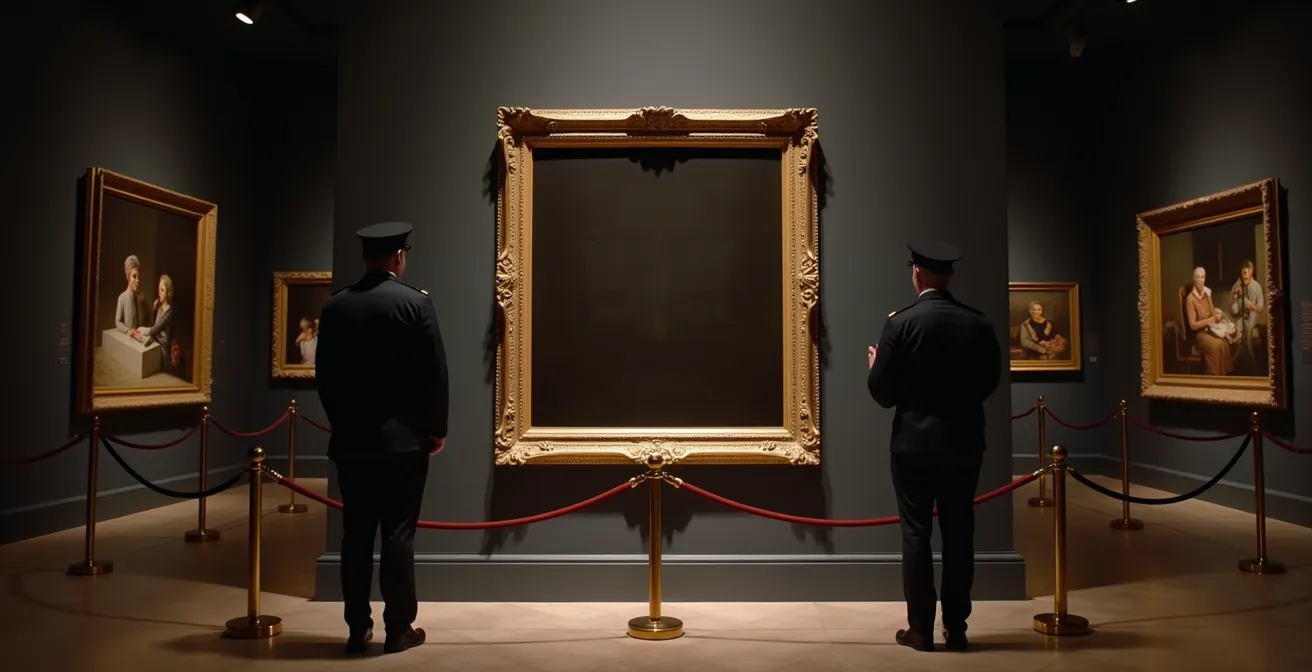
Repin’s work consistently courted controversy because it refused to idealize. He presented a “social X-ray” that revealed the sickness within the state’s very origins. His art was a direct challenge to the official historical narrative. Indeed, many contemporary critics condemned Repin’s paintings, stating his work was described as ‘pseudo-liberal denunciation and protest’. The attacks on the painting are a testament to its enduring power. It proves that Repin did not just paint a historical scene; he painted a national trauma so profound that, even today, some feel compelled to physically attack the canvas to silence its terrible truth.
Levitan’s landscapes: Why are simple birches considered the soul of Russia?
While Repin dissected the turbulent history of Russia’s people, Isaak Levitan found the nation’s soul in its silent, expansive landscapes. To the uninitiated, his paintings of birch groves, muddy spring thaws, and vast, somber plains might seem merely picturesque. But for a Russian viewer, they are deeply resonant icons of national identity. Levitan’s genius was in transforming the humble Russian countryside into a vessel for profound spiritual and philosophical meaning, creating what is often called the “mood landscape.”
This elevation of the local landscape was a quiet but powerful political act. In the late 19th century, Russia’s identity was in crisis. The traditional pillars of Tsar, Orthodoxy, and serfdom were crumbling or being questioned. As one analysis notes, Russians found a sense of self and national unity in the physical land they inhabited, a constant presence amid social upheaval. Levitan’s landscapes provided a new kind of icon—secular, tangible, and deeply patriotic. A simple birch tree was no longer just a tree; it was a symbol of Russia itself—resilient, graceful, and melancholic.
Levitan himself felt this connection with an almost religious fervor, seeing the divine not in a church, but in the natural world. He once wrote:
I imagine such a gracefulness in our Russian land – overflowing rivers bringing everything back to life. There is no country more beautiful than Russia! There can be a true landscapist only in Russia
– Isaak Levitan, Wikipedia – Peredvizhniki
His paintings capture a uniquely Russian feeling known as toska—a deep, often directionless spiritual anguish mixed with a longing for something unattainable. Works like Vladimirka Road, depicting the infamous path prisoners walked to Siberia, are not just landscapes; they are meditations on suffering, endurance, and the immense, sorrowful beauty of the motherland. In Levitan’s hands, a simple dirt road or a stand of birch trees becomes a stage for the drama of the Russian soul, embodying both its immense capacity for sadness and its quiet, unyielding strength.
The Demon Seated: How Vrubel’s obsession led to the birth of Russian Symbolism?
Just as the Peredvizhniki seemed to have perfected the art of social critique through realism, Mikhail Vrubel shattered the mirror they held up to society. He was not interested in the external world of social problems but the internal, mystical, and often terrifying world of the human psyche. His magnum opus, the “Demon” series, and particularly The Demon Seated (1890), marks a pivotal break from Realism and the birth of Russian Symbolism. The painting shows a muscular, androgynous figure, a fallen angel, brooding amidst a fractured, crystalline landscape at twilight. It is a portrait not of a person, but of a state of being: titanic power bound by profound despair and isolation.
Vrubel’s obsession with the “Demon” theme, inspired by Mikhail Lermontov’s epic poem, was all-consuming. He painted version after version, each more tormented than the last. This was no longer the psychological realism of Repin, which explored the minds of historical figures; this was an exploration of pure, archetypal forces. Vrubel abandoned the clear, narrative light of the Realists for a fragmented, mosaic-like style, using a palette knife to create jewel-like surfaces that seem to shimmer with an inner, otherworldly light. His goal was not to depict reality, but to evoke a feeling and suggest a hidden, spiritual truth beyond the visible world.
This shift was monumental. Vrubel turned away from the Peredvizhniki’s civic duty and social messaging, plunging instead into themes of myth, spirituality, and the eternal struggle between good and evil. His demon is not a simple villain; he is a symbol of the creative spirit itself—powerful, alienated, and forever striving. Vrubel’s tortured, obsessive process and his radical stylistic innovations blew the doors open for a new generation of artists, including the “Blue Rose” group, who would abandon reality altogether in favor of dreams, symbols, and pure color. Vrubel’s demon, in its tragic grandeur, sits at the crossroads of Russian art, marking the end of Realism’s dominance and the dawn of the avant-garde.
Where to buy high-quality English catalogs of Russian Realism in Moscow?
After immersing oneself in the powerful narratives of Russian art, the desire to take a piece of that experience home is natural. For the English-speaking art lover in Russia, a high-quality exhibition catalog is more than a souvenir; it’s an essential tool for continued study. While the masterpieces themselves reside in museums, their stories, contexts, and high-resolution reproductions can be found in well-produced books. However, navigating museum shops and bookstores can be daunting. The key is to know where to look and what to look for.
The primary sources are, unsurprisingly, the museum bookshops themselves. The Tretyakov Gallery and the State Russian Museum (in St. Petersburg) are the epicenters for 19th-century Realism and offer the most comprehensive publications. The New Tretyakov is the go-to for the 20th-century and avant-garde periods. Look for publications by Palace Editions, a publisher renowned for its scholarly and beautifully printed catalogs on Russian art, often available in English.
To help you navigate your search for the perfect art book, here is a comparison of the main museum shops an art lover might visit in Moscow:
| Museum Shop | English Catalog Quality | Price Range | Specialty |
|---|---|---|---|
| Tretyakov Gallery | Excellent | €20-50 | 19th century Realism |
| State Russian Museum | Very Good | €15-40 | Comprehensive collection |
| New Tretyakov | Good | €10-30 | 20th century/Soviet art |
| Pushkin Museum | Good | €25-60 | International context |
Finding the right catalog requires a clear plan. Below is a checklist to guide your search and ensure you acquire a volume that truly enriches your understanding.
Your Action Plan: Securing the Best Russian Art Catalogs
- Start at the source: Prioritize visiting the main museum shops, such as the Tretyakov Gallery bookstore for its comprehensive English-language publications on 19th-century Realism.
- Identify key publishers: Keep an eye out for books by reputable houses like Palace Editions, which specializes in high-quality Russian museum catalogs.
- Match the book to your interest: If your focus is modernism, head to the New Tretyakov; for the most extensive collection overview, the State Russian Museum shop in St. Petersburg is a must.
- Assess quality over quantity: Instead of buying multiple small guides, invest in one major exhibition catalog with scholarly essays and high-resolution plates.
- Plan ahead: For major exhibitions, consider checking the websites of international museum shops (like the Royal Academy in London) to pre-order catalogs before your trip, as they often have English editions.
Tretyakov or Pushkin Museum: Which one should art lovers prioritize?
For any art lover with limited time in Moscow, a difficult choice arises: the State Tretyakov Gallery or the Pushkin State Museum of Fine Arts? While both are world-class institutions, they offer fundamentally different experiences. The decision hinges on a single question: do you want to understand Russia, or do you want to see Russia in the context of the world?
If your goal is a deep immersion into the Russian soul, the Tretyakov Gallery is non-negotiable. It is the world’s foremost repository of Russian art, from medieval icons to the masterpieces of the 19th-century Realists we have been discussing. This is where you will stand face-to-face with Repin’s Ivan the Terrible, Levitan’s landscapes, and the foundational works of the Peredvizhniki. The Tretyakov is not just a museum; it is a visual encyclopedia of Russian national identity, charting its history, its traumas, and its triumphs through the eyes of its own artists. The Peredvizhniki movement alone had a staggering impact, and the 48 exhibitions held between 1870 and 1923 shaped the nation’s artistic consciousness, a legacy the Tretyakov enshrines.
The Pushkin Museum, by contrast, offers a global perspective. Its collection was built to show the story of world art, featuring everything from Ancient Egyptian artifacts and casts of classical sculptures to a magnificent collection of French Impressionist and Post-Impressionist paintings. While it does house some Russian art, its primary mission is to place art in an international dialogue. Visiting the Pushkin is about seeing how Monet, Van Gogh, and Picasso fit into the grand timeline of art history.
So, the choice is one of depth versus breadth. To understand the specific phenomenon of Russian Realism and its role as a “social X-ray,” the Tretyakov is the essential pilgrimage. It provides the concentrated, undiluted narrative. The Pushkin is for those who want to see the great works of Western art that were created concurrently, providing context but not the core story of Russian artistic identity. For the traveler seeking the heart of Russian art, the Tretyakov must be the priority.
What is ‘Toska’ and can you experience this specific melancholia as a tourist?
To look at a Russian Realist painting is often to feel a particular kind of melancholy, a profound and soulful sadness that permeates the canvas. This feeling has a name in Russian: toska. Vladimir Nabokov famously described it as a “sensation of great spiritual anguish, often without any specific cause… a longing with nothing to long for, a sick pining, a vague restlessness.” It is more than just sadness; it is a deep ache of the soul. But can a tourist, a non-Russian, truly experience or understand this feeling simply by looking at art?
The answer lies in empathy. The Peredvizhniki, and especially Ilya Repin, were masters of channeling toska through their subjects, creating a direct emotional conduit to the viewer. Look again at his Barge Haulers on the Volga. The great writer Fyodor Dostoevsky, upon seeing the painting, perfectly captured how Repin transmits this debt of suffering without sentimentality:
Not a single one of them shouts from the painting to the viewer, ‘Look how unfortunate I am and how indebted you are to the people!’ [I saw] barge haulers, real barge haulers, and nothing more … you can’t help but think you are indebted, truly indebted, to the people
– Fyodor Dostoevsky, Wikipedia – Barge Haulers on the Volga
This is the key. You experience toska not by trying to feel “Russian,” but by allowing yourself to feel the humanity of the individuals portrayed. Repin’s genius was in his empathetic portrayal of his subjects. He spent months with the barge haulers, getting to know their stories. As an analysis of his process reveals, Repin found particular empathy with Kanin, the defrocked priest leading the group, who embodies a quiet, intellectual dignity despite his grueling labor. The men are shown with dignity—bowed but not broken, exhausted but enduring. They are not objects of pity but subjects of immense resilience.
So yes, a tourist can experience a reflection of toska. It happens when you move past seeing the “suffering people” and see people who are suffering with dignity. It’s the moment you look into the eyes of Kanin in Repin’s painting and feel that “debt” Dostoevsky described—a shared human responsibility for one another’s burdens. It is an experience of profound, melancholic empathy, and it is the very heart of what makes this art so powerful and timeless.
Key Takeaways
- Russian Realism was a political rebellion against academic art, aiming to use the canvas as a tool for social critique.
- Artists like Repin created a “psychological realism” that exposed the traumas and contradictions of Russian history, making their work controversial to this day.
- The Russian landscape, particularly in the hands of Levitan, became a powerful symbol of national identity and a vessel for the unique melancholic feeling of ‘toska’.
Why is Malevich’s ‘Black Square’ at the New Tretyakov worth €10?
After a journey through the rich, narrative-filled world of 19th-century Russian Realism, encountering Kazimir Malevich’s Black Square at the New Tretyakov can feel like hitting a wall. It is a canvas painted black. There is no story, no social commentary, no suffering peasant, no birch grove. So why is this painting, which seemingly offers nothing, considered one of the most important works of the 20th century, and why is the museum’s €10 entry fee a bargain to see it?
The answer is that the Black Square (first painted in 1915) represents not the continuation of art, but its complete and total reset. It is the “zero point” of painting. Malevich, the founder of the Suprematist movement, sought to free art from the “ballast of the objective world.” He wanted to drain it of all stories, symbols, and representations to get to its purest form: color and shape. The black square on a white ground was the most absolute, irreducible image he could conceive. It is not a picture *of* something; it *is* something—an icon of pure feeling and pure form.
Its value lies in its radical audacity. By painting a black square, Malevich effectively declared the end of the entire tradition of art that came before him, including the Realism of the Peredvizhniki. If their art was a “social X-ray,” Malevich’s was a black hole, absorbing all narratives and leaving only the stark reality of the medium. To see the Black Square in person, especially after having seen the works at the main Tretyakov Gallery, is to witness the cataclysmic rupture between two worlds. It’s the moment Russian art leaps from depicting the world to creating new ones.
The €10 ticket is not for the pleasure of looking at a black shape. It is payment for an audience with a turning point in human consciousness. You are paying to stand in the presence of the “zero hour,” the moment art killed its past to be reborn. It is the full stop at the end of the long, complex sentence of Russian Realism and the first word of a new, abstract language. For any serious art lover, that is an experience worth far more than the price of admission.
Frequently Asked Questions about Russian Realist Art
Where can I see Barge Haulers on the Volga?
The original painting is housed in the State Russian Museum in St. Petersburg, not Moscow.
What makes the Tretyakov Gallery unique for Russian art?
It houses the world’s foremost collection of Russian fine art, particularly 19th-century Realist works.
Should I visit both museums in one trip?
If time permits, yes – they offer complementary perspectives on Russian and international art. The Tretyakov offers a deep dive into Russian art, while the Pushkin Museum places it in a global context.