Destinations & Neighborhoods in Moscow
Moscow unfolds across a vast territory—roughly twice the size of Paris—where centuries of history have layered distinct neighborhoods, each telling a different chapter of Russia’s story. Understanding the city’s geographical and cultural divisions transforms a potentially overwhelming visit into a coherent journey through imperial grandeur, Soviet ambition, and contemporary renaissance. For French travelers accustomed to Paris’s arrondissement logic, Moscow requires a different mental map: one organized around concentric rings radiating from the Kremlin, with character districts scattered along ancient trade routes and the bends of the Moskva River.
This comprehensive overview introduces Moscow’s essential neighborhoods, from the fortified heart at Red Square to the experimental loft districts emerging in former industrial zones. Whether you’re planning a short trip and need to prioritize must-see areas, or seeking to understand the architectural dialogue between tsarist palaces and Soviet monuments, this guide provides the foundational knowledge to navigate Russia’s capital with confidence. Each district offers distinct atmospheres, historical layers, and practical considerations that shape how visitors experience this complex metropolis.
The Historic Heart: Kremlin and Red Square Area
The Kremlin complex functions as Moscow’s absolute center—geographically, historically, and symbolically. This fortified citadel, surrounded by 2.5 kilometers of crenellated red walls, contains layers of power spanning from medieval principalities to contemporary governance. The area immediately surrounding the Kremlin demands at least a full day to properly absorb, though many visitors underestimate the time required to navigate security protocols and appreciate the architectural density.
Red Square itself serves as Moscow’s ceremonial stage, bordered by the whimsical domes of Saint Basil’s Cathedral to the south and the elegant façade of GUM department store to the east. This historic shopping arcade, with its glass-roofed galleries and fountain-centered layout, recalls Parisian passages couverts but on a grander scale. Beyond retail therapy, the surrounding streets—particularly those leading toward Kitay-gorod—preserve fragments of the pre-Soviet merchant quarter, where narrow lanes and hidden courtyards offer respite from Red Square’s crowds.
Accessing certain areas requires advance planning and patience. The restricted sections of the Grand Kremlin Palace, including state reception halls adorned with imperial opulence, open only for scheduled tours with limited availability. These spaces, where tsars once held court and Soviet leaders entertained foreign delegations, provide unparalleled insight into Russian ceremonial architecture. Security remains stringent—comparable to visiting the Élysée Palace—with bag restrictions and photography limitations that visitors should anticipate.
Imperial Moscow: Palaces and Royal Heritage
Moscow’s imperial legacy extends far beyond the Kremlin walls, manifesting in suburban estates where the Romanov dynasty built summer residences and pilgrimage destinations. Understanding these sites requires recognizing their dual function: they served both as aristocratic retreats and as strategic demonstrations of Orthodox piety and architectural patronage.
Romanov Residences and the Coronation Path
The historic coronation route traces the ceremonial journey new tsars traveled from the Kremlin to receive blessings at various churches and monasteries. Walking even portions of this path today reveals how imperial power was geographically inscribed across Moscow’s landscape. Key residences dot this route, each reflecting different periods of Romanov taste—from the baroque exuberance favored by Elizabeth to the neoclassical restraint preferred by Alexander I.
Comparing these residences illuminates evolving royal priorities. Some estates prioritized military display and administrative efficiency, while others embraced romantic landscape design inspired by European trends. French travelers will recognize familiar influences: the gardens of certain palaces deliberately echoed Versailles, though adapted to Moscow’s harsher climate with different plant palettes and heating innovations.
Kolomenskoye: Wooden Architecture and Sacred Landmarks
The Kolomenskoye estate, perched on bluffs overlooking the Moskva River, preserves exceptional examples of wooden palace architecture and stone church construction. The reconstructed wooden palace of Tsar Alexei Mikhailovich—a fantasy of carved galleries and onion-domed towers—demonstrates the sophisticated carpentry techniques that defined pre-Petrine Russian architecture. Original structures were dismantled in the 18th century, but recent reconstruction based on historical documents allows visitors to experience spaces that once astonished foreign ambassadors.
The estate’s Church of the Ascension, a UNESCO World Heritage site, pioneered the tent-roof style that became emblematic of Russian sacred architecture. Built in the 1530s to commemorate the birth of Ivan the Terrible, its vertical thrust and geometric purity influenced church design for generations. The surrounding parkland, with ancient oak groves and traditional wooden structures relocated from across Russia, functions as an open-air museum of vernacular architecture.
Soviet Legacy: Monumental Architecture and Ideological Spaces
No understanding of Moscow’s neighborhoods is complete without grappling with the Soviet era’s architectural ambitions. The communist regime reshaped the city with unprecedented scale, creating monuments, exhibition spaces, and residential towers designed to physically manifest ideology and demonstrate socialist achievement.
The Seven Sisters and Stalinist Gothic
The Seven Sisters—seven skyscrapers built in the Stalinist Gothic style during the late 1940s and early 1950s—punctuate Moscow’s skyline with their distinctive tiered silhouettes and ornate spires. Spotting all seven becomes a game for visitors: they house everything from Moscow State University to luxury hotels and government ministries. Their locations were strategically chosen to create visual anchors across the city, visible from multiple vantage points and serving as landmarks for navigation.
These structures represent Soviet architecture at its most grandiose, blending Art Deco motifs, Gothic verticality, and Russian traditional elements into a unique synthesis. The interiors—where accessible—feature lavish materials including marble, bronze, and crystal chandeliers, demonstrating that Soviet austerity rhetoric had significant exceptions. Finding entrances can challenge visitors, as many buildings maintain security protocols, but lobbies of the hotel and residential tower offer glimpses of this distinctive aesthetic.
VDNKh: Exhibition Grandeur and Thematic Pavilions
The VDNKh exhibition center sprawls across 240 hectares in northern Moscow, functioning as an architectural theme park of Soviet republics and industries. Originally created to showcase collective farm achievements, the complex features dozens of pavilions, each representing different Soviet republics or economic sectors through distinctive architectural styles—from Central Asian motifs to Ukrainian baroque interpretations.
Recent restoration efforts have revitalized VDNKh as a cultural destination beyond its historical curiosity value. The space now combines Soviet nostalgia with contemporary museums, seasonal festivals, and public leisure facilities. French visitors often compare it to a hybrid of an exposition universelle and a permanent fairground, though the ideological underpinnings distinguish it from Western exhibition sites. The famous Friendship of Nations fountain, with its gilded figures representing Soviet republics, epitomizes the site’s blend of artistic craft and propaganda messaging.
Character Neighborhoods: Traditional Moscow’s Living Fabric
Beyond monumental landmarks, Moscow’s most rewarding discoveries often happen in residential neighborhoods where pre-Soviet urban patterns survived twentieth-century reconstruction. These districts offer glimpses of how Muscovites actually lived—and continue to live—amid the city’s dramatic historical transformations.
Zamoskvorechye: Merchants and Orthodox Heritage
The Zamoskvorechye district, literally “beyond the Moskva River,” preserves Moscow’s most coherent pre-Soviet urban fabric. This area developed as a merchant quarter, with wealthy traders building family compounds around Orthodox churches that still define neighborhood landmarks. The district’s street grid follows organic medieval patterns rather than Soviet planning logic, creating a walkable scale rare in Moscow’s sprawling geography.
Navigation here rewards wandering: hidden churches emerge from residential streets, traditional wooden houses survive between modern construction, and courtyards reveal layered histories. The area’s character reflects merchant-class piety and commercial success, distinct from the aristocratic pretensions of central neighborhoods or the working-class identity of industrial districts. Several notable art collections—gathered by textile magnates and other industrialists—remain accessible in preserved mansions.
Arbat Streets: Pedestrian Heritage and Contrasting Identities
Understanding Moscow requires comparing Old and New Arbat, two parallel streets with radically different characters despite their shared name. Old Arbat, Moscow’s most famous pedestrian street, embodies tourist-friendly heritage: street performers, souvenir vendors, portrait artists, and literary history markers create a perpetually festival-like atmosphere. The street’s aristocratic past—when noble families maintained townhouses here—surfaces in plaques commemorating Pushkin, Tolstoy, and other cultural figures.
New Arbat, by contrast, exemplifies Soviet-era urban renewal at its most disruptive. This wide thoroughfare, sliced through the existing urban fabric in the 1960s, features monolithic residential towers and a scale designed for automobile traffic rather than pedestrian experience. The contrast between these streets, separated by mere blocks, illustrates Moscow’s layered development more effectively than any museum exhibit. Both offer distinct pleasures: Old Arbat for atmospheric strolling and people-watching, New Arbat for architectural photography and understanding Soviet urban planning philosophy.
Hidden Courtyards and Secret Urban Spaces
Moscow’s most enchanting discoveries often hide behind unpromising façades. The concept of the “savvy yard”—secret courtyards known primarily to locals—captures an essential aspect of Moscow navigation. These spaces, typically accessed through archways or unmarked passages, might contain café gardens, artist studios, boutique shops, or simply peaceful retreats from street-level chaos.
Streets like Zabelina and areas around Kuznetsky Most reward exploratory instincts. Zabelina Street, in particular, has emerged as a cultural destination where contemporary galleries and design shops occupy courtyards once devoted to light industry. The challenge lies in knowing which archways lead somewhere interesting—a knowledge gap that separates tourists from residents. Patient exploration, however, yields discoveries impossible to capture in conventional guidebooks.
Contemporary Moscow: Urban Transformation and Cultural Revival
Moscow’s ongoing transformation reveals itself most dramatically in former industrial zones being reimagined as cultural districts. This process, accelerating over recent years, parallels similar developments in Paris’s 13th arrondissement or London’s Shoreditch, though with distinctive Russian characteristics including larger scales and more dramatic contrasts with surrounding areas.
The best loft districts cluster in former factory complexes, particularly in areas northeast of the city center. These spaces—Red October, Arma, Flacon, and others—combine art galleries, design studios, performance venues, and restaurants within brick industrial architecture. The aesthetic deliberately preserves Soviet-era machinery, signage, and architectural elements as design features, creating environments where historical industrial identity dialogues with contemporary creative uses.
Nightlife has similarly evolved beyond the historic entertainment districts. While areas like the traditional nightlife quarter near Tverskaya maintain their party reputation, newer venues scatter across gentrifying neighborhoods. The result is a more decentralized nightlife geography where knowing specific venues matters more than targeting particular districts. Underground clubs occupy basements of residential buildings, rooftop bars crown unexpected structures, and concept bars integrate theatrical design with mixology innovation.
This urban transformation reflects Moscow’s positioning as a contemporary European capital, though the pace and scale of change can disorient even frequent visitors. Entire blocks transform within months, former residential areas acquire commercial functions, and previously inaccessible zones open to public use. The Cathedral of the Armed Forces, recently completed in the Moscow suburbs, exemplifies how contemporary Russia continues building monumental religious and patriotic structures with architectural ambitions rivaling historical predecessors.
Navigating Moscow: Practical Strategies for District Exploration
Successfully navigating Moscow’s neighborhoods requires understanding both physical infrastructure and time management realities. The city’s metro system, renowned for its palatial stations and efficiency, provides the primary navigation framework. However, distances between destinations frequently exceed visitor expectations—what appears close on a map may require 45 minutes of metro travel plus walking.
For short trips of three to five days, selecting must-see districts demands difficult choices. A logical approach concentrates on two to three neighborhoods daily, clustering geographically related sites rather than crisscrossing the city. Morning visits to major monuments (Kremlin, major palaces) avoid afternoon crowds, while evening hours suit neighborhood wandering in areas like Arbat or Zamoskvorechye. Many cultural sites close at least one day weekly—typically Mondays or Tuesdays—requiring advance schedule coordination.
Combining sites strategically maximizes limited time. The Luzhniki area, for instance, pairs the famous stadium with riverfront parks and cable car rides offering panoramic views. Similarly, a Kolomenskoye visit can extend to include the nearby Tsaritsyno estate, creating a full day of imperial architecture and landscaped grounds. Understanding these logical combinations prevents the exhausting fragmentation that undermines many first-time Moscow itineraries.
Finding specific locations within districts presents challenges beyond basic navigation. Entrances to major sites aren’t always obvious—the Kremlin, for example, has limited entry points requiring circuitous approaches. Courtyard venues deliberately maintain low profiles, and Cyrillic signage without Latin transliteration tests non-Russian speakers. Downloading offline maps and saving specific addresses in both Latin and Cyrillic alphabets prevents navigation frustrations when mobile data proves unreliable.
Moscow’s neighborhoods ultimately reward preparation balanced with spontaneity. Understanding the city’s layered geography—concentric rings, distinct district characters, dispersed landmarks—provides the framework for confident exploration. Yet the most memorable experiences often emerge from unexpected encounters: a church stumbled upon during a wrong turn, a courtyard café discovered by following locals, or an architectural detail noticed because you paused to rest. This balance between structured itinerary and openness to serendipity captures the ideal approach to Moscow’s complex, rewarding urban landscape.
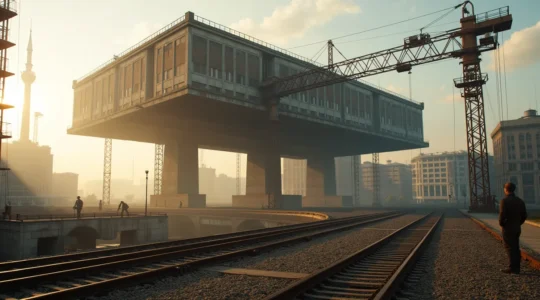
How were massive buildings on Tverskaya moved while people slept inside?
The legendary feat of moving Moscow’s Tverskaya buildings was not magic, but a triumph of audacious structural engineering and absolute state control. Engineers used a system of steel frames, rollers, and synchronized winches to move structures weighing up to 23,000…
Read more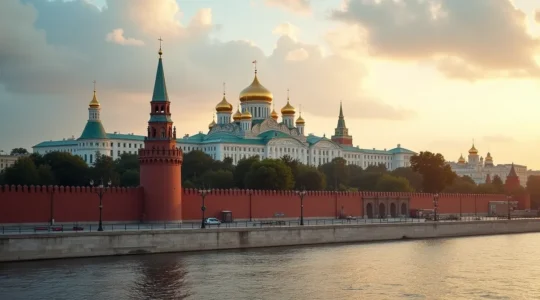
How to Visit the Terem Palace: An Insider’s Guide to the Kremlin’s Forbidden Rooms
Accessing the Kremlin’s restricted palaces isn’t about finding a secret entrance; it’s about strategically navigating the official bureaucratic system. The most opulent areas like the Grand Kremlin Palace and Terem Palace are functioning state residences, accessible only via special request…
Read more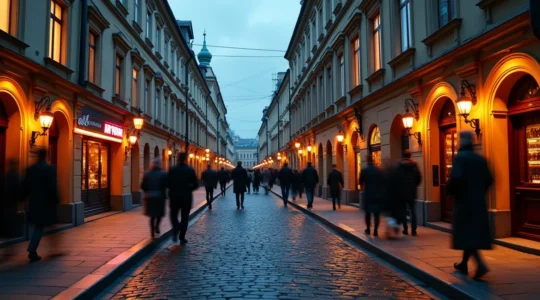
Kitay-Gorod nightlife: The safest bar-hopping route for foreigners
Forget generic top-10 lists; navigating Kitay-Gorod’s legendary nightlife requires strategy, not just suggestions. Success isn’t about knowing bar names, but understanding the “unwritten rules” like face control and hidden entrances. A safe night out involves a planned route that mixes…
Read more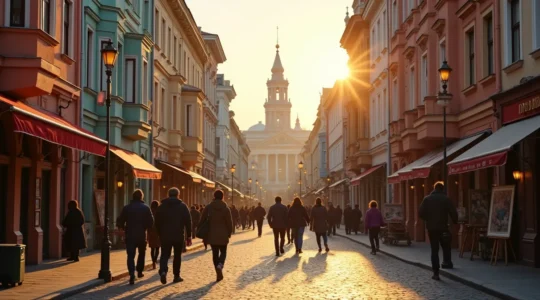
Old Arbat walking tour: Avoiding the tourist kitsch to find history
Contrary to its reputation as a mere tourist thoroughfare, Old Arbat is a historical text where Moscow’s pre-Soviet elegance, counter-cultural rebellion, and architectural ghosts are hidden in plain sight. The street’s true value lies not in its souvenir stalls but…
Read more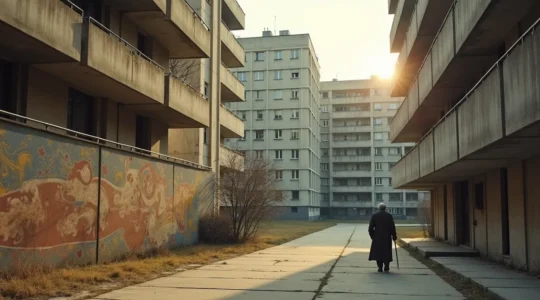
Where to Find Authentic Soviet Heritage Beyond the Red Square Crowds?
In summary: Look for “Stolovaya” (столовая) signs to find authentic, low-cost Soviet-style canteens. Evaluate specialized sites like the Taganka Cold War Bunker based on their specific, theatrical experiences versus historical displays. Focus on specific metro stations like Mayakovskaya, Kiyevskaya, and…
Read more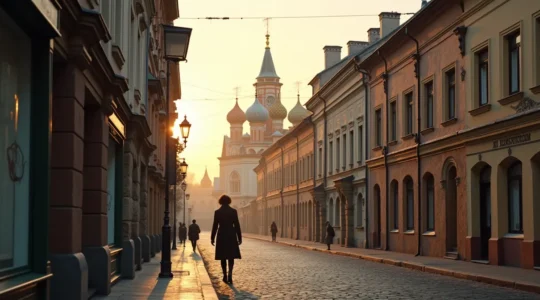
Walking Old Moscow: A Historian’s Guide to Finding the Real Pre-Soviet Vibe
To find Moscow’s authentic pre-Soviet charm, you must look beyond the monumental facades and into the quiet, layered urban fabric that survived centuries of change. The city’s true 19th-century atmosphere is found not in grand squares, but in the merchant…
Read more