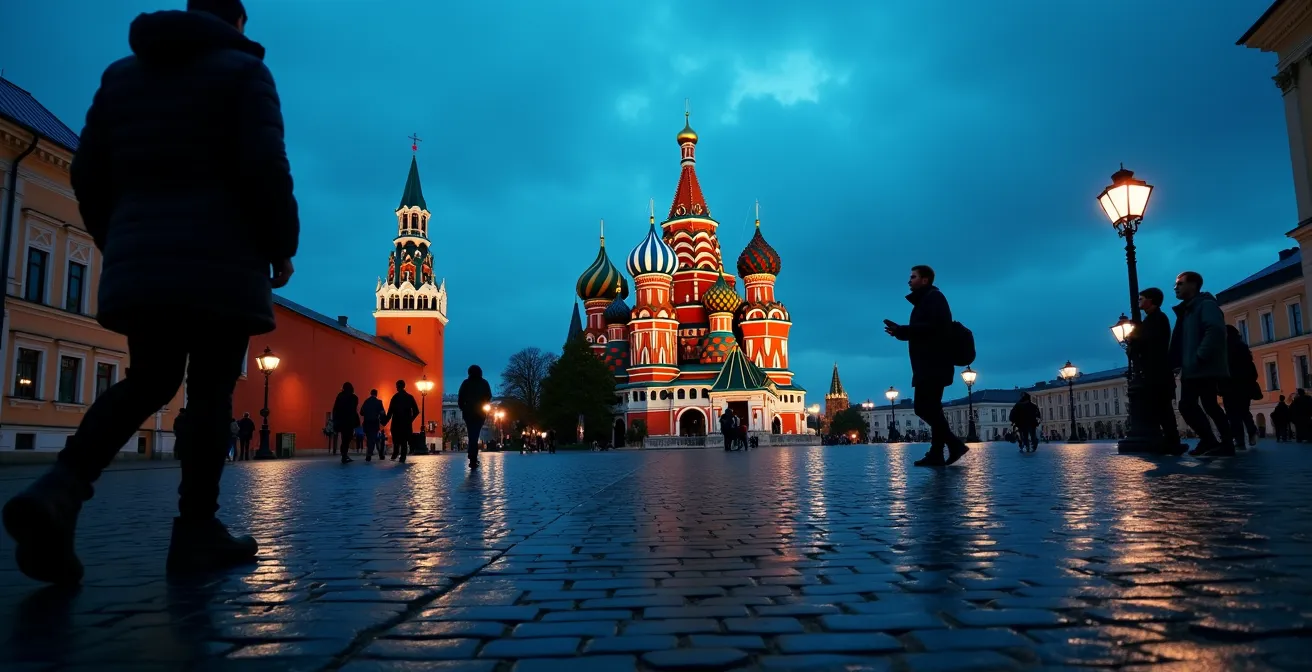
The story that Ivan the Terrible blinded the architects of Saint Basil’s Cathedral is a powerful legend, but historically false.
- Historical records show the lead architect, Postnik Yakovlev, went on to design other significant structures after Saint Basil’s was completed.
- The myth likely emerged later to encapsulate the very real terror of Ivan’s reign and his use of architecture as a tool of absolute power.
Recommendation: Look beyond the myth and see the cathedral not just as a beautiful landmark, but as a complex symbol of Russian identity, born from an era of profound political paranoia and national ambition.
It’s one of history’s most chilling architectural tales: upon seeing the kaleidoscopic beauty of Saint Basil’s Cathedral for the first time, a proud and jealous Tsar Ivan the Terrible orders his architects to be blinded, ensuring they could never again create something so magnificent. This gruesome story has been whispered for centuries, cementing the image of a brilliant but monstrous ruler. For folklore lovers and history buffs alike, it presents a tantalizing horror story, perfectly in character for Russia’s first and most infamous Tsar. It has become as much a part of the cathedral’s identity as its iconic onion domes.
Yet, like many compelling legends, its foundations are more myth than masonry. The common approach is to simply debunk this story, pointing out that historical records show the architects working on subsequent projects. But this simple fact-checking misses the more fascinating question: why did this specific legend arise and endure? The answer is far more revealing than a simple yes or no. The myth isn’t just a lie; it’s a symptom. It’s a popular echo of a very real atmosphere of fear and control that defined Ivan’s rule, an era when architecture itself became a weapon of psychological warfare.
This investigation will peel back the layers of the legend. We will explore not just the fate of the architects, but the political and architectural DNA of 16th-century Moscow. By understanding the buildings that came before Saint Basil’s, the pervasive terror of Ivan’s secret police, and the Tsar’s paranoid vision for his capital, we can uncover a truth more complex and compelling than the legend itself. We will see how a building can become a narrative, and how a myth, even a false one, can tell a deeper truth about the time that created it.
To fully grasp the story of this iconic building, this article explores the political climate, architectural influences, and historical truths that shaped both the cathedral and its enduring legends. Follow along as we deconstruct the myth and rebuild the fascinating history behind it.
Summary: Unraveling the Myth of Saint Basil’s Cathedral
- Why did Ivan the Terrible ban the construction of tent-roof churches?
- The Church of the Ascension: The prototype that inspired Ivan’s architects
- Where in Moscow can you find traces of Ivan’s terror police headquarters?
- How architecture reflected the paranoia of the first Tsar?
- Italian architects in Moscow: How much did the West influence Ivan’s buildings?
- Saint Basil vs. Intercession Cathedral: What is the real name of the building?
- Getting to Kolomenskoye: The easiest route to see the UNESCO Church of the Ascension
- Romanov history tour: Which museums depict the Imperial era best?
Why did Ivan the Terrible ban the construction of tent-roof churches?
A common misconception, often tangled with the legend of the blinded architects, is that Ivan the Terrible himself stifled architectural innovation by banning the uniquely Russian “tent-roof” style. This dramatic, soaring design is a hallmark of the era, and its suppression seems to fit the narrative of a tyrannical ruler. However, historical records tell a different story. The ban wasn’t a product of Ivan’s wrath, but of religious orthodoxy that came much later. As renowned historian of Russian architecture William Brumfield clarifies, the prohibition was a theological, not a political, decision.
The ban was actually enacted later by Patriarch Nikon, not Ivan. The tent-roof style was considered too secular and not in line with Byzantine tradition.
– William Brumfield, Journeys through the Russian Empire
Patriarch Nikon, a powerful church reformer in the mid-17th century, sought to align Russian Orthodox practices more closely with their Greek roots. The tent-roof, a style born from Russian wooden architecture, was seen as a deviation from the traditional Byzantine cross-in-square plan and hemispherical domes. It was a national innovation, but to Nikon, it was an impurity. Ivan, on the contrary, was a champion of this style, as evidenced by Saint Basil’s itself, a glorious explosion of tent-roofed chapels.
The style didn’t disappear forever. It went dormant, only to be resurrected with patriotic fervor in the 19th century. In a wave of national romanticism, the tent-roof style was revived as a nationalist statement, much like the Neo-Gothic movements in Western Europe that looked back to a romanticized medieval past. This revival cemented the style as a key part of Russia’s architectural identity, a symbol of its unique cultural path, independent from the Byzantine traditions Nikon tried to enforce.
The Church of the Ascension: The prototype that inspired Ivan’s architects
Saint Basil’s Cathedral did not spring from a vacuum. Its revolutionary design was an evolution, a masterful synthesis of architectural ideas that had been developing in the Grand Duchy of Moscow for decades. The most important of these prototypes, the building that serves as its direct ancestor, is the stunning Church of the Ascension in Kolomenskoye, completed in 1532 to celebrate the birth of Ivan the Terrible himself. This UNESCO World Heritage site is the first great stone tent-roof church, a statement of ambition and a departure from traditional Byzantine forms.
Its single, elegant white spire soaring towards the heavens was a radical statement. It broke the mold of the multi-domed church, focusing all its energy into one vertical thrust. This concept of a central, towering form became a key element in the architectural DNA of Saint Basil’s. The visual dialogue between the two structures is striking; one is a solitary, graceful poem in white stone, the other a joyous, chaotic epic in red brick and colored tile.

The architects of Saint Basil’s, Postnik and Barma, were brilliant composers, not just inventors. They took the central tent-roof concept from the Church of the Ascension and combined it with other existing ideas to create their masterpiece. As a detailed analysis of the cathedral’s structure reveals, Saint Basil’s is a complex hybrid. It incorporates the staggered, layered design from the Ivan the Great Bell Tower (1508), the central tent from Kolomenskoye (1530s), and the unique cylindric shape of the chapels from the Church of Beheading of John the Baptist in Dyakovo (1547). Saint Basil’s is thus not a singular creation, but a symphony of pre-existing Muscovite architectural themes, brilliantly arranged into a new and unprecedented whole.
Where in Moscow can you find traces of Ivan’s terror police headquarters?
The myth of the blinded architects gains its chilling believability from the very real and pervasive terror of Ivan’s reign, particularly the period of the Oprichnina. This was a state-within-a-state, a territory ruled directly by Ivan through his black-clad secret police, the Oprichniki. They were a force of terror, responsible for purges, public executions, and land confiscations, all aimed at crushing the power of the hereditary nobility, the boyars. The Oprichnina was not a fleeting moment of rage; historical records confirm the Oprichnina terror police operated for seven years, from 1565 to 1572, casting a long shadow over Muscovite society.
While the Oprichnina headquarters itself was deliberately erased from the cityscape by subsequent rulers, its ghost lingers in the very heart of Moscow. The territory of the Oprichnina included several key streets in the historic Kitay-Gorod district, the merchant quarter adjacent to Red Square. A walk through this area is a walk through a landscape of fear. The Old English Court, a residence for English merchants, stands as a silent witness, its inhabitants having nervously chronicled the purges they saw. Streets like Nikolskaya were part of this dark domain, where the Oprichniki’s presence was a daily threat.
The most profound trace of this era is, ironically, the absence of buildings. Many structures associated with disgraced boyars or the Oprichnina itself were torn down. The ground was built over, a deliberate act of historical sanitization. Today, standing near Saint Basil’s and looking towards Kitay-Gorod, one is looking at a space that was once the nerve center of Ivan’s terror state. It’s in this atmosphere of absolute, violent power that the legend of the blinded architects took root. The story felt true because it matched the lived reality of a populace who knew their Tsar was capable of anything.
Your Action Plan: A Walking Tour of Ivan’s Moscow
- Start at Red Square near Saint Basil’s Cathedral to get your bearings.
- Walk through the Kitay-Gorod district, the historic merchant quarter that was the heart of the Oprichnina territory.
- Visit the Old English Court on Varvarka Street, where foreign merchants documented the period’s events.
- Explore Nikolskaya Street and imagine it under the control of Ivan’s black-clad police force.
- End at the sites where many historical buildings were deliberately built over, reflecting the city’s attempt to erase this dark chapter.
How architecture reflected the paranoia of the first Tsar?
Ivan the Terrible’s reign was defined by a deep-seated paranoia, a conviction that he was surrounded by traitors among the powerful boyar clans. This mindset wasn’t just a personal failing; it was a state policy that became physically manifest in the architecture he commissioned. His buildings were not merely places to live or pray; they were fortresses, statements of power, and instruments of control. The aesthetic of his rule was one of psychological intimidation, blending grandeur with a palpable sense of threat. The legend of the blinded architects is the ultimate expression of this possessive, paranoid control over creation itself.
The clearest example of this “paranoid architecture” is not in central Moscow, but at the Alexandrov Kremlin (Alexandrova Sloboda), the fortress that served as Ivan’s de facto capital during the Oprichnina. Imagine standing in the shadow of these massive, fortified walls, not as a modern tourist, but as a 16th-century boyar summoned by the Tsar. The narrow, watchful windows and oppressive stone construction were designed to make you feel small and vulnerable. It was a physical manifestation of the Tsar’s absolute and suspicious power, a place from which he could rule by fear.
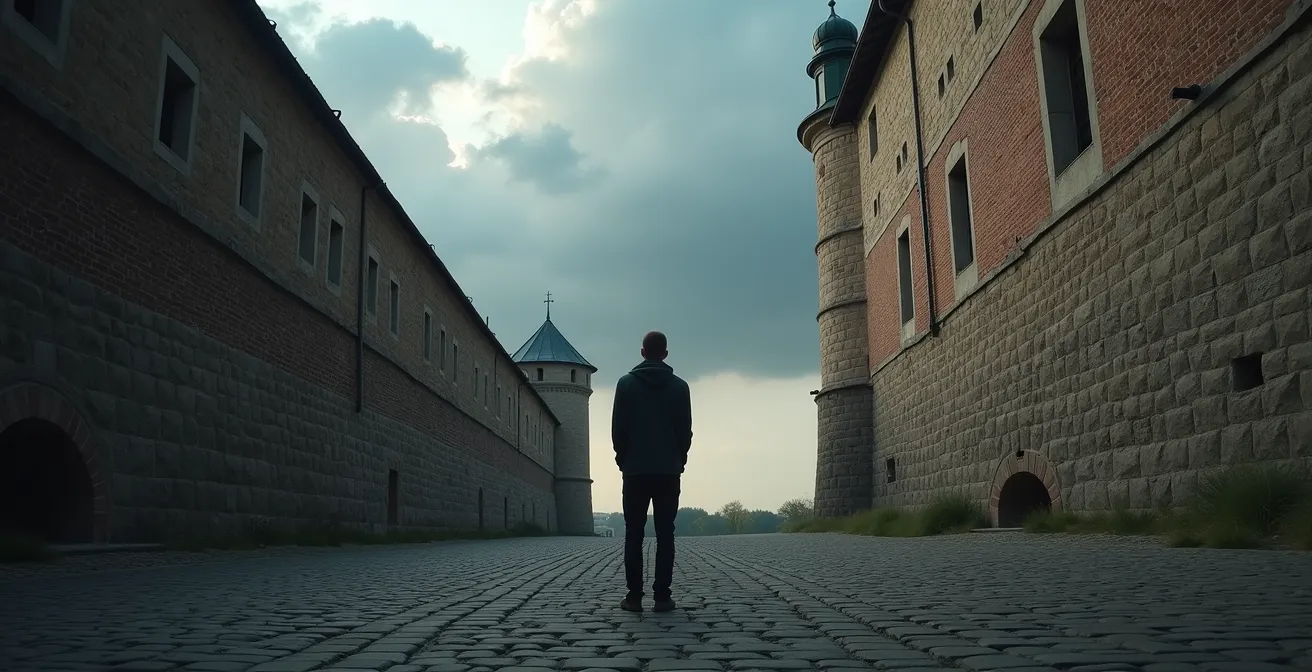
Saint Basil’s Cathedral, while visually joyous, is also part of this narrative. It’s not a fortress, but it is a monument to absolute victory and divine right. As historian William Brumfield explains, its purpose was political from the very beginning. It was built to commemorate the conquest of the Khanate of Kazan, a decisive victory that consolidated Muscovy’s power. Its construction on Red Square, right next to the Kremlin, was a permanent declaration of the Tsar’s might. The building’s bewildering, asymmetrical complexity, with its nine distinct chapels, defies easy comprehension. It presents an image of power so great and multifaceted that it cannot be grasped at a single glance—a fitting monument for a ruler like Ivan.
Italian architects in Moscow: How much did the West influence Ivan’s buildings?
While Saint Basil’s stands as a monument to a uniquely Russian identity, it was built in a Moscow already transformed by foreign masters. For decades before Ivan’s reign, Italian architects had been instrumental in rebuilding the Moscow Kremlin, turning it from a wooden fortress into a formidable citadel of stone and brick that could rival those in Europe. A continuous stream of Italian talent flowed into Moscow, with records showing that from 1474 to 1539, a large group of Italian architects and craftsmen continuously worked in Moscow. They brought Renaissance principles of symmetry, classical proportions, and advanced engineering techniques.
Architects like Aristotile Fioravanti and Aleviz Novy were responsible for some of the Kremlin’s most important buildings, including the Cathedral of the Dormition. Their work represented a conscious effort by Ivan’s predecessors to connect Moscow to its European counterparts and position it as the “Third Rome.” This created a fascinating architectural tension in the heart of the city: a classically-inspired, symmetrical Kremlin core, representing a connection to the West, standing right next to the defiantly asymmetrical, vibrantly Russian Saint Basil’s.
This table highlights the stark contrast between the two dominant styles of the period, demonstrating how Saint Basil’s was a deliberate statement of cultural independence.
| Feature | Italian Renaissance (Kremlin Cathedrals) | Russian National (Saint Basil’s) |
|---|---|---|
| Architects | Aristotile Fioravanti, Aleviz | Postnik and Barma (Russian) |
| Style | Classical proportions, symmetry | Asymmetrical, organic growth |
| Materials | White stone, imported brick techniques | Red brick with colorful decoration |
| Domes | Golden, hemispherical | Multicolored onion-shaped |
| Cultural Statement | Connection to European culture | Uniquely Russian identity |
The choice to have Russian architects—Postnik and Barma—design the new cathedral was a powerful political and cultural statement. It signaled that while Muscovy had learned from the West, it would now forge its own path. Saint Basil’s was the culmination of native traditions, a proud assertion of a unique Russian aesthetic against the backdrop of an Italian-built Kremlin.
Saint Basil vs. Intercession Cathedral: What is the real name of the building?
For millions of visitors and admirers around the world, the building is simply “Saint Basil’s Cathedral.” Yet, this famous name is not its official one. It’s a popular nickname, or sobriquet, that has eclipsed its original, more formal title. This naming confusion is another layer of folklore surrounding the building, born from the people’s reverence for a local holy figure. According to official documentation from the State Historical Museum, the building’s true identity is tied to the military victory it was built to celebrate.
The building, now a museum, is officially known as the Cathedral of the Intercession of the Most Holy Theotokos on the Moat, or Pokrovsky Cathedral.
– State Historical Museum, Official museum documentation
The official name, Cathedral of the Intercession, commemorates Ivan’s victory over the Khanate of Kazan. The final, decisive battle took place on October 1, 1552, the day of the Feast of the Intercession of the Theotokos (the Virgin Mary). The cathedral was built as a votive church, a monument of thanks for this divine intervention. The “on the Moat” part of the name is a simple geographical descriptor, as a defensive moat ran along the eastern wall of the Kremlin at the time.
So where did “Saint Basil” come from? Basil the Blessed (Vasily Blazhenny) was a “yurodivy,” or “holy fool for Christ,” a figure of immense spiritual importance in medieval Russia. These ascetics renounced all worldly possessions and conventional behavior to serve God, and were often believed to possess the gift of prophecy. Basil was a contemporary of Ivan the Terrible, and one of the very few people who could criticize the Tsar without fear of reprisal. When he died in 1557, he was buried near the still-under-construction cathedral. In 1588, a ninth chapel was added over his grave, and he was canonized. The people’s love for Saint Basil was so immense that they began referring to the entire cathedral by the name of this small chapel, a practice that eventually became the building’s common name worldwide.
Getting to Kolomenskoye: The easiest route to see the UNESCO Church of the Ascension
For any traveler in Moscow wishing to understand the origins of Saint Basil’s, a visit to the Kolomenskoye Estate is essential. This sprawling park on the banks of the Moskva River is home to the Church of the Ascension, the architectural prototype that inspired Ivan’s masterpiece. Unlike the bustling Red Square, Kolomenskoye offers a serene, park-like setting, making it a perfect half-day trip for history and architecture lovers. Reaching it is straightforward using Moscow’s efficient metro system.
The journey itself is part of the experience, taking you from the city’s dense urban core to a historic royal estate. Walking from the metro station through the park, you will see the church’s brilliant white spire rise above the trees long before you arrive at its base. The sense of discovery is palpable. To make the journey seamless, a little preparation goes a long way. The following steps provide a clear guide for any visitor, particularly those, like many French tourists, who appreciate combining cultural visits with pleasant walks.
This plan ensures you can focus on the history and beauty of the site, not the logistics of getting there. The park is vast, so wearing comfortable shoes is highly recommended. Bringing a small picnic is a wonderful way to enjoy the scenery after you’ve marveled at the church that heralded the birth of Ivan the Terrible and the architectural style he would champion.
Your Field Guide: Step-by-Step Metro Journey to Kolomenskoye
- Purchase a Troika card (Moscow’s rechargeable transport card) at any metro station for easy travel.
- Take the dark green line (Line 2, Zamoskvoretskaya) heading south from the city center.
- Exit at Kolomenskaya station (Коломенская in Cyrillic).
- Follow the signs and walk approximately 10-15 minutes through the main park entrance to reach the Church of the Ascension.
- For the best photography, visit in the early morning to avoid crowds or in the late afternoon for the warm “golden hour” light.
This simple excursion provides the missing piece of the puzzle for understanding Saint Basil’s, allowing you to walk in the footsteps of its architectural ancestors.
Key Takeaways
- The legend of the blinded architects is a myth; the lead architect is known to have worked on other projects afterward.
- The myth’s power comes from how it reflects the real-life terror of Ivan the Terrible’s reign, especially the Oprichnina period.
- Saint Basil’s was a deliberately nationalist statement, contrasting with the Italian-influenced Renaissance architecture of the Kremlin.
Romanov history tour: Which museums depict the Imperial era best?
The story of Ivan the Terrible and Saint Basil’s marks the dawn of the Tsardom of Russia, but the era that followed, dominated by the Romanov dynasty, defined the Russian Empire for the next 300 years. For a visitor interested in the full sweep of Russian history, exploring the legacy of the Romanovs is the logical next step. Moscow is filled with museums and estates that bring this imperial era to life, showcasing everything from the dynasty’s origins to the opulent, often French-influenced, culture of its peak.
A tour of Romanov Moscow begins where the dynasty did: the Romanov Boyar Chambers in Zaryadye Park, near Saint Basil’s. This museum, the birthplace of the first Romanov Tsar, Michael, offers a glimpse into the daily life of the powerful boyar class in the 16th and 17th centuries, bridging the gap between Ivan’s time and the rise of the new dynasty. The exhibits feature furniture, clothing, and utensils that paint a vivid picture of the transition from medieval Muscovy to the early Russian Empire.
For those interested in the strong cultural exchange between France and Imperial Russia, two sites are unmissable. The Pushkin Museum of Fine Arts holds fabulous collections of French art, much of it assembled by Russian merchants in the 19th and early 20th centuries. Further afield, the Kuskovo Estate is often called “Moscow’s Little Versailles.” This perfectly preserved 18th-century summer residence, with its palace, gardens, and grottoes, is a monument to the Russian aristocracy’s fascination with French culture. Finally, the State Historical Museum on Red Square contains dedicated halls that chronologically detail the Romanov reign, providing a comprehensive overview that ties all these disparate sites together.
Exploring these museums provides a richer context, showing how the foundations laid in Ivan’s time evolved into the vast and complex Russian Empire, a story that continues to fascinate historians and travelers alike.
Frequently Asked Questions About Did Ivan the Terrible really blind the architects of Saint Basil’s?
Why is it called Saint Basil’s if that’s not the official name?
The cathedral’s popular name comes from Basil the Blessed, a revered “holy fool” who was buried on the site. A chapel was added over his grave in 1588, and the people’s devotion to him was so strong that his name gradually became associated with the entire cathedral, overshadowing its official title, the “Cathedral of the Intercession on the Moat.”
When did the Saint Basil name become popular?
The name “Saint Basil’s” gained widespread popularity after 1588, following the construction of a dedicated chapel over the grave of Saint Basil the Blessed. Over time, this popular moniker became more commonly used than the cathedral’s official name.
What does the official name commemorate?
The official name, “Cathedral of the Intercession of the Most Holy Theotokos on the Moat,” commemorates the Russian victory over the Khanate of Kazan in 1552. The final assault occurred on the Feast of the Intercession, and the cathedral was built as a monument of thanks for this triumph.