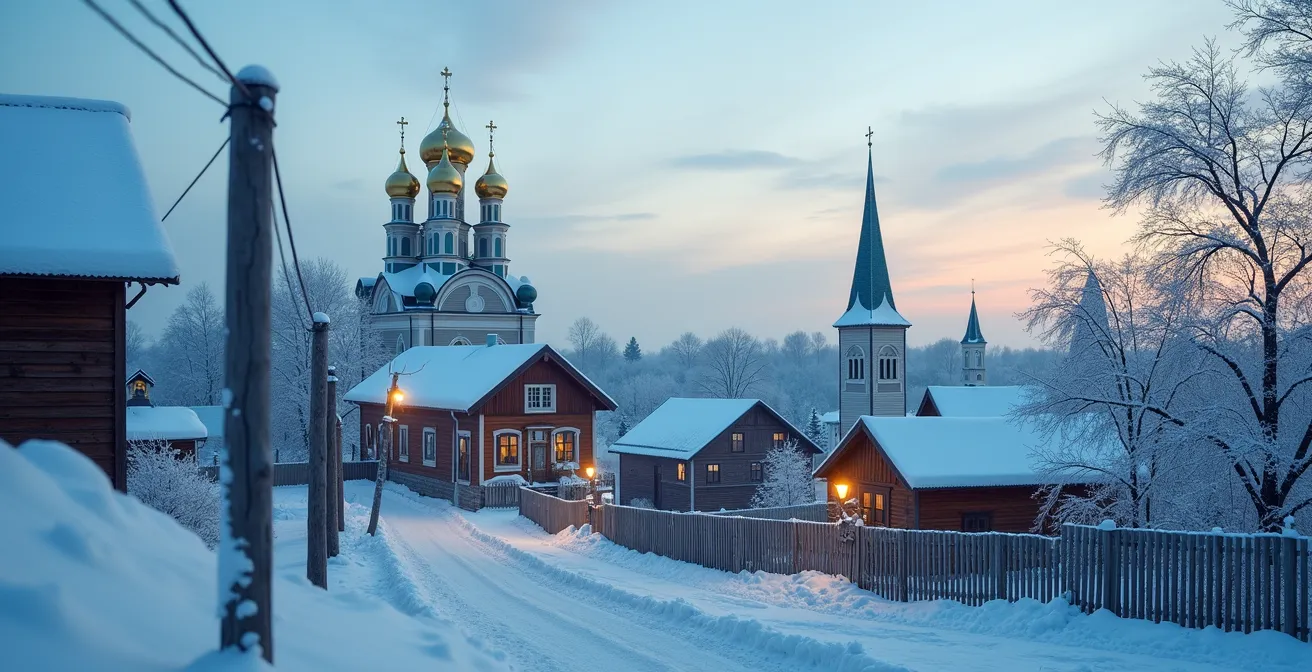
A 2-day Golden Ring trip offers a high return on authenticity, but only if you meticulously plan logistics to minimize costs and what can be called “logistical friction.”
- Suzdal offers a more rustic, genuinely immersive experience compared to the more accessible but conventional Sergiev Posad.
- Self-guided travel using the train-to-bus route is significantly cheaper than private tours, maximizing your value-per-euro and keeping the trip under budget.
Recommendation: For a trip under €200, prioritize Suzdal via the Vladimir train-and-bus connection and use simple communication hacks to overcome the language barrier effectively.
Standing in Moscow’s Red Square, surrounded by the Kremlin’s imposing walls and the vibrant domes of St. Basil’s, a traveler often wonders: Is this the full picture, or does the ‘real’ Russia lie beyond the capital’s ring road? The common advice is to “just hop on a train” to the Golden Ring, a collection of ancient towns fabled for their monasteries, idyllic countryside, and onion-domed churches that seem to have sprung from a fairytale.
This idyllic vision, however, raises critical questions for the pragmatic traveler. With a tight budget of around €200 and only two days to spare, is the journey a sound investment of time and money? The internet is filled with platitudes about “stepping back in time,” but offers little in the way of a concrete cost-benefit analysis. Is the experience gained truly worth the travel hassle, the expense, and the potential language barriers?
This is not just another travel guide; it is a logistical and value-focused assessment. We will move beyond the postcards to analyze whether a two-day, €200 Golden Ring trip offers a genuine return on investment. Instead of simply listing sights, we will break down the operational challenges, evaluate the “authenticity index” of key towns, and provide a clear framework to help you decide if this classic Russian side trip truly aligns with your travel goals and budget.
This article provides a detailed breakdown of the key factors for your decision. We will analyze transport options, compare the primary destinations, offer survival strategies for navigating the provinces, and delve into the history that gives these sites their true value.
Summary: A Cost-Benefit Analysis of the Golden Ring
- Train or Private Driver: What is the best way to reach Suzdal in winter?
- Suzdal or Sergiev Posad: Which town offers the most authentic experience?
- How to survive in the Russian provinces without speaking a word of Russian?
- Why is Sergiev Posad considered the “Vatican of Russian Orthodoxy”?
- Where to find authentic mead and pastries in Suzdal for under €10?
- The Church of the Ascension: The prototype that inspired Ivan’s architects
- Belorusskaya Station: How to transfer from train to metro without stairs?
- Why are Moscow’s cathedral domes shaped like onions?
Train or Private Driver: What Is the Best Way to Reach Suzdal in Winter?
The first variable in your cost-benefit analysis is transportation. Reaching Suzdal, a town with no railway station, involves a multi-step journey from Moscow that presents a clear trade-off between cost and convenience. Your choice here will significantly impact your €200 budget. The most cost-effective method involves a combination of train and bus, but it introduces what we can call logistical friction—the hassle of connections, ticket purchases, and navigating unfamiliar stations.
The primary route is a high-speed train from Moscow’s Kursky Station to the nearby city of Vladimir, followed by a short bus or taxi ride to Suzdal. A private taxi for the entire journey is an option, but its cost can consume a large portion of your two-day budget. For the truly budget-conscious traveler seeking a more local flavor, the slower ‘elektrichka’ suburban train offers the lowest price point at the expense of time. Winter conditions add another layer of complexity, making smooth transfers and warm transport a priority. The key is to weigh the monetary savings against the time and energy spent on navigating these connections.
Here is a breakdown of the primary options:
- High-Speed Train & Bus (Best Value): Take a modern Lastochka, Sapsan, or Strizh train from Moscow’s Kursky Station to Vladimir. The journey takes under two hours. From Vladimir’s station, cross the road to the bus terminal for a 30-40 minute ride to Suzdal. This is the most balanced option for cost and speed.
- Taxi from Vladimir (Convenience): After arriving in Vladimir by train, a taxi transfer directly to your accommodation in Suzdal costs around €48 for a car that fits up to 4 passengers, eliminating the final bus leg.
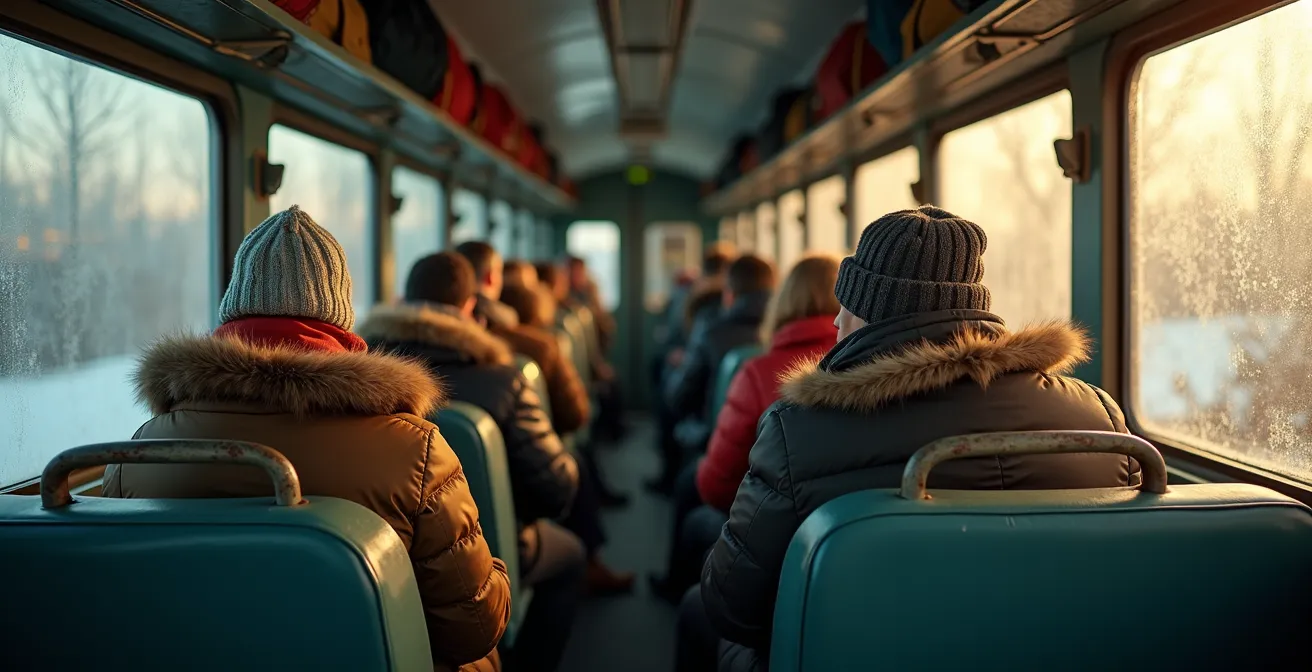
- ‘Elektrichka’ (Budget & Authentic): For a truly local experience, the suburban ‘elektrichka’ train to Vladimir takes around 3 hours but costs a fraction of the high-speed options. It provides an unpolished glimpse into everyday Russian life.
This photo captures the atmosphere inside a typical Russian ‘elektrichka’ during winter, the most budget-friendly and arguably most authentic way to travel between provincial towns.
Ultimately, the “best” way is subjective. The train-and-bus combo maximizes the value-per-euro for your €200 budget, while the taxi option buys you convenience and reduces logistical friction, a worthwhile luxury in the cold Russian winter.
Suzdal or Sergiev Posad: Which Town Offers the Most Authentic Experience?
With limited time, you’ll likely have to choose between the two most popular Golden Ring destinations: Sergiev Posad and Suzdal. This choice is pivotal to the ROI of your trip. Sergiev Posad is closer to Moscow and easier to reach, but the consensus among seasoned travelers suggests that Suzdal delivers a higher return on authenticity. We can evaluate this using an “Authenticity Index,” considering factors like historical preservation, commercialization, and overall atmosphere.
Sergiev Posad is dominated by its single, massive attraction: the Trinity Lavra of St. Sergius. While historically immense, the town itself is often described as nondescript. Suzdal, by contrast, is a living museum. It’s a town where medieval monuments are not just isolated attractions but are woven into the fabric of a rustic, rural landscape. There are no tall buildings, no railway station, and life moves at a slower pace. This lack of modern intrusion is precisely what gives Suzdal its high authenticity score.
This sentiment is echoed by travelers who have visited both. As one visitor from San Francisco noted on TripAdvisor, this contrast is stark:
SP has a pretty standard Russian monastery stuck in a so-so town. But it’s accessible. I’ll prefer Suzdal no question.
– A traveler from San Francisco, TripAdvisor
Another visitor confirmed the unique appeal of Suzdal’s environment, recommending an overnight stay to fully absorb its character. The “rustic, country atmosphere combined with its medieval monuments” makes it the clear winner for those seeking an escape from urban reality. From a value perspective, the extra logistical effort to reach Suzdal pays dividends in the form of a more memorable and genuine experience.
How to Survive in the Russian Provinces Without Speaking a Word of Russian?
The language barrier is a significant source of potential “logistical friction” and can seem daunting. In Moscow, English is increasingly common in the tourist sector. In provincial towns like Suzdal, this is not the case. However, navigating the experience without speaking Russian is entirely achievable with a strategic approach. The key is not to attempt fluency but to master a few simple, effective communication hacks. This is less about language learning and more about practical problem-solving to ensure your trip stays on track and on budget.
Russian railway staff and locals are generally helpful, especially when they see a foreign traveler making an effort. A smile, a clear destination written down, and a bit of patience go a long way. Modern technology is your greatest ally, but relying on it completely can be a mistake due to potentially spotty connectivity outside major cities. Therefore, a hybrid approach of digital tools and old-school preparation is the most effective strategy. By focusing on simple, visual communication and understanding the basic logic of Russian transport systems, you can navigate with confidence.
The following checklist provides a framework for overcoming the language barrier efficiently, turning a potential stressor into a manageable part of the adventure.
Action Plan: Navigating Provincial Russia Without the Language
- Master Cyrillic Place Names: Don’t try to learn the whole alphabet. Focus on the first 2-3 Cyrillic letters of your key destinations (e.g., Suzdal is СУЗДАЛЬ, so look for ‘СУЗ’). This makes reading station signboards manageable.
- Use Visual Aids: Always have your ticket, a map, or your destination written in Cyrillic on your phone or paper. Pointing to it is a universal language that station staff will understand immediately.
- Leverage Offline Technology: Before leaving Moscow’s reliable Wi-Fi, download offline maps (Google Maps) and a translation app with an offline dictionary. This is your safety net when connectivity is limited.
- Understand Timetable Logic: Russian train timetables show both Moscow time and local time. Since 2018, this has been standardized, but always double-check which time is being displayed to avoid confusion.
- Communicate with a Smile: Non-verbal communication is critical. Russian railway staff are often very helpful to polite, smiling travelers who are visibly trying to navigate the system.
This strategic approach turns the language barrier from an obstacle into a simple logistical task to be managed, preserving your energy and budget for the experience itself.
Why Is Sergiev Posad Considered the “Vatican of Russian Orthodoxy”?
While Suzdal may win on atmospheric authenticity, Sergiev Posad’s value lies in its immense historical and spiritual gravitas. Understanding why it’s called the “Vatican of Russian Orthodoxy” is key to appreciating the ROI of a visit. The title isn’t just hyperbole; it reflects the town’s role as the undisputed spiritual center of the Russian Orthodox Church for centuries. A trip here is less about rustic charm and more about witnessing the heart of a nation’s faith.
The entire town revolves around the Trinity Lavra of St. Sergius, a massive fortified monastery that is a UNESCO World Heritage site. It’s not just a single church but a complex of over 50 buildings constructed over centuries by Russia’s finest craftsmen. Its significance is both spiritual and political. It has served as a military fortress, a center of resistance, and the temporary residence of the Patriarch of Moscow and All Russia, the head of the church. Unlike many other religious sites that were destroyed during the Soviet era, the Lavra was preserved, cementing its status as the enduring soul of Russian Orthodoxy. To visit Sergiev Posad is to understand the resilience and centrality of the church in Russian history.
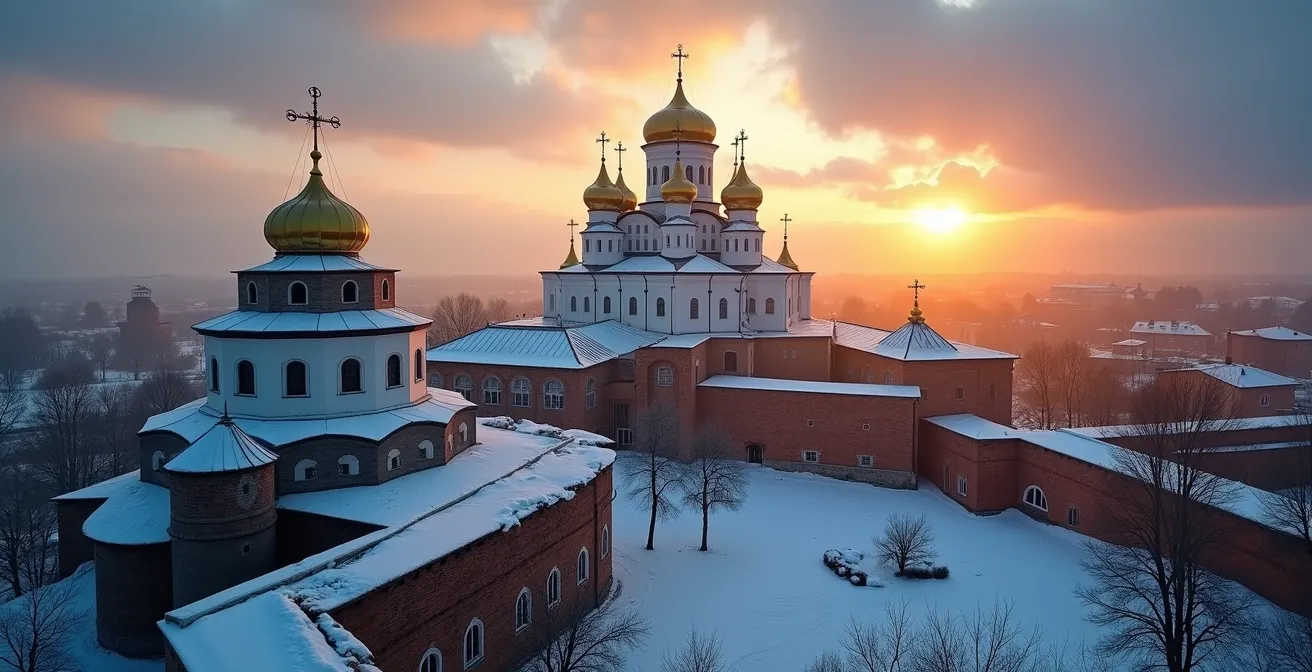
The immense scale and historical weight of the monastery are what justify a trip, offering a different kind of value than Suzdal’s quaintness.
Case Study: The Trinity Lavra of St. Sergius
Founded in 1340 by Sergius of Radonezh, the Trinity Lavra serves as the spiritual headquarters of the Russian Orthodox Church. The complex houses a history and art museum with a collection of over 120,000 items, including priceless ancient icons, medieval manuscripts, and church artifacts from the 14th to 17th centuries. Its inclusion on the UNESCO World Heritage list in 1993 recognized its outstanding architectural ensemble and its role as a pivotal center of Russian spiritual and political life for over 600 years.
For travelers interested in history, religion, and politics, the “value” of visiting Sergiev Posad is exceptionally high, making the easy day trip from Moscow a very efficient use of time and money.
Where to Find Authentic Mead and Pastries in Suzdal for Under €10?
A key part of experiencing Suzdal’s authenticity is tasting its local specialties, and doing so on a budget is central to our €200 challenge. The town is famous for medovukha, a honey-based alcoholic beverage that is an integral part of its identity. Finding authentic, well-priced food and drink here means avoiding the most obvious tourist traps and heading to the places where locals and savvy visitors congregate. For under €10, you can easily sample the town’s signature drink and enjoy a hearty snack.
The heart of this budget-friendly culinary exploration is the Torgovaya Ploschad (Trade Square), home to the 19th-century Trading Arcades and a bustling souvenir market. Here, you’ll find numerous vendors offering medovukha in a variety of flavors. As the Rusmania travel guide explains in its feature, “Day trip to Suzdal from Moscow”:
Suzdal is famous for its medovukha (mead) which is an alcoholic drink made out of honey. It can be drunk either hot or cold, meaning it perfect in both summer and winter, and you will find it on practically every menu in the city.
– Rusmania Travel Guide, Day trip to Suzdal from Moscow
Beyond medovukha, look for local canteens, known as ‘stolovayas’, for simple, cheap, and filling meals. These are often located near the main squares but away from the primary tourist-facing restaurants. Exploring the market stalls and arcades not only provides cheap eats but also a chance to discover other local delicacies like cucumber jam and pickled mushrooms. This approach delivers maximum cultural value for a minimal cost. Here’s a quick guide to finding Suzdal’s local specialties on a budget:
- Visit the souvenir market on Torgovaya Ploschad to sample medovukha from various vendors.
- Try both the hot version (perfect for winter) and the cold version of the mead.
- For a cheap meal, seek out a ‘stolovaya’ (canteen) near the Trading Arcades.
- Ask local vendors selling handmade goods like ‘valenki’ (felt boots) for their recommendations on the best food spots.
- Explore the pillared Trading Arcades (built 1806-1811), which house several reasonably priced cafes.
The Church of the Ascension: The Prototype That Inspired Ivan’s Architects
Part of the “value” of a Golden Ring trip is intellectual; it’s about understanding what you are seeing. The architecture of this region is not just beautiful, it’s a history book written in stone and brick. The towns of the Golden Ring, particularly the older ones like Vladimir, served as the architectural laboratory for what would become the iconic Russian style. The Church of the Ascension in Kolomenskoye (Moscow), with its famous tent-roof, was not born in a vacuum. It was the culmination of ideas developed centuries earlier.
The city of Vladimir, founded in 1108 and a mandatory stop on the way to Suzdal, was once the capital of ancient Rus. Its 12th-century monuments are crucial prototypes. According to an analysis of the region’s architectural evolution, landmarks like the Dormition Cathedral and the Golden Gates in Vladimir are now protected as UNESCO World Heritage sites precisely because they represent the transition from Byzantine-influenced designs to a uniquely Russian style. It was here that builders mastered stone construction and developed the forms that would later be adopted and elaborated upon by Muscovite rulers.
When Ivan the Terrible’s architects designed churches, they drew upon this established vocabulary. The distinctive tent-roof design, which became a hallmark of Russian Orthodox architecture, was an evolution of the principles of verticality and structural innovation first tested in places like Vladimir. Therefore, a visit to Vladimir and Suzdal is not just a tour of individual churches; it’s a journey through the timeline of an architectural language, from its early drafts to its most famous expressions. This understanding adds a profound layer of value to what might otherwise be just a collection of pretty buildings.
Belorusskaya Station: How to Transfer From Train to Metro Without Stairs?
Logistical precision is paramount for a successful, low-stress trip. A common point of confusion for travelers planning their Golden Ring excursion from Moscow is the departure station. While Belorusskaya Station is a major hub, especially for airport connections, it is not the correct departure point for this journey. Addressing this misconception is a critical piece of practical advice that can save a traveler significant time and stress.
The question of stair-free transfers at Belorusskaya is, therefore, irrelevant to this specific itinerary. The crucial piece of information that every traveler must know is a simple, verifiable fact. According to official railway information, all trains from Moscow to Golden Ring cities like Vladimir and Sergiev Posad depart from a different station entirely: Yaroslavsky Station. This station is part of a major transport nexus in Moscow known as Komsomolskaya Square, which also includes Leningradsky and Kazansky stations, and is served by the Komsomolskaya metro station on both the Circle and Red lines.
Focusing your planning on Yaroslavsky Station is essential. This is where you will buy tickets (if not purchased online), find your platform, and begin your journey. Any time spent researching the layout of Belorusskaya for this trip is wasted. Correcting this single piece of information provides immense practical value, preventing a catastrophic planning error that could derail your entire two-day excursion before it even begins. Your logistical analysis must start with the right departure point.
Key Takeaways
- Value vs. Convenience: Suzdal offers higher authenticity, while Sergiev Posad provides historical weight with less travel complexity.
- Cost Control is Key: The self-guided train/bus combination is the only way to realistically stay under a €200 budget for two days.
- Knowledge is Value: Understanding the symbolism of the architecture and the history of the sites transforms the trip from sightseeing into a meaningful cultural experience.
Why Are Moscow’s Cathedral Domes Shaped Like Onions?
The final, and perhaps most enduring, “return on investment” from a Golden Ring trip is understanding the iconic symbols of Russia. The onion dome is the most recognizable feature of Russian church architecture, yet its meaning is widely misunderstood. The common explanation that the shape is designed to shed snow is a practical but incorrect assumption. The true meaning is deeply symbolic and spiritual, and grasping it enriches the viewing experience immeasurably.
The onion-shaped domes are intended to represent the flame of a candle, symbolizing prayer rising up to heaven. This powerful metaphor transforms the skyline of towns like Suzdal and Moscow into a collective expression of faith. A detailed study of the symbolism of Russian dome architecture reveals that the colors are also part of this religious language. This color-coding is rooted in Orthodox theology:
- Gold domes represent divine glory and Jesus Christ. They are typically used for the most important cathedrals.
- Blue domes, often adorned with stars, signify the Virgin Mary and are associated with churches dedicated to her.
- Green domes represent the Holy Spirit and the Holy Trinity.
The Cathedral of the Nativity in Suzdal’s Kremlin is a perfect example, with its vibrant blue domes dotted with golden stars. This is not a random aesthetic choice; it is a declaration of the cathedral’s dedication to the Mother of God. Understanding this symbolism allows the traveler to read the spiritual and architectural landscape, turning a passive viewing into an active interpretation of a rich cultural text. This knowledge is the lasting value you take home, long after the trip is over.
So, is the trip worth €200? The answer is a clear “yes,” but with a crucial condition: it is worth it for the traveler who acts as their own logistics expert. By strategically choosing Suzdal for authenticity, mastering the train-and-bus route to control costs, and investing a little time to understand the profound history and symbolism of the sites, you transform a simple excursion into a high-value cultural and intellectual experience. To make your own value-based decision, the next logical step is to start mapping your preferred itinerary using these logistical frameworks.