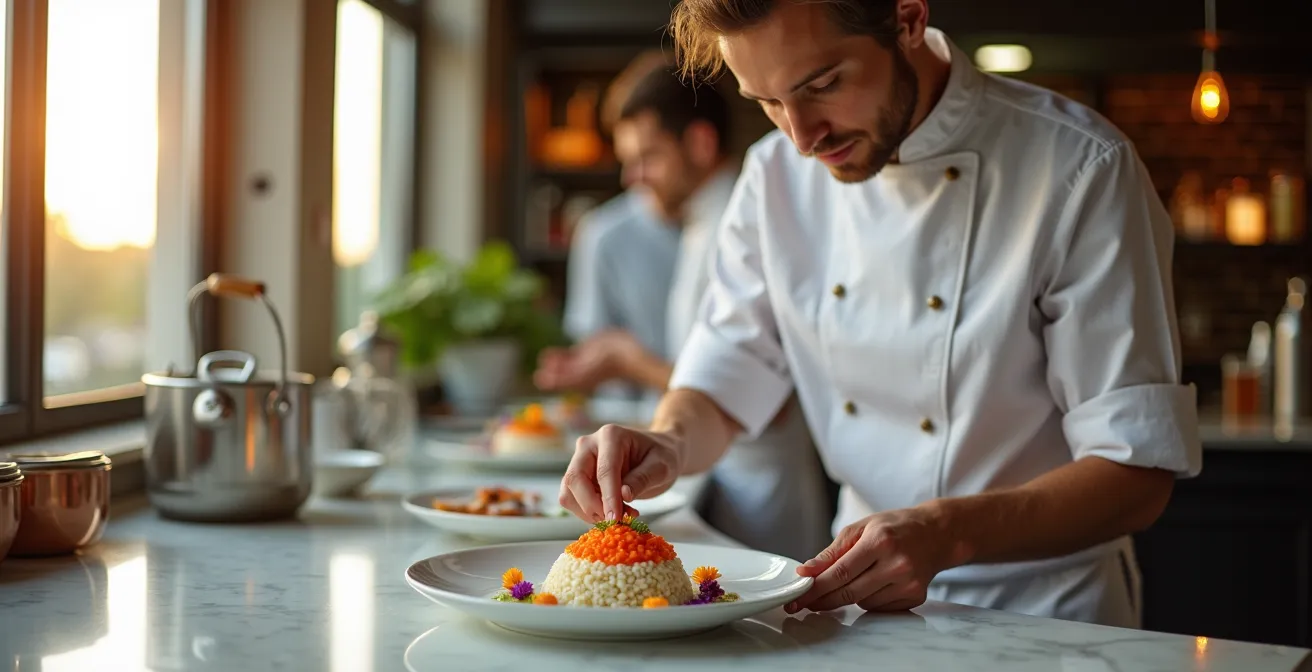
Moscow’s culinary scene is no longer about imitating the West; it’s a product-driven revolution offering gastronomic experiences that rival Europe’s best, often at a fraction of the price.
- Hyperlocal ingredients like Murmansk sea urchins and Siberian fish are the new stars, delivering superior freshness and value compared to Parisian markets.
- A new generation of sommeliers champions exceptional Russian wines from regions like Krasnodar, providing perfect pairings for modern Russian cuisine.
Recommendation: For a true taste, look beyond the grand palaces to the chef-driven restaurants and embrace the ‘biznes-lanch’ for incredible fine dining deals.
For the discerning French palate, the term “Russian cuisine” often conjures images of hearty, rustic fare: borscht, pelmeni, and generous servings of vodka. The fine dining scene, in turn, is frequently perceived through the lens of opulent, gilded palaces—magnificent to behold, but perhaps suspected of prioritizing spectacle over substance, often by replicating French culinary traditions. This perception, while rooted in a certain historical reality, overlooks the profound transformation currently sweeping through Moscow’s kitchens. A new gastronomic identity is emerging, one that speaks a language any true gourmet will understand: the language of the product.
The real story of modern Russian gastronomy is not one of imitation, but of reappropriation. Chefs are turning inward, looking to the vast expanse of their own country to unearth ingredients of exceptional quality. Humble staples, long taken for granted, are being re-examined and elevated with modern techniques. The humble buckwheat grain, or *grechka*, once a simple side dish, is now the protagonist in avant-garde creations, its nutty, earthy profile explored in everything from risottos to delicate desserts. This is not about copying France; it is about building a new Russian culinary lexicon based on its own unique, and often surprising, *terroir*.
This shift creates a fascinating value proposition. By shortening supply chains and celebrating local products, from Murmansk’s arctic sea urchins to Krasnodar’s burgeoning vineyards, Moscow’s best restaurants are offering world-class quality at prices that can seem astonishingly reasonable compared to Paris or London. This guide is designed for the curious gourmet, ready to look beyond the clichés and discover the authentic, innovative, and surprisingly accessible luxury of Moscow’s new cuisine.
To navigate this exciting culinary landscape, this article delves into the key experiences that define Moscow’s gastronomic renaissance. From understanding the market dynamics of its seafood to pairing its finest local wines, we will explore where to find both opulence and incredible value.
Summary: How Moscow chefs are transforming buckwheat into a luxury dish?
- Why are Murmansk sea urchins cheaper in Moscow than in Paris?
- Krasnodar wines: Which Russian red pairs best with venison?
- Muksun and Omul: The Siberian fish you have never heard of but must try
- Pushkin or Turandot: Which palace-restaurant has the better food?
- Business Lunch sets: How to eat fine dining for under €15?
- Adjarian vs. Imeretian: Which cheese boat suits your appetite?
- How to taste caviar samples at Danilovsky before buying a tin?
- Is the White Rabbit tasting menu worth the hype and the price?
Why are Murmansk sea urchins cheaper in Moscow than in Paris?
The concept of “accessible luxury” is perhaps best demonstrated by one of the ocean’s most prized delicacies: the sea urchin. While a plate of fresh *oursins* in a Parisian bistro is a celebrated indulgence, Moscow’s restaurants offer them with a freshness and at a price point that can seem bewildering. The answer lies not in a difference in quality, but in superior logistics and a commitment to a hyperlocal supply chain. Murmansk, a port city on the Barents Sea, provides a direct, rapid supply of arctic sea life to the capital.
This removes the costly and time-consuming international distribution networks, like the Rungis market that supplies much of Paris. By sourcing directly, Moscow chefs get unparalleled access to pristine product, passing the savings on to the consumer. This principle extends beyond urchins; a Russian food guide notes there can be up to 50% savings on premium Ossetra and Beluga caviar at Moscow markets compared to their Parisian counterparts. The result is a unique opportunity to savour premium seafood without the expected premium price tag.
This table, based on recent market analysis, illustrates the significant price advantage driven by Moscow’s direct sourcing model compared to the traditional European distribution system.
| Location | Price Range (per kg) | Market Type |
|---|---|---|
| Moscow Markets | $4.85 – $13.85 | Direct from Murmansk |
| French Markets | Higher premium | Via Rungis distribution |
| Export from Russia | $27.31m (2019 total) | Growing 16% annually |
The freshness is palpable. The urchins arrive brimming with the cold, briny flavour of the Arctic—a testament to the product-driven revolution defining the city’s food scene. This isn’t just about being cheaper; it’s about a fundamentally different, more direct relationship between the producer and the chef.
Krasnodar wines: Which Russian red pairs best with venison?
For decades, the notion of Russian wine was met with skepticism by international connoisseurs. That era is definitively over. The Krasnodar region, near the Black Sea, has emerged as Russia’s answer to Bordeaux or the Rhône Valley, producing wines of increasing complexity and character. A new generation of sommeliers is championing these local gems, building wine lists that celebrate Russia’s own gastronomic terroir rather than just importing foreign labels. When faced with a rich, gamey dish like venison, these sommeliers are increasingly turning to native grape varieties.
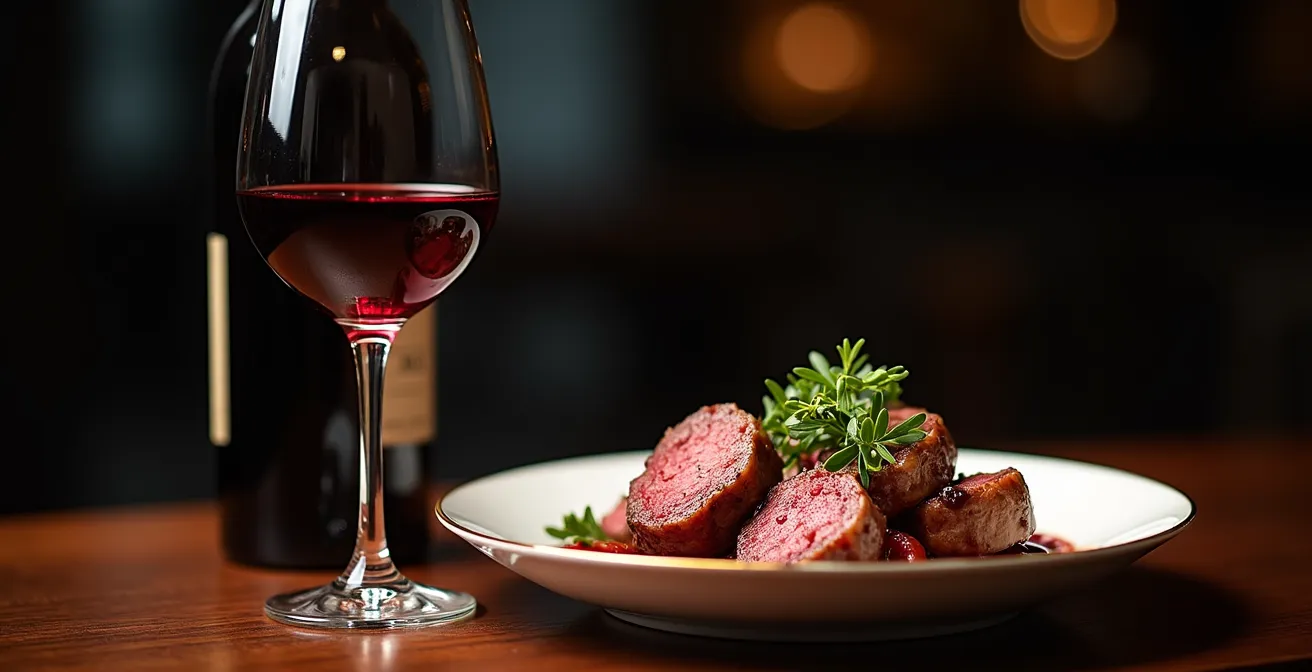
The star grape is often Krasnostop Zolotovsky, a native variety that produces deep, structured red wines with notes of dark fruit, spice, and a distinctively earthy character. A Moscow-based sommelier offers a perfect comparison for the French palate:
Think of Krasnostop Zolotovsky as a rustic cousin to Syrah from the Northern Rhône, with the structure to handle game.
– Moscow Sommelier, Expert recommendation for French wine lovers
For those seeking a more familiar profile, estates like Sikory are producing excellent Cabernet Sauvignon that rivals quality Bordeaux blends. A great way to explore this is to ask the sommelier for a comparative tasting: a glass of a Russian-grown international variety next to a native one like Saperavi or Krasnostop. This dialogue in the glass—between the global and the local—is a perfect reflection of Moscow’s modern culinary identity.
Muksun and Omul: The Siberian fish you have never heard of but must try
Beyond the arctic bounty of Murmansk lies another of Russia’s great culinary frontiers: the vast, icy rivers and lakes of Siberia. This region is home to unique species of fish that are virtually unknown in the West but are revered by Russian chefs for their delicate flavour and texture. Among the most prized are muksun and omul, both members of the whitefish family, famed for their fatty, almost translucent flesh that melts in the mouth. These are not farmed fish; they are wild-caught delicacies that embody the pristine nature of their origin.
Finding these fish is an experience in itself, as they represent a form of exclusive, protected gastronomy. Their fishing is often regulated, requiring special permits, which makes their presence on a Moscow menu a statement of both quality and connection. This rarity and regional specificity create a powerful parallel to certain protected French delicacies.
Case Study: Beluga Restaurant’s Siberian Exclusives
Located in the historic National Hotel with views of the Kremlin, Beluga restaurant has built its reputation on showcasing Russia’s finest seafood. Alongside premium caviar and giant oysters, its menu features rare Siberian fish like muksun. The sourcing of these protected species is a complex affair, making them exclusive delicacies. In terms of rarity and the reverence they inspire, they can be compared to the experience of tasting pibales (glass eels) in the Spanish Basque Country or a freshly caught *lotte* from a small Breton fisherman.
Typically served lightly salted (*malossol*), smoked, or as part of a *stroganina* platter (thinly shaved frozen raw fish), muksun and omul offer a taste that is subtle, clean, and deeply evocative of Siberia’s wild landscape. This is the epitome of the product-driven philosophy: a simple preparation that allows an extraordinary ingredient to shine.
Pushkin or Turandot: Which palace-restaurant has the better food?
No gastronomic tour of Moscow is complete without experiencing one of its “palace-restaurants.” These establishments are famous for their jaw-dropping interiors, where dining becomes a theatrical event. The two undisputed titans in this category are Café Pushkin and Turandot. For the first-time visitor, the choice can be daunting, as both promise an unforgettable evening. However, their culinary philosophies are worlds apart, and the decision ultimately depends on the type of experience you seek: historical immersion or fantastical opulence.

Café Pushkin is a masterfully executed fantasy of a 19th-century Russian nobleman’s mansion. Every detail, from the antique-filled “Library” dining room to the starched uniforms of the staff, is designed to transport you back in time. The cuisine reflects this, offering a refined take on historic Franco-Russian dishes—a culinary dialogue that began with chefs like Marie-Antoine Carême. It is the place for a perfectly executed Beef Stroganoff or a classic Pozharsky cutlet. Turandot, on the other hand, is pure, unadulterated spectacle. The result of a reported $50 million investment, its interior is a breathtaking fusion of Versailles-style grandeur and Chinoiserie motifs. The food follows suit, leaving behind Russian tradition for an inventive Pan-Asian fusion menu.
This comparative table breaks down the essential differences between the two iconic venues, helping you decide which palace is right for your palate.
| Aspect | Pushkin | Turandot |
|---|---|---|
| Style | 19th-century noble mansion fantasy | Versailles-meets-Chinoiserie opera set |
| Cuisine | Historical Franco-Russian (Carême influence) | Pan-Asian fusion |
| Investment | Historic restoration | $40-50 million construction |
| Service | Imperial theatre performance | Grand theatrical spectacle |
| Best For | A traditional Russian-French experience | An opulent Asian fusion adventure |
Ultimately, there is no wrong choice, only a different one. Pushkin is an education in culinary history, while Turandot is a feast for the senses. For the better “food” in the traditional sense, Pushkin’s focus on classic Russian cuisine is arguably more authentic to the setting, but Turandot’s adventurous menu provides its own kind of thrill.
Business Lunch sets: How to eat fine dining for under €15?
While Moscow boasts some of the world’s most lavish restaurants, it also holds a secret that is a dream for any food-loving traveler on a budget: the “biznes-lanch.” This is far more than the French *formule déjeuner*; it is a cultural institution. On weekdays, typically between noon and 4 PM, a vast number of restaurants—including many high-end and even Michelin-recommended venues—offer set three-course menus at astonishingly low prices. This is not a “lesser” menu, but often features the same high-quality dishes served in the evening, simply in a set format.
The value proposition is remarkable. It is entirely possible to enjoy a starter, main course, and dessert in an elegant setting for a price that would barely cover a main dish in a comparable Parisian establishment. Moscow dining guides report that it is common to find deals for as little as €10 for a full three-course meal at upscale restaurants. This tradition allows locals to enjoy the city’s best kitchens regularly and provides an unparalleled opportunity for visitors to sample fine dining without the financial commitment of an evening reservation.
To make the most of this local “bon plan,” a few simple strategies can help you navigate the options and maximize the value of your midday meal.
Your action plan: Mastering the Moscow business lunch
- Visit between 12:00 and 16:00 on weekdays to find business lunch offerings.
- Look for signs or menu sections advertising ‘biznes-lanch’ (бизнес-ланч) at high-end restaurants.
- Expect a 3-course structure: a salad or soup, a main course with a side dish, and a drink (often *kompot*, a traditional fruit drink).
- Compare with evening prices: the same dishes can cost over 50% more after 16:00.
- Note that some French-style restaurants may offer a simple 15% discount on their à la carte menu for lunch instead of a separate set menu.
Embracing the business lunch is the single best way to explore Moscow’s diverse and high-quality food scene affordably. It democratizes fine dining and turns a simple lunch into a gastronomic discovery.
Adjarian vs. Imeretian: Which cheese boat suits your appetite?
Moscow’s culinary diversity extends far beyond Russian cuisine, and its most beloved adopted food culture is undoubtedly Georgian. The city is filled with exceptional Georgian restaurants, from bustling market stalls to elegant dining rooms in the trendy Patriarch Ponds district. Central to any Georgian meal is *khachapuri*, the iconic cheese-filled bread. However, not all khachapuri are created equal. The two most famous styles, Adjarian and Imeretian, offer vastly different experiences, and choosing the right one depends entirely on your appetite and mood.
The Imeretian khachapuri is a round, enclosed pie, filled with soft, slightly salty Imeretian or sulguni cheese. It’s savoury, shareable, and serves as a perfect appetizer for the table, much like a *pissaladière* or a cheese-topped *focaccia*. The Adjarian khachapuri, however, is a showstopper. Shaped like a boat, the bread cradles a pool of molten sulguni cheese, which is topped with a raw egg yolk and a pat of butter just before serving. The ritual involves stirring the egg and butter into the hot cheese to create a gloriously rich, gooey fondue, which you eat by tearing off pieces of the crusty bread boat for dipping.
For a French cheese lover, the appeal of the Adjarian style is immediate and deeply resonant. As one French food critic in Moscow described it:
The Adjarian khachapuri, with its molten sulguni cheese and runny egg yolk, is the ultimate comfort food for anyone who loves a gooey Mont d’Or or tartiflette.
– French food critic in Moscow, Comparative culinary guide
For an authentic experience, head to a restaurant like Kazbek, which is renowned for its traditional preparations. Choose Imeretian for a polite starter and Adjarian for a decadent, interactive main course that is an experience in itself.
How to taste caviar samples at Danilovsky before buying a tin?
For many gourmets, a trip to Russia is synonymous with caviar, and Moscow’s markets offer the chance to buy this luxury product at its source. Danilovsky Market, a modern food hall bustling with high-quality vendors, is a prime destination. However, faced with numerous sellers and varieties like Beluga, Ossetra, and Sevruga, making a choice can be intimidating. The key is to embrace the local custom of tasting before buying, a process that is both expected and surprisingly straightforward.
First, don’t be shy. Approaching a vendor and asking for a ‘proba’ (a taste) is standard practice. The traditional method for tasting is not with a blini or a spoon, but directly from the back of your hand, between the thumb and index finger. This allows the warmth of your skin to slightly heat the caviar, releasing its full aromatic complexity without any interference from other flavours. This lets you judge the pure quality: the pop of the eggs, the level of saltiness, and the nutty or buttery finish. This direct approach allows for an objective comparison and highlights the fact that in Moscow, caviar is treated as a fresh food product, not just a rarefied luxury.
The financial incentive is significant. Market price comparisons show that you can achieve 50% savings on premium Ossetra and Beluga versus Petrossian Paris. For a French traveller planning to bring some home, a few practical tips are essential. Always look for the CITES label on the tin, which certifies it as legally farmed and is crucial for customs. Remember the personal import limit into the EU, which is 125 grams per person. Keeping your receipt will ensure a smooth passage through customs at airports like Charles de Gaulle.
Key takeaways
- Moscow’s fine dining is defined by a “product-driven revolution,” focusing on high-quality, hyperlocal Russian ingredients over foreign imports.
- There is an exceptional value proposition (“accessible luxury”) in Moscow, with items like sea urchins and caviar available at significantly lower prices than in Paris due to direct supply chains.
- The culinary scene offers a rich diversity, from the rediscovered traditions of modern Russian chefs to the beloved adopted cuisines like Georgian khachapuri.
Is the White Rabbit tasting menu worth the hype and the price?
At the pinnacle of Moscow’s gastronomic revolution stands White Rabbit. Perched under a glass dome on the 16th floor of a skyscraper, the restaurant offers breathtaking panoramic views of the city. But it is the vision of its chef, Vladimir Mukhin, that has cemented its place on the global culinary map. For the international gourmet, whose approval is often measured in stars and rankings, White Rabbit speaks a familiar language of excellence. It is not just one of Moscow’s best restaurants; it is one of the world’s best.
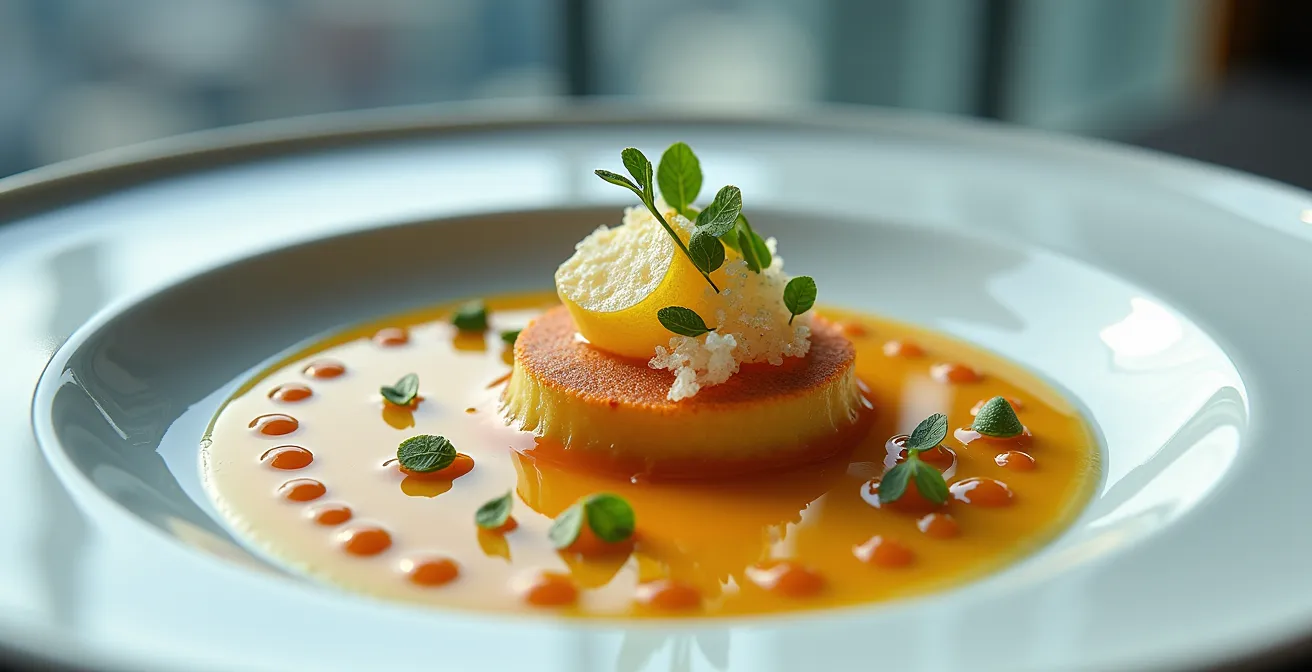
The hype is backed by serious credentials. White Rabbit was awarded a Michelin star in the inaugural 2021 Moscow guide and has been a consistent fixture in The World’s 50 Best Restaurants list, climbing as high as 13th place. Chef Mukhin’s philosophy is the perfect embodiment of the new Russian cuisine: a deep respect for historical recipes and native ingredients, reinterpreted through an avant-garde lens. His tasting menus are a journey across Russia, showcasing products from Black Sea oysters to Sakhalin shrimps.
The White Rabbit Experience: Beyond the Plate
A meal at White Rabbit is more than just dinner; it is a narrative. Each dish on the tasting menu tells a story about a specific Russian region or a forgotten 19th-century recipe. This is where humble ingredients like buckwheat, celeriac, or swan liver are transformed into intricate, artistic creations. The price is undoubtedly high, comparable to a Michelin-starred experience in any major European capital. However, the question of whether it is “worth it” transcends a simple cost analysis. The price reflects the immense research, rare ingredients, and technical skill on display. It is an investment in experiencing the peak of Russia’s modern culinary identity.
So, is it worth it? For a traveller seeking a comfortable, predictable meal, perhaps not. But for the true gourmet, eager to witness a country’s culinary soul being redefined at the highest level, the answer is an unequivocal yes. It is a destination restaurant that delivers on its promise of innovation and excellence.
Explore Moscow’s culinary landscape with this new perspective, and book a table to experience this gastronomic revolution firsthand.