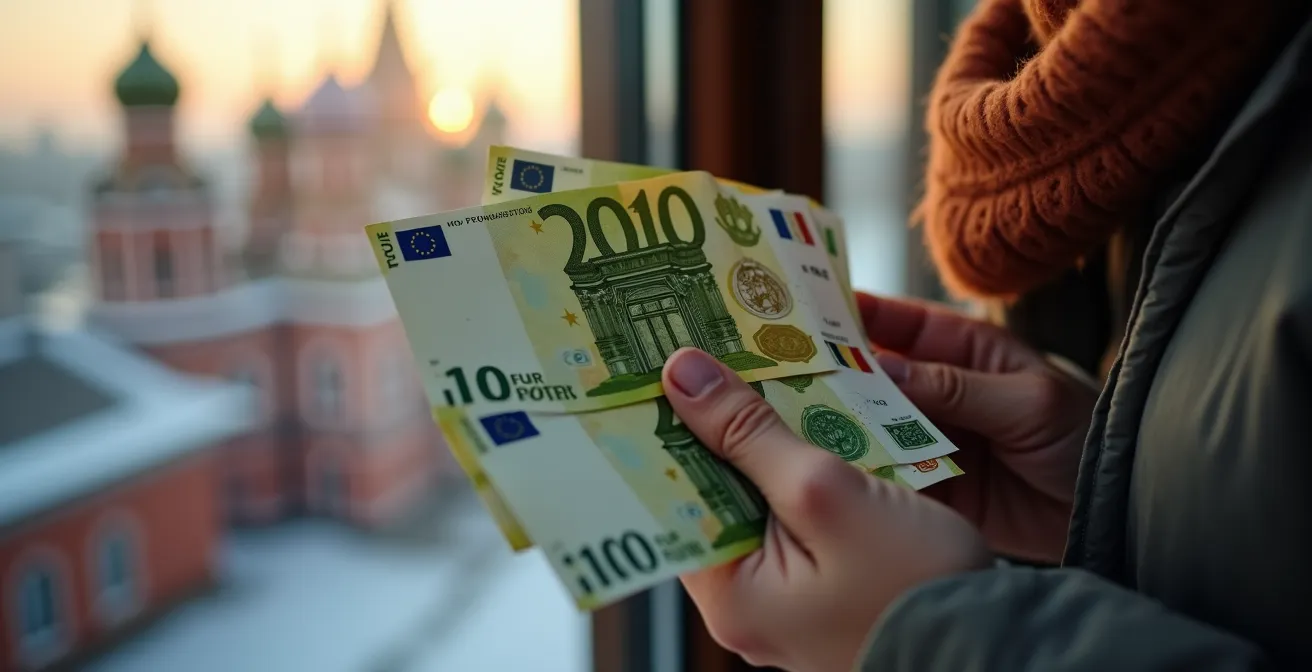
With French-issued bank cards now non-functional in Russia, managing funds has become a critical logistical challenge requiring a robust, cash-centric strategy.
- Pristine Euro banknotes are non-negotiable for successful exchange, as even minor flaws lead to rejection.
- Digital P2P platforms offer an alternative for acquiring Rubles but introduce significant security risks that must be managed.
Recommendation: A multi-layered approach is essential. Combine a primary supply of flawless Euro cash with a clear understanding of local payment systems and digital workarounds to maintain financial liquidity.
For any French traveler, the current financial landscape in Russia presents a stark reality: your trusted Visa or Mastercard, issued by banks like BNP Paribas or Société Générale, is effectively a useless piece of plastic. Since the spring of 2022, the familiar convenience of card payments and ATM withdrawals has vanished, creating significant operational hurdles for tourists. The standard advice to simply “bring cash” is an oversimplification that ignores the nuanced challenges on the ground. This isn’t just about carrying money; it’s about navigating a disconnected system plagued by what can be called ‘financial friction’.
The real difficulties lie in the details that generic advice often misses. How do you exchange Euros for Rubles when banks have surprisingly strict criteria for accepting banknotes? What are the viable digital workarounds, and how do you use them without falling prey to scams? How do you handle everyday micro-transactions, like paying for a Yandex Go ride or buying a souvenir at a flea market, in a cash-only environment? Standard travel preparation is no longer sufficient; a tactical financial plan is now a prerequisite for a smooth trip.
This guide moves beyond the obvious to provide a concrete framework specifically for French travelers. We will dissect the process of exchanging currency, explore the feasibility of alternative card systems, provide a security protocol for using P2P services, and offer practical budgeting and payment advice. The goal is to equip you with the knowledge to overcome these financial frictions and manage your funds with confidence throughout your stay in Russia.
Summary: A French Traveler’s Guide to Managing Money in Russia
- Airport vs. City Bank: Where to get the best Euro-Ruble rate?
- Why do Russian banks reject Euro notes with small tears or ink marks?
- Does a French-issued UnionPay card actually work in Moscow ATMs?
- How to use Telegram wallet P2P to get Rubles in Moscow?
- How much cash in Rubles do you need for a 5-day trip per person?
- Why does Yandex Go reject French cards and how to pay with cash?
- How to tell if that Soviet camera at the flea market is actually working?
- Bargaining at Izmailovo: How to save 30% on souvenirs using Euro cash?
Airport vs. City Bank: Where to get the best Euro-Ruble rate?
The first financial decision you’ll make upon arrival in Russia is where to exchange your Euros for Rubles. The choice between an airport exchange bureau and a city bank has a significant impact on your travel budget. While the convenience of airport kiosks is tempting after a long flight from Paris, they are notorious for offering poor exchange rates. This is a standard travel principle that holds particularly true in Russia’s current economic climate. City-center banks and official exchange bureaus consistently provide more favorable rates, allowing your funds to stretch further.
To put this in perspective, it’s crucial to understand the official baseline. For example, analysis based on official data shows the ruble trading at approximately 109.8 rubles per euro as of late 2024. Airport exchanges will typically offer a rate several points below this benchmark, sometimes with added commission fees, representing an immediate loss on your transaction. Conversely, major banks in downtown Moscow or St. Petersburg will hew much closer to the official rate. Therefore, the most prudent strategy is to exchange only a very small amount at the airport—enough for a taxi or public transport—and wait to exchange the bulk of your cash at a reputable bank in the city.
Before you even leave France, request crisp, new Euro notes from your bank. While some services in the EU, like ExactChange, allow you to acquire Rubles in advance, their rates are generally uncompetitive. The best value is almost always found by exchanging pristine Euros inside Russia, but far from the airport’s captive market. Remember to keep your total cash amount in mind, as there are legal limits to what you can carry without a declaration.
Why do Russian banks reject Euro notes with small tears or ink marks?
One of the most common and frustrating examples of ‘financial friction’ a French traveler will encounter is having their Euro banknotes rejected by a Russian bank. While a small tear, a stray pen mark, or a soft fold might be perfectly acceptable in France, Russian financial institutions operate under extremely strict acceptance standards. This isn’t arbitrary; it’s a measure to combat counterfeiting and ensure the quality of foreign currency reserves. For the unprepared tourist, this can lead to a situation where the cash you brought is effectively worthless for exchange.
Banks and exchange offices in Russia are trained to look for any imperfection. This includes microscopic tears, creases, ink stamps from other banks, or even excessive wear. Sources suggest that Russian banks may reject notes with even a small wrinkle, demanding bills that are crisp and look brand new. This is why it is absolutely imperative to inspect every single Euro note you plan to bring *before* you leave France. Request only the most pristine, new-looking bills from your home bank and handle them with care to avoid any damage during your journey.
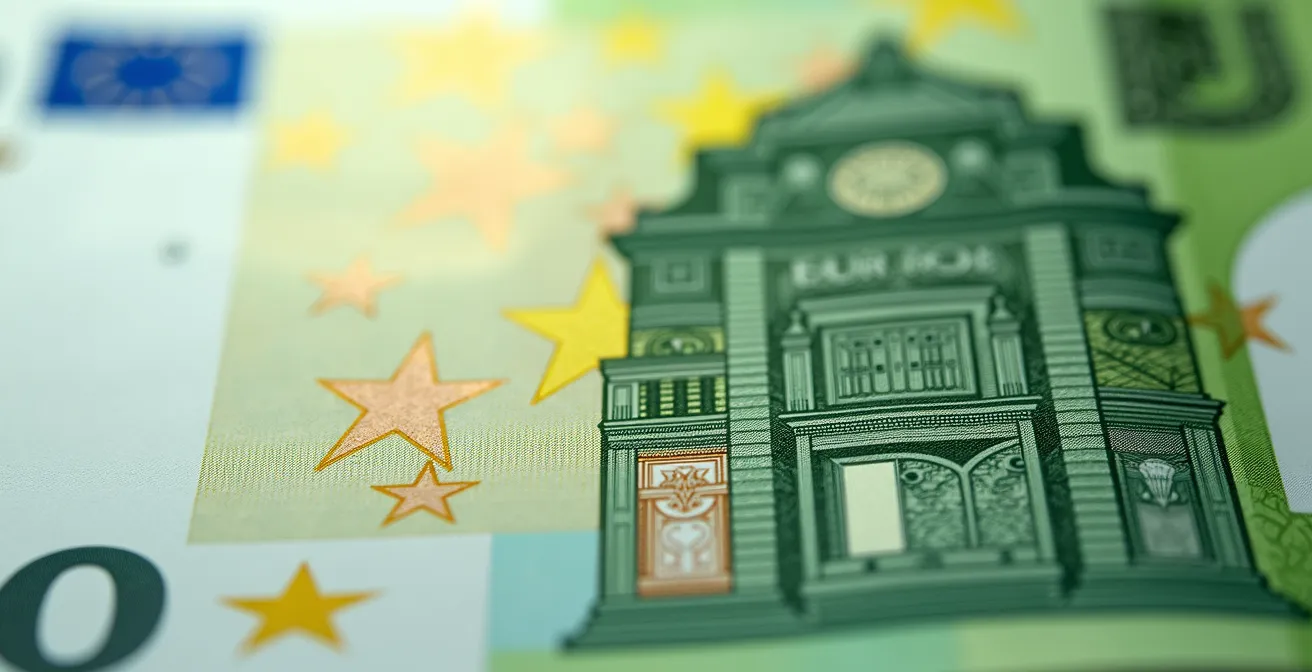
As the image above highlights, the texture and integrity of the banknote paper are paramount. Before attempting an exchange, perform a quick three-point inspection on each bill: check it visually under good light for any marks or scratches, feel for tears or rough patches, and scan for any foreign ink. Any note that appears worn, repaired with tape, or has any writing on it is a candidate for rejection. Bringing only flawless currency is the first step to a successful cash-based trip.
Does a French-issued UnionPay card actually work in Moscow ATMs?
With Visa and Mastercard out of the picture, many travelers look to China’s UnionPay system as a potential solution. In theory, UnionPay cards issued by foreign banks are still accepted at some ATMs and merchants in Russia. However, for a traveler departing from France, this option is largely a dead end. The primary obstacle is availability: currently, no major French retail banks offer UnionPay cards to their individual customers. This means you cannot simply walk into a branch of Société Générale, BNP Paribas, or Crédit Agricole and request one.
While it is technically possible for a French resident to open an account with an online or foreign bank that does issue UnionPay cards, this is a complex and time-consuming process that is not practical for a short-term tourist trip. You would need to navigate the application process, wait for the card to be delivered, and potentially deal with international transfer fees and account management in a foreign system. Furthermore, even if you manage to acquire a UnionPay card, its acceptance within Russia is not guaranteed. While many larger businesses and ATMs in Moscow and St. Petersburg may support it, smaller vendors and businesses in other regions are unlikely to have the necessary infrastructure.
For these reasons, relying on UnionPay as your primary financial tool is an unadvisable strategy. The effort required to obtain a card from France is disproportionate to its limited and uncertain utility on the ground. For short-term stays, the consensus among experienced travelers and financial advisors remains clear: carrying a sufficient amount of cash is the simplest and most reliable method for managing your expenses in Russia. It eliminates the uncertainty of card acceptance and the complexity of acquiring a niche product unavailable in your home country.
How to use Telegram wallet P2P to get Rubles in Moscow?
For the more tech-savvy traveler, peer-to-peer (P2P) exchanges via platforms like the Telegram wallet present a digital workaround to acquire Rubles. These services connect you with local individuals willing to trade digital assets (like cryptocurrency) or a bank transfer in your home currency for physical cash in Rubles. While this can be an effective method, it operates in a grey market and carries significant risks of scams and theft. It should only be considered as a supplementary option and approached with extreme caution.
The process generally involves using a P2P marketplace within the Telegram wallet or similar platforms like YooMoney. You find a seller with a good reputation, agree on an exchange rate (which is often more favorable than official rates), and arrange a meeting. The critical part of this process is the security protocol. Never transfer any funds digitally until you have the physical Ruble cash in your hands and have counted it. Always conduct a small test transaction of around €20 first to verify the seller’s legitimacy before committing to a larger amount.

Choosing the meeting location is paramount for your safety. As depicted, always arrange to meet in a very public and busy place, such as a major shopping center, a well-lit metro station, or a bustling café during peak hours. Avoid private residences, quiet streets, or secluded areas. It’s also wise to have a friend or contact aware of your meeting details, including the time, location, and the seller’s username. This method requires a high degree of situational awareness and is not for the faint-hearted, but it remains a functional, albeit risky, tool for cash liquidity.
How much cash in Rubles do you need for a 5-day trip per person?
Budgeting for a trip to Russia in a cash-only environment requires careful planning. Since you cannot rely on a card for unexpected expenses, it’s better to overestimate your needs slightly. The amount of cash you’ll need depends heavily on your travel style—whether you’re a backpacker, a mid-range traveler, or seeking more comfort. A helpful approach is to set a daily budget in Rubles and multiply it by the number of days of your trip. Remember that while Russia can be more affordable than major Western European cities, costs can add up.
When converting your budget from Euros, be mindful of the customs regulations. As a French traveler entering Russia, you must declare any cash amount exceeding the equivalent of $10,000. It’s crucial to stay under this limit to avoid legal complications. An official source confirms that any sum over $10,000 brought into Russia must be declared, a rule that applies to all foreign currencies. Plan your budget to remain comfortably below this threshold.
To help with your planning, here is a comparative guide for a 5-day trip to Moscow, per person. The Paris equivalent is provided for context, illustrating the relative affordability.
| Budget Level | Daily Amount (Rubles) | Daily Amount (Euros) | 5-Day Total | Paris Equivalent |
|---|---|---|---|---|
| Backpacker | 3,600 RUB | €40 | €200 | €300-350 |
| Mid-Range | 5,400-7,200 RUB | €60-80 | €300-400 | €500-600 |
| Comfort | 6,000-10,000 RUB | €60-100 | €300-500 | €700-900 |
This table provides a solid baseline. A mid-range traveler should plan for approximately €300-€400 in cash for a 5-day trip, covering food, local transport, and entry fees. This excludes accommodation, which should be prepaid before your departure. Always carry a mix of large and small denomination Ruble notes for convenience.
Why does Yandex Go reject French cards and how to pay with cash?
Navigating Russian cities heavily relies on ride-sharing apps, with Yandex Go being the most prominent. However, just like at points of sale, the app will automatically reject any French-issued Visa or Mastercard. This is a direct consequence of the same financial sanctions that block card payments elsewhere. The app’s payment gateway is part of the Russian banking system, which is disconnected from the international networks your card uses. For a newly arrived tourist, this can be a moment of confusion and frustration when trying to book a ride from the airport.
Fortunately, Yandex Go is fully equipped to handle cash payments, and setting it up is straightforward. Before you even request your first ride, you must navigate to the payment settings within the app and manually select ‘Cash’ (Наличные) as your default payment method. This ensures that when you book a trip, the driver is notified that you will be paying in person with physical currency. It’s also good practice to verbally confirm with the driver (“U menya nalichnyye” – I have cash) when they arrive to avoid any misunderstanding.
To make these transactions smooth, it is essential to carry small denomination Ruble notes. Most rides within major city centers will cost between 200-500 RUB, so having 100 and 500 Ruble notes is ideal. Tipping is not obligatory but is appreciated. Trying to pay for a 300 RUB fare with a 5,000 RUB note will likely cause issues, as drivers may not have enough change. Learning a key phrase like ‘Mozhno s’dachu?’ (Can I have change?) can also be very helpful. By preparing the app and your wallet in advance, using Yandex Go becomes a seamless cash-based experience.
How to tell if that Soviet camera at the flea market is actually working?
Flea markets like the famous Izmailovo Market in Moscow are treasure troves for unique souvenirs, including iconic Soviet-era cameras like the Zenit or Zorki. However, these are often sold as-is, with no guarantee of functionality. Since all transactions will be in cash, returns are highly unlikely, making it crucial to perform a quick on-the-spot inspection before you buy. You don’t need to be an expert photographer to run a few basic checks that can save you from purchasing a beautiful but broken piece of memorabilia.
The key is to test the core mechanical functions of the camera. The shutter, lens, and aperture are the three most important components. Start by turning the shutter speed dial to different settings (e.g., 1s, 1/60s, 1/500s) and firing the shutter. You should hear a distinct difference in the sound and duration of the click; if they all sound the same, the mechanism is likely broken. Next, turn the focus ring on the lens. It should move smoothly without any grinding, sticking, or excessive looseness. Then, adjust the aperture ring while looking through the front of the lens; you should see the small blades inside open and close cleanly.
Finally, ask the vendor if you can open the back of the camera. Inspect the shutter curtain (the fabric or metal sheet) for any holes, tears, or wrinkles, and look for any signs of mold or rust inside the camera body. These simple checks take only a few minutes but can give you a strong indication of whether the camera is a functional device or just a decorative shelf piece.
Your 5-Minute Soviet Camera Functionality Test
- Shutter Speed Test: Set the dial to different speeds (e.g., 1s, 1/500s) and listen for distinct sounds as you fire the shutter. A uniform sound often indicates a fault.
- Lens Focus Ring Check: Turn the focus ring through its entire range. It should rotate smoothly without any grinding, sticking, or wobbling.
- Aperture Blade Verification: Adjust the aperture ring while looking through the lens. The internal blades should open and close cleanly and symmetrically.
- Internal Body Inspection: Open the camera back to check for signs of mold, rust, or damage to the shutter curtain (tears or holes).
- Final Mechanical Check: Operate the film advance lever and shutter release button several times. They should feel responsive and not overly stiff or loose.
Key Takeaways
- Your financial strategy for Russia must be cash-first, as French-issued cards are completely non-functional.
- Only bring pristine, new-looking Euro notes for exchange to avoid rejection by Russian banks.
- For daily transport, set the Yandex Go app to ‘Cash’ (Наличные) before your first ride and carry small Ruble notes.
Bargaining at Izmailovo: How to save 30% on souvenirs using Euro cash?
At sprawling souvenir markets like Izmailovo, bargaining is not just accepted, it’s expected. While most negotiations happen in Rubles, the astute French traveler has a hidden advantage: hard currency. In the current economic climate, many vendors have a strong preference for stable foreign currencies like Euros or US Dollars. This preference can be used as powerful leverage to secure significant discounts, often ranging from 20% to 30%, a strategy confirmed by travel experts who note that vendors often prefer EUR or USD, giving tourists bargaining leverage.
The key is to employ a two-stage negotiation tactic. Begin the process in Rubles, following the standard bargaining etiquette. Inquire about the price, make a counteroffer that is reasonably lower, and engage in a bit of friendly back-and-forth. If you reach a stalemate and the vendor is unwilling to meet your price, this is the moment to deploy your leverage. Politely begin to walk away, then turn back and ask if they would accept a specific, lower amount in Euros. For example, if you are negotiating for a 2,500 Ruble item (approx. €23) and are stuck at 2,000 RUB, offering to pay €15 in cash can often close the deal instantly. This psychological shift from a fluctuating local currency to a stable foreign one is often enough to secure the discount.
To give you a practical idea of what to expect, here are some common starting prices at Izmailovo and a realistic target price in Euros you could aim for using this strategy.
| Item | Starting Price (RUB) | Target Price (EUR) | Savings |
|---|---|---|---|
| Ushanka Hat | 2,000-3,000 | €15-20 | 25-30% |
| Matryoshka (5-piece) | 1,500-2,500 | €12-18 | 20-25% |
| Soviet Pins (set) | 500-800 | €4-6 | 20-30% |
| Vintage Posters | 1,000-2,000 | €8-15 | 25-35% |
Ultimately, navigating Russia’s financial landscape as a French traveler is a test of preparation and adaptability. A successful trip hinges on a meticulously planned, cash-centric strategy that anticipates these unique challenges. Before your departure, your most critical task is to prepare a detailed financial plan that addresses currency exchange, daily payments, and budgeting.