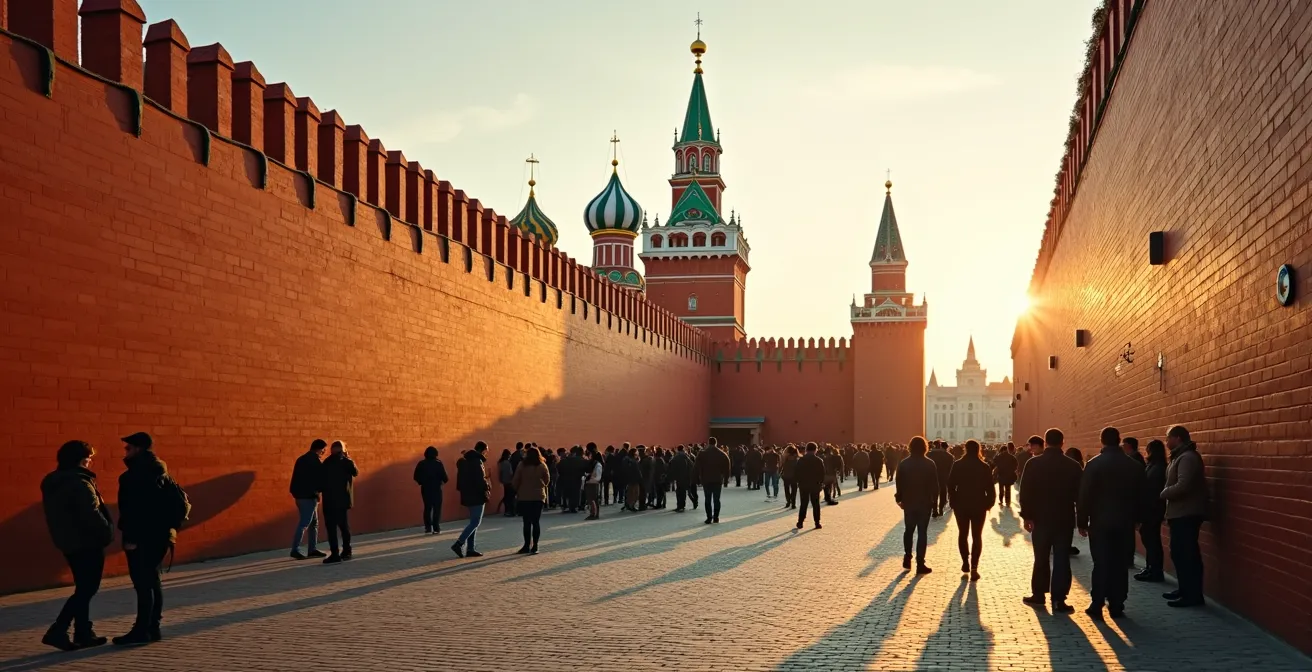
The secret to conquering the Kremlin isn’t just buying a ticket online; it’s executing a precise operational choreography that treats the entire Red Square complex as a single, timed mission.
- The Kremlin’s ticketing is intentionally fragmented; there is no “one ticket for everything.” Mastering this system is key.
- Surrounding free attractions should be used strategically to manage time and avoid peak crowd flows into the main complex.
Recommendation: Stop thinking about avoiding a single queue. Instead, architect your day around the Armoury’s fixed entry time, using the strategies in this guide to build your itinerary forwards and backwards from that single point.
The image is a familiar one for any visitor to a world-class landmark: a sprawling, disorganized queue of frustrated tourists snaking towards a distant ticket office. At the Moscow Kremlin, this scene is not just a possibility; it’s the default experience for the unprepared. Many guides will offer the standard, simplistic advice: “buy your tickets online.” While not incorrect, this tip barely scratches the surface of the challenge. It fails to address the complex reality of visiting the heart of Russia.
Conquering the Kremlin, and specifically its magnificent Armoury Chamber, is not a simple transaction. It is a tactical exercise in what I call operational choreography. The entire complex, from Red Square to the inner cathedrals, operates on a series of distinct schedules, separate ticketing systems, and crowd-flow patterns. The true key to an efficient visit lies not in a single trick, but in understanding and exploiting the system’s inherent inefficiencies. This is about more than just saving two hours in line; it’s about transforming a potentially stressful day into a masterful and seamless exploration of priceless treasures.
This guide abandons generic advice. Instead, we will construct a strategic itinerary. We will dissect the fragmented ticketing puzzle, identify optimal timings for ceremonies, and pinpoint the exact locations for priceless views. Forget the passive tourist experience; you are about to become the architect of a flawless visit to one of the most formidable and rewarding sites on Earth.
To achieve this, we will deconstruct the Kremlin and its surroundings piece by piece. The following sections provide the intelligence needed to build your strategic plan, covering everything from sacred mausoleums and historical myths to the critical details of purchasing tickets in the current geopolitical climate.
Table of Contents: A Strategic Itinerary for the Kremlin & Red Square
- When is Lenin’s Mausoleum actually open (and why is it free)?
- Is the GUM department store just for shopping or is it a monument?
- Where to throw a coin at the Zero Kilometer mark for good luck?
- Eternal Flame: What is the best time to watch the Changing of the Guard?
- Lobnoye Mesto: Was it really used for executions or just speeches?
- Kremlin and Red Square: How to buy one ticket for the whole complex?
- Where to stand to see a church, a skyscraper, and a palace in one frame?
- How to visit the Terem Palace typically closed to the public?
When is Lenin’s Mausoleum actually open (and why is it free)?
Lenin’s Mausoleum operates on a schedule as rigid and austere as the institution it represents. Access is free, a holdover from Soviet tradition where visiting the founder’s tomb was a civic pilgrimage, not a commercial transaction. However, this comes with strict, non-negotiable conditions. The Mausoleum is only open on Tuesday, Wednesday, Thursday, and Saturday, from 10:00 AM to 1:00 PM. Missing this narrow window means missing the opportunity entirely.
The strategic approach here is to use its limitations to your advantage. Since the queue forms at the Nikolskaya Tower for a security check, arriving around 9:00 AM positions you ahead of the main tourist wave. The most critical rule is the absolute prohibition of bags, cameras, and mobile phones. Leave them at your hotel or use the paid lockers in the Alexander Garden. Any attempt to bring these items will result in being turned away, forcing you to the back of the queue.
For a French visitor, the experience is a stark contrast to the Panthéon. As one travel analysis notes, unlike the freedom of movement in the Paris landmark, the Mausoleum enforces a strict, one-way route at a brisk pace, with guards ensuring no one stops. You must keep your hands out of your pockets and maintain absolute silence. The entire visit inside lasts only a few minutes, making it a quick, albeit intense, stop in your operational choreography before tackling the main Kremlin complex.
Is the GUM department store just for shopping or is it a monument?
To dismiss GUM (Glavny Universalny Magazin) as a mere shopping mall is to fundamentally misunderstand its place in Russian history. While it now houses luxury Western brands, its soul is that of a historical and architectural monument. Built in 1893, its magnificent glass roof and Russian Revival architecture were designed to showcase the industrial and commercial might of the Tsarist empire. Under the Soviets, it became the “State Department Store,” a symbol of planned economy prestige.
Today, it serves a dual purpose. For the strategic tourist, its primary value isn’t shopping but its role as a free, climate-controlled sanctuary and a living museum. It’s the perfect place to warm up in winter, use clean facilities, or absorb the atmosphere without spending a ruble. The must-do experience is not buying a luxury handbag but tasting the traditional Soviet-style ice cream (“plombir”) sold from carts near the central fountain. It’s a taste of nostalgia and a direct link to the building’s past.
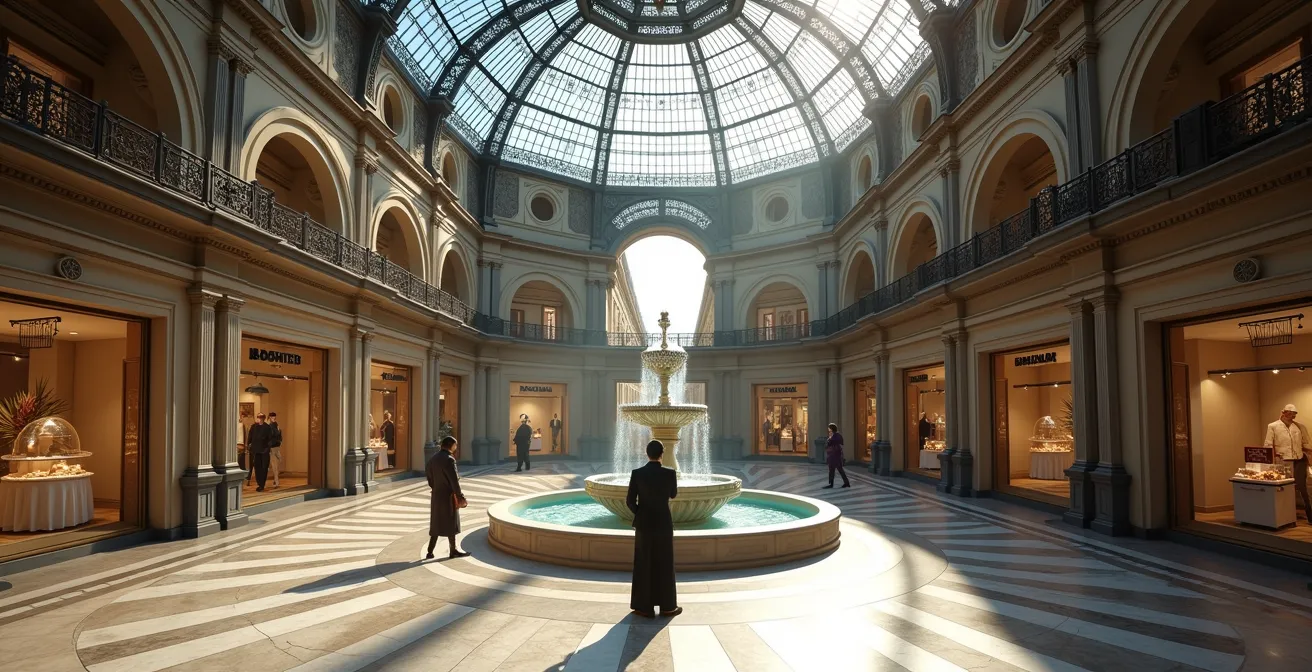
The architectural grandeur alone justifies a visit. The best photo spot is from the bridges on the second or third levels, which allow for a perfectly symmetrical shot of the vaulted glass ceiling. For a French visitor, the comparison to Parisian counterparts is telling of its unique identity.
As this comparative analysis from a Moscow travel guide shows, GUM’s journey from a state symbol to a luxury destination gives it a depth that a purely commercial space like Galeries Lafayette, for all its beauty, does not possess.
| Aspect | GUM Moscow | Galeries Lafayette Paris |
|---|---|---|
| Built | 1893 | 1912 |
| Architecture | Russian Revival with glass roof | Art Nouveau with Byzantine dome |
| Historical role | Soviet state department store | Private luxury retail |
| Current status | Luxury mall + historical monument | Active department store |
| Must-try experience | Soviet ice cream at fountain | Rooftop terrace views |
| Photo spot | Upper bridge for symmetry | Under the dome |
Where to throw a coin at the Zero Kilometer mark for good luck?
Tucked away from the grandeur of St. Basil’s and the Kremlin walls lies a small but significant ritual site: the Zero Kilometer marker. This bronze plaque marks the official starting point of all major highways in Russia, the symbolic heart of the nation’s vast expanse. For visitors, it offers a moment of personal tradition and a popular photo opportunity, but only if you know where to find it and how to perform the ritual correctly.
The marker is not in Red Square itself, but in the short passage of the Resurrection Gate (Voskresensky Vorota), located between Red Square and Manege Square. During peak hours, this small area can become a bottleneck of tourists and, unfortunately, a hotspot for pickpockets. Therefore, timing is critical. Plan this activity for the early morning (before 9 AM) or later in the evening (after 7 PM) to avoid the densest crowds and maintain situational awareness.
The ritual itself is simple but specific. To ensure your wish to return to Moscow comes true, you must follow the local custom precisely. A professional guide will instruct you with the following steps for a successful wish:
- Locate the bronze plaque in the Resurrection Gate passage.
- Stand with your back to the marker, facing away from Red Square.
- Make a wish to return to Moscow.
- Throw a coin over your left shoulder.
- Crucially, keep your wallet and valuables in a front pocket and be highly aware of your surroundings as you perform the ritual.
This small act is a perfect, quick addition to your itinerary as you move between the Alexander Garden and Red Square, adding a touch of local superstition to your strategic plan.
Eternal Flame: What is the best time to watch the Changing of the Guard?
At the Tomb of the Unknown Soldier, just outside the Kremlin walls in the Alexander Garden, the Eternal Flame burns in solemn tribute to those lost in the Great Patriotic War (World War II). Guarded by the elite Kremlin Regiment, the site is home to one of Moscow’s most moving ceremonies: the Changing of the Guard. This is not a tourist show; it is a display of profound respect and military precision.
The ceremony is reliably punctual. As confirmed by Moscow’s official tour resources, the guard change happens every hour from 8:00 AM to 8:00 PM, seven days a week. The entire procedure, from the guards emerging from the gate to the final synchronized turn, lasts approximately five minutes. The key to a good experience is not the timing of the hour, but your positioning. Arriving 10-15 minutes before the hour is essential to secure a prime viewing spot, as crowds gather quickly.
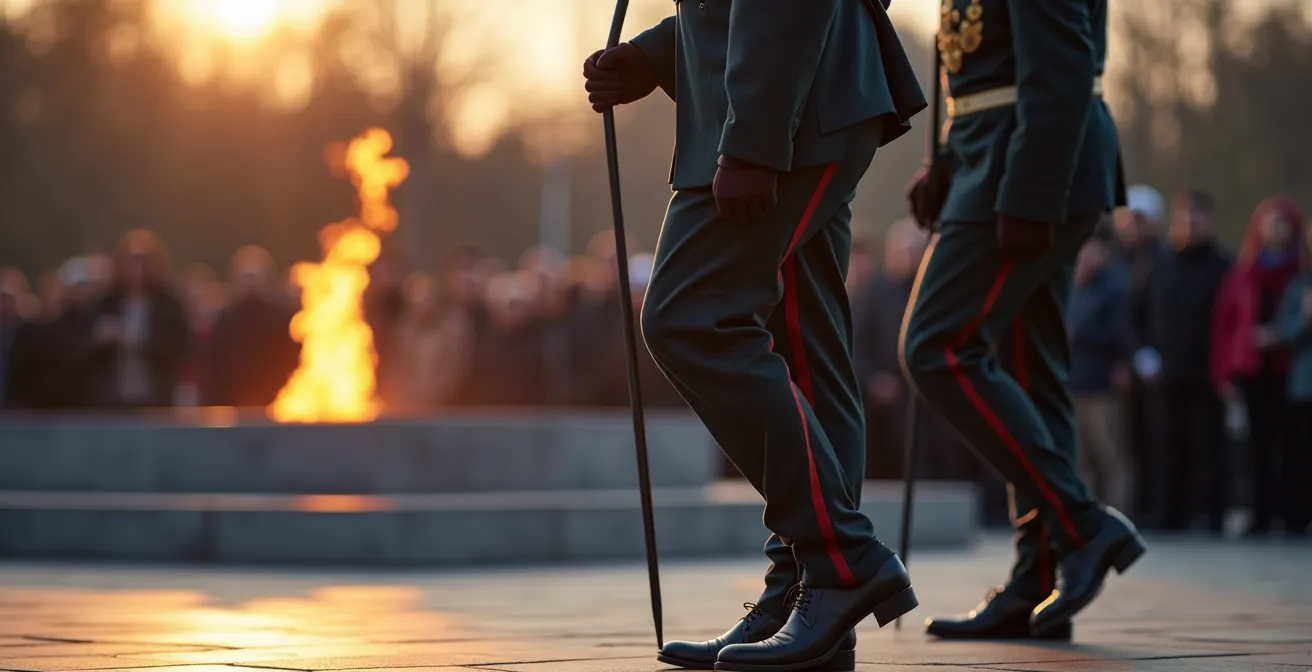
Most tourists make the mistake of standing directly in front of the tomb. A strategist does better. For the best view of the iconic high-stepping “goose step” march, position yourself at a 45-degree angle from the flame, on the side closer to the garden. This provides an unobstructed line of sight for photos and video. Remember that this is a place of reverence; remove hats, remain quiet, and never use a flash. A respectful distance of at least three meters from the guards’ path is mandatory.
Integrating this into your plan is simple. If you are heading to the Kremlin ticket office (also in the Alexander Garden), time your arrival to coincide with the ceremony. It’s a powerful, ten-minute investment that connects you to the deep historical currents of the nation before you even step inside the fortress walls.
Lobnoye Mesto: Was it really used for executions or just speeches?
The circular stone platform in Red Square, known as Lobnoye Mesto or the “Place of the Skull,” carries a fearsome reputation. Popular culture and countless movies have depicted it as a gruesome stage for public executions, where Ivan the Terrible and other tsars dispensed brutal justice. However, the strategist and historian alike know to separate Hollywood fiction from historical fact. The truth is far more administrative and less bloody.
Contrary to its grim legend, Lobnoye Mesto was almost never used for executions. The platform’s primary function was as a tsarist rostrum for official proclamations. It was from this elevated spot that imperial decrees were read to the public, important news was announced, and heirs to the throne were presented to the people. It was a nexus of communication between the ruler and the ruled.
As historical records and expert guides clarify, its role was also deeply religious. As one historical tour guide service points out:
Lobnoye Mesto served as a platform for imperial decrees and religious ceremonies rather than executions… where religious processions stopped during Palm Sunday celebrations.
The few executions that did take place in Red Square occurred on temporary wooden scaffolds erected nearby, not on the permanent stone structure itself. Knowing this fact transforms your perception of the site. Instead of a place of death, you can see it for what it truly was: a stage for power, faith, and pronouncements that shaped the course of Russian history. It’s a quick but essential stop to correct a common misconception and deepen your understanding of the square.
Kremlin and Red Square: How to buy one ticket for the whole complex?
Here we arrive at the central challenge for any visitor: the ticket system. The most common and frustrating question is, “How do I buy one ticket for the whole complex?” The simple, authoritative answer is: you cannot. The Kremlin’s ticketing is a masterpiece of intentional fragmentation, a system of “ticket arbitrage” that the strategic tourist must master. There is no single “pass” that grants access to everything.
The complex is divided into several separately ticketed zones. Understanding this is the absolute key to avoiding queues and disappointment. The main components are the Armoury Chamber, the Cathedral Square, the Diamond Fund, and the Ivan the Great Bell Tower. Each requires a different ticket, and some can only be purchased in person. For example, a ticket to the Armoury does not grant access to Cathedral Square, and vice versa. An analysis from a leading Russia travel portal, Russiable, breaks down the main options clearly.
The table below outlines the core components. Note that the Armoury Chamber operates on strict, timed entry slots, which must be the anchor point of your entire day’s schedule. You build your itinerary around your Armoury time, not the other way around.
| Ticket Type | Price (Rubles) | Includes | Purchase Method |
|---|---|---|---|
| Cathedral Square | 700 (1000 with audio) | All cathedrals and museums except Ivan the Great Bell Tower | Online or ticket office |
| Armoury Chamber | 1000 (1300 with audio) | Royal treasures, Fabergé eggs | Separate ticket, timed entry |
| Diamond Fund | 500 | Crown jewels collection | Only at ticket office |
| Ivan the Great Bell Tower | 350 | Panoramic views (no children under 14) | Only at ticket office |
The second major hurdle, particularly for French and other Western tourists, is payment. Due to sanctions, Visa and Mastercard issued outside Russia do not work on the official Kremlin website or at the ticket office. This requires a specific payment strategy.
Action Plan: Ticket Purchase Without a Russian Bank Card
- Authorized Tour Operators: Book through trusted international platforms like GetYourGuide or Viator, which accept foreign cards and PayPal. This is the most reliable method.
- Cash at Ticket Office: Purchase directly at the ticket office in the Alexander Garden using cash (Rubles). To be effective, you must arrive before 9:30 AM to beat the long lines.
- Hotel Concierge Service: Use your hotel’s concierge to procure tickets for you. This is convenient but expect a significant service fee of 20-30%.
- Guided Tour Package: Join a guided tour where the tickets are included in the price. This often provides the added benefit of skipping the security line.
- Plan Your Days: Remember that the Kremlin is always closed on Thursdays. Do not plan any part of your visit for this day.
Where to stand to see a church, a skyscraper, and a palace in one frame?
After mastering the logistical challenges, you deserve the reward: a view that encapsulates the sprawling, contradictory history of Moscow in a single photograph. There is a specific, almost secret, vantage point where you can frame three distinct eras of Russian architecture: the medieval might of a Kremlin tower, the monumental ambition of a Stalinist skyscraper, and the imperial elegance of the Grand Kremlin Palace.
This “Three Ages of Moscow” shot is not found by chance. It requires precise positioning and timing. The location is the Bolshoy Kamenny Bridge, specifically the western pedestrian walkway that offers a view looking back towards the Kremlin. From this spot, the layers of history reveal themselves. The precise GPS coordinates for this photographic sweet spot are approximately 55°45’01.8″N 37°36’51.9″E.
Achieving the perfect shot, however, involves more than just standing in the right place. It requires a photographer’s eye and a strategist’s timing. To capture this iconic view, follow this professional guidance:
- Position: Stand on the Bolshoy Kamenny Bridge’s western pedestrian walkway, looking northeast.
- Timing: Aim for the “golden hour,” roughly between 4 PM and 6 PM, when the setting sun bathes the red Kremlin walls in a warm, dramatic light.
- Composition: Use a wide-angle lens (24-35mm range is ideal). Frame the Kremlin towers in the left third of your shot, allowing the Kotelnicheskaya Embankment Building (the Stalinist skyscraper) to rise in the center-right. Use the Moskva River as a leading line to draw the viewer’s eye into the scene.
- Camera Settings: Set your aperture to f/8 or higher to ensure everything from the bridge to the skyscraper is in sharp focus. Keep your ISO low (100-400) for a clean, noise-free image.
- Smartphone Tip: If you don’t have a wide-angle lens, your phone’s panorama mode, used vertically, can often capture the necessary height and breadth of the scene.
This photograph is more than a souvenir; it’s a visual thesis on Moscow’s layered identity. It’s the payoff for your meticulous planning—a moment of beauty made possible by strategic positioning.
Key Takeaways
- The Kremlin complex must be approached as an integrated itinerary, not a series of individual sights.
- The ticketing system is deliberately fragmented. Master its components (Armoury, Cathedrals, etc.) to control your day.
- Timing is everything: for the Armoury’s fixed entry, for the Changing of the Guard, and for avoiding crowds at ritual spots.
How to visit the Terem Palace typically closed to the public?
Among the Kremlin’s many treasures, the Terem Palace holds a special, almost mythical, allure. Its colorful, fairy-tale-like chambers were the private residence of the 17th-century tsars. Naturally, the discerning visitor asks: how can I get inside? The answer, for a regular tourist, is both simple and disappointing: you cannot. This is the final and most important piece of insider knowledge a professional guide can offer—managing expectations to avoid scams and wasted effort.
The Terem Palace is not just a museum; it is incorporated into the official residence of the President of the Russian Federation. As such, it is under the highest level of security and is strictly off-limits to the public. As confirmed by the Kremlin’s official channels and premium tour operators, access is not a matter of buying a special ticket or knowing the right person. As one specialized agency, Tsar Visit, states, gaining entry requires special written requests to the Kremlin Commandant, typically reserved for diplomatic delegations or accredited academic groups. For an individual tourist, access is effectively impossible.
Be extremely wary of any third-party operator claiming to offer “exclusive Terem Palace access.” These are almost certainly scams. Instead of chasing an impossible goal, a strategist focuses on the best possible alternatives to experience its grandeur:
- Watch the Official Virtual Tour: The Kremlin Museums have produced a stunning, high-resolution 4K virtual tour available on their official YouTube channel, allowing you to explore the interiors digitally.
- Visit the Armoury Chamber: Many rooms in the Armoury feature interiors and artifacts from the same period as the Terem Palace, providing an authentic sense of the era’s royal aesthetics.
- See the Facade from Cathedral Square: The five golden domes and ornate roof of the Terem Palace are clearly visible from Cathedral Square during a standard Kremlin visit. It’s a beautiful sight in itself.
- Look for Grand Kremlin Palace Tours: On very rare occasions, special public tours of the adjacent Grand Kremlin Palace are announced on the official Kremlin website. These are the closest one can get to the presidential interiors.
Knowing what is impossible is as valuable as knowing what is possible. By focusing on these excellent alternatives, you can appreciate the legacy of the Terem Palace without falling for false promises.
By adopting this strategic mindset—planning, understanding the systems, and knowing the real from the mythical—you transform your visit from a standard tourist trek into a seamless and deeply rewarding conquest. Apply this operational choreography, and you will not only bypass the queues but also unlock a richer understanding of the heart of Russia.