In summary:
- Surviving the Moscow Metro is not about avoiding the crowds, but about understanding its unwritten rules and moving with the “flow”.
- Listen for the gender of the announcer’s voice: a male voice indicates a train going towards the city center, while a female voice means it’s heading away from it.
- With luggage, your designated spot is the dead space by the carriage doors, never the central aisle.
- The dogs you see sleeping in the stations are a protected and beloved part of the metro’s ecosystem, not a threat.
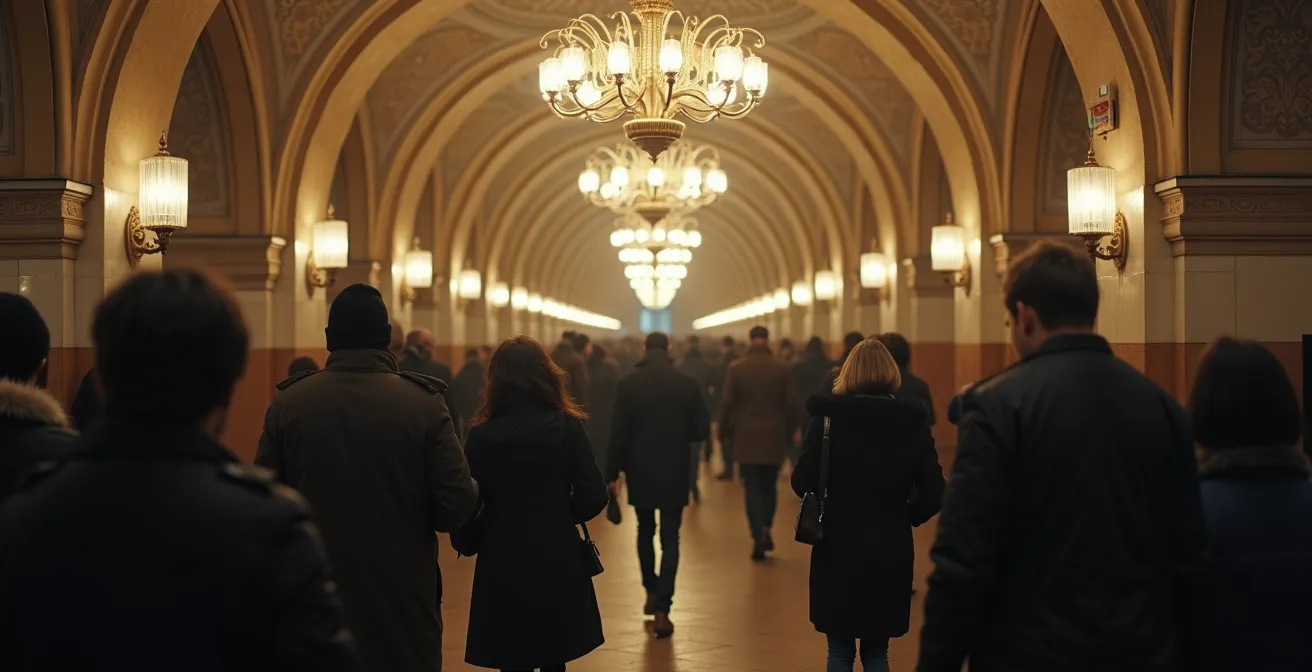
The hiss of the doors, the wall of bodies, the sheer momentum of the crowd—for a Parisian used to the RATP, the Moscow Metro during rush hour can feel like a familiar nightmare cranked up to an entirely new level of intensity. The typical advice you’ll find online is predictable and often impractical: “avoid peak times.” But as a tourist, your schedule isn’t always your own. You have sights to see, and the metro is the lifeblood of the city, an unavoidable, magnificent beast.
Forget the generic tips. The key to survival isn’t avoiding the crush; it’s about decoding the system’s hidden language and mastering its relentless flow. It’s an urban choreography, and once you learn the steps, the terror of being swept away is replaced by the confidence of knowing exactly where you’re going and how to get there. This isn’t about fighting the current; it’s about learning to swim with it. The difference between a panicked tourist and a seasoned commuter is a handful of unspoken rules.
This guide provides that secret codebook. We will move beyond the obvious and give you the practical, street-smart knowledge you need to navigate the ‘underground palaces’ not just with efficiency, but with the cool composure of a local. From deciphering audio cues to understanding your place in the human river, you’ll learn to turn chaos into a predictable and even enjoyable experience.
Summary: Your Guide to Mastering the Moscow Metro
- How to bypass the SMS verification for Metro Wi-Fi with a foreign number?
- Clockwise or Counter-clockwise: How to read the male/female voice announcements?
- What to do if you leave your gloves on the train at Ploshchad Revolyutsii?
- The unspoken rule of where to stand with a suitcase in a crowded carriage
- Are the dogs sleeping in the metro dangerous or commuters too?
- Metro plus Bus: How to trigger the free transfer within 90 minutes?
- Which 3 metro stations have the most impressive propaganda mosaics?
- Why do Soviet mosaics depict a future that never happened?
How to bypass the SMS verification for Metro Wi-Fi with a foreign number?
The first rule of urban survival is self-reliance. While the Moscow Metro boasts a comprehensive Wi-Fi network, it’s notoriously tricky for foreigners to access due to an SMS verification system that often fails with non-Russian numbers. The professional commuter’s solution is simple: don’t depend on it. Your real lifeline is what you prepare before you even descend the escalator. Being disconnected is a feature, not a bug, if you have the right offline tools.
Instead of fumbling for a signal, your goal is to have a complete navigation arsenal that works perfectly in the deepest tunnels. This means pre-loading your smartphone with specific applications that are designed for offline use in Moscow. This strategy not only solves the Wi-Fi problem but also makes you faster and more confident than anyone relying on a live connection. It’s the ultimate power move in a city that values efficiency.
Action Plan: Your Offline Metro Survival Kit
- Download the Yandex Metro app before you leave France; it works completely offline and offers route planning using the Latin alphabet.
- Install the official Moscow Metro app for real-time updates (if you get a signal) and Troika card management (NFC features are Android-only).
- Get a metro map app that shows detailed station layouts, including the crucial exits and transfer corridors to avoid getting lost in the labyrinthine passages.
- Save an offline Google Map of Moscow’s city center as a reliable backup for when you emerge from underground.
- Take screenshots of your key station names in both Cyrillic and Latin alphabets for quick visual reference.
Clockwise or Counter-clockwise: How to read the male/female voice announcements?
In the roar of an approaching train and the press of the crowd, the station announcements can seem like just more noise. But for a local, they contain a simple, brilliant code that instantly provides orientation. This is one of the most crucial signals to decode. You don’t need to understand Russian; you just need to listen to the pitch of the voice. The system is a masterclass in elegant design, turning a simple audio cue into an infallible compass.
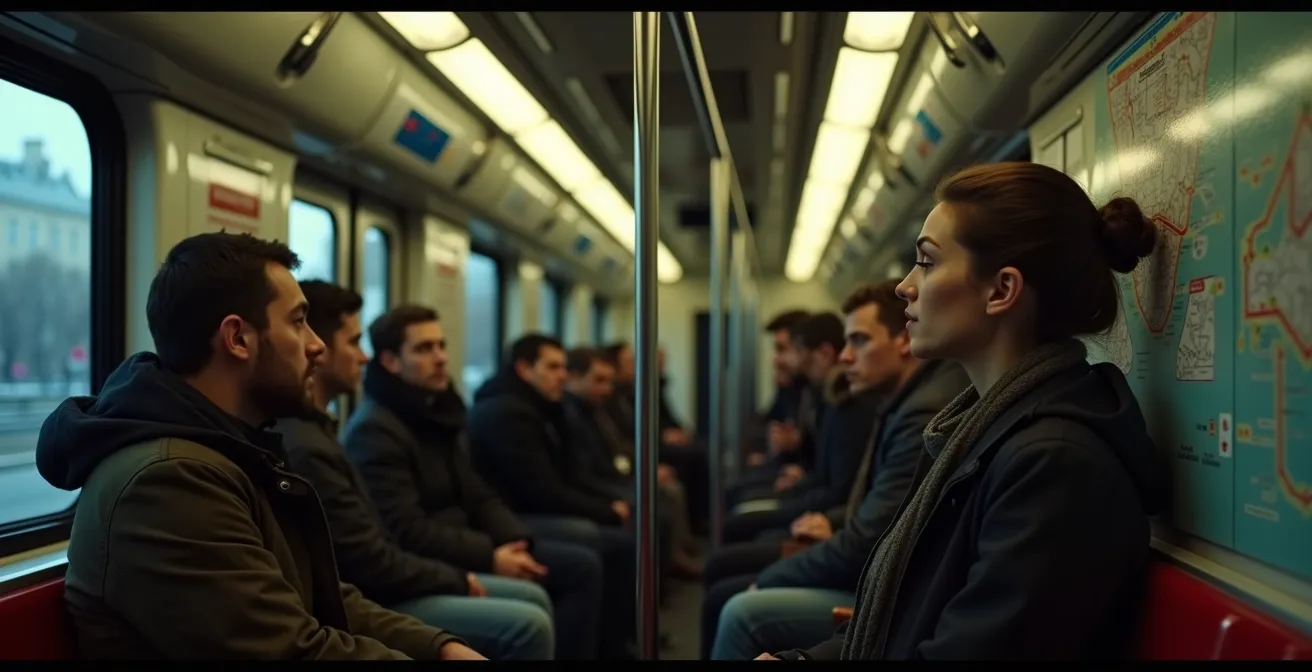
Here is the unbreakable rule: on the radial lines, a male voice announces the stations when the train is heading towards the city center, and a female voice announces them when heading away from the center. On the Circle Line (Line 5), the male voice indicates clockwise travel, and the female voice indicates counter-clockwise travel. This simple binary signal allows you to confirm your direction of travel without ever looking at a map. In a system where trains can run with intervals as short as 80 seconds during peak hours, this instant confirmation is vital to keeping up with the pace.
What to do if you leave your gloves on the train at Ploshchad Revolyutsii?
Losing an item in the metro’s churn feels like a catastrophe, a final offering to the chaos. But the Moscow Metro is a surprisingly orderly system, even when it comes to lost belongings. Panic is the tourist’s reaction; a clear plan of action is the commuter’s. If you realize you’ve left something behind, especially at a major hub like Ploshchad Revolyutsii, there is a formal process. The key is to act quickly and methodically.
Even in a moment of stress, take a moment to appreciate where you are. Ploshchad Revolyutsii is famous for its 76 bronze sculptures. As local legend has it, students heading to an exam touch the nose of the dog on the ‘Frontier Guard with a Dog’ sculpture for good luck. While you might not need academic success, a little bit of luck can’t hurt your quest to retrieve your lost item. As one French expat noted, this station is filled with these little rituals that are part of the city’s fabric.
Checklist: The Moscow Metro Lost & Found Protocol
- Immediately note the exact time, the color of the metro line, and the direction you were traveling.
- If possible, report the loss to the station duty officer (дежурный) at your destination station within 20 minutes.
- Make your way to the central Moscow Metro Lost Property Office, located at Komsomolskaya station (on the Circle Line).
- Fill out the required form with a detailed description of your item. Use a translation app on your phone to write it in Russian for clarity.
- You can check back in person after 3 business days or call the office directly at +7 (495) 622-20-85 to inquire.
The unspoken rule of where to stand with a suitcase in a crowded carriage
This is the ultimate test of the urban choreographer. Bringing luggage into a metro system that moves over 7 million passengers a day is a high-stakes maneuver. The cardinal sin, the one that will immediately brand you as a clumsy tourist, is blocking the flow. The central aisle of the carriage is a river, and your suitcase is a boulder. Placing it there disrupts the entire ecosystem of commuters embarking and disembarking.
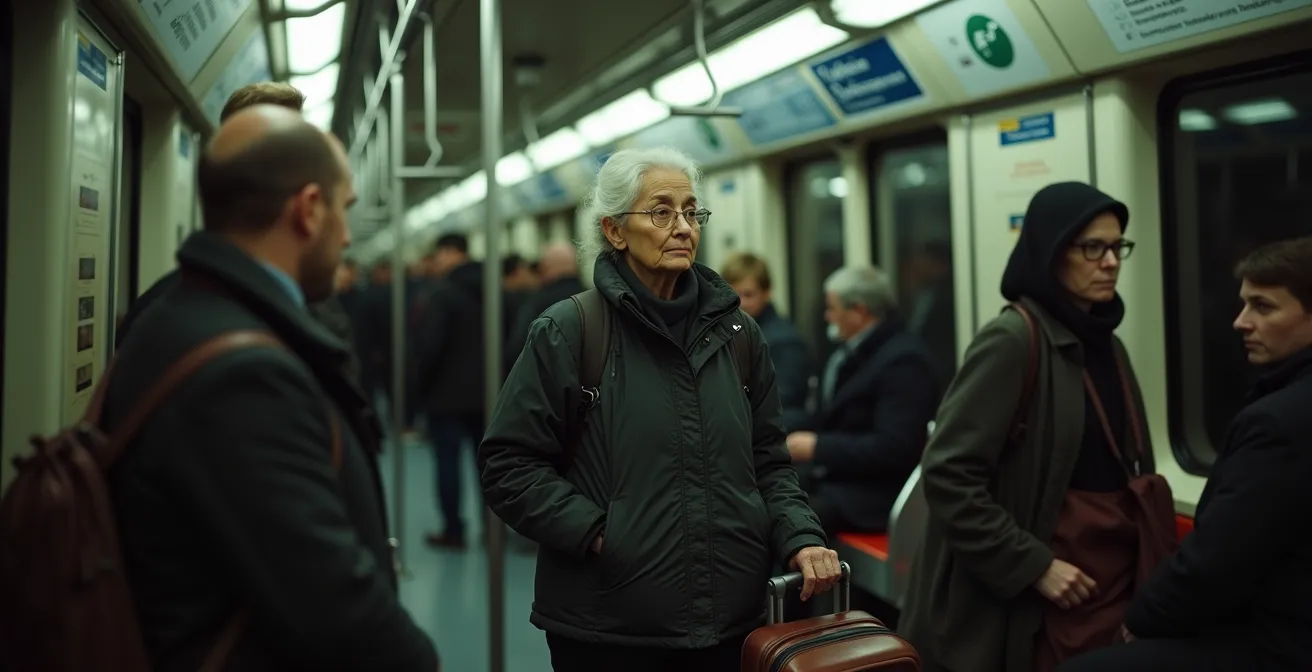
The unspoken rule is to claim the “dead zones.” These are the areas with the least foot traffic. Your primary targets are the wide, open spaces directly next to the train doors. When you enter, immediately move your suitcase to one side of the door area. This keeps the main pathway clear for the constant stream of people moving in and out and through the carriage. Another acceptable zone is the space in the articulated accordion section between carriages, though this is less ideal. By occupying this marginal space, you show respect for the system and its seasoned users, transforming from an obstacle into a considerate fellow traveler.
Are the dogs sleeping in the metro dangerous or commuters too?
Seeing a large dog sleeping peacefully on a station platform or even inside a train carriage can be jarring for a first-time visitor. Your instinct might be to see it as a stray and a potential danger. This is a profound misreading of one of the most unique aspects of Moscow’s culture. These dogs are not just strays; they are, in a very real sense, fellow commuters. They are a cherished and protected part of the metro’s identity, with a story that reveals the soul of the city.
The Legend of Malchik: The Dog Who Became a Monument
The most famous story is that of Malchik (“Little Boy”), a black feral dog who lived at Mendeleyevskaya station. He was known for guarding his home against drunks and other aggressive dogs. In 2001, in front of horrified rush-hour commuters, a woman stabbed and killed him after he barked at her pet. The public outrage was immense. As a result of a massive fundraising campaign supported by celebrities and ordinary citizens, a bronze statue named “Compassion” was erected in his memory at the station’s entrance. This incident cemented the status of metro dogs as a protected class in the public consciousness.
With a population of as many as 35,000 stray dogs living in Russia’s capital, many have famously learned to navigate the subway system, using it to travel to areas with more food. They are known for their intelligence and peaceful coexistence. So, when you see a dog in the metro, the correct etiquette is to do what Muscovites do: leave it alone, give it space, and admire it as a furry veteran of the urban commute.
Metro plus Bus: How to trigger the free transfer within 90 minutes?
Mastering the metro is one thing; mastering the entire public transport network is next-level. One of the best-kept secrets for savvy travelers is Moscow’s integrated fare system, which allows for free transfers between the metro and surface transport. This is all managed through the city’s transport card, the Troika. For a Parisian, think of it as a supercharged version of your Navigo, but with its own set of powerful rules. The most valuable of these is the ’90-Minute Ticket’ feature.
The logic is simple: once you tap your Troika card to start a journey on the metro, a 90-minute timer begins. Within that window, your first metro or monorail ride is included, along with unlimited transfers on any city bus, tram, or electric bus at no extra cost. This is incredibly useful for journeys that require a final leg on surface transport after exiting the metro. You just need to ensure you’ve loaded the correct fare type onto your card. Instead of paying for two separate journeys, the system bundles it into one, rewarding efficient travel planning.
For a direct comparison, here’s how the Troika stacks up against a familiar system for any French tourist.
| Feature | Moscow Troika | Paris Navigo |
|---|---|---|
| Base fare | 63 rubles (€0.7) | €2.15 |
| 90-min transfer | 94 rubles total | Included in base fare |
| Card deposit | 50 rubles (refundable) | €5 (non-refundable) |
| Coverage | Metro + Bus + Tram + MCC | Metro + RER + Bus + Tram |
| Contactless payment | Yes (Visa/Mastercard) | Yes (via smartphone) |
Which 3 metro stations have the most impressive propaganda mosaics?
While your primary mission is survival, the reward for mastering the metro’s flow is the time and mental space to appreciate its staggering beauty. Many stations are not just transport hubs; they are underground art galleries, museums of a bygone era. The most breathtaking artworks are the Soviet-era mosaics, which tell stories of power, unity, and a glorious future. When you need a moment to catch your breath, these three stations offer the most impressive displays.
First, Kiyevskaya on the Circle Line is a monument to Russo-Ukrainian friendship, opened in 1954. Its opulent mosaics, crafted from smalt and precious stones, depict scenes from Ukrainian history and culture. As the creators from “We Heart Moscow” note, its rich decoration is devoted to the friendship between the two peoples.
The station was opened on March 14, 1954. It was named after the nearby Kievsky Railway Station. Decorating of station is devoted to friendship of Russian and Ukrainian people. Rich mosaic decoration is made from smalt and valuable stones
– We Heart Moscow, Moscow Metro Guide
Second, Komsomolskaya, also on the Circle Line, is the apotheosis of Stalinist Empire style. Its grand yellow ceilings are adorned with eight massive mosaics by artist Pavel Korin, celebrating Russian military victories and great leaders. Finally, Mayakovskaya on the green line is a pre-war art deco masterpiece. Look up to see 34 stunning ceiling mosaics by Alexander Deyneka on the theme “24-Hour Soviet Sky,” depicting a utopian vision of Soviet life from morning to night.
Key takeaways
- Self-reliance is key: prepare offline maps and apps, as you cannot count on public Wi-Fi.
- The announcer’s voice is your compass: male voices guide you toward the city center, female voices guide you away.
- Respect the flow: luggage belongs in the dead zones near the doors, keeping the central path clear for commuters.
- The metro dogs are a protected part of the urban ecosystem; they are fellow commuters, not a danger.
Why do Soviet mosaics depict a future that never happened?
As you gaze up at the mosaics in Kiyevskaya or Komsomolskaya, you’re not just looking at art; you’re looking at a carefully constructed ideology. The heroic workers, smiling farmers, and triumphant soldiers all depict a concept known as `Svetloe budushchee`—the “radiant future.” This was the cornerstone of Socialist Realism, the state-approved artistic style of the Soviet Union. The art wasn’t meant to reflect reality as it was but to project the glorious communist utopia that was supposedly just around the corner.
These stations were conceived as “underground palaces of the people,” a term that perfectly captures their dual purpose. They were functional infrastructure, but they were also showcases for the power and success of the Soviet state. As noted in historical analyses, their purpose was to serve as landmarks and propaganda. They were built to awe and inspire the masses, offering a daily glimpse of the strength and beauty of the socialist vision.
The stations being constructed under Stalin’s regime, in the style of socialist classicism, were meant as underground ‘palaces of the people’. Stations such as Komsomolskaya, Kiyevskaya or Mayakovskaya and others built after 1935 are tourist landmarks.
– Wikipedia, Moscow Metro History
The future they depicted—one of effortless abundance, universal harmony, and technological supremacy under communism—never came to pass in the way the mosaics promised. Today, these stunning artworks stand as monuments to a powerful dream. They are historical artifacts of a future that never was, preserved in the bustling, chaotic, and profoundly real present of the Moscow Metro.
Now that you have the codebook, your next step is to review these rules before you land in Moscow. Turn terror into confidence and navigate the world’s most impressive metro like you were born to it.