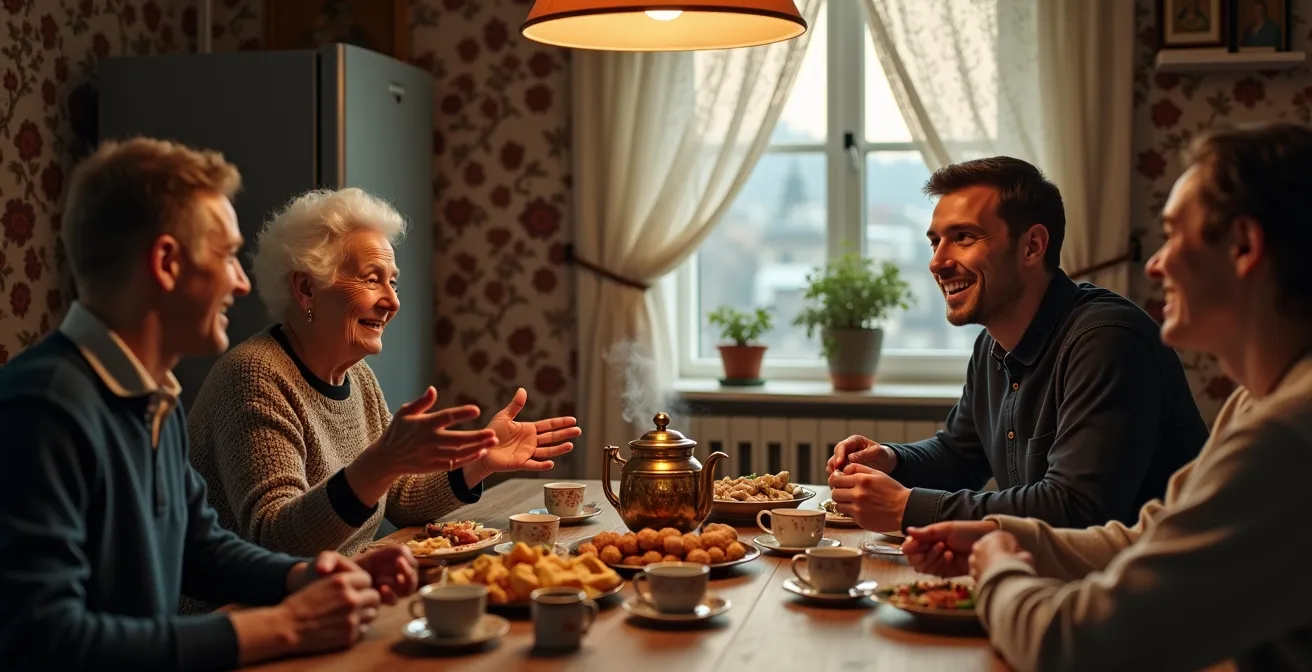
Many travelers believe connecting with Muscovites is impossible without fluent Russian, citing a perceived public ‘coldness.’ The truth is, connection isn’t about language; it’s about understanding cultural codes. Genuine warmth in Moscow is reserved for the private sphere. The real challenge isn’t breaking the ice on the street, but being invited across the threshold into the home, where true hospitality begins.
You’re wandering through Moscow, mesmerized by the grandeur of the Kremlin and the intricate beauty of the Metro stations. You want more than just photos; you want to connect, to understand the soul of the city through its people. Yet, you’re met with reserved expressions on the street, and the language barrier feels like a fortress wall. Standard advice tells you to use apps or learn a few phrases, but this rarely leads to the deep, meaningful interactions you crave as a traveler.
After a decade of living here as an expat, I can tell you the secret isn’t in what you say, but in understanding where and how connections are made. The key to unlocking Moscow’s legendary hospitality lies in a concept I call the “Threshold.” There is a powerful, almost sacred line between the formal, public world and the warm, intimate private one. Smiling at a stranger on the street might be seen as odd, but once you’re invited into a Russian home, you’re no longer a stranger; you’re a guest, and everything changes.
This guide is designed to help you cross that threshold. We won’t focus on textbook Russian phrases. Instead, we’ll decode the unspoken rules of engagement, from joining a local chess game to knowing exactly what gift to bring to a dinner party. You’ll learn why Muscovites seem reserved in public but are incredibly warm in private, and how the smallest gestures can open the door to the most unforgettable experiences—the kind that happen late at night, around a kitchen table.
This article will walk you through the practical steps and cultural insights needed to move from being a tourist to becoming a welcome guest. The following sections break down the essential strategies for finding and fostering these authentic connections.
Summary: Your Guide to Genuine Moscow Connections
- Why Couchsurfing meetups in Moscow are safer than you think?
- How to join a local running club or chess game in Gorky Park?
- The “Smiling Myth”: Why do Muscovites seem cold on the street but warm at home?
- Where do English-speaking Muscovites hang out on Friday nights?
- What to bring if a Russian invites you to their home for dinner?
- The “Kitchen Conversation” phenomenon: Why deep talks happen at 3 AM?
- Why you shouldn’t tag the location of a speakeasy on Instagram?
- Why do Muscovites rarely smile on the street but welcome you home?
Why Couchsurfing meetups in Moscow are safer than you think?
The idea of Couchsurfing in a city with a reputation for being reserved might seem daunting. However, it’s one of the most effective shortcuts to crossing the public-private barrier. Moscow’s Couchsurfing community is less about free lodging and more about genuine cultural exchange. Hosts are often well-traveled, English-speaking professionals eager to share their city and practice their language skills. The key is not to treat it as a hotel booking service, but as a direct line to a local friend.
Of course, safety is paramount. The platform’s global nature means you must be discerning. But in Moscow, I’ve found that hosts who are active in the community are incredibly reliable. They understand the nuances of their own culture and are often the first to explain the “smiling myth” to you. They act as a cultural bridge. Vetting hosts properly isn’t just about safety; it’s about finding the right personality match for a truly authentic experience. Look for detailed profiles and personal messages—it’s the first sign of a genuine invitation.
To navigate this effectively, you need an insider’s checklist. These are the green (and red) flags specific to the Moscow scene that will help you find a fantastic, safe, and welcoming host.
- Read at least 5 references, paying close attention to reviews from other Western European travelers.
- Check for linked social media profiles, especially VKontakte (VK), which is Russia’s primary social network and a good indicator of a real identity.
- Prioritize hosts who write detailed, personal messages over generic copy-pastes. This shows genuine interest.
- Look for families or couples if you’re traveling alone and want an added layer of security.
- Verify that hosts have a “Verified Member” status, which means they’ve confirmed their identity through the platform’s paid system.
How to join a local running club or chess game in Gorky Park?
If you want to meet Muscovites in their natural habitat, forget the tourist-packed bars. Head to Gorky Park. This isn’t just a park; it’s the city’s living room, where connection happens through shared activities, not small talk. The best part? Participation is often spontaneous and requires almost no Russian. Your presence and interest are the only invitation you need. The most iconic example is the park’s vibrant chess scene.
Unlike some exclusive chess clubs in Paris, Gorky Park’s culture is built on open participation. An analysis of the Gorky Park chess fraternity highlights that it has been the city’s chess hub since 1928, operating as an open cultural institution. You’ll see elderly masters playing against schoolchildren, and they actively welcome newcomers. Simply approaching a table and watching with interest is often enough to get a nod and an invitation to play the next game. It’s a perfect example of shared experience over conversation.
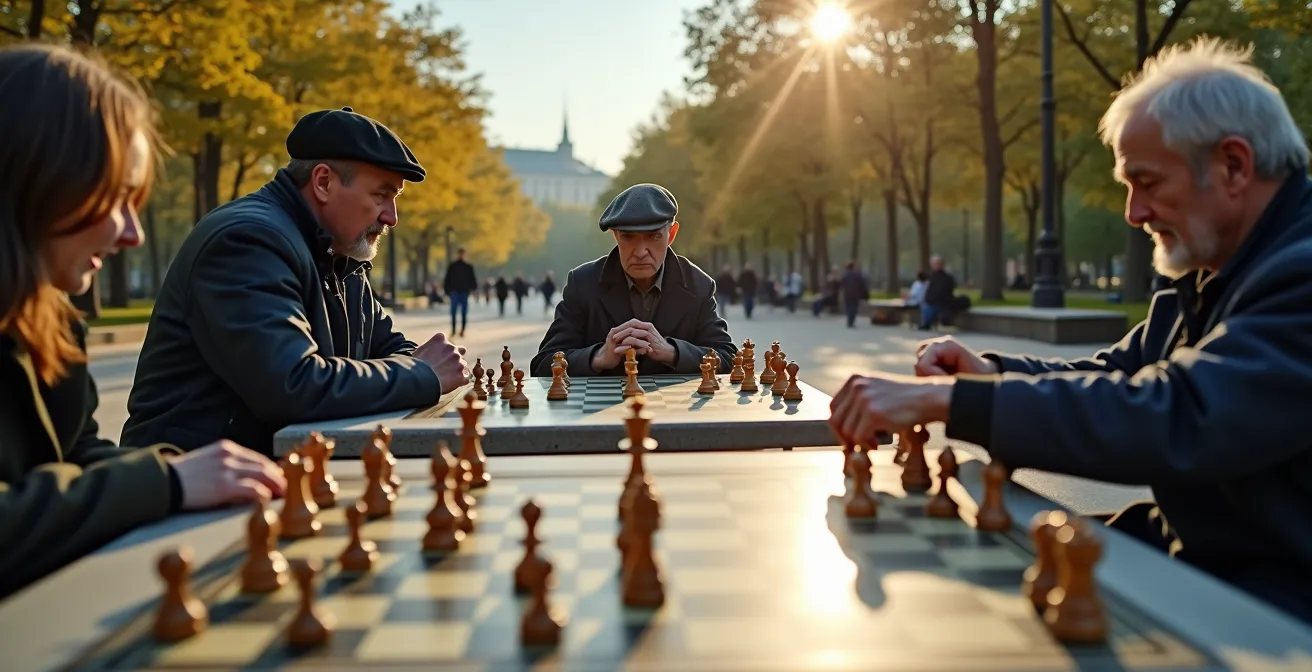
As you can see, the atmosphere is relaxed and inclusive. But chess isn’t the only option. Gorky Park is a hub of activity where you can easily join in. Here are a few concrete ways to get involved:
- Running: Join the free jogging sessions at the Sport Center, typically at 20:00 on weekdays and 12:00 on weekends. Just show up and fall into step.
- Chess: Look for the dedicated tables near the Neskuchny Garden area for casual games that run all day.
- Table Tennis: The Ping Pong Club Moscow has 40 tables and is almost always buzzing with players looking for a match.
- Roller Skating: Check the park’s official forum or information boards for lesson schedules and group skates.
A simple “Можно присоединиться?” (Mozhno prisoedinit’sya? – “Can I join?”) is all you need, but even a simple gesture towards an empty spot is usually understood and welcomed.
The “Smiling Myth”: Why do Muscovites seem cold on the street but warm at home?
This is the most important cultural code you need to crack. Many Westerners, particularly those from France where a ‘bonjour’ to a shopkeeper is standard, interpret the lack of public smiling in Moscow as unfriendliness or even hostility. This is a fundamental misunderstanding. In Russian culture, a smile is not a casual social lubricant; it is a genuine expression of personal affection reserved for friends and family. Smiling at a stranger is often seen as insincere or, in some contexts, even suspicious.
The best analogy for a French visitor is the distinction between ‘copains’ (acquaintances) and ‘amis’ (true friends), but amplified tenfold. A case study on public versus private behavior in Moscow explains that Russians reserve all their warmth for their trusted inner circle. In public, respect is shown not with a smile, but with a firm handshake, direct eye contact, and a certain formal gravity. This public-facing persona is a protective shell, a holdover from a history where it was wise not to draw attention to oneself.
The magic happens when you are invited to cross the threshold into the private sphere—typically, someone’s home. The moment you step inside, the reserved stranger from the metro disappears. They are replaced by an incredibly warm, hospitable host who will immediately offer you ‘tapochki’ (slippers), endless cups of tea, and their undivided, genuine attention. This transformation is not an act; it’s a code switch. You have moved from the world of strangers to the world of guests, and this is where the true Russian soul reveals itself. Understanding this dichotomy is the absolute key to not feeling rejected and to recognizing the real signs of welcome.
Where do English-speaking Muscovites hang out on Friday nights?
While a home invitation is the ultimate goal, the journey often starts with a social encounter. But where do you go to meet English-speaking locals who are open to conversation? Moscow’s nightlife is vast and varied, and choosing the right district is crucial. Heading to a random bar on Tverskaya, the city’s equivalent of the Champs-Élysées, will likely only surround you with other tourists. You need to go where the creative, international, and well-educated crowds gather.
To help you navigate, I’ve created a quick comparison table. Think of it as a guide to Moscow’s nightlife, translated for a Parisian’s perspective. Choosing a district based on its “vibe” is the first step to putting yourself in the right place at the right time. For instance, as a comparative analysis of Moscow’s nightlife districts shows, different areas attract very different crowds.
| District | Paris Equivalent | Vibe | English-Speaking Level |
|---|---|---|---|
| Patriarch Ponds | Saint-Germain-des-Prés | Chic, literary, expensive | High |
| Red October/Artplay | Belleville | Bohemian, artistic, edgy | Very High |
| Tverskaya | Champs-Élysées | Mainstream, touristy | Moderate |
| Kitay-Gorod | Le Marais | Historic, mixed crowd | High |
Once you’ve chosen your district, you can narrow it down to specific spots known for attracting an international and local mix. Here are some reliable starting points:
- Strelka Bar: Located in the Red October complex, its riverside terrace is a famous meeting point for architects, designers, and creative professionals. English is the de facto language here.
- Mendeleev Bar: A speakeasy hidden behind a noodle shop on Petrovka Street. Its sophisticated cocktails and discerning crowd make it a great place for real conversation.
- 16 Tons Club: An institution for expats and music-loving locals, this English-style pub hosts live bands and has a famously friendly atmosphere.
- Events at the Institut Français de Russie: An obvious but often overlooked choice. Film screenings or lectures are natural conversation starters for fellow Francophiles, both Russian and international.
What to bring if a Russian invites you to their home for dinner?
Congratulations! You’ve received the golden ticket: an invitation to a Russian’s home. This is the moment you cross the “Threshold” from public to private. How you handle these first few minutes will set the tone for the entire evening. The single most important gesture is bringing a thoughtful gift. This is not just a polite formality; it is a sign of respect and gratitude that is deeply appreciated.
However, gift-giving etiquette in Russia has its own specific rules, some of which are counter-intuitive for a French person. Your goal is to bring something that shows thought and a touch of your own culture. Generic items are fine, but something uniquely French will be a huge hit. The key is in the details.
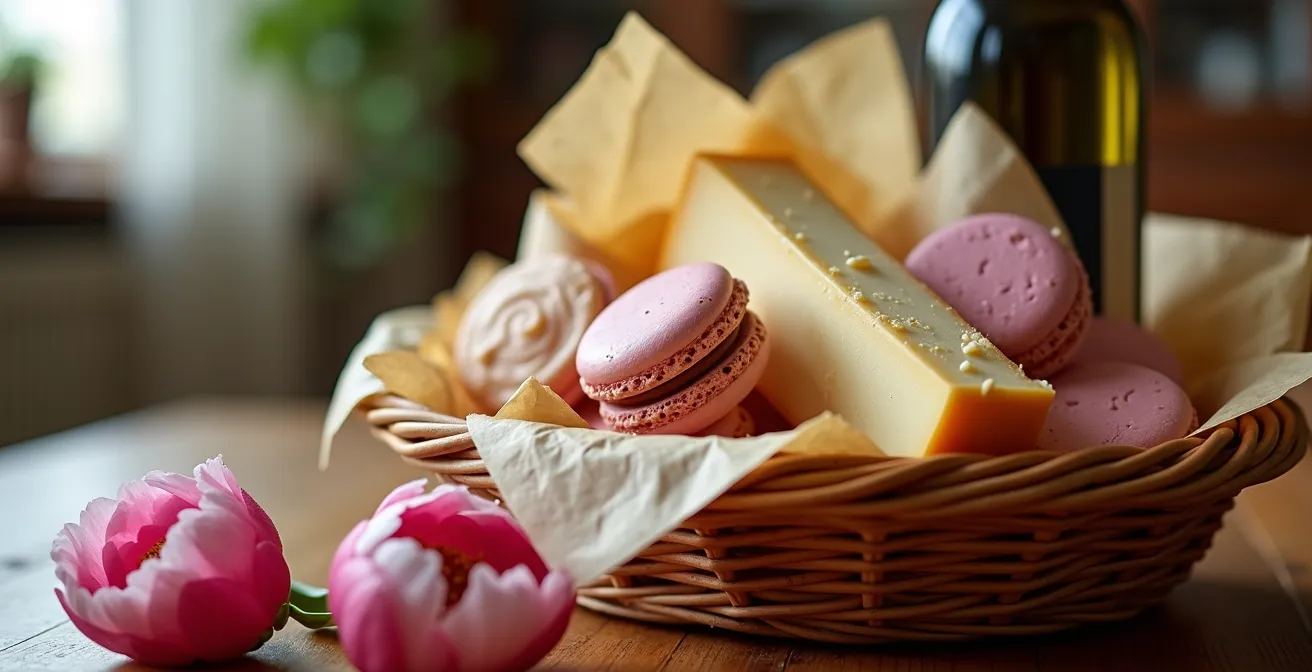
Here is your essential checklist for the perfect host gift, designed to impress and show genuine appreciation:
- Uniquely French Items: A regional cheese, a box of macarons from a well-known pâtisserie, or even a book by a French author in Russian translation are fantastic choices.
- Flowers: Always bring an odd number of flowers (1, 3, 5, etc.). Even numbers are strictly for funerals. Also, avoid red carnations, as they have strong historical associations with Soviet-era memorials.
- Wine: Unlike in France, where bringing wine can sometimes imply the host’s cellar is inadequate, in Russia it is a very welcome contribution to the evening’s festivities.
- Vodka: Do NOT bring a standard bottle of vodka. It’s like bringing a generic baguette to a French person’s home. Only bring it if it’s a very high-end or unique craft brand they are unlikely to have.
- Reciprocity: Don’t be surprised if your host gives you a small gift in return at the end of the evening. It’s a common practice.
- The Thank You Note: Sending a short ‘merci’ text or message the next day is considered incredibly thoughtful and will be remembered.
The “Kitchen Conversation” phenomenon: Why deep talks happen at 3 AM?
If you play your cards right at dinner, you may find yourself part of one of Russia’s most cherished social rituals: the ‘kukhnya’ conversation. The evening doesn’t end after the main course. Instead, everyone migrates to the kitchen (‘kukhnya’), and over endless cups of tea and simple snacks, the real talking begins. These conversations can last for hours, often until the early morning, and cover everything from life and love to philosophy and the “Russian soul.”
This tradition is a direct legacy of the Soviet era. As a study of Soviet-era kitchen culture explains, the kitchen was historically the only truly private space in an apartment, free from the prying ears of the state. While French intellectuals debated philosophy in public cafés like Les Deux Magots, their Russian counterparts held their dissident discussions in the intimacy of the ‘kukhnya’. This has ingrained the kitchen in the national psyche as the place for absolute trust and sincerity. To be invited to a kitchen conversation is to be fully accepted into the inner circle.
Participating in one of these conversations is a privilege. It’s less about debating and more about listening and sharing. Your intellectual prowess is less important than your sincerity. Vulnerability builds trust much faster than clever arguments. To help you navigate this unique social setting, here is a practical guide.
Your Action Plan for Authentic Kitchen Conversations
- Listen more than you speak: Initially, show you are genuinely interested. Russians value a sincere and attentive audience.
- Ask about life, not just politics: Start with questions about family, dreams, and personal experiences. This builds a human connection first.
- Frame sensitive topics carefully: If politics comes up, frame your questions as a desire to understand their perspective, not to challenge or debate it.
- Accept all hospitality: Always accept the offered tea, coffee, or snacks. Refusing can be seen as standoffish and breaks the flow of trust.
- Share your own stories: Be prepared to open up. Sharing personal anecdotes and being vulnerable is the fastest way to build a lasting bond.
Key takeaways
- The key to connection in Moscow is understanding the “Threshold” between the reserved public sphere and the warm private sphere.
- Shared activities in places like Gorky Park are a more effective way to meet locals than relying on small talk in bars.
- Gift-giving etiquette is crucial; a thoughtful, culturally aware gift is a powerful sign of respect when invited to a home.
Why you shouldn’t tag the location of a speakeasy on Instagram?
As you delve deeper into Moscow’s social scene, you might discover another layer of its private world: the hidden speakeasy bars. These are not just trendy spots; they are curated communities built on secrecy and trust. Getting in often requires a phone number, a password, or knowing the right person. Revealing their location publicly on social media is the fastest way to break that trust and disrespect the culture of the establishment.
The secrecy is the entire point. As Russia Beyond notes in its guide to the city’s hidden bars, some venues take this to an extreme. Speaking of one such bar, it states:
Chainaya takes its secrecy to a whole new level, as it refuses to have any signage, and bookings are only made possible either by having the right contacts, or by calling in advance and getting lucky
– Russia Beyond, Moscow’s Secret Cocktail Bars Guide
This discretion is not just about marketing; it’s about preserving a specific atmosphere and, in some cases, operating in a legal gray area that requires a low profile. When a local shares one of these places with you, they are trusting you with a secret. Protecting that secret is a sign of respect for your host and the community. Tagging the location on Instagram is seen as a major social faux pas—it’s the digital equivalent of shouting a secret in a quiet room.
So, how do you share the experience without betraying the trust? It’s about style and subtlety. Here’s how to do it right:
- Post close-up shots of the unique cocktail or a cryptic detail of the decor, without showing any identifiable features of the venue.
- Use ambiguous captions like, “If you know, you know. Moscow nights.”
- Focus your storytelling on the experience, the drink, or the company—not on providing directions.
- If you must tag something, tag the city, or even better, the friend who took you there (with their permission).
Why do Muscovites rarely smile on the street but welcome you home?
We return to the most fundamental concept because it governs everything. By now, you understand the theory: the public persona is reserved, the private one is warm. Now, let’s focus on the most critical moment of your journey: the first five minutes after you’ve been invited inside someone’s home. This is the practical application of the “Smiling Myth,” the moment the transformation happens right before your eyes.
As one local guide service for English speakers in Moscow describes, the shift is immediate and physical. The host’s face relaxes, their body language opens up, and they make warm, direct eye contact. This is the “welcome” you were looking for, and it happens at the threshold. The simple act of being handed a pair of ‘tapochki’ (slippers) is a deeply symbolic gesture; it signifies that you have officially crossed from the cold, formal outside world into the warm, trusted inner sanctum of the home. Your shoes, carrying the dirt of the public street, are left at the door, and so is your “stranger” status.
Navigating these first few moments correctly solidifies your position as a welcome guest. It’s a simple sequence of events, but getting it right shows immense cultural awareness. Here is your step-by-step guide to crossing the threshold flawlessly:
- Accept the ‘tapochki’ immediately and without question. This is the first and most important step.
- Hand over your gift. Do this right after you’ve taken off your shoes, before you move further into the apartment.
- Compliment the home. A genuine compliment on the decor, the view, or the general atmosphere is always appreciated. Russians take great pride in their private spaces.
- Accept the first offer of a drink. Whether it’s “Чай? Кофе?” (Chay? Kofe? – “Tea? Coffee?”), accepting is crucial for building rapport.
- Do NOT attempt ‘la bise’. The French cheek kiss is not a standard greeting here. A firm handshake for men and a polite nod for women is appropriate unless a closer relationship has already been established.
These actions, though small, are the practical embodiment of all the cultural theory we’ve discussed. They are the keys that unlock the door to genuine hospitality. You’ve shown that you understand their world, and in return, they will welcome you into it with open arms.
By moving beyond the surface-level stereotypes and learning to read these crucial cultural codes, you are no longer just a tourist. You are an informed and respectful guest, ready to experience the deep, sincere, and unforgettable warmth of the Russian people. Start by focusing on shared experiences, embrace the intimacy of the kitchen, and you will find the connections you’re looking for.