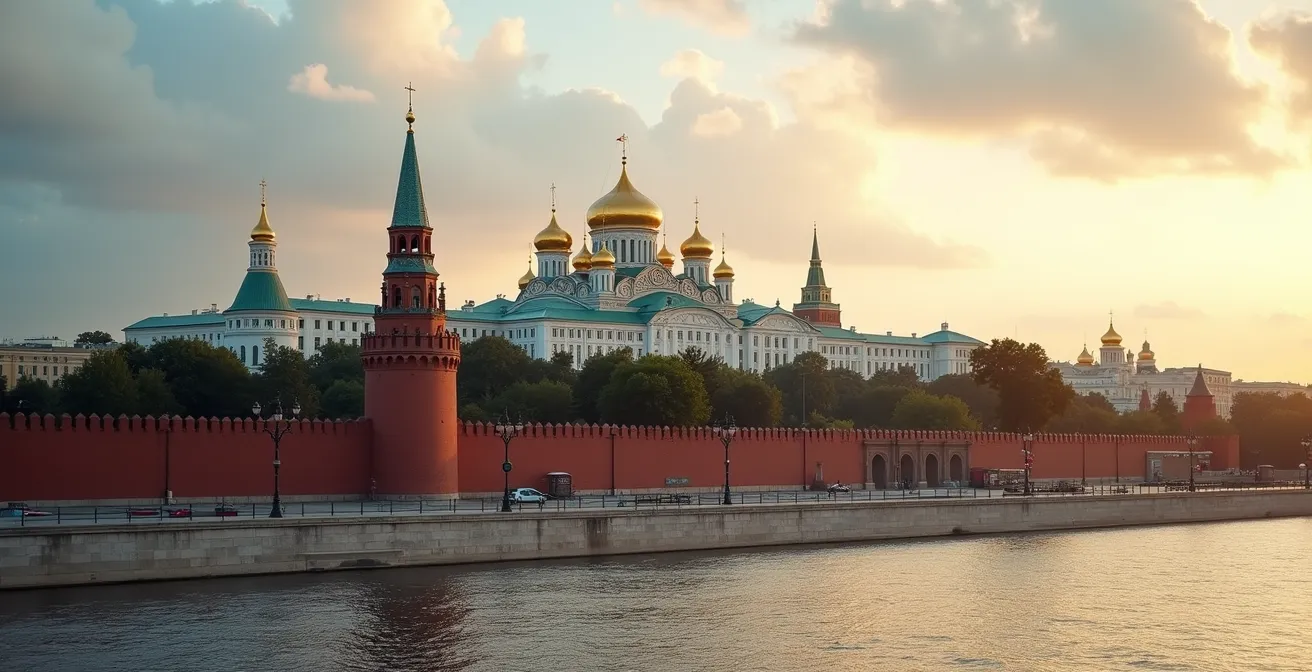
Accessing the Kremlin’s restricted palaces isn’t about finding a secret entrance; it’s about strategically navigating the official bureaucratic system.
- The most opulent areas like the Grand Kremlin Palace and Terem Palace are functioning state residences, accessible only via special request through the Kremlin Commandant’s office.
- Understanding the historical context of each building—from the Renaissance-era Faceted Chamber to the pre-Petrine Boyar Chambers—is key to appreciating their significance.
Recommendation: Instead of focusing on a single ‘closed’ door, approach the Kremlin as an ecosystem. Plan visits to accessible-but-related sites like the Armoury and Kolomenskoye to build a complete picture of Tsarist life, while pursuing official channels for exclusive access.
For any history enthusiast, standing in Moscow’s Cathedral Square is a breathtaking experience. Yet, it’s often tinged with frustration. You gaze at the brilliant, candy-striped roof of the Terem Palace, the private chambers of the first Tsars, only to be met with the same answer from every guide: “It’s closed to the public.” This feeling is compounded when you look towards the immense, imperial yellow facade of the Grand Kremlin Palace, the official residence of the President, and realize it too is off-limits.
The common advice is disheartening: access is only possible with rare, pre-arranged group tours that are notoriously difficult to book. Many articles will simply list the public attractions like the Armoury Chamber or the Diamond Fund, leaving the true heart of the Tsarist court a mystery. But what if the key wasn’t about finding a loophole, but about understanding the system itself? What if you could approach the Kremlin not as a tourist, but as an informed guest who knows the protocol?
This guide is built on that very premise. As a coordinator familiar with the inner workings of the Kremlin, I can tell you that access is a matter of protocol, not secrets. We will deconstruct the Kremlin’s ecosystem, treating its palaces as what they are: functioning state buildings with specific rules of engagement. For you, the French visitor with a keen sense of history, we will draw parallels to Versailles and the formal courts of Europe to contextualize what you’re seeing. This article will guide you through the logic of Kremlin access, from understanding the architectural significance of its oldest secular hall to comparing its opulence with the Winter Palace, all while providing actionable strategies for experiencing these exclusive spaces.
This detailed exploration will equip you with the knowledge to navigate the official channels and appreciate the accessible alternatives. The following sections break down the key questions and comparisons that will transform your visit from a standard tour into a deep historical inquiry.
Summary: A Strategic Guide to the Kremlin’s Exclusive Palaces
- Why is the Faceted Chamber considered the oldest secular building in Moscow?
- Winter Palace vs. Grand Kremlin Palace: Which offers more opulence?
- The confusing process of booking a Diamond Fund ticket without a guide
- What do the 17th-century stove tiles in the Terem Palace reveal about daily life?
- The best angle to shoot the Grand Kremlin Palace from the Moskva River
- The Chambers of the Romanov Boyars: What was life like before Peter the Great?
- Where to stand to see a church, a skyscraper, and a palace in one frame?
- Tsaritsyno or Kolomenskoye: Which palace estate suits a family picnic?
Why is the Faceted Chamber considered the oldest secular building in Moscow?
The Palace of Facets (Granovitaya Palata) stands on Cathedral Square, surrounded by icons of Orthodox faith, yet it is fundamentally different. Its status as Moscow’s oldest preserved secular building isn’t just about age, but about its original purpose and architectural DNA. To understand it, one must go back to the 15th century, when Grand Prince Ivan III decided to transform the Kremlin from a wooden fortress into a symbol of a powerful, unified Russia. To do this, he looked not to Russian tradition, but to the Italian Renaissance.
He invited architects Marco Ruffo and Pietro Solari from Italy, who brought with them a new vision of statecraft expressed through stone. The Faceted Chamber, built between 1487 and 1491, was designed not for worship, but for power. Its very name comes from the distinctive diamond-point stone facing, a technique straight from the Italian Quattrocento, instantly distinguishing it from the nearby Byzantine-style cathedrals. This was a deliberate statement.
The chamber’s function was purely political. It served as the primary throne room and formal reception hall for the Muscovite grand princes and later, the Tsars. This is where foreign ambassadors were received, military victories were celebrated with grand banquets, and crucial meetings of the Zemsky Sobor (the assembly of the land) took place. Its entire existence was dedicated to the performance of state power, a concept entirely separate from the religious authority embodied by the adjacent Dormition and Archangel Cathedrals. It was the Kremlin’s first and most important hall of state, a secular heart within a sacred fortress.
Winter Palace vs. Grand Kremlin Palace: Which offers more opulence?
Comparing the opulence of the Winter Palace in St. Petersburg and the Grand Kremlin Palace in Moscow is like comparing two different philosophies of imperial power. Both are staggering in their scale and grandeur, but they speak in different architectural languages. The Winter Palace is an outward-facing statement of European Baroque splendour, while the Grand Kremlin Palace is an inward-looking testament to Russian-Byzantine tradition and state authority.
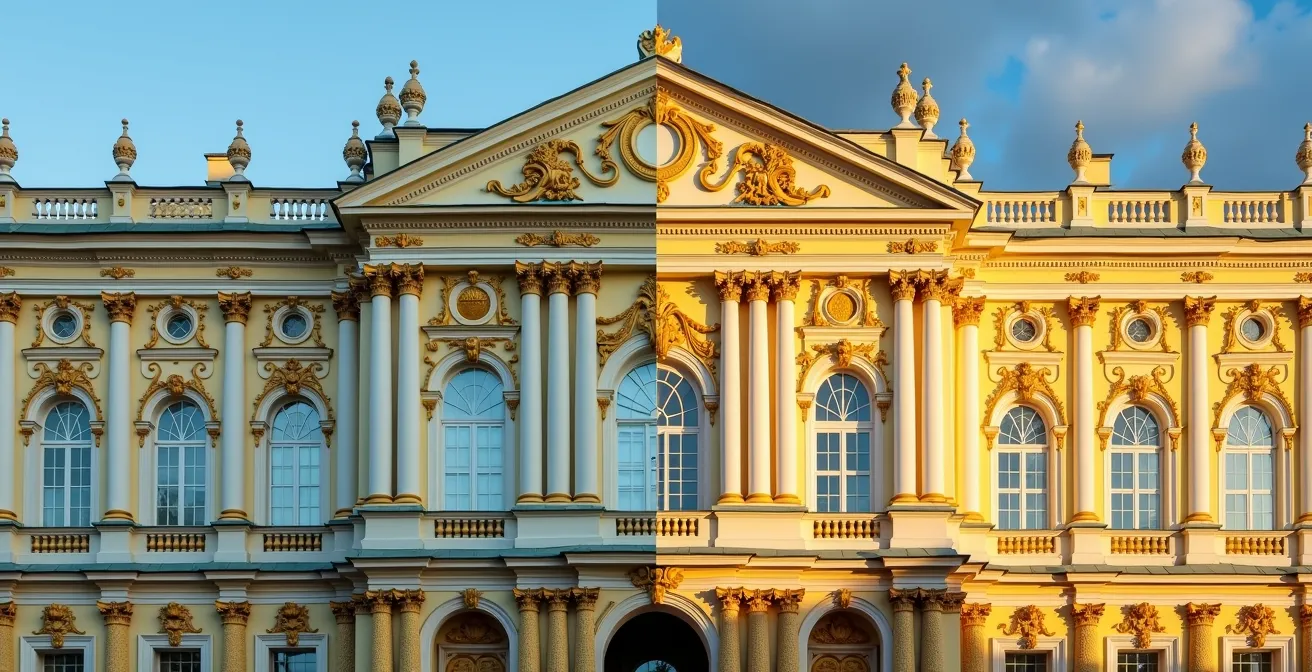
The sheer metrics tell part of the story. The Winter Palace, designed by the Italian Bartolomeo Rastrelli, is a masterpiece of the Elizabethan Baroque style. It was the official residence of the Romanovs for nearly two centuries and was built to impress and overwhelm European rivals. Its scale is almost incomprehensible. Conversely, the Grand Kremlin Palace, designed by Konstantin Thon in the 19th century, was intended to integrate seamlessly with the older Terem Palace and the Kremlin’s ancient churches, celebrating a distinctly Russian identity.
To truly compare them, one must look beyond aesthetics to their function and accessibility, which reveals the true nature of their “opulence.” The following table breaks down these differences, highlighting why one is a world-famous museum and the other remains a seat of power.
| Aspect | Winter Palace (St. Petersburg) | Grand Kremlin Palace (Moscow) |
|---|---|---|
| Size & Scale | 1,500 rooms, 1,886 doors, 1,945 windows, 117 staircases, 233,345 square metres floor area | 700 rooms across 35,000 square meters |
| Architectural Style | Elizabethan Baroque style by Bartolomeo Rastrelli, green-and-white facade, 215 metres long and 30 m high | Russian-Byzantine style by Konstantin Thon, matching the decoration of the adjacent Terem Palace |
| Public Accessibility | Open daily as Hermitage Museum, standard ticket purchase | Excursions only during free time from official events, requires special organizational requests to the Kremlin Commandant |
| Historical Significance | Official residence of the House of Romanov from 1732 to 1917 | Currently serves as the official working residence of the president of Russia |
| Cost for Tourists | Standard Hermitage ticket: approximately 15-20 EUR | A two-hour excursion costs over $80 |
The confusing process of booking a Diamond Fund ticket without a guide
Navigating the ticket process for the Kremlin’s main attractions can feel like a bureaucratic puzzle, and the Diamond Fund (Almazny Fond) is a prime example. While it is located inside the Armoury building, it is a separate exhibition with its own ticket. For the independent French traveler wishing to avoid mandatory guided tours, securing a ticket requires a specific strategy and a bit of patience.
The most straightforward method is to purchase tickets in person. You must go to the Kremlin ticket offices located in the Alexander Garden, specifically looking for kassa (ticket office) #4. These offices open at 9:00 and close at 16:30, but arriving early is crucial to avoid long queues, especially during peak season. First, you purchase your entry ticket to the Armoury (1,000 rubles), and then, once inside the Armoury building, you can purchase the separate ticket for the Diamond Fund (an additional 500 rubles). While it has been reported that credit cards are accepted, it is wise to be prepared for technological glitches.
This is where an insider’s warning becomes critical, particularly for French visitors. The official body, Gokhran of Russia, states that it is not responsible for any payment disputes between a customer and a credit institution. This hands-off approach means you cannot rely on a single payment method. It is highly advisable to carry both Visa and Mastercard, ensure they are enabled for international transactions, and have a sufficient amount of cash in rubles as a reliable backup. This foresight can be the difference between a smooth visit and a frustrating dead end. If all else fails, a second ticket office is located at Manezhnaya St., 2-10, building 3, though the Alexander Garden location remains the primary hub.
Your Pre-Booking Audit for the Diamond Fund
- Payment Methods: Verify you have at least two different credit cards (e.g., Visa and Mastercard) enabled for foreign use, plus a backup supply of cash in rubles.
- Timings & Location: Confirm the opening hours (9:00-16:30, closed Thursdays) and exact location of ticket office #4 in the Alexander Garden. Plan to arrive before 9:00.
- Dual-Ticket Strategy: Acknowledge that you must first buy the Armoury ticket and then the Diamond Fund ticket separately inside the Armoury complex.
- Online Plan B: Research the official Kremlin museum website for online tickets, but be prepared for a potentially confusing interface and a bureaucratic refund process if plans change.
- Contingency Plan: If on-site tickets are sold out, have an alternative activity planned, such as exploring the Alexander Garden or visiting the State Historical Museum.
What do the 17th-century stove tiles in the Terem Palace reveal about daily life?
The magnificently tiled stoves (pechi) of the Terem Palace are far more than just antique heating systems; they are vibrant storybooks of 17th-century Muscovite life and belief. While the palace itself is notoriously inaccessible, understanding these tiles offers a profound glimpse into the world of the early Tsars. The exterior of the palace, with its brilliant red, yellow, and orange hues, is exuberantly decorated with these colored tiles, which served both a practical and a narrative purpose.
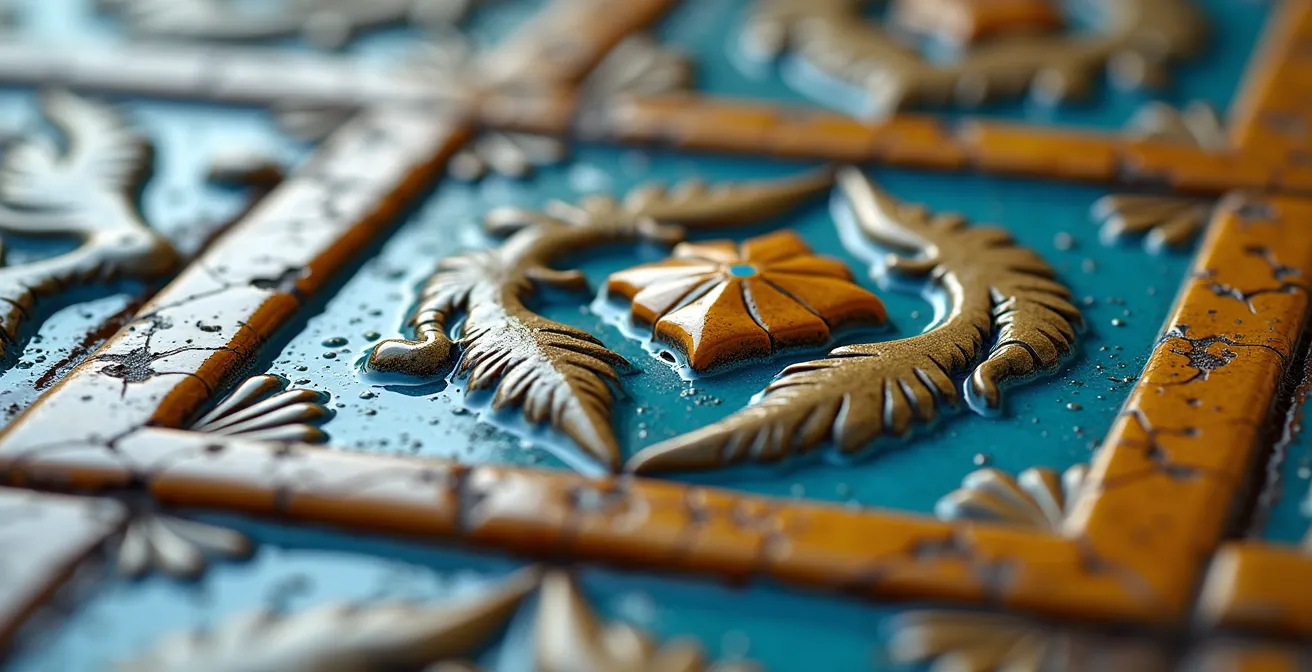
These weren’t just decorative patterns. Each tile, or series of tiles, often depicted scenes from Russian folklore, biblical parables, or even daily court life. They functioned much like the grand tapestries of the Gobelins Manufactory in France, which told stories of mythology and royal power to the court of Louis XIV. For the Tsar and his family, confined within the palace walls for much of the winter, these stoves were a source of warmth and a constant visual reminder of their culture, faith, and dominion. They were the television and the art gallery of their time, rolled into one.
Since viewing the Terem Palace tiles is a rare privilege, the savvy history enthusiast should explore accessible alternatives where this incredible art form is on full display. Fortunately, Moscow offers several outstanding options:
- Kolomenskoye Estate: The reconstructed wooden palace of Tsar Alexei Mikhailovich features breathtakingly authentic 17th-century tiled stoves, giving you the most accurate feel for the original Terem interiors.
- Chambers of the Romanov Boyars: Located near Red Square, this museum is the ancestral home of the Romanov dynasty and displays period tiled stoves in an authentic noble residence setting.
- State Historical Museum: This vast museum on Red Square contains an extensive collection of historic Russian tiles, allowing you to see their evolution up close.
- Izmailovo Kremlin: While a modern recreation, it features artisans demonstrating traditional tile-making techniques, offering insight into the craft itself.
The best angle to shoot the Grand Kremlin Palace from the Moskva River
Photographing the Grand Kremlin Palace from the Moskva River offers a majestic perspective, but capturing the perfect shot requires more than just pointing your camera from a tour boat. As an insider, I can tell you the best angle is a matter of timing, positioning, and anticipating the movement of the vessel. The goal is to capture its immense, uninterrupted facade without the visual clutter of the foreground.
Most river cruises pass along the Kremlin Embankment, providing a direct view. The optimal moment arrives as your boat aligns directly opposite the palace, with the Borovitskaya Tower to your left and the Water Supplying Tower to your right. This vantage point allows you to capture the full length of Konstantin Thon’s 125-meter-long facade. Using a lens in the 35-50mm range on a full-frame camera will allow you to frame the palace without significant distortion, capturing its rhythmic procession of arched windows and the Russian flag flying proudly from its roof.
Timing is everything. Aim for a cruise during the “golden hour,” the period shortly after sunrise or before sunset. During these times, the low-angled sun bathes the palace’s warm yellow stucco in a soft, flattering light, accentuating the architectural details and creating a beautiful reflection on the Moskva’s surface. Be prepared for the technical challenge: the boat is constantly moving. Use a faster shutter speed (at least 1/250s) to avoid motion blur and consider using a polarizing filter to reduce glare from the water and deepen the blue of the sky. This combination of strategic positioning, perfect lighting, and technical readiness is the key to a truly postcard-worthy shot.
The Chambers of the Romanov Boyars: What was life like before Peter the Great?
To truly understand Russia, one must grasp the world that existed before Peter the Great forcibly turned the country towards Europe. A visit to the Chambers of the Romanov Boyars, the ancestral home of the dynasty, provides a rare and authentic window into this pre-Petrine era. Life for the powerful boyars (the highest rank of nobility) was a unique blend of state duty, religious piety, and deeply ingrained tradition that stands in stark contrast to the court life of 17th-century France.
The daily routine was centered entirely around the Tsar. In the morning, the boyars would gather in the Antechamber, waiting for the Tsar’s appearance. The Tsar would then meet with his Boyar Council in the Assembly Hall to discuss matters of state. In a fascinating break from protocol that would have been unthinkable in Europe, Tsar Alexey Mikhailovich would often read aloud the most interesting articles from European newspapers, which were delivered daily. This act of the Tsar himself reading to his subjects would have shocked the French nobility at Versailles, where every moment of the king’s day, including his morning dressing (the *lever*), was a highly ritualized performance where nobles vied for the honor of simply being present.
This difference highlights the unique nature of Muscovite autocracy. While the Tsar held absolute power, his relationship with the boyars was more patriarchal and less formal than that of Louis XIV with his courtiers. The boyars’ lives were governed by the Domostroy, a 16th-century rulebook dictating social, religious, and domestic behavior, emphasizing piety and household management over the elaborate courtly etiquette that defined Versailles. Their world was smaller, more insular, and deeply rooted in Orthodox tradition, a world Peter the Great would soon shatter with his reforms.
Where to stand to see a church, a skyscraper, and a palace in one frame?
In Moscow, history is not linear; it is layered. There is one specific, almost magical spot where you can capture three distinct eras of Russian power—Tsarist, Soviet, and modern—in a single photograph. This “Trinity View” is a must-capture for any history enthusiast, as it visually encapsulates the nation’s complex and often contradictory timeline. The key is knowing exactly where to stand.
The primary location is the Patriarshy Bridge, a modern pedestrian bridge often called Moscow’s ‘Pont des Arts.’ From the center of this bridge (GPS: 55.7449° N, 37.6119° E), you can perfectly frame the shot. To your left stands the gleaming golden dome of the Cathedral of Christ the Saviour, a symbol of Orthodox Russia’s resilience (it was destroyed by Stalin and rebuilt in the 1990s). In the center, you will see the walls and palaces of the Kremlin, representing centuries of Tsarist rule, with the Grand Kremlin Palace now serving as the residence of the president. To the right, looming in the background, is the iconic Kotelnicheskaya Embankment Building, one of Stalin’s imposing “Seven Sisters” skyscrapers, a monument to Soviet ambition and power.
For the best results, follow these technical tips:
- Best Timing: Go during the “golden hour,” about an hour before sunset, when the warm light illuminates the Cathedral’s white facade.
- Camera Settings: Use a wide-angle lens (24-35mm) to capture the full panorama. Set your aperture to f/8-f/11 to ensure everything from the church to the skyscraper is in sharp focus.
- Composition: Apply the rule of thirds, placing the cathedral on the left, the Kremlin in the center, and the skyscraper on the right to create a balanced, dynamic image.
If the bridge is too crowded, two excellent alternative spots are the “floating bridge” in Zaryadye Park for a unique low-angle view, or the observation deck of the Central Children’s Store for an elevated perspective.
Key takeaways
- Exclusive access to the Kremlin’s inner palaces is a bureaucratic process, not a tourist one, requiring official requests to the Kremlin Commandant.
- Understanding the architectural history, like the Italian Renaissance influence on the Faceted Chamber, provides crucial context.
- For a complete historical experience, supplement your Kremlin visit with accessible sites like Kolomenskoye Estate and the Chambers of the Romanov Boyars, which offer authentic period details.
Tsaritsyno or Kolomenskoye: Which palace estate suits a family picnic?
After the intensity of exploring the Kremlin, a relaxing day at one of Moscow’s sprawling palace estates is the perfect antidote. For a family picnic, the two best choices are Kolomenskoye and Tsaritsyno. While both offer beautiful landscapes and historical architecture, they provide very different experiences, much like the choice between Paris’s rustic Bois de Vincennes and the formal gardens of the Parc de Sceaux.
Kolomenskoye is an ancient, sprawling royal estate overlooking the Moskva River. It feels more like a vast, natural park with a deep sense of history. Its open meadows and riverside spots are perfect for spreading out a picnic blanket. For children, the appeal lies in the traditional wooden playgrounds and the stunning reconstruction of Tsar Alexei Mikhailovich’s fairy-tale wooden palace. The terrain is more rustic, with some unpaved paths, giving it an authentic, countryside feel.
Tsaritsyno, on the other hand, is a masterpiece of Gothic Revival architecture with a more dramatic, romantic atmosphere. It has a sad but fascinating history; it was designed for Catherine the Great, but she never lived there. The palace was left in ruins for centuries before a massive restoration in 2005-2007. Today, it boasts perfectly manicured formal gardens, modern playgrounds, and dazzling musical fountain shows that captivate children. Its network of paved paths makes it exceptionally easy to navigate with a stroller.
To help you decide, here is a direct comparison for a French family considering a day out:
| Feature | Kolomenskoye (Moscow’s ‘Bois de Vincennes’) | Tsaritsyno (Moscow’s ‘Parc de Sceaux’) |
|---|---|---|
| Park Character | Ancient, rustic, sprawling natural landscape | Has a sad history – designed as Catherine II’s residence but never lived in, only restored in 2005-2007 to become the amazing palace its architects envisioned |
| Picnic Friendliness | Excellent – large open meadows, riverside spots | Good – formal gardens but designated picnic areas |
| Children’s Facilities | Traditional wooden playground, hands-on history workshops | Modern playgrounds, musical fountain shows |
| Stroller Access | Mixed – natural paths, some unpaved areas | Excellent – paved paths throughout |
| Teen Appeal | Historical reenactments, apple orchards | Instagram-worthy palace backdrops, light shows |
| Food Options | Basic cafes, bring your own recommended | Multiple restaurants, formal dining available |
With this insider knowledge, you are now equipped to plan a trip to Moscow that goes far beyond the standard tourist itinerary. By understanding the system, appreciating the history, and knowing the practical details, you can unlock a side of the Kremlin and its surrounding history that remains hidden to most.