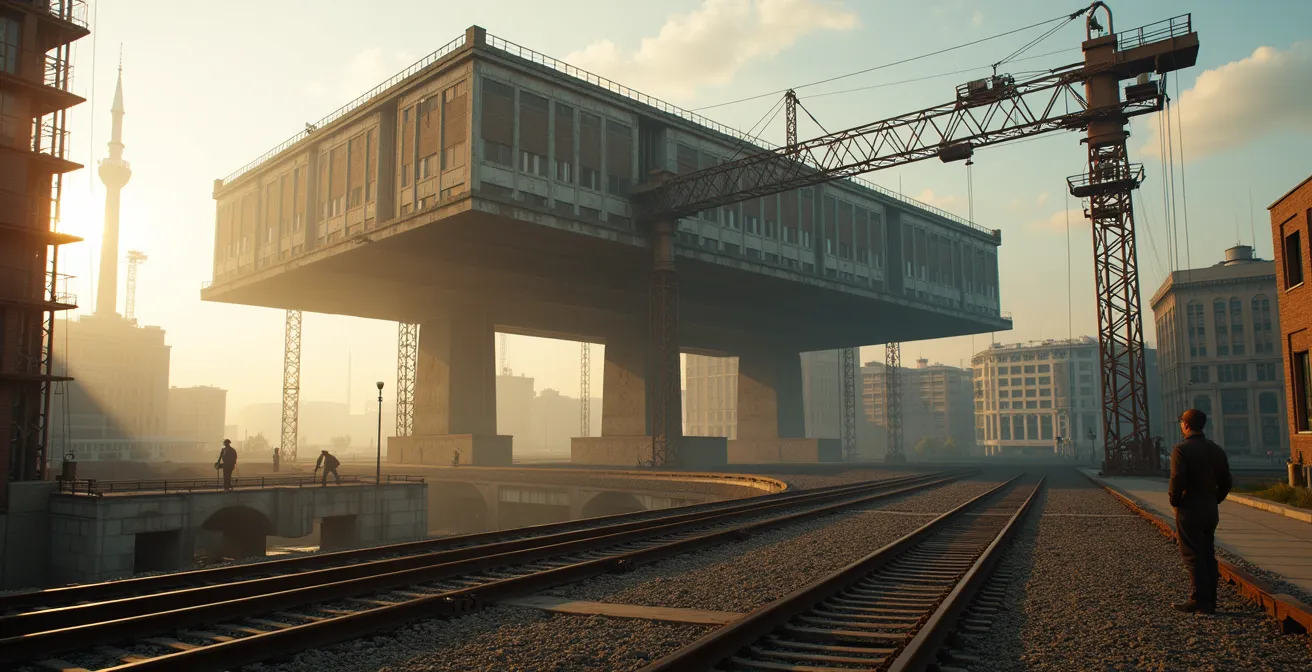
The legendary feat of moving Moscow’s Tverskaya buildings was not magic, but a triumph of audacious structural engineering and absolute state control.
- Engineers used a system of steel frames, rollers, and synchronized winches to move structures weighing up to 23,000 tons.
- This transformation was a core component of Stalin’s 1935 Master Plan, which prioritized monumentalism over the city’s organic fabric.
Recommendation: To truly grasp this project, view Tverskaya not as a single street, but as a multi-layered museum of competing urban philosophies.
The story sounds like a fantastical tale: in the dead of night, while residents slept soundly in their beds, entire multi-story masonry buildings in the heart of Moscow were silently lifted and moved to new locations. Water, sewage, and electricity remained connected. In the morning, residents would wake up to find their view—and their address—irrevocably changed. This was the reality on Gorky Street, now Tverskaya, during the 1930s. While the anecdote of sleeping inhabitants is the most famous part of the legend, it often obscures the true marvel of the operation.
The common understanding is that the buildings were simply “put on rails and pushed.” But this simplification belies the staggering complexity and precision involved. This was not a stunt; it was a calculated, audacious demonstration of engineering prowess, a key part of Stalin’s 1935 General Plan for the Reconstruction of Moscow. The goal was to transform the narrow, winding Tverskaya into a wide, monumental artery fit for military parades and symbolic of the new Soviet power. This ambition required a form of urban cannibalism, where some buildings were devoured to make way for the new avenue, while others were meticulously relocated in a breathtaking logistical ballet.
This article moves beyond the legend to explore the structural engineering principles that made the impossible possible. We will analyze the methods used, examine the fate of key buildings that survived this radical surgery, and place this feat within the broader ideological context of Stalinist urbanism. From the subterranean propaganda of the Moscow Metro to the sky-piercing Stalinist skyscrapers, the relocation of Tverskaya’s buildings was a terrestrial symptom of a city-wide ideological transformation.
To understand this monumental project, we will deconstruct its various layers, from specific buildings that were moved or left behind to the overarching philosophy that drove this unprecedented urban redesign. The following sections will guide you through the past and present of Moscow’s most famous street.
Summary: The Engineering and Ideology of a Transformed Moscow
- Eliseevsky Store: Is the most beautiful grocery store in the world closing down?
- Savvinskoye Podvorye: How to find the building hidden behind Tverskaya?
- The Tverskaya route: Is it better to walk or take the bus to the Kremlin?
- Nightlife on Tverskaya: Where to eat after the clubs close?
- The legendary spy restaurant: What remains of the KGB hangouts on Tverskaya?
- Why you should walk Old Arbat but drive through New Arbat?
- The 24 hours of Soviet Sky: How to read the ceiling domes of Mayakovskaya?
- How to photograph Moscow’s Stalinist skyscrapers in low winter light?
Eliseevsky Store: Is the most beautiful grocery store in the world closing down?
Before it became a stage for Soviet engineering, Tverskaya Street was Moscow’s most fashionable boulevard, lined with neo-baroque and Art Nouveau masterpieces. The Eliseevsky Gastronome, with its gilded chandeliers and opulent decor, is perhaps the most spectacular relic of this Tsarist-era grandeur. Opened in 1901, it survived the 1917 Revolution and the subsequent Stalinist reconstruction, standing as a silent witness while the buildings around it were either demolished or moved. Its survival is a testament to its architectural and cultural significance, an island of pre-revolutionary luxury that was too iconic even for the Soviets to destroy.
However, the very transformations that spared it may now be contributing to its decline. The widening of Tverskaya and the subsequent shifts in urban demographics have altered the street’s character. Once a residential hub, the area has become increasingly commercial and administrative, a reality highlighted by economic expert Igor Berezin. In an interview with the Christian Science Monitor, he noted the core issue facing the historic store:
Eliseevsky is mainly a shop for local residents, but there are far fewer of them in that area than there used to be
– Igor Berezin, Christian Science Monitor
The potential closure of Eliseevsky isn’t just a commercial failure; it represents the final chapter of an urban story. The monumental scale of the new Tverskaya, designed for parades and power, has slowly eroded the fine-grained, human-scale community that once sustained such establishments. The store stands as a beautiful but fragile monument to a bygone era, its fate intertwined with the very urban transformations that defined modern Moscow.
Savvinskoye Podvorye: How to find the building hidden behind Tverskaya?
The Savvinskoye Podvorye is the star exhibit of the Tverskaya relocation project. This 23,000-ton apartment building, constructed in 1907, was moved 50 meters in a single night in 1939 to clear a path for the expanding avenue. To find it today, one must walk into a non-descript archway at Tverskaya, 6 and discover it nestled in a courtyard, an architectural ghost hidden behind a stern Stalin-era facade. So, how was this monumental feat of structural engineering accomplished?
The process was a masterclass in planning and execution. First, a deep trench was dug around the building’s perimeter. Engineers then carefully inserted a massive steel frame, known as a “rama,” through the basement walls, effectively creating a rigid new foundation. This frame was then used to lift the entire building off its original foundation using hundreds of hydraulic jacks. The true genius lay in the next step: the entire structure was lowered onto a network of steel rollers placed on meticulously leveled railway tracks. The motive force was not brute pushing but synchronized propulsion, achieved with powerful electric winches pulling steel cables attached to the frame. The entire operation was controlled from a central command post, ensuring the movement was perfectly even, at a rate of just a few meters per hour, to maintain structural integrity.
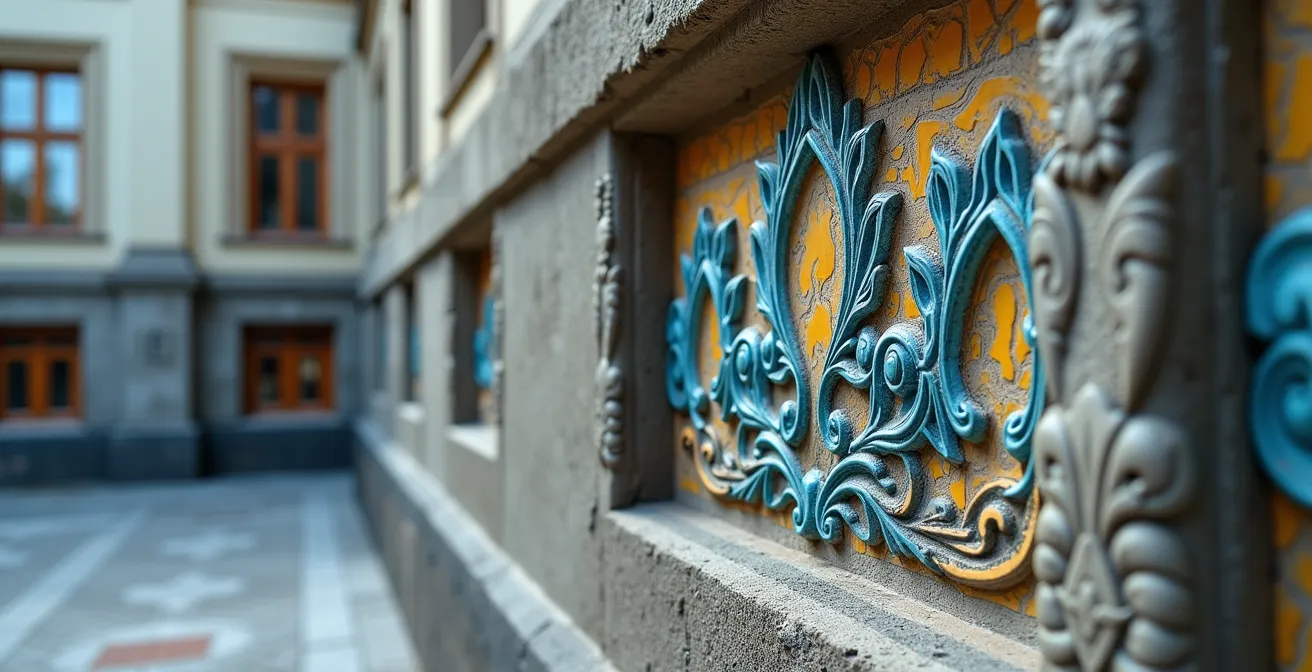
This image captures the jarring contrast between the delicate Art Nouveau details of the original Savvinskoye Podvorye and the imposing concrete of the building that now conceals it from the main street. The meticulous preservation of the building during its move highlights the engineers’ primary goal: not destruction, but the complete subordination of the urban environment to a state-mandated plan. The building wasn’t just moved; it was repositioned on the city’s chessboard.
The Tverskaya route: Is it better to walk or take the bus to the Kremlin?
Experiencing Tverskaya Street today presents a choice that reflects its dual nature. Should you walk its 1.6-kilometer length to absorb the details, or take a bus to appreciate its monumental scale? From an engineering and historical perspective, the answer is both, as each method reveals a different layer of the 1930s reconstruction. Walking is an exercise in urban archaeology. It allows you to peer into courtyards and spot the architectural seams where old meets new. You can stand on the spot where the Moscow City Hall (the Mossovet building) was moved back 14 meters, a subtle shift almost invisible to the passing car.
Riding the bus, however, offers the cinematic experience the Soviet planners intended. From a moving vehicle, the individual buildings blur into a single, imposing architectural ensemble. The uniform height, the powerful cornices, and the sheer width of the avenue create a feeling of overwhelming scale and order. This was the “flow” envisioned by the architects—a grand processional route leading to the heart of power, the Kremlin. Tverskaya’s post-Soviet transformation into a hub of high-end retail only amplifies this sense of grandeur. In 2008, it even ranked as the third most expensive street in the world based on commercial rental rates, a direct legacy of its prestigious, state-mandated makeover.
Your Tverskaya Experience: A Guide to Walking vs. Riding
- Walk to Discover: Walking is essential for finding the hidden courtyards where moved buildings like Savvinskoye Podvorye now reside.
- Ride for Scale: A bus or car ride provides the cinematic view of Stalin’s monumental urban planning, appreciating the avenue’s uninterrupted sweep.
- Walk to Spot Details: On foot, you can identify the 14-meter displacement of the Mayor’s residence and other subtle clues of the street’s surgical alteration.
- Ride for the Full Sweep: By vehicle, you experience the full 1.6km axis from Manezhnaya Square to Triumfalnaya Square as a single, powerful statement.
- Walk for Layers: Walking reveals the different architectural eras—Tsarist, Soviet, and modern—that coexist at street level.
Ultimately, the choice depends on what you seek. Walk to understand the sacrifices and clever engineering solutions. Ride to feel the ideological power that reshaped a city.
Nightlife on Tverskaya: Where to eat after the clubs close?
The transformation of Tverskaya from a bustling residential and commercial street into a monumental state avenue had a profound, long-term effect on its social function. Decades after the reconstruction, with the fall of the Soviet Union, the street’s immense scale and central location made it the natural epicenter for a new kind of public life. As noted in historical analyses, Tverskaya quickly became the center of the city’s nightlife and entertainment. The grand avenue, once designed for military parades, was now the stage for post-Soviet capitalism and hedonism.
This evolution gave rise to a distinct late-night culture. While Paris has its tradition of onion soup in classic brasseries, Moscow’s post-club scene on and around Tverskaya developed its own character, often blending Soviet nostalgia with modern convenience. Many 24/7 establishments occupy spaces that were once state-run canteens (*stolovayas*), now serving hearty, traditional Russian fare like *pelmeni* (dumplings) or borscht to a late-night crowd. It’s a substantial, restorative dining culture, a stark contrast to the lighter, quicker bites one might find in other European capitals.
This table highlights the differing traditions, showing how Moscow’s late-night dining scene on Tverskaya is a unique product of its tumultuous history.
| Aspect | Moscow (Tverskaya) | Paris |
|---|---|---|
| Traditional late-night food | Hearty pelmeni, borscht | Onion soup at Au Pied de Cochon |
| Dining culture | Substantial meals after clubs | Light crêpes or quick bites |
| Historical venues | Former Soviet stolovayas transformed | Classic brasseries still operating |
| Operating hours | Many 24/7 options | Limited late-night choices |
The street’s modern identity as an entertainment hub is therefore not a departure from its past, but a direct consequence of it. The monumental scale designed to project state power created a vast public stage that was later repurposed for commerce and leisure, making Tverskaya a living chronicle of Russia’s social and economic shifts.
The legendary spy restaurant: What remains of the KGB hangouts on Tverskaya?
Beneath the visible layers of architectural transformation on Tverskaya lies an invisible history of power and intrigue. During the Soviet era, the street’s proximity to the Kremlin and its concentration of official institutions made it a natural habitat for the political elite and the security services. While specific “spy restaurants” are more the stuff of Cold War legend than verifiable fact, certain cafes and establishments were well-known as informal gathering spots for KGB officers and party functionaries. These places were part of the street’s unseen infrastructure, as critical to the state’s functioning as the government buildings themselves.
Today, almost nothing of that clandestine world remains. The arrival of Western brands in the 1990s, most famously the first McDonald’s in Russia just off Tverskaya at Pushkin Square, heralded a dramatic cultural shift. The secretive hangouts of the Soviet elite were replaced by the transparent, standardized environments of global capitalism. Yet, the street’s identity is a palimpsest, with each era writing over the last without ever fully erasing it. A powerful summary of this layered history comes from The Washington Post’s reflection on the street’s significance:
It is where Russians danced in the time of the czars, where Stalin ordered buildings moved, where Western fast food arrived and where dissidents still gather
– The Washington Post, On Moscow’s Tverskaya Street
This quote perfectly captures the street’s role as a continuous stage for Russian history. The legacy of the KGB era is not found in specific locations you can visit, but in the collective memory and the understanding that this grand avenue has always been a corridor of power, whether wielded by Tsarist aristocrats, Soviet spies, or modern-day oligarchs. The physical act of moving buildings was merely the most visible expression of the state’s power to reshape reality, a power that also operated in the city’s more shadowy corners.
Why you should walk Old Arbat but drive through New Arbat?
To truly understand the philosophy behind the reconstruction of Tverskaya, it is immensely useful to compare it with another famous Moscow thoroughfare: the Arbat. Or rather, the two Arbats. Old Arbat (Stary Arbat) is a charming, pedestrianized street that has evolved organically over centuries. Its winding path and human-scale buildings represent the pre-revolutionary city. New Arbat (Novy Arbat), by contrast, was blasted through a historic neighborhood in the 1960s. It is a wide, straight artery lined with modernist towers, a later-generation echo of the principles first applied to Tverskaya.
Walking Old Arbat is an intimate experience; driving through New Arbat is an act of efficient, impersonal transit. This contrast embodies the fundamental conflict in 20th-century urban planning: the organic city versus the planned city. The Tverskaya project was the ultimate expression of the latter. It was not just a renovation but an industrial process, managed with ruthless efficiency. This is perfectly illustrated by the methodology of its chief architect.
Case Study: The ‘Flow Method’ of Arkady Mordvinov
The Gorky Street (Tverskaya) project was a testing ground for new construction management techniques. According to historical architectural analyses, Arkady Mordvinov implemented the ‘flow method’ (potochny metod) to manage the rebuilding of the central section between 1937 and 1939. This method, borrowed from industrial factory production, treated the entire street as an assembly line. Construction activities were standardized and sequenced, allowing for a continuous ‘flow’ of work along the length of the street. This state-planned approach to urban development, prioritizing speed and scale over preservation, finds its modern parallel in projects like Paris’s La Défense, as noted in a comparative study on Stalinist architecture and its influence.
Driving through New Arbat or the rebuilt Tverskaya, you are experiencing the city as a machine for movement. Walking Old Arbat, you experience the city as a place for human interaction. The decision to move massive buildings on Tverskaya was born from the same ideology that created New Arbat: a belief that the city’s fabric could and should be completely re-engineered to serve the state’s vision of modernity.
The 24 hours of Soviet Sky: How to read the ceiling domes of Mayakovskaya?
The 1935 Moscow Master Plan was not limited to the city’s surface. It envisioned a total transformation that extended deep underground. The Moscow Metro, particularly its central stations built in the 1930s and 40s, was conceived as a subterranean palace for the people—and a powerful propaganda tool. Mayakovskaya station, opened in 1938, is perhaps the most elegant expression of this vision and a direct counterpart to the reconstruction happening on Tverskaya just above it.
Designed by Alexey Dushkin, the station is a masterpiece of Art Deco-influenced Stalinist architecture, with graceful steel arches and walls clad in marble and rhodonite. Its most defining feature, however, is the series of 34 ceiling mosaics designed by the artist Alexander Deyneka, collectively titled “24-Hour Soviet Sky.” To “read” these domes is to witness an idealized vision of Soviet life, a perfect sky that was a metaphor for the bright future being built. The mosaics depict a chronological progression from morning to night, filled with scenes of aviation and peaceful labor: biplanes soaring, parachutists descending, and athletes competing, all under a perpetually sunny or starlit sky.
There is no hint of the dark political realities of the late 1930s—the purges, the fear, the shortages. The “Soviet Sky” of Mayakovskaya is a carefully constructed utopia. It served the same ideological purpose as the widened Tverskaya: to project an image of a powerful, modern, and triumphant state. While the street was a stage for displaying military might on the ground, the metro was a sanctuary that promised a heavenly future below it. Both were integral parts of the same grand narrative, using structural and artistic innovation to shape the consciousness of the Soviet citizen.
Key Takeaways
- The Tverskaya building relocation was a complex engineering feat involving steel frames, rollers, and synchronized winches, not just a simple push.
- The project was a core part of Stalin’s 1935 Master Plan, prioritizing monumental avenues and state power over historical preservation.
- The legacy of this transformation is visible everywhere, from hidden buildings like Savvinskoye Podvorye to the scale of the Stalinist skyscrapers that dominate the skyline.
How to photograph Moscow’s Stalinist skyscrapers in low winter light?
The final, vertical exclamation point of Stalin’s 1935 Master Plan was the “Seven Sisters,” a ring of skyscrapers built between 1947 and 1953. These monumental buildings, including the main building of Moscow State University (MSU), were the ultimate expression of the same ideology that widened Tverskaya. They were designed to dominate the skyline and project Soviet power both inward and outward. In fact, the MSU building, reaching 240 meters, remained Europe’s tallest building until 1990. Capturing their essence in photography, especially in the challenging low light of a Moscow winter, is an exercise in understanding their architectural intent.
The key is to emphasize their oppressive grandeur and monumental scale. Using a wide-angle lens from a low viewpoint makes the buildings tower menacingly over the viewer. The “blue hour”—the period just after sunset when the sky is a deep blue but the building lights are on—provides a dramatic contrast that highlights their form. Winter is particularly effective, as long shadows cast by the low sun can be used to underscore their massiveness. Shooting from across the Moskva River, for instance from Sparrow Hills, allows for a “gaze of power” perspective, framing the skyscrapers as a dominant force overseeing the city.
This monumentalism, however, came at an immense human cost. The focus on such grandiose projects had a direct impact on the lives of ordinary citizens. As one historical analysis points out, the resources diverted to constructing the Seven Sisters were staggering:
The resources diverted for this project effectively halved housing construction rates
– Wikipedia, Seven Sisters (Moscow)
Photographing these towers, therefore, is not just an architectural exercise. It is about capturing a paradox: the sublime beauty of their design and the immense, often brutal, state power they represent. They are the vertical culmination of the same philosophy that treated Tverskaya’s buildings as movable pieces on a chessboard—a belief in the state’s absolute right to reshape the world in its own image, no matter the cost.
To truly appreciate the audacity of the Soviet era, the next logical step is to delve into the archival blueprints and period footage that document these incredible engineering feats. Analyzing these primary sources offers a direct window into the minds of the engineers who turned the impossible into a concrete reality.