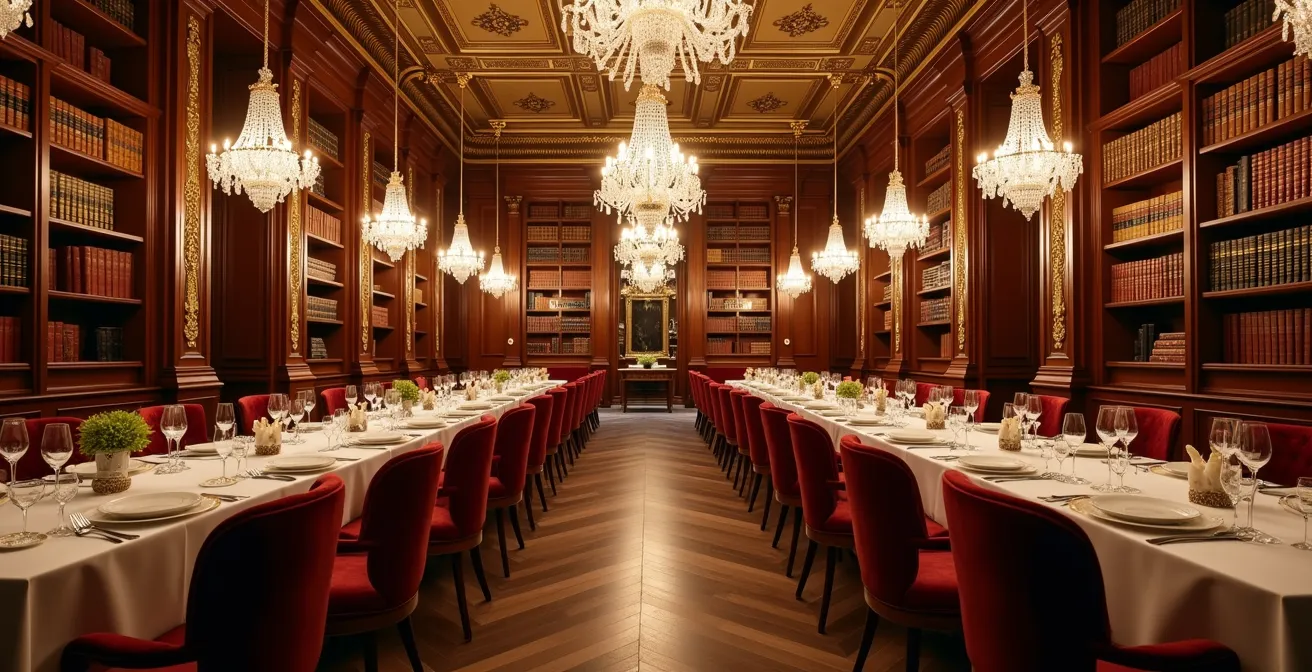
Café Pushkin’s value is not in its historical authenticity, which is a complete fabrication, but in its flawless execution as a piece of culinary theatre.
- The opulent 19th-century decor is a modern creation, meticulously designed to fulfill a myth born from a French song.
- The experience is split between two distinct “acts”: the casual Pharmacy Hall and the deeply formal Library Hall, each demanding a different budget and attire.
- Its true, unique strength lies in serving meticulously prepared nostalgic cuisine 24/7, offering a refined haven at 4 AM.
Recommendation: Treat it not as a historic visit, but as a ticket to an immersive performance. Book the Library Hall for a grand, romantic occasion, but only if you are prepared to play your part.
For any discerning traveller with a taste for the finer things, Moscow’s Café Pushkin presents a conundrum. It’s a name whispered in the same breath as Parisian institutions, a place steeped in an aura of literary romance and aristocratic grandeur. The question that hangs in the air, as thick as the velvet curtains, is whether the experience justifies a bill that easily crests €100 per person. Is this the pinnacle of Russian gastronomic nostalgia, or a brilliantly marketed illusion for tourists, a gilded veneer on an otherwise standard offering?
Most commentary focuses on the obvious: the stunning, antique-filled interiors and the eye-watering prices. But this surface-level analysis misses the point. To truly evaluate Café Pushkin, one must look at it through the lens of a food critic, not a historian. The key is not to ask if it’s “real,” but to judge the quality of the performance. The real question is this: beyond the myth and the gold leaf, does the substance—the cuisine, the service choreography, the very soul of the place—deliver a value worthy of its reputation? This is not just about dining; it’s about investing in a legendary experience.
This guide deconstructs the Café Pushkin “performance,” from its fabricated origins to the nuance of its dress code. We will dissect the menu, compare its distinct atmospheres, and even explore its surprising role in Moscow’s late-night culture, providing the definitive verdict on whether it’s a booking you should make.
Summary: A Critic’s Guide to the Café Pushkin Experience
- Why is Café Pushkin famous because of a French song, not the poet?
- Pharmacy vs. Library Hall: Which atmosphere suits a romantic date?
- Why you must order the “Chocolate Pushkin” dessert?
- Why is Café Pushkin the best place for a post-clubbing breakfast at 4 AM?
- Do you need a tie to enter Café Pushkin for lunch?
- How to have tea at the Metropol glass roof without booking a room?
- How to reserve a window seat at White Rabbit for the panoramic view?
- How are Moscow chefs transforming buckwheat into a luxury dish?
Why is Café Pushkin Famous Because of a French Song, Not the Poet?
The first and most crucial thing to understand about Café Pushkin is that it is a masterpiece of culinary theatre, not historical preservation. Its entire existence is a fantasy brought to life, an origin story that is more about marketing genius than monarchist legacy. The restaurant has no direct connection to the poet Alexander Pushkin, other than its location on Tverskoy Boulevard, which he frequented. The fame comes from a completely different, and notably French, source: a song.
In 1964, French chansonnier Gilbert Bécaud released his famous song “Nathalie,” a Cold War-era love story about a guide in Moscow. He sings of a romantic rendezvous with his guide:
We’d drink hot chocolate, and talk about something completely different…
– Gilbert Bécaud, Lyrics from ‘Nathalie’ song
The problem was, “Café Pouchkine” did not exist. It was a poetic invention. Yet, for decades, French tourists arriving in Moscow would ask for this mythical café. Enter Andrei Dellos, a visionary restaurateur who saw an opportunity not to restore history, but to build a myth. According to the restaurant’s own history, the restaurant was created as the embodiment of the myth born from the song. Opened in 1999 in a meticulously restored Baroque mansion, it was designed from the ground up to be the place everyone imagined, a perfect simulacrum of a pre-revolutionary nobleman’s house. This is not a flaw; it is the central premise of the experience.
You are not paying for history. You are paying for a flawless, immersive execution of a fantasy. Understanding this is the key to judging its worth.
Pharmacy vs. Library Hall: Which Atmosphere Suits a Romantic Date?
Choosing your “scene” at Café Pushkin is as important as choosing your meal. The experience is dramatically different depending on whether you are seated downstairs in the “Pharmacy Hall” or upstairs in the “Library Hall.” This is the first critical decision that dictates the tone, formality, and budget of your visit. For a romantic date, the choice is not merely preferential; it is paramount.
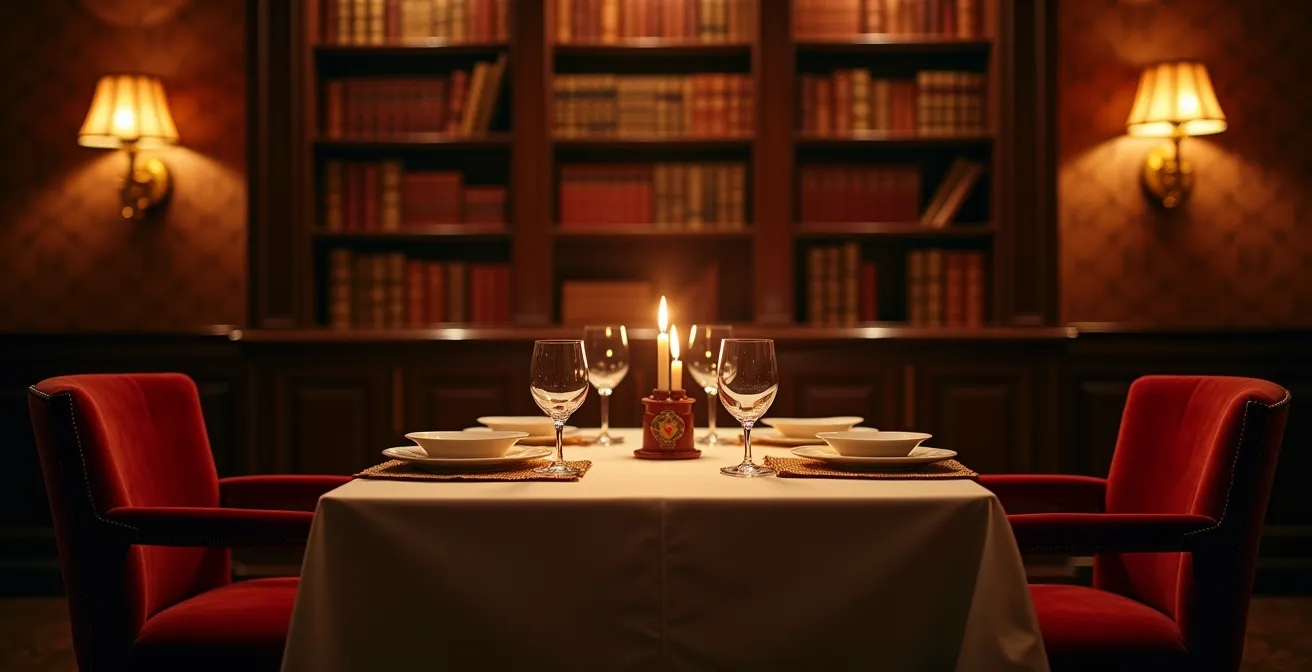
The ground-floor Pharmacy Hall is designed to evoke an old-world apothecary, with high ceilings, bustling energy, and a more casual bistro-style service. It is lively, bright, and perfect for a luxurious lunch or a less formal dinner. However, for true romance, the upstairs Library Hall is non-negotiable. Ascending the grand staircase is like stepping into another century. The atmosphere is hushed, the walls are lined with antique books, and the lighting is low and intimate. This is where the service choreography becomes truly apparent, with waiters moving with a formal grace that feels worlds away from the brasserie buzz downstairs.
This division is reflected in everything from the noise level to the price, as this comparison makes clear, based on an analysis of the restaurant’s dual concepts.
| Feature | Pharmacy Hall | Library Hall |
|---|---|---|
| Atmosphere | Lively, casual bistro-style | Hushed, formal dining |
| Price Level | More democratic pricing | Higher-end pricing |
| Service Style | Relaxed, brasserie-like | Formal, French-style |
| Best For | Casual dates, lunch | Special occasions, romantic dinners |
| Noise Level | Brighter with conversation buzz | Quiet, intimate atmosphere |
For a truly special, romantic evening, the Library Hall is the only choice. The slightly higher cost is an investment in an atmosphere of unparalleled intimacy and old-world elegance. Booking in advance and specifically requesting this hall is essential.
Why You Must Order the “Chocolate Pushkin” Dessert?
While the menu at Café Pushkin is a sprawling homage to 19th-century Franco-Russian noble cuisine, with excellent versions of classics like Borsch and Beef Stroganoff, the dessert course is where the culinary theatre reaches its crescendo. One might be overwhelmed by choice; a glance at the menu shows an almost obsessive dedication to patisserie, with some listings showing that the restaurant offers an extensive selection of over 50 desserts. Amidst this sweet opulence, one item stands out as a mandatory part of the performance: the “Chocolate Pushkin.”
Ordering this dessert is not simply about satisfying a sweet tooth; it’s about participating in the restaurant’s core narrative. It is a direct nod to Gilbert Bécaud’s “chocolat chez café Pouchkine” and serves as the edible, tangible culmination of the myth you’ve been immersed in all evening. It is the signature of the house, a piece of edible branding as potent as the monogrammed silverware.
The dessert itself is a technical marvel. It arrives as a perfect, dark chocolate sphere. The waiter then pours hot, liquid chocolate over the top, causing the sphere to dramatically melt and unfurl, revealing a decadent filling of mousse, biscuit, and wild berries. It is a moment of pure spectacle, designed for gasps and Instagram feeds. But critically, it is not just for show. The balance of textures—the rich, warm sauce, the cool mousse, the crisp biscuit, and the tartness of the berries—is impeccably judged. It is a technically accomplished dessert that proves the kitchen’s substance is equal to its style.
To skip it would be like leaving a play before the final, most memorable scene. It is the moment where the restaurant’s founding myth is served to you on a plate, and it happens to be delicious.
Why is Café Pushkin the Best Place for a Post-Clubbing Breakfast at 4 AM?
Perhaps the most unexpected and compelling argument for Café Pushkin’s value lies not in its peak-hour dinner service, but in its existence in the liminal hours of the early morning. Moscow’s nightlife is legendarily hedonistic, but the question of where to find a refined, high-quality meal after the clubs close is a perennial challenge. This is where Pushkin reveals its secret weapon: it operates 24 hours a day on weekends.
This round-the-clock service transforms the restaurant from a formal dining destination into something far more useful and unique. It becomes Moscow’s most elegant late-night canteen, a civilized sanctuary from the chaos of the night. As travel writer Jasiminne Yip of Posh, Broke, & Bored notes in her review, this is a defining feature:
This restaurant never sleeps, and like Duck & Waffle in London, is the refined watering hole for night-owls and party people who want their haute bites at silly o’clock
sauce – Jasiminne Yip, Posh, Broke, & Bored travel blog
This is the “4 AM Verdict.” Judging the restaurant at this hour strips away the pomp of a Saturday night dinner reservation. What’s left is the raw product: the quality of the food, the professionalism of the staff, and the comfort of the environment. Serving a perfectly executed Pelmeni or a delicate Syrniki (cheese pancake) with the same precision at 4 AM as at 8 PM is a testament to an extraordinary operational standard. For those who appreciate the city’s nocturnal pulse, this service is not just a gimmick; it’s an essential part of the luxury Moscow experience. The fact that the restaurant operates continuously on weekends is a cornerstone of its modern-day legend.
Therefore, part of the €100 price tag at dinner is paying for an institution with the consistency and capability to operate at this level, at any hour. It’s a hallmark of a truly great, world-class establishment.
Do You Need a Tie to Enter Café Pushkin for Lunch?
Navigating the dress code of a foreign establishment can be a source of anxiety, especially one with a reputation соперничающий with the grand dames of Paris or London. For Café Pushkin, a simple “smart casual” guideline is insufficient. The required “costume” for this culinary theatre depends entirely on the time of day and the “scene” you have booked—the Pharmacy or the Library.
For a daytime meal in the downstairs Pharmacy Hall, the atmosphere is more relaxed. A tie is certainly not required. However, Russian diners, particularly Muscovites, tend to dress with more formal flair than jejich Parisian counterparts for similar occasions. While you might see Parisians in designer sneakers and a blazer at a chic bistro, at Pushkin, “smart casual” leans more towards “smart.” Think elegant knitwear, quality trousers or dark jeans, and proper shoes. Athleisure is out of the question.
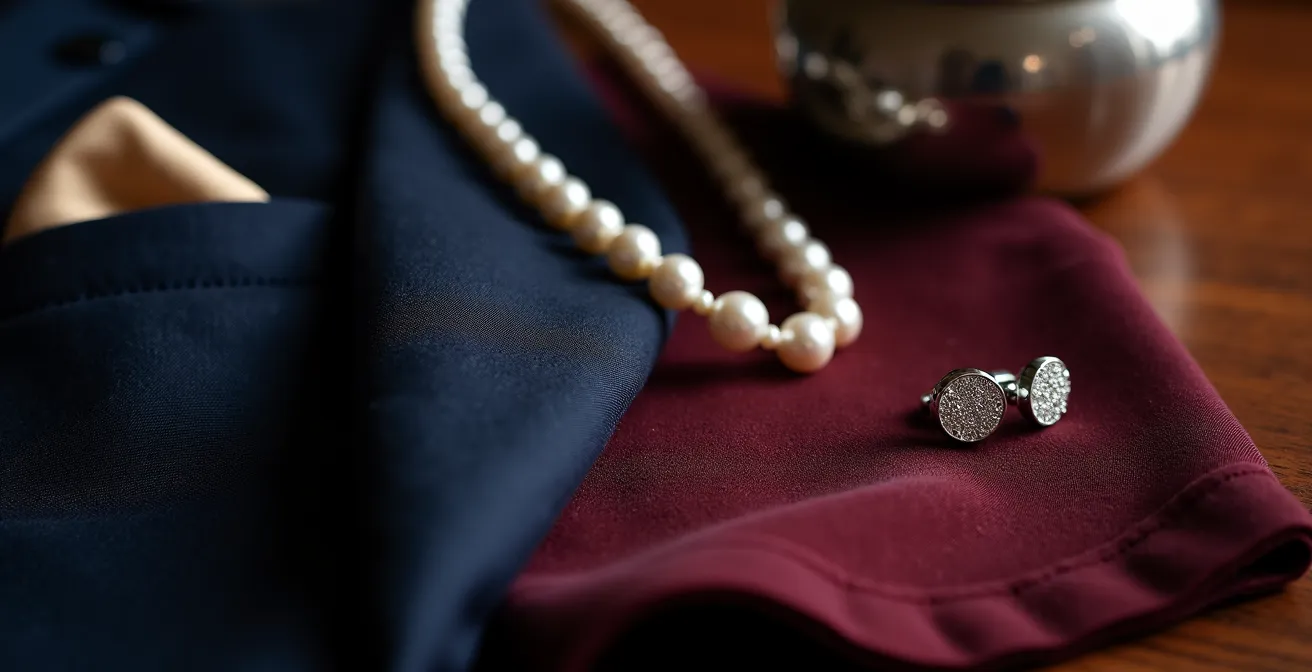
For dinner, especially in the upstairs Library Hall, the code shifts decisively to business elegant. A jacket is strongly advised for men, and while a tie may not be strictly mandatory, its absence would be conspicuous. For women, an elegant dress or a sophisticated blouse and skirt ensemble is the norm. The key is to err on the side of elegance. Showing up underdressed is the quickest way to feel out of place and break the immersive spell of the restaurant.
Your Action Plan: Decoding the Pushkin Dress Code
- Lunch (Pharmacy Hall): Aim for “smart casual.” For men, this means collared shirts and smart trousers or dark, well-fitting jeans. For women, a chic blouse or elegant knitwear is appropriate. No sneakers.
- Dinner (Library Hall): Elevate to “business elegant.” A jacket is a near-necessity for men. For women, a cocktail dress or a refined ensemble is the standard. This is an occasion to dress up.
- Late Night (After 2 AM): The code relaxes. Stylish party attire is perfectly acceptable, but scruffy post-club wear is not. Maintain a sense of polish.
- Cultural Context: Remember the local standard. Muscovites often dress more formally for fine dining than many Europeans. When in doubt, go one level smarter than you think you need to.
- Footwear Check: Regardless of the time, your footwear is critical. Avoid trainers, flip-flops, or overly casual shoes. Polished leather shoes or elegant heels are a safe bet.
In short: no tie for lunch, but dressing with intention is always required. For dinner in the Library, a jacket is your ticket to feeling truly part of the experience.
Key Takeaways
- Café Pushkin is a modern fantasy, not a historical artifact; its value lies in the flawless execution of this theatrical concept.
- The experience is sharply divided: the casual Pharmacy Hall for lunch and the formal, romantic Library Hall for special occasions. Choose wisely.
- Beyond the main courses, the signature “Chocolate Pushkin” dessert and the 24/7 weekend service are two of its most compelling and unique value propositions.
How to Have Tea at the Metropol Glass Roof Without Booking a Room?
While Café Pushkin offers a specific brand of aristocratic nostalgia, Moscow holds other keys to gilded-age luxury. For a different, yet equally enchanting afternoon, the Metropol Hotel presents a stunning alternative. Its legendary afternoon tea, served under a magnificent Art Nouveau glass roof, is one of the city’s most coveted experiences. Contrary to popular belief, you do not need to be a hotel guest to partake.
The experience is less about literary romance and more about turn-of-the-century grandeur. Sitting in the Chaliapin Bar, bathed in the light filtering through the stained-glass dome, is an event in itself. Securing a spot, however, requires a specific strategy, as demand is high and a simple walk-in is almost never successful. The process is a ritual of planning and confirmation, ensuring you are seated in the prime location and not in a less desirable corner of the hall.
- Book Far in Advance: Reservations should be made online via the hotel’s official website at least two to three weeks ahead of your desired date.
- Be Specific in Your Request: During the booking process, you must explicitly request “Afternoon Tea under the glass roof.” In Russian, this is “Чайная церемония под стеклянной крышей.” This is a crucial step to avoid being seated elsewhere.
- Reconfirm Your Seating: A phone call to the hotel 48 hours before your reservation to reconfirm your request for a seat under the glass roof is a wise, professional-level travel tactic.
- Dress the Part: The attire is smart casual, but think of the standards of a Parisian palace hotel. Polished, elegant, and refined is the expectation.
For those who value authentic historical architecture over narrative fantasy, an afternoon at the Metropol can be an even more rewarding experience, offering a direct link to Moscow’s pre-revolutionary past.
How to Reserve a Window Seat at White Rabbit for the Panoramic View?
If Café Pushkin is the master of gastronomic nostalgia, White Rabbit is its modernist, high-altitude counterpoint. Consistently ranked among the world’s best restaurants, it offers a vision of new Russian cuisine from a glass dome on the 16th floor, with a breathtaking 360-degree view of Moscow. Here, the “theatre” is not the decor, but the panoramic cityscape itself. Securing a window seat is the entire point of the visit, and it is an art form in itself.
Chef Vladimir Mukhin’s innovative cooking is the main draw, but the experience is undeniably amplified by the view. Getting a front-row seat to the sunset over the Moskva River requires more than just a simple reservation; it demands a proactive, multi-step approach. Competition for these prime tables is fierce, and the restaurant’s booking system does not explicitly guarantee them. You must actively campaign for your spot.
Here is the insider’s strategy for securing that coveted window-side table:
- Book Months, Not Weeks, Ahead: A reservation should be made one to two months in advance through the restaurant’s official website. This is the absolute minimum for a weekend evening.
- Follow Up Immediately: After making the online booking, send a polite but direct email to the restaurant. State your reservation details and your specific request for a window seat. Mentioning a special occasion (anniversary, birthday) can significantly increase your chances.
- The 48-Hour Confirmation Call: A call two days prior to your reservation to politely reconfirm your request is a crucial step. It puts your name back at the top of the host’s mind.
- The Sunset Strategy: For the ultimate experience, book your table for 30 minutes before the local sunset time. This allows you to enjoy the view in daylight, witness the sunset, and see the city lights emerge.
- Have a Plan B: If all window seats are taken, request a table on the “second-tier” platform. These are slightly elevated and still offer excellent, albeit not direct, panoramic views.
Success here provides a thrilling, contemporary luxury experience that serves as the perfect foil to Pushkin’s historical fantasy, showcasing the dynamic range of high-end dining in the Russian capital.
How are Moscow Chefs Transforming Buckwheat into a Luxury Dish?
The final piece of the Moscow dining puzzle lies in understanding the current culinary movement. Beyond the walls of institutions like Café Pushkin, a quiet revolution is taking place. Chefs across the city are spearheading a renaissance of Russian cuisine, taking humble, almost “peasant-level” ingredients and elevating them with modern techniques, much in the way Parisian chefs championed “bistronomy” by transforming simple ingredients into gastronomic highlights.
Nowhere is this more evident than with buckwheat, or grechka. A staple of the Russian pantry, it is being completely reimagined. As Andrey Makhov, the head chef at Café Pushkin itself, states, the philosophy is to connect the past with the present:
The idea was to adapt the dishes of the Pushkin era to modern life
– Andrey Makhov, Cafe Pushkin Head Chef
This ethos is spreading. According to observations of Moscow’s culinary scene, Russian cuisine is experiencing a renaissance with chefs cooking traditional dishes in a modern way. They are deconstructing staples and applying global techniques. Buckwheat is no longer just a simple porridge; it is transformed into a creamy risotto infused with porcini mushrooms and truffle oil, served as a crunchy, savory granola atop a delicate fish fillet, or even milled into flour for sophisticated blinis. This movement is about exploring gastronomic nostalgia with confidence and creativity.
This culinary creativity proves that Moscow’s dining scene is more than just a few famous names; it’s a dynamic and exciting landscape where even the humblest ingredient can become the star of a luxury dish. A visit to Café Pushkin is an entry point into this much larger, and deeply compelling, story.