
The common belief is that hailing a taxi at the airport is the simplest option. The reality is that pre-booking a transfer is your most powerful tool for ensuring a safe, calm, and predictable arrival in France.
- It transforms chaos into order by providing a dedicated driver waiting just for you.
- It eliminates financial surprises with a fixed, pre-agreed fare, protecting you from surge pricing and detours.
- It legally guarantees safety compliance, especially for children, which a standard taxi cannot.
Recommendation: View your airport transfer not as an expense, but as the first and most critical investment in your travel well-being.
The moment you step through the sliding doors of an international arrivals hall is a moment of heightened vulnerability. Weary from your flight, managing luggage, and navigating a foreign environment, you are the prime target for the cacophony of “Taxi! Taxi!” and the subtle chaos of official-looking queues. Many travelers believe hailing a cab is the most straightforward path to their hotel. This assumption, however, overlooks the numerous friction points—from unpredictable pricing and language barriers to serious safety concerns—that can derail the start of your trip.
The conventional wisdom is to find the official taxi rank and hope for the best. But what if the queue is an hour long? What if they don’t have a vehicle large enough for your family, or a legally required child seat? These are not mere inconveniences; they are significant sources of arrival anxiety. The alternative, pre-booking a private transfer (known in France as a VTC – Voiture de Transport avec Chauffeur), is often misunderstood as a luxury. In reality, it is a strategic act of self-preservation.
This guide reframes the conversation. Instead of asking which option is cheaper, we will ask: which option provides a protective bubble from the moment you land? We will dismantle the arrival process piece by piece, demonstrating how pre-booking systematically eliminates every point of stress. From finding your driver in a crowd to ensuring your children are safe, you will discover that a pre-booked transfer is the definitive answer for any cautious traveler seeking peace of mind.
This article provides a detailed breakdown of why a pre-booked VTC is the superior choice for a secure and seamless arrival in France. Explore the sections below to understand each crucial aspect of your journey from the terminal to your destination.
Summary: Why a Pre-Booked VTC in France is Your Best Arrival Strategy
- The sign board: How to find your driver in the crowded arrival hall?
- GetTransfer vs. Hotel Car: Is the hotel pickup worth the 50% premium?
- Does the driver wait if your flight is delayed by 2 hours?
- Why you must specify child age when booking a transfer in Russia?
- Should you tip a pre-paid transfer driver in Moscow?
- How long is the walk from Terminal D to the train station?
- Business vs. Premier: Is the upgrade to Yandex Ultima worth the cost?
- How to use Yandex Go to send keys or documents across Moscow?
The signboard: How to find your driver in the crowded arrival hall?
The arrivals hall of a major French airport like Paris Charles de Gaulle (CDG) is a sensory overload. With over 70 million passengers passing through Paris CDG annually, you are instantly immersed in a sea of faces, signs, and competing sounds. For the unprepared traveler, the first challenge is simply orientation. Where is the taxi rank? Is this long queue the right one? This initial uncertainty is a major source of arrival anxiety. It’s a moment where mistakes, like following an unofficial tout, are easily made.
A pre-booked VTC replaces this chaos with a single, reliable beacon: a driver holding a signboard with your name on it. This “meet & greet” service is not a luxury add-on; it’s a fundamental part of the pre-booking process. It establishes a chain of certainty from the moment you clear customs. You are not looking for a generic sign or a location; you are looking for a person who is looking specifically for you. This simple act immediately reduces your cognitive load, allowing you to focus on your family and your luggage instead of battling the crowd.
Platforms like GetTransfer.com ensure this process is seamless by having drivers whose profiles are thoroughly verified, which is a stark contrast to the anonymity of a random taxi. You’re not just getting a car; you’re getting a professional, vetted driver whose job is to find you. This eliminates the physical and mental stress of navigating a confusing, high-traffic environment, creating a protective bubble the instant you enter the public area.
Action plan: Finding your pre-booked driver at a French airport
- Check confirmation: Review your booking for the exact meeting point. French airports have designated ‘VTC’ pickup areas, separate from official ‘Taxis’ ranks.
- Spot your name: Look for your driver in the specified arrivals hall holding a sign with your name. This is a standard meet & greet service.
- Verify vehicle details: Before leaving, use your booking app to confirm the driver’s vehicle model and license plate match what is on file.
- Use in-app contact: If you cannot locate your driver within 5 minutes, use the in-app messaging feature or the dedicated support hotline provided.
- Follow the right signs: To get to the pickup zone, always follow airport signage for VTC (Voitures de Transport avec Chauffeur), not Taxis.
GetTransfer vs. Hotel Car: Is the hotel pickup worth the 50% premium?
Once you’ve decided against a traditional taxi, the choice often comes down to a pre-booked VTC service (like GetTransfer) or the hotel’s own car service. The latter often comes with a significant price increase, sometimes a 50-70% premium. As a safety consultant, my advice is to analyze this not as a simple cost, but as a difference in service level and what you are truly paying for.
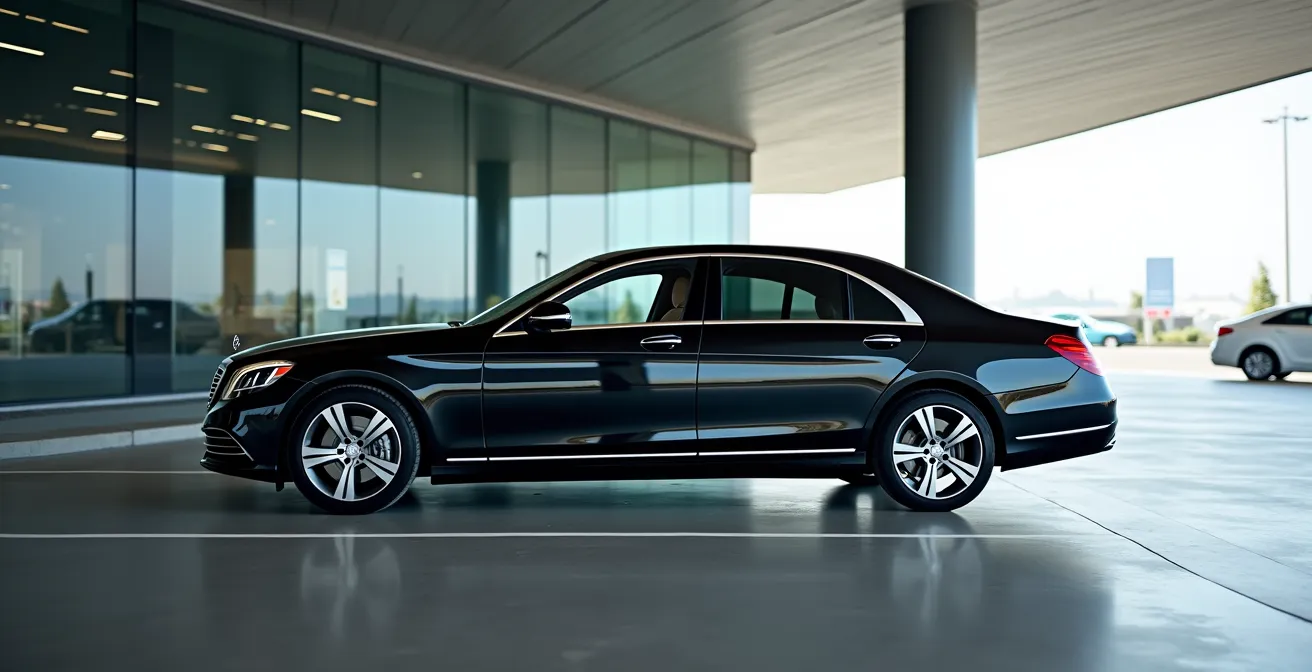
A hotel car service often positions itself as the ultimate luxury experience. You may get a higher-end vehicle and a driver who acts more like a concierge, potentially offering insider tips. This is a valid choice if your priority is a seamless, high-touch transition integrated with your hotel stay. However, for most cautious travelers, the primary goal is safety, reliability, and fair, fixed pricing—all of which are standard features of a reputable pre-booked VTC service. The “premium” you pay for a hotel car is often for the hotel’s brand and logistical coordination, not necessarily for a fundamentally safer or more reliable transfer.
The key is to compare features and decide where the value lies for you. A pre-booked VTC offers flight monitoring, a vetted professional driver, and a locked-in price, effectively neutralizing the main sources of arrival anxiety. The hotel service adds a layer of luxury on top of that. For the security-conscious traveler, the VTC already provides the complete protective bubble you need.
This table breaks down the core differences, helping you decide if the premium is justified for your specific needs. As you can see from this recent comparative analysis, the core safety and reliability features are present in standard pre-booked services.
| Service Type | Average Cost | Availability | Features |
|---|---|---|---|
| Pre-booked Transfer (GetTransfer) | Fixed rate, up to 40% less than on-site taxis | Guaranteed with advance booking | Flight monitoring, meet & greet, fixed pricing |
| Hotel Car Service | 50-70% premium over standard transfers | Limited during peak seasons | Luxury vehicles, concierge-driver, potential insider recommendations |
| Standard Taxi (on arrival) | Variable with meter + potential surge pricing | Subject to availability and queues | Basic service, no flight monitoring |
Does the driver wait if your flight is delayed by 2 hours?
This is one of the most significant sources of anxiety for any traveler: “What happens if my flight is late?” With a traditional taxi, a delay means re-joining the queue and facing uncertainty, especially late at night when fewer cars are available. This fear is particularly acute in France, where air traffic control strikes can cause widespread disruption, as when 75% of flights at Paris Orly were cancelled during a recent event.
Herein lies a core protective feature of pre-booked VTC services: proactive flight monitoring. When you provide your flight number during booking, you are not just giving information; you are activating a safety net. The transfer company monitors your flight’s arrival time in real-time. If your flight is delayed by 30 minutes or even two hours, the driver adjusts their pickup schedule accordingly. They will be there when you land, not when you were *supposed* to land.
This completely removes the stress of a delay. You don’t need to frantically call a foreign number from the plane or worry if you’ll be stranded. The system is designed to absorb this common travel friction point. Reputable services include a complimentary waiting period (often 60 minutes after the actual landing time) to allow for baggage claim and immigration. For significant delays, their 24/7 customer support coordinates with the driver to ensure you are met without any action required on your part. This transforms a potential travel disaster into a minor inconvenience, keeping your protective bubble intact no matter what happens in the air.
Why you must specify child age when booking a transfer in France?
For any parent traveling, the safety of their children is non-negotiable. However, many are unaware of the strict legal requirements for child restraints in vehicles in France. It’s not a suggestion; it’s the law. Children under the age of 10 must use an appropriate car seat or booster. Failure to comply can result in you being unable to travel or even facing an on-the-spot fine of up to €135.
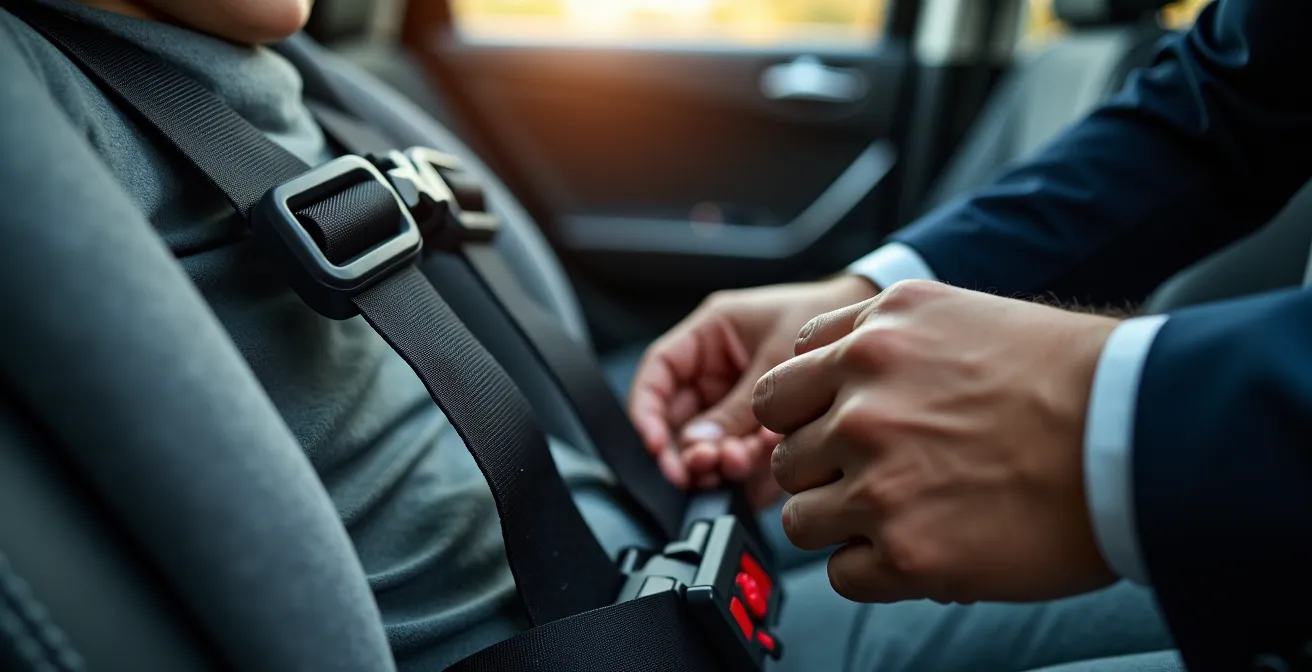
Here is the critical difference: official taxis in France are legally exempt from the obligation to provide child seats. This means that when you hail a cab at the airport, you have no guarantee they will have the correct seat for your child’s age and weight, or any seat at all. You are left with a terrible choice: break the law and risk your child’s safety, or wait indefinitely trying to find a properly equipped taxi.
Pre-booking a VTC is the only way to solve this problem with certainty. When booking, you are required to specify the number of children and their ages. This is not for data collection; it is to ensure the driver arrives with the legally-mandated, appropriate car seat installed. Whether it’s a rear-facing infant seat for a baby or a booster for a seven-year-old, the vehicle will be prepared for your family’s needs. This single feature elevates a pre-booked transfer from a convenience to an essential safety measure for anyone traveling with children in France.
The requirements are specific:
- Under 10kg (22 lbs): A rear-facing infant seat is mandatory. The passenger-side airbag must be deactivated if the seat is placed in the front.
- 9-18kg (20-40 lbs): A forward-facing seat with a five-point harness is required.
- 15-36kg (33-79 lbs): A booster seat is required until the child reaches a height of 135cm.
Should you tip a pre-paid transfer driver in France?
After a long flight and a safe transfer, the final point of potential awkwardness is the tip. Do you tip? How much? Do you need to have the right amount of cash in the local currency? This small moment can add a final dose of cognitive load to your arrival, something you’ve worked hard to avoid. Understanding French tipping culture is key to navigating this smoothly.
In France, the principle of ‘service compris’ (service included) is common in restaurants and also influences expectations in other service industries. Tipping is generally not mandatory or expected in the same way it is in the United States. It is a gesture of appreciation for excellent service, not an obligation. As the experts at Airporttaxis.com note in their France Airport Transfer Guide, “Tipping is not mandatory in France, but it’s appreciated. If you’re satisfied with the service, rounding up the fare or leaving a small tip of around 10% is considered polite”.
This is another area where modern pre-booked VTC services provide a protective advantage. The entire fare is pre-paid, so there is no transaction at the end of the ride. Furthermore, most booking platforms and apps (like GetTransfer or Uber) now include an in-app tipping feature. This allows you to add a gratuity electronically after the ride is complete, removing any pressure or the need to fumble for cash. You can decide on a tip calmly, based on the quality of the service, long after you’ve settled into your hotel. This feature is the final step in creating a completely frictionless arrival experience, eliminating one last point of potential social anxiety.
How long is the walk from Terminal D to the train station?
The promise of easy public transport access from the airport can be misleading. At sprawling airports like Paris CDG, “access” does not mean a short, simple walk. Terminal 2, for example, is not a single building but a collection of sub-terminals (2A through 2G), some of which are very distant from the central TGV/RER train station. This journey is not a simple walk down a corridor; it’s a multi-stage expedition that can be a physical ordeal, especially with luggage, children, or mobility issues.
Official data suggests the typical transit time from gate to the TGV/RER station can easily exceed 45 minutes. This journey often involves long walks, escalators, and the use of the CDGVAL automated shuttle train to connect distant terminals like 2E’s satellite gates (K, L, M) to the main hub. This is a significant physical barrier. You are not just walking; you are navigating a complex, multi-level environment while hauling your possessions after a tiring flight.
This is what I call the “CDG Gauntlet.” A pre-booked VTC completely bypasses this. Your driver meets you in the arrivals hall, just after baggage claim, and escorts you to a nearby, designated VTC pickup area. The long walk is eliminated. The need to navigate the airport’s internal transit system is gone. The physical strain of managing luggage over long distances vanishes. The service is truly curbside-to-curbside. For anyone with heavy bags, traveling with family, or simply wishing to conserve energy, this feature alone makes pre-booking an investment in physical well-being, not just convenience.
Business vs. Premier: Is the upgrade to Yandex Ultima worth the cost?
When you pre-book a VTC in France, you’ll often be presented with several vehicle classes, typically ranging from a standard “Berline” (sedan) to a “Van” and up to a “Premium” or “Luxe” option. This choice is not about extravagance; it’s about aligning the service with your specific needs to ensure maximum comfort and safety.
Upgrading isn’t just about a more prestigious car model. It’s about a suite of features tailored to different travel profiles. As AtoB Transfer notes, the variety of choices, “from luxury cars, minivans, and economy towncars,” ensures that services “can cater to all needs.” A solo business traveler might find a standard sedan perfectly adequate, offering a professional and efficient transfer. However, a family of five with multiple suitcases will find the upgrade to a Van not a luxury, but a logistical necessity.
Similarly, an upgrade to a Premium class (often featuring vehicles like a Mercedes E-Class or Tesla Model S) typically includes value-added services such as an English-speaking driver, complimentary bottled water, and onboard Wi-Fi. For an executive who needs to prepare for a meeting or a tourist looking for a higher level of comfort and communication, this upgrade is a worthwhile investment in the overall travel experience. The choice is about function, not just form.
This table outlines the typical VTC service classes available in France, helping you choose the right tool for the job.
| Service Class | Vehicle Examples | Typical Features | Best For |
|---|---|---|---|
| Berline/Economy | Peugeot 508, Volkswagen Passat | Standard sedan, professional driver, fixed pricing | Solo business travelers, couples |
| Van/Family | Mercedes V-Class, Renault Trafic | 6-8 seats, large luggage capacity | Families, groups with luggage |
| Premium/Green | Tesla Model S, BMW 5 Series Hybrid | Luxury vehicles, English-speaking driver, Wi-Fi, water bottles | Executive travel, eco-conscious passengers |
Key takeaways
- Pre-booking a VTC is a strategic move to eliminate arrival anxiety, not just a convenience.
- Fixed pricing protects you from unpredictable meter fares and surge pricing common with airport taxis.
- Flight monitoring and guaranteed child seats are critical safety features that standard taxis do not offer.
How to use Yandex Go to send keys or documents across Moscow?
The true value of a pre-booked VTC service extends far beyond a simple airport transfer. Once you understand the reliability and flexibility of the system, you can leverage it as a powerful logistical tool during your stay in France. Premium hourly chauffeur services allow you to book a professional driver by the hour, transforming your transport into a personal, on-demand concierge.
This opens up a world of possibilities for solving common travel problems with efficiency and security. Imagine you’ve checked out of your hotel in Le Marais but your flight from CDG isn’t until the evening. Instead of dragging your luggage around Paris, you can book a VTC by the hour to transport your bags to a new hotel or even hold them for you while you enjoy your last day hands-free. This service is also a lifesaver for more complex itineraries.
Consider these creative applications:
- Lost & Found Recovery: Realized you left a passport or phone at your hotel after checking out? An hourly VTC can be dispatched to retrieve it and deliver it to you at the airport or your current location.
- Multi-Stop Itineraries: Need to pick up keys from a rental agency before heading to your apartment? An hourly booking handles this complex trip with a single, seamless transaction.
- Emergency Courier: For business travelers, it’s a secure and rapid way to send important documents or items across a city when time is critical, without relying on slower courier services.
Viewing your VTC provider as a flexible logistics partner, rather than just a taxi alternative, unlocks a new level of control and problem-solving capability. It’s the final step in mastering your travel environment, ensuring that even unexpected logistical challenges are handled with calm efficiency.
Ultimately, choosing to pre-book your airport transfer in France is an active decision to prioritize your safety, peace of mind, and well-being. It is the first, and perhaps most important, step in guaranteeing a smooth, stress-free start to your journey. To put these principles into practice, your next logical step is to explore the options and secure your transfer before you travel.
Frequently Asked Questions about Pre-Booked Transfers in France
What happens if my flight is delayed?
Reputable airport transfer services actively monitor your flight’s arrival timetable to ensure your driver is there when you land, not when you were scheduled to. If your flight is delayed, drivers will typically wait at no extra cost, provided it doesn’t create a major conflict with their schedule. For significant delays, the service will make the necessary arrangements to have a driver ready for your new arrival time.
How long will my pre-booked driver wait?
Most pre-booked transfers include a complimentary “meet & greet” service, which comes with a standard waiting period after your flight’s actual landing time (often 45-60 minutes). This allows you ample time for immigration and baggage claim. Drivers monitor flight arrivals, and 24/7 customer support is available to coordinate any changes or extended delays.
What about night arrivals after delays?
This is a key advantage of pre-booking. Unlike taxi ranks, which can have limited availability and apply legally inflated night fares, your pre-booked transfer maintains its fixed rate regardless of the time you actually arrive. This ensures you are not stranded or forced to pay an exorbitant price after an already stressful delayed flight.