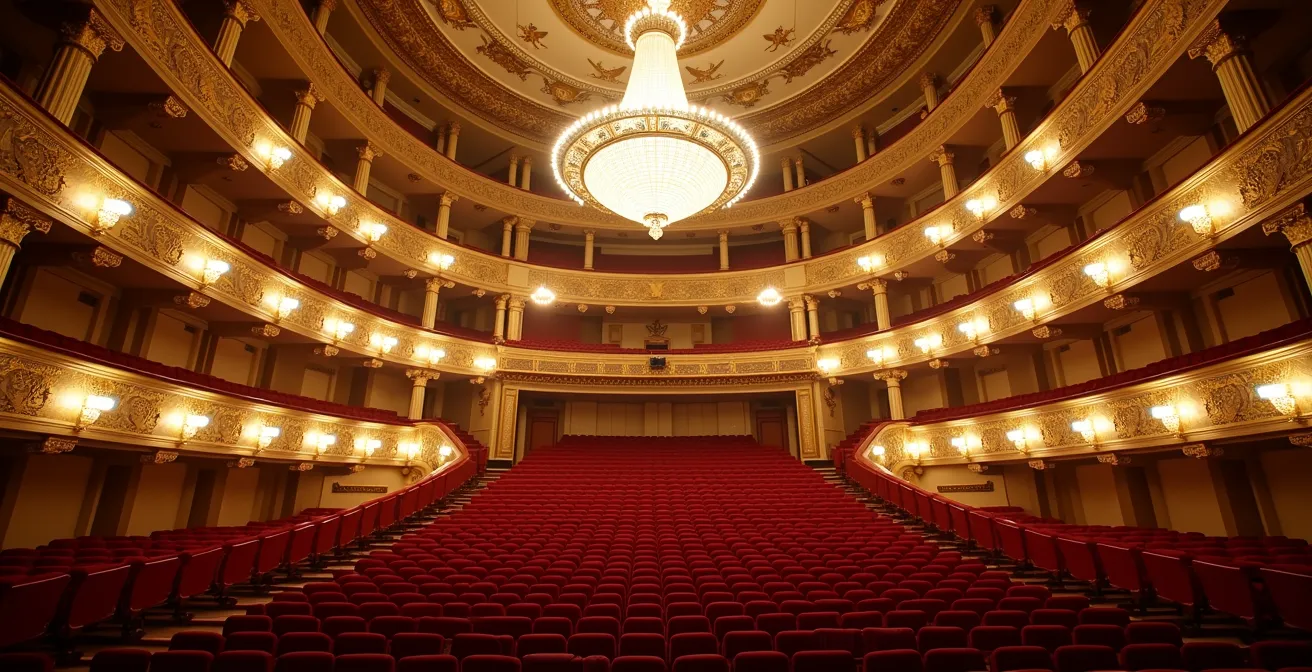
Contrary to the official narrative of a faithful ‘restoration,’ the Bolshoi Theatre’s six-year renovation created a sonically new instrument. The debate is not about ‘better’ or ‘worse,’ but about a fundamental shift in acoustic philosophy. The project traded the historic hall’s warm, blended character for a modern, clinical precision. This analysis deconstructs the architectural and material choices that engineered a new, and for many, colder, auditory experience.
For six years and over a billion dollars, the Bolshoi Theatre vanished behind scaffolding, promising a return to its former glory. When it reopened in 2011, the world saw a dazzling resurrection of Imperial Russia, with gilded stucco and plush red velvet. But for opera aficionados, the crucial question was never about the visuals; it was about the sound. The fear was palpable: had this monumental effort preserved the legendary acoustics, or had it inadvertently performed an act of sonic vandalism on one of the world’s great opera houses?
The common discourse often gets trapped in simplistic binaries: it was a triumph, or it was a failure. The official line, as reported by various outlets, was a meticulous restoration of the pre-Soviet acoustics. However, this narrative overlooks a crucial truth. The project was less a restoration and more a complete re-engineering of the hall’s acoustical signature. The real story lies not in whether the sound is ‘worse,’ but in how it was deliberately and fundamentally changed.
This analysis moves beyond the surface-level debate. We will dissect the physical choices—from the resonance of the great crystal chandelier to the density of the stage floor—to understand the new psychoacoustics of the Bolshoi. This is an autopsy of a sound, exploring how the pursuit of technical perfection may have sacrificed the very soul that aficionados cherished. We will investigate the materiality of the sound itself to determine what was truly lost, and what was gained, in the quest for an idealized past.
To fully grasp the implications of this transformation, this article will guide you through the theatre’s various facets, from its main stages and hidden halls to the very process of experiencing a performance. Each element provides a clue to understanding the new acoustic reality of the Bolshoi.
Summary: An Acoustic Dissection of the Bolshoi’s Rebirth
- Historic vs. New Stage: Which Bolshoi venue offers better value for money?
- Why was the Apollo statue on the Bolshoi roof “censored” during restoration?
- The underground concert hall: How to see the Bolshoi’s hidden venue?
- The Crystal Chandelier: How many lightbulbs light up the main hall?
- The Bolshoi Museum: Where to see the costumes of Pavlova and Nijinsky?
- Swan Lake or Nutcracker: Which ballet is better for a first-time viewer?
- Music in the Metro: How to find the schedule of official metro performers?
- How to buy Bolshoi tickets online without paying a broker fee?
Historic vs. New Stage: Which Bolshoi Venue Offers Better Value for Money?
The choice between the Bolshoi’s Historic Stage and its New Stage is more than a matter of budget; it is a decision between two conflicting acoustic and aesthetic philosophies. The Historic Stage, with its 1,740 seats, is the heart of the “restoration” debate. It was engineered to recreate a specific 19th-century acoustical signature, prioritizing a blended, rich sound ideal for grand opera and ballet. The New Stage, built in 2002, is a product of modern theatrical design, offering a more direct, less reverberant sound in a more intimate 900-seat setting.
From a purely financial perspective, the New Stage is more accessible. However, for an aficionado, “value” is measured in the quality of the auditory experience. The Historic Stage promises imperial tradition and the sound of a bygone era, while the New Stage delivers contemporary clarity. The following comparison breaks down the key differences to help you determine which venue aligns with your priorities.
This table, based on information from guides for Moscow visitors, helps compare the tangible aspects of each stage.
| Feature | Historic Stage | New Stage |
|---|---|---|
| Capacity | 1,740 seats | 900 seats |
| Price Range | 600-15,000 RUB | 200-5,000 RUB |
| Acoustics | Restored pre-revolutionary quality | Modern technical equipment |
| Experience | Imperial luxury & tradition | Contemporary elegance |
| Availability | Books out months ahead | More accessible tickets |
Ultimately, the “better value” depends on your goal. If you seek the grand, historical Bolshoi experience and want to judge the controversial acoustics for yourself, the Historic Stage is essential. If you prefer a more modern, intimate performance with clearer sightlines and more accessible pricing, the New Stage is a valid and often excellent choice. Your decision is the first step in engaging with the theatre’s complex identity.
Your Venue Selection Audit: 5 Points to Verify
- Contact Points: List all channels where your desired performance is featured (Historic Stage schedule, New Stage schedule, specific artist calendars) to identify all opportunities.
- Information Gathering: Inventory the details of the available performances—repertoire, conductor, lead performers, and pricing tiers for each venue.
- Coherence Check: Confront the options with your personal criteria. Does the grand, potentially less clear sound of the Historic Stage match your desire for authenticity, or does the clarity of the New Stage better suit your preference?
- Experience Value: Evaluate the emotional draw. Is the performance a unique, must-see event on the Historic Stage, or a standard repertoire piece where the modern comfort of the New Stage might be preferable?
- Integration Plan: If your first choice is unavailable, what is your backup plan? Identify an alternative performance or date on the other stage that still meets your core objectives.
Why Was the Apollo Statue on the Bolshoi Roof “Censored” During Restoration?
The controversy surrounding the Apollo quadriga statue, specifically the addition of a fig leaf to the nude god, is a perfect microcosm of the entire renovation project’s philosophy. The term “censorship” is provocative but misleading. From a critical perspective, this was not an act of puritanism but of curated historical idealism. The restorers were not simply fixing a building; they were crafting a specific, sanitized version of an imperial past. The original 1825 statue by Pyotr Clodt von Jürgensburg was indeed nude, but the decision to alter it reflects a desire to present a flawless, non-controversial image of classicism.

This choice is acoustically significant because it reveals the project’s guiding principle: control. Just as the statue was sculpted to fit a modern ideal of historical perfection, the hall’s sound was engineered to achieve a quantifiable, “perfect” acoustic model. The original hall’s sound was a product of centuries of accidents, modifications, and material aging. The new sound is a product of computer modeling and deliberate material science. The fig leaf on Apollo is the visual equivalent of damping an unwanted frequency or eliminating a “flawed” overtone. Both actions stem from a belief that the original can be improved upon in the act of “restoring” it.
Therefore, the statue wasn’t censored; it was edited. It was made to conform to the cohesive, idealized aesthetic that governed the entire project. This same editorial hand shaped the hall’s sonic character, polishing away the rough edges of history to produce a sound that is technically immaculate but, for some, emotionally sterile. The statue is a clear signal that the goal was never a truly authentic replication, but the creation of a hyperreal version of the past.
The Underground Concert Hall: How to See the Bolshoi’s Hidden Venue?
Beneath the opulent grandeur of the main building lies a space that represents the modern face of the Bolshoi: the Beethoven Hall. This 300-seat concert hall is the architectural antithesis of the Historic Stage. The fact that analysis shows the hall’s location is 30 meters underground is telling. It is physically and philosophically separate, a purpose-built acoustic “laboratory” insulated from the historical and structural complexities of the main building.
Accessing this hidden venue requires a separate approach from attending a main stage performance. It has its own schedule, focused primarily on chamber music, vocal recitals, and experimental works. Here, the acoustics are not about recreating a 19th-century blend but about providing pristine clarity. The reverberation time (RT60) is shorter, and the sound is more direct, making it ideal for the nuance of a string quartet or a lieder recital. For an aficionado, visiting the Beethoven Hall provides a crucial point of comparison. It allows one to hear the “house sound” in its most controlled, modern form, which in turn helps to better identify the specific acoustic choices made upstairs in the historic hall.
To experience this unique space, one must specifically seek it out. Tickets are booked separately, and the programming offers a glimpse into the more intimate side of the Bolshoi’s artistic life. It’s an opportunity to experience world-class artists in a space designed for sonic precision, a stark contrast to the blended grandeur of the main hall.
- First, visit the official Bolshoi website and navigate to the schedule specifically for the “Beethoven Hall.”
- Take note that its programming is distinct, focusing on chamber and vocal repertoire.
- Book your tickets for a performance explicitly listed in this hall, as they are not interchangeable with main stage tickets.
- You will enter through the main Bolshoi building and follow the signage down to the subterranean level.
- Arrive with time to spare to appreciate the intimate, modern design of this dedicated acoustic space.
The Crystal Chandelier: How Many Lightbulbs Light Up the Main Hall?
While the exact number of lightbulbs is a piece of trivia (the restored three-tiered chandelier has around 2,000), the far more critical question for an acoustician is how this two-ton object affects the hall’s sound. The chandelier is not merely a light source; it is a massive acoustic diffuser and potential resonator hanging directly over the prime listening area of the stalls. Its restoration was a pivotal part of the acoustic renovation, a detail confirmed on the Bolshoi’s own historical pages. The goal was to recreate the visual warmth of 19th-century gaslight, but the material and structural choices had profound sonic consequences.
Every element of the chandelier—the density of the crystal pendants, the rigidity of its metal frame, the way it is suspended—influences how sound waves from the stage and orchestra pit are scattered and reflected. A chandelier with tightly packed, heavy crystals can help break up long sound waves, preventing harsh echoes and creating a more diffuse, enveloping sound. Conversely, if its frame has a natural resonant frequency that aligns with certain musical notes, it could create an undesirable ringing or color the sound. The “shimmer” of a great hall is both visual and auditory.
The restoration team’s work on the chandelier reveals their focus on controlling every variable. They didn’t just clean it; they re-engineered it. The choice of modern lighting to mimic gaslight subtly alters the audience’s perception—a key principle of psychoacoustics. The perceived warmth of the light can influence the perceived warmth of the sound. This focus on the chandelier underscores the core argument: the new Bolshoi sound is not an accident of history but a meticulously engineered product, where even the light fixtures are considered acoustic treatment.
The Bolshoi Museum: Where to See the Costumes of Pavlova and Nijinsky?
The Bolshoi Museum, located in the theatre’s historic left wing, is a sanctuary dedicated to the material culture of performance. While visitors hope to see relics from legends like Pavlova and Nijinsky, the collection’s true significance for an acoustic analysis lies in its focus on preservation. The museum meticulously safeguards the theatrical wardrobe of icons like Feodor Chaliapin and Maya Plisetskaya, a task that involves a deep understanding of materials. According to a feature by Google Arts & Culture on the collection, these delicate fabrics are stored under strict climate control to prevent decay.
This focus on the materiality of preservation provides a direct analogy to the acoustics of the main hall. The costumes—made of silk, velvet, and cotton—are highly sound-absorbent materials. The museum’s struggle to preserve them highlights the acoustic role that similar materials play within the auditorium itself. The vast expanses of velvet on the seats and box fronts, the heavy draperies, and even the clothing of the 1,740 audience members act as a massive acoustic dampening system, primarily absorbing high-frequency sounds.
During the renovation, one of the key acoustic decisions was the precise specification of these soft materials. The type of velvet, the density of the seat padding, and the weave of the curtains were all chosen for their specific sound absorption coefficients. The goal was to “tune” the hall’s reverberation. By controlling the absorption, engineers could control the clarity and warmth of the sound. The museum’s painstaking work to save old fabrics reminds us that the new fabrics in the hall were not chosen for aesthetics alone; they were selected to be active components in the new acoustic engine of the Bolshoi.
Swan Lake or Nutcracker: Which Ballet Is Better for a First-Time Viewer?
For a first-time visitor to the Bolshoi, the choice between its two most iconic Tchaikovsky ballets, *Swan Lake* and *The Nutcracker*, often comes down to personal taste. However, considering the theatre’s new acoustic signature can add another layer to the decision. *The Nutcracker* is a fairy tale, its music filled with memorable melodies and sparkling orchestrations like the celesta in the “Dance of the Sugar Plum Fairy.” *Swan Lake* is a darker, more dramatic tragedy with sweeping emotional arcs and powerful symphonic weight.
The new, clinically precise acoustics of the Historic Stage may arguably favor the intricate, delicate textures of *The Nutcracker*. The enhanced clarity allows each section of the orchestra to be heard with distinct separation, making the playful woodwinds and glittering percussion shine. The hall’s controlled reverberation prevents the sound from becoming muddy, which can be a risk with such detailed orchestration. It’s a performance that benefits from a high-definition auditory environment.
Conversely, some might argue that the tragic grandeur of *Swan Lake* suffers slightly in this new environment. Its power often relies on a massive, blended orchestral sound and a warmer, more forgiving reverberation to create a sense of overwhelming passion. While the technical execution at the Bolshoi is flawless, the new acoustics can sometimes feel less immersive, dissecting the sound rather than letting it wash over the listener. The choice depends on what you seek: the magical clarity of a fairy tale or the raw, though perhaps less sonically cohesive, power of a romantic tragedy.
| Criteria | Swan Lake | Nutcracker |
|---|---|---|
| Dramatic Intensity | High – tragic love story | Moderate – fairy tale |
| Family-Friendliness | Adults and older children | All ages welcome |
| Russian Cultural Significance | Premiered at Bolshoi 1877 | Holiday tradition |
| Musical Complexity | Complex orchestration | Memorable melodies |
| Performance Duration | 3+ hours with intervals | 2 hours with interval |
Music in the Metro: How to Find the Schedule of Official Metro Performers?
To fully understand the Bolshoi, one must look beyond its walls to the ecosystem that feeds it. Moscow’s “Music in the Metro” project provides a fascinating glimpse into this world. Unlike the informal busking in many cities, Moscow’s program is a highly competitive, curated system. As detailed by the city’s official news agency, musicians must pass competitive auditions to perform at designated spots across the metro network.
This system creates a public stage for a vast pool of talent, including students from the elite Moscow Conservatory. For an opera aficionado, this presents a unique opportunity: the chance to hear a future Bolshoi star in the rawest of acoustic environments. The sound in a marble-lined metro station is a wash of uncontrolled reverberation—the polar opposite of the engineered acoustics of the Bolshoi’s halls. Yet it is in this challenging environment that a singer’s raw power, technique, and ability to connect with an audience are laid bare.
Finding these performances is part of the experience. The project, which has expanded to over 15 stations, has an official schedule, often promoted through the Moscow Metro’s official channels and social media. Following these sources allows a determined visitor to catch a free, high-caliber performance. It’s a powerful reminder that the polished perfection on the Bolshoi stage begins with immense talent cultivated in every corner of the city, from the conservatory classroom to the reverberant depths of the metro.
Key Takeaways
- The Bolshoi’s renovation was a re-engineering, not a restoration, creating a new acoustic signature defined by clarity and precision over historic warmth.
- Every architectural element, from the Apollo statue to the crystal chandelier, was part of a controlled design philosophy that impacts the final sound.
- The theatre offers multiple acoustic experiences, from the grand Historic Stage to the modern Beethoven Hall, each with a distinct sonic character.
How to Buy Bolshoi Tickets Online Without Paying a Broker Fee?
Securing tickets to the Bolshoi Theatre directly from the source is a challenge that requires strategy and precision, but it is the only way to avoid exorbitant broker fees and guarantee authenticity. The process is a race against time, as performances on the Historic Stage, in particular, sell out within minutes. Success hinges on understanding and preparing for the system’s specific rules.
The single most important rule is that tickets are released exactly three months in advance of the performance date, according to Moscow time. This means you must calculate the corresponding time in your local zone and be ready at your computer the moment sales open. Pre-registering on the official Bolshoi website (bolshoi.ru) is a mandatory preparatory step, as you will need to have your passport details and payment information ready to go. The system is strict and allows a maximum of only two tickets per purchase for any given performance, a measure designed to combat resellers.
When selecting seats, be extremely cautious. The historic U-shaped design of the auditorium means that many seats, particularly on the upper tiers and sides, have severely limited visibility—some as much as 50%. The seating chart on the official website indicates these limitations, and they should be taken seriously. If you miss the initial sale, don’t despair. Check the official website’s resale section daily during the week leading up to the performance, as this is where legitimate ticket holders can return seats they are unable to use. Adhering strictly to the official `bolshoi.ru` website is the paramount rule for a successful and fairly-priced purchase.
Armed with this analytical framework and a valid ticket, the final step is to take your seat. Listen not for what you remember or what you’ve been told to expect, but for what is actually there: the new, complex, and meticulously engineered sound of the 21st-century Bolshoi. Conduct your own auditory analysis and decide for yourself if this new instrument sings a song you wish to hear.