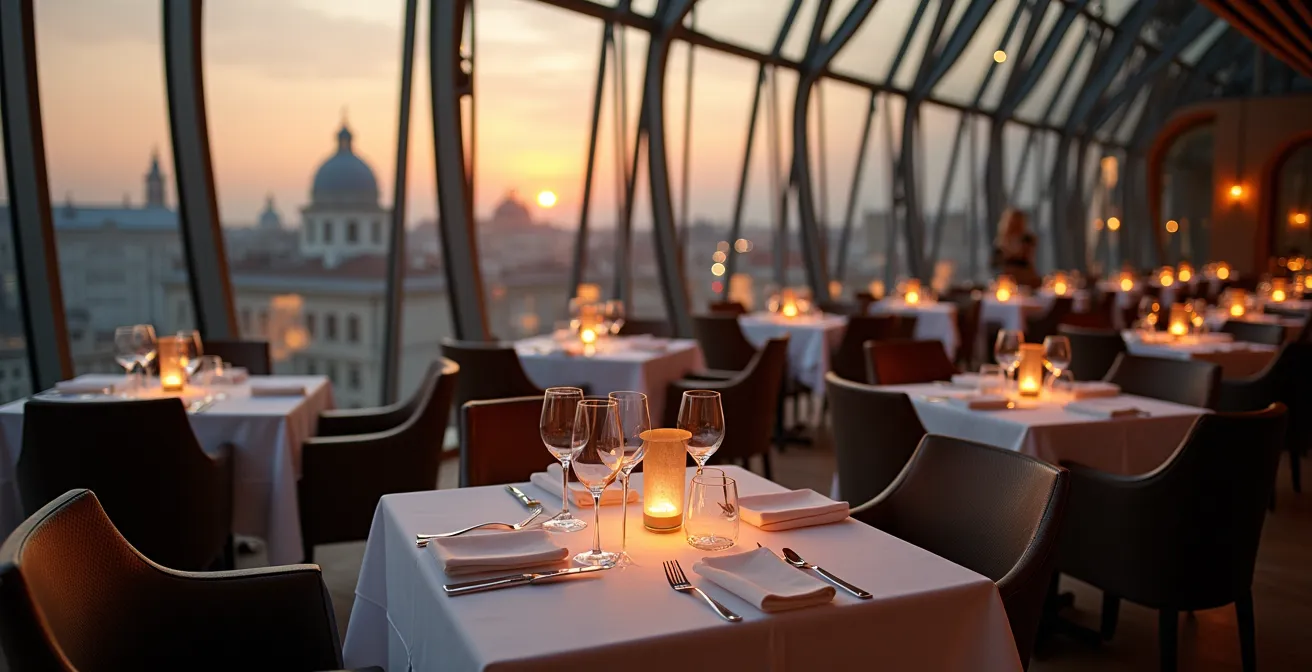
For the discerning diner, White Rabbit’s value lies not in its panoramic view, but in its audacious and authentic exploration of Russian culinary heritage—a proposition that justifies the price only if you seek a unique cultural taste, not just another luxury meal.
- The tasting menu is a masterclass in fermentation, offering flavour profiles unavailable in the Parisian fine-dining scene.
- The “smart casual” dress code leans significantly more formal than in Paris, requiring a jacket for men and a glamorous style for women to feel comfortable.
Recommendation: Book White Rabbit for the unique gastronomic education in Russian terroir; for a superior Kremlin view without the full tasting menu commitment, the O2 Lounge at the Ritz-Carlton is a more direct choice.
The ascent to the 16th floor of the Smolensky Passage is laden with expectation. White Rabbit, crowned by a glass dome, promises two of Moscow’s most coveted luxuries: a panoramic view of the city’s historic heart and a seat at the table of Vladimir Mukhin, a chef who has catapulted modern Russian cuisine onto the global stage. For the high-spending traveler, accustomed to the three-star temples of Paris or London, the question is not merely “is it good?” but “is it worth it?”. The hype is considerable, fueled by its consistent placement among The World’s 50 Best Restaurants.
Many reviews fixate on the spectacle—the glittering city lights, the almost theatrical setting. This is the common narrative. But spectacle is cheap in the world of haute cuisine. A truly memorable experience, one that justifies a price tag like the one here—which, based on recent dining reviews, was around 10,000 RUB for the tasting menu—must offer more. It requires genuine gastronomic substance, a point of view, and a sense of place that cannot be replicated elsewhere. The true measure of White Rabbit is not how it compares to other rooftop restaurants, but how its culinary proposition stands up to critical scrutiny.
This analysis will deconstruct the White Rabbit experience through a critical lens, moving beyond the obvious allure of the view. We will assess the core of its offering: the chef’s philosophy, the specific challenges of securing the best experience, the unwritten social codes, and how it stacks up against its most direct competitors in Moscow’s opulent dining scene. The objective is to provide a verdict on whether the investment of time and money delivers a return in genuine, world-class culinary discovery.
This guide provides a detailed inspection of every aspect of the White Rabbit experience, from securing a reservation to understanding its place in Moscow’s luxury landscape. The following sections break down what you need to know before you commit.
Summary: A Critical Guide to the White Rabbit Experience
- How to reserve a window seat at White Rabbit for the panoramic view?
- Vladimir Mukhin: How does he use fermentation to revive old recipes?
- Smart Casual or Formal: What to wear to not feel underdressed at White Rabbit?
- Selfie or Gorynych: Which other White Rabbit Family restaurant is better for casual dining?
- Smolensky Passage: How to find the elevator to the glass dome?
- Pushkin or Turandot: Which palace-restaurant has the better food?
- Is the Ritz-Carlton rooftop accessible without being a hotel guest?
- Which rooftop bar offers the best sunset view over the Kremlin?
How to Reserve a Window Seat at White Rabbit for the Panoramic View?
Securing a table at White Rabbit is standard procedure for a world-ranked establishment. Securing a window table, however, is a separate strategic exercise. The view is a primary component of the restaurant’s appeal, and a poorly positioned table can significantly diminish the experience. A simple online booking is insufficient; it requires a more direct and informed approach, particularly for international visitors from France trying to align with peak travel periods.
The process is less about a secret handshake and more about diligent planning and direct communication. The restaurant staff are accustomed to such requests, but priority is naturally given to those who demonstrate serious intent and make their requests through the proper channels, well in advance. Leveraging concierge services, for instance, is a highly effective method in Moscow’s luxury market, often more so than in Paris, where the booking is more transactional. For those planning a trip, understanding the local rhythm is key; for example, late August is a strategic window when Muscovites have returned to their routines but many Parisians are still on their “grandes vacances”.
Your Action Plan: Securing Prime Real Estate
- Book 3-4 months in advance, especially during French school holidays (vacances scolaires), for any chance at guaranteed window seating.
- Utilize the restaurant’s 3D virtual tour on their website to pre-select one or two preferred tables before making contact.
- After making an online reservation, contact the restaurant directly by phone at +7 (495) 510-510-1 to formally request your specific seating preference.
- Leverage premium credit card concierge services (like American Express Platinum or Visa Infinite), which carry significant weight and are highly respected in Moscow’s luxury service scene.
- Consider booking mid-week in late August, a period when Parisian holiday-goers might find better availability as local Muscovites have returned to work.
Ultimately, a proactive and multi-channel approach is non-negotiable for securing the premier experience that White Rabbit’s location promises.
Vladimir Mukhin: How Does He Use Fermentation to Revive Old Recipes?
Beyond the glass dome and city views lies the true heart of White Rabbit: the culinary philosophy of Vladimir Mukhin. His mission is not merely to cook Russian food, but to resurrect it. He acts as a culinary archaeologist, digging into pre-revolutionary texts to unearth forgotten techniques and ingredients. Central to this revival is his sophisticated use of fermentation. This is not the trendy kombucha of Western cafes; it is a deep, historical practice used to create complex layers of flavour, or what he calls “100 percent of Russian tastes”.
Mukhin treats fermentation not just as a preservation method but as a transformative tool. He applies ancient techniques to new ingredients, or uncovers novel ways to use traditional ones. This approach allows him to build dishes with profound umami and acidity that are entirely rooted in Russian terroir. In an interview with NPR, he explained this philosophy with a specific example:
It’s like soup from fermented cabbage. Very simple, but with a lot of influence from the countryside of Russia inside. We make it not from the cabbage. We take the grapes’ leaves, fermented the same like cabbage, and make the soup from this.
– Vladimir Mukhin, NPR Interview on Russian Cuisine Revival
This single example—swapping cabbage for grape leaves—demonstrates a deep understanding of process over ingredient. He isolates the essence of a traditional flavour (the sour, complex taste of shchi) and reconstructs it in an unexpected way. This intellectual rigor is the “gastronomic substance” that elevates his cooking beyond simple heritage revival.
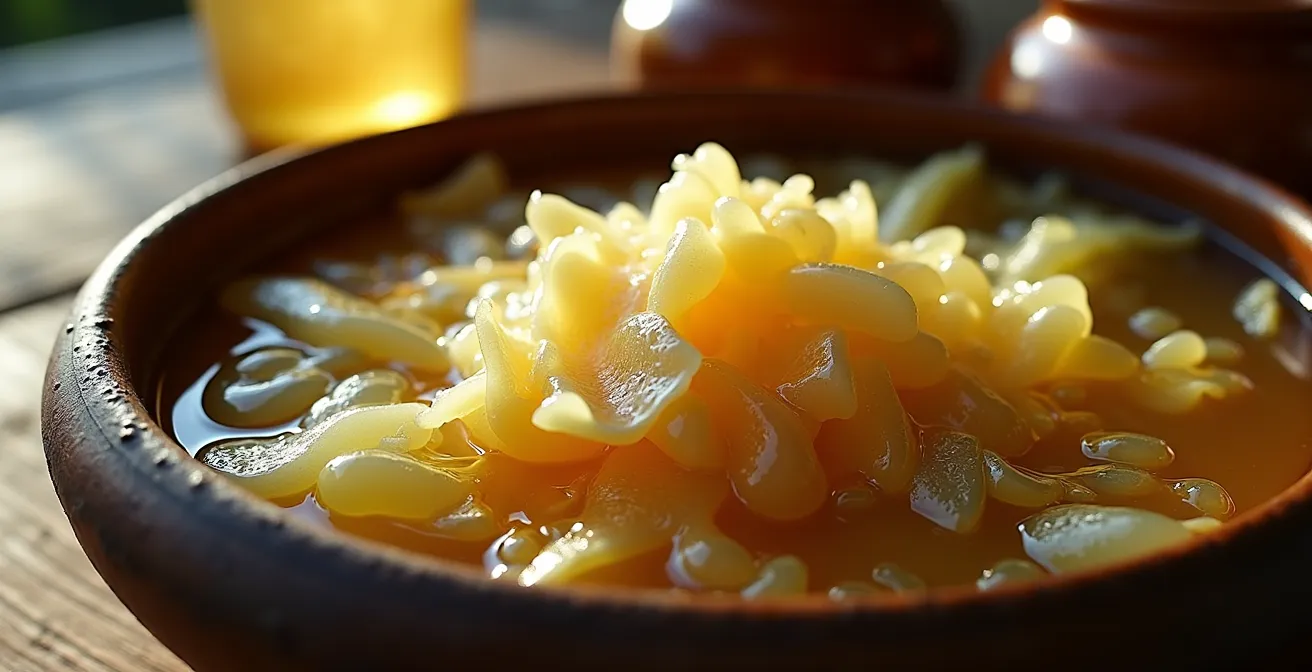
This dedication to technique is also a tool for cultural diplomacy. An account from his visit to Dallas, Texas, showed him teaching an American barbecue chef how to make properly fermented cabbage. This act of sharing his craft demonstrates a confidence in the universal appeal of these uniquely Russian flavours, proving they can be integrated into entirely different culinary contexts. For a French diner, this is the real draw: a taste of a sophisticated culinary history that is entirely distinct from the French classical tradition.
It is this scholarly yet innovative approach to fermentation and history that forms the core of the White Rabbit proposition, offering a taste of authentic cultural terroir that is impossible to find in Paris.
Smart Casual or Formal: What to Wear to Not Feel Underdressed at White Rabbit?
Navigating the dress code of an international fine-dining restaurant is a familiar challenge, but Moscow introduces its own cultural nuances. The official directive is “smart casual,” a term whose interpretation varies wildly from city to city. While a Parisian might interpret this as “effortless chic,” in Moscow, the expectation leans towards a more pronounced and visible sophistication. According to seasoned diners on forums, while there is little risk of being turned away at the door for being underdressed, there is a significant risk of social discomfort. The key is not to meet a formal rule, but to match the ambiance set by the local elite.
For a French visitor accustomed to the discreet luxury of Parisian dining rooms, where designer sneakers or the absence of a blazer can be a statement of confidence, the Moscow approach is different. It is more presentational, more glamorous, and less forgiving of casualness. A well-cut jacket on a man is not optional; it’s the baseline. Similarly, heels on a woman are the norm, not the exception. The goal is to appear polished and intentional, as the restaurant is as much a social stage as it is a place for dining. To feel truly at ease and not like a tourist, one must adapt to this more demonstrative expression of style.
This table, based on an analysis from luxury travel experts, clarifies the distinction between the smart casual expectations in Paris versus Moscow for an upscale restaurant like White Rabbit.
| Aspect | Paris Smart Casual | Moscow Smart Casual |
|---|---|---|
| Men’s Attire | Designer jeans acceptable, blazer optional, quality sneakers OK | Well-cut jacket non-negotiable, dress shoes required, no sneakers |
| Women’s Attire | Effortless chic, flats acceptable, understated elegance | Cocktail/glamorous lean, heels preferred, more demonstrative style |
| Overall Vibe | Discreet luxury | Visible sophistication |
In essence, while the restaurant enforces no strict code, the clientele does. Adopting the local standard of “visible sophistication” is the only way to avoid feeling conspicuously underdressed.
Selfie or Gorynych: Which Other White Rabbit Family Restaurant is Better for Casual Dining?
While White Rabbit is the flagship, the White Rabbit Family (WRF) group operates a portfolio of other acclaimed restaurants in Moscow. For a diner looking for a less formal or less expensive experience, but still wishing to sample the group’s high standards, two prominent options are Selfie and Gorynych. The choice between them depends entirely on the desired experience. It’s a question of whether one seeks gastronomic exploration or a vibrant social scene—a distinction familiar to any Parisian who has chosen between a quiet “bistronomie” spot in the 11th arrondissement and a trendy hotspot in Saint-Germain-des-Prés.
Based on the group’s own positioning, Selfie is the clear choice for the serious food lover. It is described as a venue for “contemporary author’s cuisine,” focusing on seasonal ingredients and the singular vision of its chef, Anatoly Kazakov. This positions it as Moscow’s equivalent to a Parisian “bistronomie” restaurant like Frenchie or Septime—a place where the focus is squarely on the plate in a relaxed but sophisticated environment. It offers an experimental, ingredient-driven experience without the grand theatricality of White Rabbit.
Gorynych, on the other hand, is a different beast entirely. Named after a mythical three-headed dragon, its concept is built around fire and spectacle, with multiple ovens and grills at its core. It is known for its lively, fashionable crowd and is more of a “scene” restaurant. While the food is well-regarded, the primary draw is the energetic atmosphere. For a visitor seeking a casual meal, Selfie offers a better insight into the WRF’s culinary talent, while Gorynych offers a better snapshot of Moscow’s vibrant social life. The choice is one of purpose: refined gastronomy or a fashionable night out.
Therefore, for a diner whose primary interest is food, Selfie provides a more focused and rewarding experience, embodying the spirit of modern Russian cuisine in a more accessible format.
Smolensky Passage: How to Find the Elevator to the Glass Dome?
The journey to White Rabbit is part of the experience, but its entrance can be slightly disorienting for a first-time visitor. The restaurant is not accessed via a dedicated, street-level lobby but is instead tucked away on the top floor of the Smolensky Passage, an upscale shopping mall. Knowing the precise path is crucial to avoid a frustrating start to a highly anticipated evening. The official address, the 16th floor, 3 Smolenskaya square, only tells part of the story. The real challenge is navigating the mall’s interior to find the correct sequence of elevators.
The route involves a two-stage elevator journey. Upon entering the main entrance of Smolensky Passage from Smolenskaya Square, one must first navigate through the ground-floor retail space to locate the initial bank of elevators. This first lift does not go all the way to the restaurant. It serves the lower floors of the mall, and you must exit on the 5th floor.
Once on the 5th floor, you must walk across a section of the mall to find a second, separate elevator bank. This is the dedicated lift that ascends to White Rabbit on the 16th floor. The transition is not immediately obvious, and it can feel like a slightly clandestine path. However, the final destination is unmistakable. Upon exiting the second elevator, guests are greeted by the restaurant’s whimsical and iconic rabbit artwork, signaling that they have successfully completed the maze and arrived at the entrance to the glass dome.
This slightly convoluted journey, from a bustling luxury mall to a serene rooftop sanctuary, acts as a modern-day secret passage, adding a layer of discovery to the dining experience.
Pushkin or Turandot: Which Palace-Restaurant Has the Better Food?
For the visitor seeking opulent, theatrical dining in Moscow, White Rabbit is not the only option. Café Pushkin and Turandot are two other legendary institutions, both celebrated for their breathtakingly ornate interiors that transport diners to another era. Café Pushkin recreates a 19th-century Russian aristocrat’s library, while Turandot presents a fantasy of 18th-century Chinoiserie. From a purely atmospheric standpoint, both are magnificent. However, for a discerning palate, the crucial question is which one delivers better gastronomic substance behind the spectacle.
Critical consensus and diner feedback suggest a clear divergence in culinary focus. Turandot is known for its elaborate Pan-Asian fusion cuisine. While competently executed, it is a style of food that can be found in luxury capitals worldwide. For a French visitor accustomed to world-class international cuisine in Paris, it may not offer a uniquely Russian experience. Café Pushkin, on the other hand, excels in the revival of authentic 19th-century Russian aristocratic cuisine. Its menu is a historical document, comparable to the classical French repertoire codified by Escoffier. This offers a genuine taste of cultural terroir that is both unique and educational.
This is not to say Pushkin is without its critics. Some find it overpriced for what they perceive as relatively simple fare, as one local reviewer on a travel forum noted with characteristic bluntness:
To tell the true, I actually do not understand a ‘Cafe Pushkin’. In my opinion – the pretentious cafe in centre of Moscow with enough usual meal and the celestial price.
– Moscow local reviewer, TripAdvisor Moscow Forum
Despite such critiques, for the international connoisseur, Pushkin’s proposition remains stronger. It offers a portal to a specific time and place through its food, a singular experience that Turandot’s more global menu cannot match. The choice is clear: if the goal is a unique cultural and culinary discovery unavailable in Western Europe, Pushkin’s historical Russian dishes provide a far more compelling reason to book.
Therefore, while both offer theatricality, only Pushkin provides a truly irreplaceable taste of Russian history, making it the superior choice for the serious food tourist.
Key takeaways
- White Rabbit’s true value is its unique Russian gastronomic identity, not its view.
- The Moscow “smart casual” dress code is significantly more formal than its Parisian counterpart, requiring a jacket for men and heels for women.
- For a comparable quality of cuisine in a more relaxed setting, Selfie is the best alternative within the White Rabbit Family group.
Is the Ritz-Carlton Rooftop Accessible Without Being a Hotel Guest?
Yes, the O2 Lounge on the rooftop of the Ritz-Carlton Moscow is 100% publicly accessible to non-guests. There is no requirement to be a resident of the hotel to enjoy what is arguably one of the most iconic views in the city: a direct, “postcard” perfect vista of the Kremlin and Red Square. This accessibility makes it a formidable competitor to White Rabbit for anyone whose primary goal is to enjoy a drink with a spectacular sunset backdrop. However, gaining entry is not as simple as walking in off the street; it requires adherence to the unwritten rules of a top-tier luxury hotel bar.
While there is no formal reservation system for just drinks, there is a clear expectation of decorum and attire. The dress code is strictly enforced and is even more formal than at a standalone restaurant like White Rabbit. Sportswear, casual t-shirts, or worn-out shoes will almost certainly result in a polite refusal at the elevator. One must dress for the occasion—think business formal or elegant evening wear. Arriving at the right time is also strategic; aiming for 5-6 PM on a weekday allows you to secure a prime spot before the post-work rush and the hotel’s own guests descend for their evening aperitif.
Furthermore, one must be prepared to participate in the bar’s economy. This is not a place to order a bottle of water and occupy a table for an hour. The expectation is an order of premium cocktails, a glass of champagne, or a bottle of wine. The service style is formal and discreet; staff should be addressed with eye contact rather than overt gestures. By respecting these implicit codes of conduct, any well-dressed visitor can confidently access the O2 Lounge and its unparalleled view without being a hotel guest.
In summary, access is granted not by a hotel key card, but by conforming to the high standards of dress and demeanor expected in a world-class luxury environment.
Which Rooftop Bar Offers the Best Sunset View over the Kremlin?
When it comes to the “best” sunset view over the Kremlin, the choice between White Rabbit and a competitor like the O2 Lounge at the Ritz-Carlton is not a matter of quality but of kind. Each offers a fundamentally different perspective and atmosphere, catering to different desires. The O2 Lounge provides a direct, frontal, “postcard” view of the Kremlin and Red Square. It is an iconic, perfectly framed shot, ideal for the classic tourist photograph. The atmosphere is that of international corporate luxury—polished, formal, and universally understood.

White Rabbit, in contrast, offers a sweeping 360-degree panoramic view of the city. The Kremlin is part of a much larger, dynamic urban tapestry, not its sole focus. The experience is less about a single, static landmark and more about the feeling of being suspended above the entire sprawling metropolis. Its atmosphere is fashionable, creative, and gastronomic, attracting a crowd more interested in culinary art and design. This is reflected in its global standing, having achieved a ranking as high as #13 among The World’s 50 Best Restaurants in 2019.
The decision, therefore, rests on the visitor’s primary objective. An analysis from rooftop bar experts clearly delineates these roles, highlighting the distinct purpose of each venue.
| Venue | View Type | Atmosphere | Best For |
|---|---|---|---|
| O2 Lounge (Ritz-Carlton) | Direct ‘postcard’ Kremlin view | International, corporate luxury | Classic tourist photos |
| White Rabbit | 360-degree panoramic city view | Fashionable, creative, gastronomic | Dining with a view |
| Summer Terrace Access | Outdoor viewing option | Seasonal, weather-dependent | Golden hour photography |
For the traveler seeking the single most iconic, picture-perfect photograph of the Kremlin at sunset, the O2 Lounge is the superior choice. For the diner who wants a world-class gastronomic experience where a breathtaking city panorama serves as the backdrop rather than the main event, White Rabbit remains the unmatched destination.