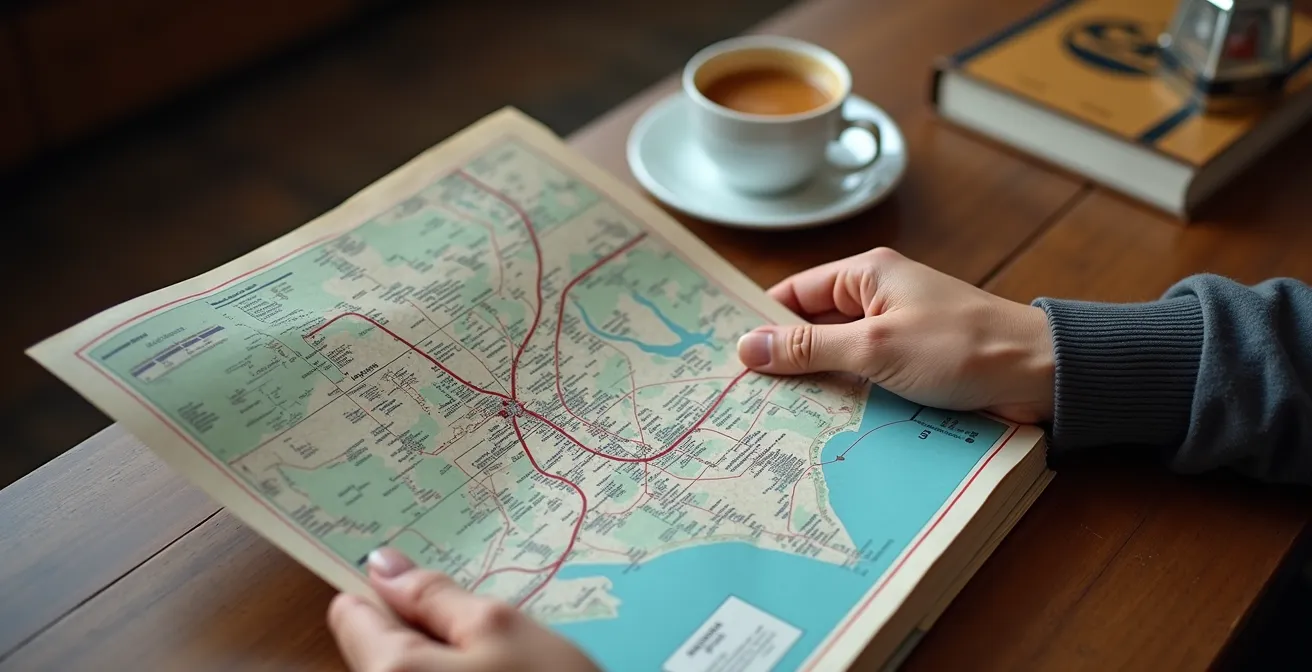
In summary:
- Focus on the 6 “false friend” letters that trick French speakers, not the entire alphabet.
- Treat reading as a decoding game, hunting for “cognates” like РЕСТОРАН (Restoran).
- Master the 10 essential menu words to order meat (Мясо) or fish (Рыба) with confidence.
- Rely on Yandex apps for superior offline map navigation and real-time translation.
Imagine standing in the Moscow Metro, surrounded by magnificent art, but feeling completely illiterate. The signs, a cascade of unfamiliar symbols, might as well be hieroglyphics. For many French travelers, this is the primary anxiety of visiting Eastern Europe: the Cyrillic alphabet barrier. The common advice is to either rely blindly on translation apps or face the daunting task of memorizing 33 seemingly alien letters. But what if this approach is fundamentally wrong?
The good news is that achieving practical literacy—the ability to read signs, menus, and maps—doesn’t require fluency. In fact, according to experienced travelers, it only takes about 3 to 4 hours of total study time to crack the code. The secret isn’t brute-force memorization; it’s a strategic shift in perspective. It’s about treating Cyrillic not as a new language to learn, but as a simple substitution cipher to decode. You already know most of the sounds.
This guide is your linguistic survival kit. We will not be conducting a boring grammar lesson. Instead, as your linguistics coach, I will show you how to recalibrate your brain to recognize the handful of letters that cause 90% of the confusion. We’ll turn decoding into a rewarding game, enabling you to navigate with confidence and experience your destination with a newfound sense of independence. We will cover the key “false friends,” how to read metro maps, decipher a menu, and use the best digital tools to support your new skill.
This structured approach will equip you with the essential skills to transform Cyrillic from a source of confusion into a key that unlocks a deeper travel experience. The following sections break down this method into simple, actionable steps.
Table of Contents: Learning Cyrillic in 3 Hours: The Survival Kit for French Travelers
- The letter ‘P’ is ‘R’: 5 Cyrillic letters that trick French speakers
- How to decode the destination names on the Moscow Metro map?
- Deciphering a menu: The 10 words you need to order meat or fish
- Yandex Translate vs. Google Lens: Which works better offline for Cyrillic?
- How to say “Thank You” without sounding like a Hollywood spy villain?
- Clockwise or Counter-clockwise: How to read the male/female voice announcements?
- Metro Partizanskaya: The step-by-step guide to finding the market entrance
- How to survive the Moscow Metro rush hour without getting crushed?
The letter ‘P’ is ‘R’: 5 Cyrillic letters that trick French speakers
The biggest barrier for a French speaker is not the letters that look completely new, but the ones that look familiar and are profoundly misleading. These are the “false friends.” Your brain is wired to see ‘P’ and think ‘P,’ but in Cyrillic, it’s a rolled ‘R’ sound. Unlearning this automatic response is the single most important step. Instead of memorizing 33 letters, let’s focus intensely on the 6 characters that cause the most confusion.
Mastering these is the 80/20 of learning to read Russian. Once you’ve calibrated your brain for them, the rest of the alphabet falls into place much more easily. Here are the culprits:
- В (V): Looks like a Latin ‘B’ but is always pronounced ‘v’, as in the French ‘voyage’.
- Р (R): Looks like ‘P’ but is a rolled ‘r’. This is the classic trap. Think ‘Paris’ but say ‘Raris’.
- Н (N): Looks like ‘H’ but is pronounced ‘n’, as in ‘non’.
- С (S): Looks like ‘C’ but is always a soft ‘s’ sound, as in ‘soupe’. It never makes a ‘k’ sound.
- У (U): Is pronounced ‘ou’, like the vowel sound in the French word ‘soupe’, not the French ‘u’.
- Х (KH): Looks like ‘X’ but represents a guttural sound, similar to the ‘ch’ in the German ‘Bach’ or a Scottish ‘loch’.
Practice writing them down and saying the correct sound out loud. This physical act helps overwrite years of Latin-based muscle memory. It’s not about achieving a perfect accent, but about creating an instant, correct association.
Your 5-Step Cyrillic Decoding Audit
- Isolate the Falsies: On a piece of paper, write down the 6 false friends (В, Р, Н, С, У, Х) and their true sounds. This is your cheat sheet.
- Find a Real-World Example: Use an online map and zoom in on a street in Moscow. Find a street name containing at least two of these letters.
- Transcribe Phonetically: Below the Cyrillic name, write out the sounds you see, letter by letter, using your French pronunciation intuition (e.g., for ‘СУП’, write ‘S-OU-P’).
- Verify with a Tool: Type the Cyrillic word into a translation app and listen to the pronunciation. How close were you? Identify where your brain tricked you.
- Repeat and Refine: Do this for five different words. The goal is to reduce the time it takes you to correctly identify the false friends without hesitation.
How to decode the destination names on the Moscow Metro map?
Once you’ve started to tame the “false friends,” the Moscow Metro becomes your training ground. Here, the goal is not fluency, but “cognate hacking”—spotting words that, once decoded, sound surprisingly familiar. Many international words have been adopted into Russian, and they are your key to navigating with confidence. You’ll feel like a codebreaker the first time you succeed.
For example, you see a sign that says РЕСТОРАН. Your old brain might see ‘PECTOPAH’. But your new, Cyrillic-calibrated brain decodes it: Р(R) – Е(YE) – С(S) – Т(T) – О(O) – Р(R) – А(A) – Н(N). Suddenly, “RESTORAN” appears. You’ve just found a restaurant. This is the magic moment. The metro is filled with these, from ‘Театр’ (Teatr) to ‘Центр’ (Tsentr). The trick is to look for phonetic similarities, not exact spellings.

While you practice your decoding skills, having the right digital tools is essential. They act as your safety net. Don’t just download any app; for Moscow, the local ecosystem is far superior.
- Yandex Metro: This is the undisputed champion. It works flawlessly offline, plans routes across all 232 stations, and shows station names in both Cyrillic and Latin scripts.
- Moscow Metro Map: A simple but effective app that helps visualize transfers and platform positions.
- Moscow Transport: Crucial for the “last mile,” this app provides exit information, telling you which exit to take for specific streets or landmarks.
Deciphering a menu: The 10 words you need to order meat or fish
Nowhere is your new skill more rewarding than at the dinner table. A Russian menu can be intimidating, but you don’t need to understand every word. You just need to identify the main sections and the key ingredients. This is where “cognate hacking” pays delicious dividends. Start by looking for words that feel familiar.
Case Study: The “Yogurt” Breakthrough
One traveler recounted their first success: seeing a container in a café labeled ‘йогурт.’ At first, it was meaningless. But by slowly decoding the letters (й=y, о=o, г=g, у=ou, р=r, т=t), the word “Yogurt” suddenly emerged. This small victory feels like cracking a secret code and is incredibly motivating. It transforms the learning process from a chore into an addictive and fun game.
Beyond cognates like ‘Десерт’ (Desert), learning a handful of specific food categories will allow you to navigate 90% of menus. This table contains the absolute essentials. Focus on recognizing the Cyrillic word and associating it with its French equivalent.
| Cyrillic | Pronunciation | French Equivalent |
|---|---|---|
| Закуски | Zakuski | Entrées/Hors d’oeuvres |
| Супы | Soupy | Soupes |
| Горячие Блюда | Goryachiye Blyuda | Plats chauds |
| Мясо | Myaso | Viande |
| Рыба | Ryba | Poisson |
| Десерт | Desert | Dessert (cognate!) |
Yandex Translate vs. Google Lens: Which works better offline for Cyrillic?
While learning the alphabet is empowering, a digital safety net is non-negotiable. Internet access can be unreliable, especially underground in the metro, and having a powerful offline tool is critical. This is particularly true in a country where, as some studies suggest, it’s estimated that only 5% of Russians speak English. Your smartphone is your most reliable interpreter, but not all apps are created equal, especially when it comes to the nuances of Moscow.
The main contenders are Yandex Translate and Google Lens. While Google is the default for many travelers, in Russia, the local champion, Yandex, has a significant home-field advantage. Its algorithms are specifically optimized for the Cyrillic script and integrated into a powerful ecosystem of local services. The comparison below highlights the key differences for a traveler in Moscow.
| Feature | Yandex Translate | Google Lens |
|---|---|---|
| Offline Mode | Full functionality with downloaded packages | Limited accuracy offline |
| Moscow Metro Integration | Direct integration with Yandex Maps & Metro | No direct integration |
| Real-time Camera Translation | Yes, optimized for Cyrillic | Yes, but can be slower offline |
| Exit Information | Shows which metro exit leads where | Not available |
The verdict is clear: for navigating Moscow, the Yandex suite of apps is superior. Its seamless integration between Maps, Metro, and Translate, combined with its robust offline performance, makes it the indispensable tool. Download the apps and the offline language packs before you leave home to ensure you’re prepared from the moment you land.
How to say “Thank You” without sounding like a Hollywood spy villain?
Your decoding skills will help you read, but a few spoken words of courtesy will open doors and earn you smiles. Russians often have a reputation for being stoic, but a sincere, correctly pronounced attempt at their language is almost always appreciated. The key is sincerity over effusiveness, and pronunciation matters. A mumbled, mispronounced “Spasiba” can sound dismissive. The goal is clarity, not a perfect accent.
Focus on the stressed syllable. In Russian, the stress is what gives the word its rhythm and makes it understandable. For “thank you,” the stress is on the second syllable. Practice these essential phrases, paying close attention to the capitalized part of the pronunciation guide.
- Спасибо (Spasiba): The basic “Thank you”. Pronounce it ‘Spa-SEE-ba’. Avoid the flat ‘spa-see-bah’ sound.
- Большое спасибо (Bolshoye Spasiba): “Thank you very much”. Pronounce it ‘Bol-CHOY-eh Spa-SEE-ba’.
- Пожалуйста (Pozhaluysta): A versatile word for “Please” and “You’re welcome”. The pronunciation is clipped: ‘Pa-ZHAL-sta’. Ignore the letters that aren’t pronounced.
- Здравствуйте (Zdravstvuyte): The formal “Hello”. This is a tough one, but the key is to start with a hard ‘Z’ sound, not ‘S’. A simple ‘ZDRAS-tvuy-tye’ is a good approximation.
A simple, well-pronounced ‘Spasiba’ accompanied by a genuine smile and a nod is far more effective than an overly elaborate attempt. Sincerity is the universal language.
Clockwise or Counter-clockwise: How to read the male/female voice announcements?
The Moscow Metro is a marvel of efficiency, but for a non-local, understanding the flow of traffic can be tricky. On the radial lines (those that go in and out of the center), the announcements are your primary audio guide. The system is brilliantly simple once you know the code: a male voice announces the stations when the train is heading towards the city center, and a female voice is used for trains traveling away from the center. Easy, right?
The confusion arises on Line 5, the Circle Line (Кольцевая линия). Here, the logic changes. A male voice indicates the train is traveling clockwise, while a female voice means it’s moving counter-clockwise. Memorizing this rule is essential for not ending up on a very long, scenic tour of the city’s outer ring. While this audio system is ingenious, always have a visual backup.
- Male Voice: Train is traveling toward the city center.
- Female Voice: Train is traveling away from the city center.
- Circle Line (Line 5) Exception: Male voice = Clockwise; Female voice = Counter-clockwise.
- Visual Backup: Always check the digital display panels on the platform, which show the next station and final destination. Modern apps like Yandex Metro also show your train’s direction visually.
Many modern train cars also have digital maps inside that show the train’s progress, but knowing the voice code is a classic Moscow skill that will make you feel like a true insider.
Metro Partizanskaya: The step-by-step guide to finding the market entrance
One of Moscow’s most famous and colorful attractions is the Izmailovo Kremlin and its sprawling flea market, a must-visit for souvenirs and soviet-era memorabilia. Getting there is easy via the metro, but finding the entrance from the station can be slightly disorienting for a first-timer. The destination is Partizanskaya station, and from there, it’s just a 10-minute walk from the metro if you know which way to go.
Partizanskaya station itself is a work of art, dedicated to the Soviet partisans of World War II. When you arrive, take a moment to admire the sculptures, but then focus on the exit. Follow these simple steps to navigate from the platform to the market gates without any guesswork.
- Take Metro Line 3 (the dark blue line, Арбатско-Покровская) to Partizanskaya (Партизанская) station.
- The station has only one exit hall. Once you go up the escalator, use the exit on the left.
- As you exit, you’ll need to cross a small street. You should immediately see the colorful, whimsical towers of the Izmailovo Kremlin ahead of you.
- Walk for about 5-10 minutes, following the crowds and the signs for ‘Измайловский Кремль‘ (Izmaylovskiy Kreml’).
- The entrance to the market complex is free. Previously, there was a small fee, but this is no longer the case.
- For the best experience with the most vendors, plan your visit for a Saturday or Sunday.
Following this path is straightforward and will lead you directly to the heart of one of Moscow’s most unique shopping experiences.
Key takeaways
- Your primary goal is to master the 6 “false friend” letters; this is more effective than trying to memorize the whole alphabet at once.
- Treating Cyrillic as a code to be broken, by hunting for familiar words (cognates) on signs and menus, makes the process fun and rewarding.
- For practical navigation in Moscow, the Yandex suite of apps (Metro, Translate, Maps) is functionally superior to Google due to its offline capabilities and local integration.
How to survive the Moscow Metro rush hour without getting crushed?
The Moscow Metro is not just a transit system; it’s the city’s circulatory system, and during rush hour (roughly 8-10 AM and 5-7 PM), it operates at maximum capacity. The crowds can be overwhelming, but the movement is surprisingly orderly if you understand the unwritten rules. Navigating it successfully isn’t about strength; it’s about technique and positioning. It’s a dance, and your goal is to move with the flow, not against it.
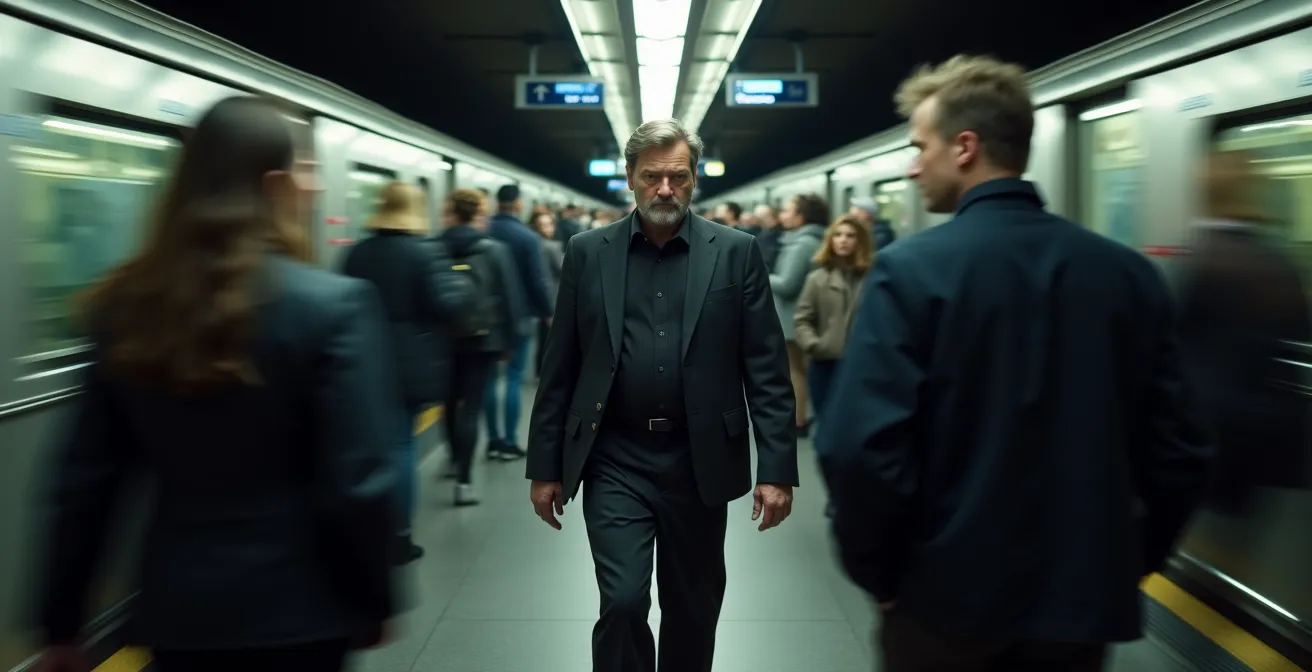
To avoid feeling like you’re being swept away by a human river, adopt the tactics of a seasoned Muscovite. These simple strategies will help you navigate the busiest times with minimal stress and maximum efficiency.
- Avoid the Edges: The first and last carriages of the train are consistently the most crowded as they are closest to station exits/entrances. Aim for the middle carriages.
- Escalator Etiquette: This is a hard and fast rule. Stand on the right, walk on the left. Blocking the left side is a major faux pas.
- Let Passengers Exit First: Never try to board a train before everyone has gotten off. Stand to the side of the doors, let the tide of people flow out, and then board.
- Drafting Technique: When the crowd is dense, position yourself directly behind a confident-looking local who is moving towards the door. Let them carve a path for you.
- Backpack Awareness: During peak times, don’t wear your backpack on your back. Hold it in front of you to save space and avoid hitting others.
- Pre-load Your Apps: Ensure your metro apps are downloaded and updated the night before. You may not have a reliable data signal underground to figure things out on the fly.
With these strategies, you’re no longer just a tourist; you’re a prepared and pragmatic traveler. You have the linguistic keys to decode the city and the practical knowledge to navigate its busiest arteries. The next step is to start practicing. Begin your decoding game today, and transform your trip from a passive experience to an active adventure.