In summary:
- Purchasing Aeroexpress tickets online or via the app is not just cheaper, it eliminates queues and travel-day stress.
- Digital tickets offer practical advantages, such as using your phone’s QR code (even offline) to pass turnstiles instantly.
- Understanding group fares like “Duo” or “Family” can unlock significant savings compared to buying individual tickets.
- Mastering the full transit journey, including stair-free metro transfers and rush hour strategies, ensures a truly efficient arrival.
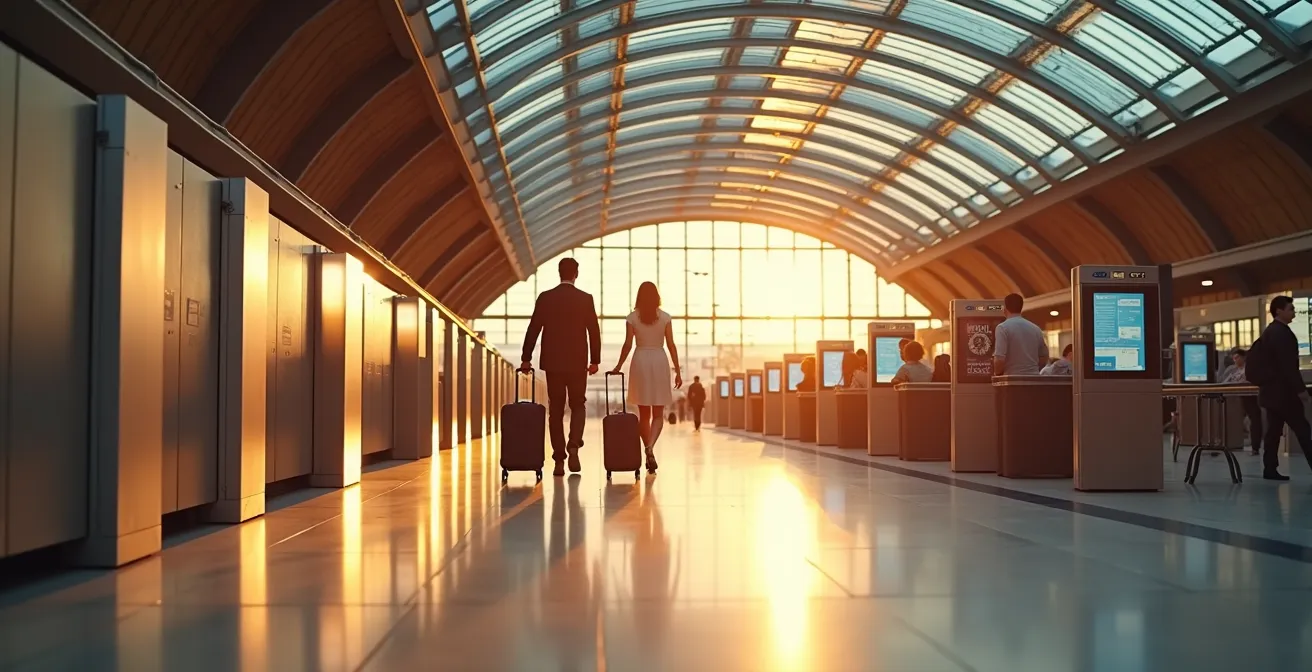
Landing at a bustling Moscow airport like Sheremetyevo or Domodedovo presents an immediate challenge: how to reach the city center efficiently. For the savvy traveler, the answer seems obvious—the Aeroexpress train. It bypasses the city’s notorious traffic jams, offering a fixed travel time. However, many visitors stop there, queuing at a ticket machine and treating it as a simple train ride. This approach misses the core benefit of the service. The real efficiency isn’t just taking the train; it’s mastering the entire Aeroexpress digital ecosystem before you even leave home.
The common advice is to “buy online to save money,” but this barely scratches the surface. The true value lies in transforming your arrival from a series of potential friction points—confusing ticket options, payment issues, navigating crowded terminals—into a single, seamless flow. This is about achieving frictionless transit. It’s the difference between simply arriving and arriving intelligently. This guide moves beyond the basics to give you the operational knowledge needed to navigate the system like a local, from choosing the right ticket class to understanding the nuances of the Moscow Metro transfer.
By treating your Aeroexpress journey as a planned operation rather than an afterthought, you don’t just save a few euros; you buy predictability and peace of mind. We’ll explore how to make the right choices at booking, use your digital ticket flawlessly, handle transfers without hassle, and even what to do if your flight is delayed. This is your playbook for a perfectly executed airport transfer.
This article provides a complete operational guide to using the Aeroexpress. The summary below outlines the key strategies we’ll cover to ensure your journey is as smooth and cost-effective as possible.
Summary: Master the Aeroexpress: Why Buying Your Ticket Online is the Ultimate Moscow Travel Hack
- Standard vs. Business: Is the Aeroexpress business class worth the extra €10?
- Belorusskaya Station: How to transfer from train to metro without stairs?
- Group discounts: How to save money if you travel as a couple?
- What happens if your flight lands after the last Aeroexpress leaves?
- How to use the Aeroexpress app to pass the turnstile with your phone?
- How long is the walk from Terminal D to the train station?
- Clockwise or Counter-clockwise: How to read the male/female voice announcements?
- How to survive the Moscow Metro rush hour without getting crushed?
Standard vs. Business: Is the Aeroexpress business class worth the extra €10?
The first decision in mastering the Aeroexpress digital ecosystem is choosing your class of service. While Standard Class is the default for most, Business Class offers specific comforts that may justify the price premium, especially after a long flight. It’s not just about a better seat; it’s about purchasing a guaranteed-calm experience. The key is to evaluate the cost against your specific needs and arrival time. For a short 35-minute journey, the extra expense might seem frivolous, but during peak hours, a guaranteed seat can be invaluable.
The primary difference lies in the guarantees. Standard is flexible—your ticket is valid for any train on the given day. Business class, however, is tied to a specific departure time, offering a reserved seat in a quieter, less crowded cabin. Additional perks like complimentary refreshments and luggage wrapping add to the value proposition. For travelers with heavy bags or those arriving exhausted, these benefits can significantly reduce arrival friction. The decision framework is simple: if you prioritize budget and flexibility, stick with Standard. If you value guaranteed space, quiet, and comfort, the upgrade is a sound investment in your well-being.
To make an informed decision, it’s helpful to see the features side-by-side. The following comparison, based on the official service offerings, breaks down what your money buys you. As you can see from the latest Aeroexpress pricing structure, the trade-offs are clear.
| Feature | Standard Class (€6-8) | Business Class (€15-18) |
|---|---|---|
| Seat Assignment | No guaranteed seat | Assigned seat guaranteed |
| Luggage Services | Basic storage only | Free luggage wrapping + storage |
| Refreshments | Not included | Complimentary drinks & snacks |
| Cabin Size | Larger, more passengers | Smaller, quieter cabin |
| Flexibility | Valid for any train that day | Specific departure time |
Ultimately, choosing to upgrade is a strategic decision. If you’re arriving during a busy holiday period or after an overnight flight, the €10 premium acts as an insurance policy against crowding and discomfort, setting a positive tone for the rest of your trip.
Belorusskaya Station: How to transfer from train to metro without stairs?
A frictionless transit experience doesn’t end when the Aeroexpress train stops. The next critical phase is the transfer to the Moscow Metro, and for travelers with heavy luggage, strollers, or mobility issues, navigating stairs can be a major source of anxiety. Fortunately, Belorusskaya station, a primary Aeroexpress terminus, is equipped with a modern, stair-free path to the metro. Knowing this route 이론 advance is a key part of an efficient arrival plan.
The journey from the Aeroexpress platform to the metro lines is designed for accessibility, but the signs for elevators can be missed in the flow of the crowd. The key is to ignore the main escalators that most passengers flock to. Instead, you’ll take a slightly different, calmer path. This small piece of knowledge can save you significant physical effort and stress, especially after a long flight. The entire process is logical once you know what to look for: the universal blue elevator icon and the Cyrillic word ‘лифт’ (lift).

As the image suggests, the access point is modern and clearly marked. To find it, simply follow this sequence:
- Exit the Aeroexpress at Belorusskaya and turn RIGHT immediately after passing through the turnstiles.
- Walk approximately 50 meters along the main corridor, past the ticket counters.
- Look for the blue elevator icon symbol on your LEFT.
- Take the elevator down to the metro level (floor -1).
- Upon exiting the elevator, turn LEFT for Line 5 (the Circle/Brown Line) or RIGHT for Line 2 (the Green Line). Both platforms are accessible without further stairs.
By planning for this accessible route, you eliminate one of the biggest physical hurdles of the airport-to-city journey, keeping your arrival smooth and energy levels high for the adventures ahead.
Group discounts: How to save money if you travel as a couple?
While individual online tickets already offer savings, the Aeroexpress digital platform provides even greater value through its group fares. For couples, families, or small groups, ignoring these options is like leaving money on the table. The “Duo” and “Family” tariffs are specifically designed to reduce the per-person cost, making the efficient train journey also the most economical choice. These fares are a core feature of the Aeroexpress digital ecosystem and are easily accessible via the website or app.
For couples, the “Duo” tariff is the most relevant. It provides a round-trip journey for two people under a single booking. Crucially, official data shows that Duo round-trip tickets save 850 RUB compared to purchasing two individual round-trip tickets. This translates to a saving of approximately €8-10 per couple—enough to cover a coffee and pastry upon arrival. The system is designed for efficiency: one payment, one QR code, and two people can pass through the turnstiles sequentially.
Case Study: The Family Pass Advantage
The “Family” fare further illustrates the benefits of group booking. It allows up to 2 adults and 3 children (aged 7-14) to travel together at a significantly reduced rate. With prices starting from 300 rubles per person within the group, this can represent savings of up to 50% compared to individual adult tickets. A key benefit for those traveling from France is that children under 7 travel entirely free, a policy that mirrors the familiar pricing structure of the SNCF, making budget planning easier.
By selecting the appropriate group tariff during the online booking process, you actively optimize your travel budget without sacrificing convenience. It’s a prime example of how a few minutes of pre-planning can yield tangible financial benefits.
What happens if your flight lands after the last Aeroexpress leaves?
The biggest risk of relying on any train service is missing the last departure. For a smart traveler, predictability involves having a contingency plan. The Aeroexpress is highly reliable, but it is not a 24-hour service. Understanding the cutoff times and having pre-vetted alternatives is crucial for a truly stress-free arrival, no matter what time you land. A quick check of the schedule is the first step; the official Aeroexpress timetable indicates last trains depart around 23:30, with slight variations by airport.
If a flight delay puts you past this cutoff, you are not stranded. Moscow’s airports have a robust network of late-night transport options, but the key is to know which ones are safe and cost-effective. The worst-case scenario is arriving unprepared and being forced to negotiate with unofficial taxi drivers. The best-case scenario is having a plan B, C, and even D ready on your phone. This is where your pre-trip preparation pays off, turning a potential moment of panic into a calm execution of your backup plan.
Here are the most reliable late-night transport options, ordered by a combination of cost and convenience:
- Option 1 – Yandex Go App: This is the local equivalent of Uber. Download the app and link your card before you travel. It offers upfront, fixed pricing (typically 2000-3000 RUB to the city center) and eliminates any need for cash or negotiation.
- Option 2 – Night Bus H1: For the budget-conscious, this bus runs from Sheremetyevo every hour after midnight. It costs a mere 55 RUB and accepts contactless payment directly on board.
- Option 3 – Official Airport Taxi: Look for the designated taxi counters inside the arrivals hall. They offer fixed, posted prices. This is more expensive than Yandex but is a regulated and safe option.
- Option 4 – Airport Hotel: If you land very late (e.g., after 11 PM), consider the cost of a late-night taxi against a nearby airport hotel. Sometimes, a short night’s rest is the more economical and sensible choice.
Having these options ready transforms a flight delay from a travel disaster into a minor inconvenience. It’s the ultimate safety net for the prepared traveler.
How to use the Aeroexpress app to pass the turnstile with your phone?
The pinnacle of a frictionless transit experience is gliding through the turnstile without breaking stride. The Aeroexpress app and mobile tickets make this possible, but “turnstile fluency” requires understanding the technology. The core component is the QR code on your ticket, which is your digital key. However, a common mistake is fumbling with the phone, holding it at the wrong angle, or having the screen brightness too low. A few simple preparations can make this process foolproof.
The system is designed for speed. As the official Aeroexpress guide published on RussianTrain.com states, “You only need to place your bank card or mobile device against the reader marked with a yellow circle at the top of the turnstile.” This simplicity, however, depends on proper technique. The scanner needs a clear, bright image to read. Dim screens, smudged displays, or a shaky hand can cause frustrating delays, forcing you to step aside and hold up the line—the very situation you sought to avoid by buying online.
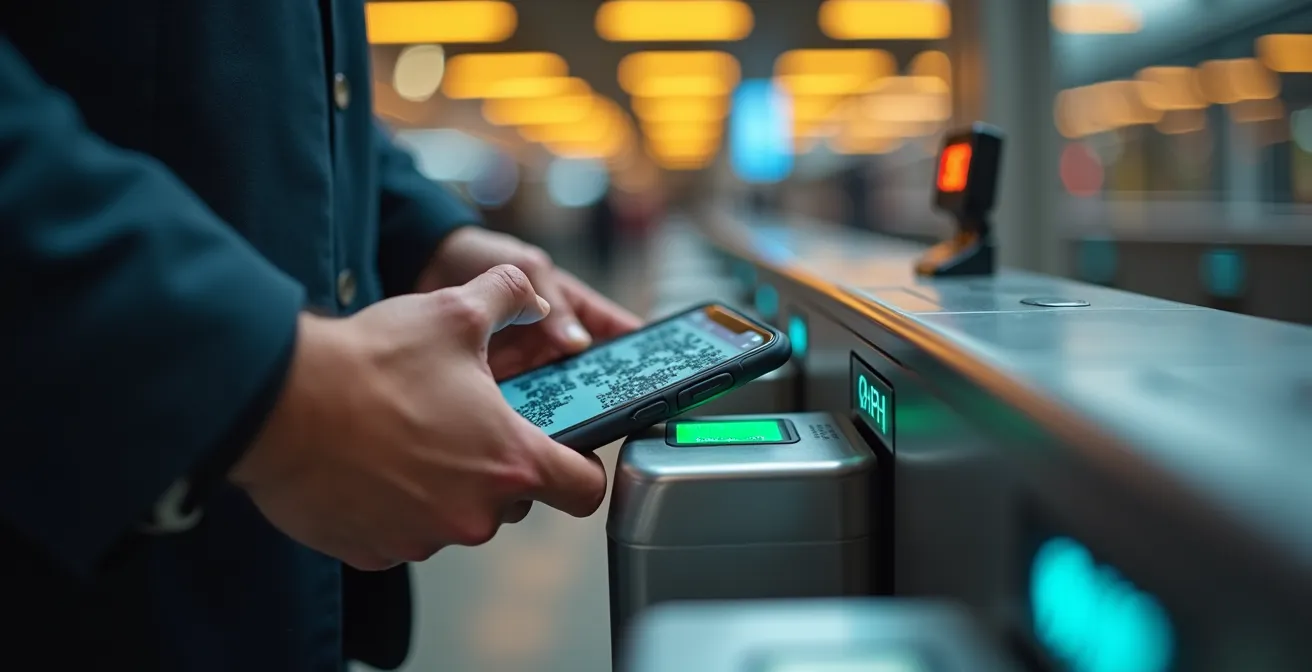
To ensure a smooth passage, think of it as a pre-flight check. The moment of truth at the gate is won or lost in the minutes before you approach it. The goal is to have your ticket ready, bright, and stable for a near-instant scan.
Your Action Plan: Perfect QR Code Scanning
- Brightness: Turn your phone’s screen brightness to the MAXIMUM level before you reach the turnstile.
- Offline Access: Take a SCREENSHOT of your QR code while you have an internet connection. It will work perfectly offline.
- Positioning: Hold your phone screen flat and steady against the yellow circle on the scanner, not at an angle.
- Troubleshooting: If the scan fails after 2-3 attempts, don’t panic. Go directly to the staffed glass booth; they will scan you through manually.
- Wallet Integration: For Apple users, add the ticket to your Wallet app. This allows for even faster contactless entry.
By following these pro tips, you ensure your digital ticket works as intended, cementing the efficiency of your online purchase and keeping your journey moving forward without a hitch.
How long is the walk from Terminal D to the train station?
At Moscow’s Sheremetyevo Airport (SVO), the physical journey from your arrival gate to the Aeroexpress platform is an integral part of your transfer time. For travelers arriving at Terminal D, this walk can seem daunting, but it is in fact a well-designed and straightforward process. Understanding the route and timing helps in planning connecting times and removes the uncertainty of navigating a large, unfamiliar airport. The entire path is a covered indoor gallery, protecting you from the elements and making the transit comfortable year-round.
The key to a stress-free walk is following the clear and consistent signage. Brown signs featuring a train icon and the word “Aeroexpress” (in both English and Cyrillic) guide you at every decision point. The inclusion of moving walkways, or travelators, helps to shorten the perceived distance and reduce physical exertion, which is especially welcome when handling luggage. The walk is not just a path but a small journey in itself, flanked by shops and cafes that act as landmarks.
Case Study: A Familiar Journey for French Travelers
The walking experience from Terminal D to the Aeroexpress station is remarkably similar to the connection between Terminal 2E and the TGV station at Paris Charles de Gaulle (CDG). The journey takes a predictable 10-15 minutes at a normal walking pace. The route is entirely wheelchair accessible, with no stairs to navigate. Clear brown signs with train icons are your guide, making the experience intuitive even for first-time visitors. This similarity in design and duration provides a familiar context for French travelers, making the process feel less foreign.
To further enhance predictability, you can use specific retail outlets as visual waypoints:
- After exiting Terminal D arrivals, immediately start following the brown ‘Aeroexpress/Аэроэкспресс’ signs.
- You will pass a Burger King on your LEFT, which serves as a good midpoint landmark.
- Continue straight, passing various duty-free shops.
- As you near the end of the gallery, you will spot a Shokoladnitsa coffee shop on your RIGHT. The Aeroexpress entrance is just after it.
This knowledge transforms a potentially confusing walk into a simple, timed-out step in your overall transit plan, contributing to a calm and collected arrival experience.
Clockwise or Counter-clockwise: How to read the male/female voice announcements?
Once you’ve seamlessly transferred from the Aeroexpress, you enter the Moscow Metro, a magnificent and sprawling system. While visually stunning, its navigation can be intimidating. One of its most ingenious yet potentially confusing features is the use of male and female voices for station announcements. This audio guidance system is a core part of the metro’s design, and understanding its logic is the key to navigating with confidence, especially on the critical Koltsevaya (Circle) Line.
The system is brilliantly simple once you know the rule. It tells you the direction of travel without you needing to read a sign. On the Circle Line (Line 5), a male voice announces the stations when the train is moving clockwise, and a female voice is used for counter-clockwise travel. On the radial lines that cross the city, the logic shifts slightly: a male voice indicates travel towards the city center, while a female voice signifies travel away from the center, towards the suburbs. This audio-based system provides a constant directional confirmation, even in a packed carriage where signs are obscured.
This concept can be made even clearer with a simple analogy. As the expert travel publication Bridge to Moscow notes in its guide, this system provides directional clarity in a unique way:
Think of the Circle Line like the Paris Périphérique with inner and outer rings – Moscow uses voices instead of signs to tell you which ring you’re on.
– Bridge to Moscow Travel Guide, How to Navigate Moscow’s Public Transport
This comparison to a familiar French landmark makes the concept instantly understandable for a French traveler. If you can’t distinguish the voices, don’t worry. Every platform also has digital displays showing the next stations, and the Yandex Metro app provides live location tracking on the map.
By learning this simple audio cue, you add another layer of mastery to your public transport skills, allowing you to navigate one of the world’s most impressive metro systems like a seasoned Muscovite.
Key takeaways
- Pre-booking online is the foundation of an efficient journey, unlocking cost savings and bypassing ticket queues.
- True mastery lies in understanding the entire digital ecosystem, from app-based QR codes to stair-free transfer routes.
- Contingency planning for late arrivals or crowded conditions transforms potential stress into manageable situations.
How to survive the Moscow Metro rush hour without getting crushed?
Navigating the Moscow Metro during peak hours (roughly 7:30-9:30 AM and 5:30-7:30 PM on weekdays) is an experience in itself. It is a powerful display of organized chaos. With over 7 million passengers served daily, making it one of the world’s busiest systems, survival requires more than just knowing your route; it demands an understanding of the unspoken local etiquette. Trying to fight the flow is futile and will only lead to frustration. The key is to move with the current, adopt local behaviors, and make smart positional choices to maintain your personal space.
The flow of people, especially on escalators and through corridors, is rapid and purposeful. One of the most strictly enforced rules is “stand right, walk left” on escalators, a rule observed with far more discipline than in the Paris Métro. Another critical courtesy is to remove your backpack and hold it in front of you or by your feet. This simple act creates a surprising amount of extra space for everyone and marks you as a considerate, aware traveler rather than a clumsy tourist. It’s these small adjustments that make a significant difference in the dense crush of a crowded carriage.
To further improve your experience, a few positional tactics can help:
- Carriage Choice: The first and last carriages of the train are often slightly less crowded than those in the middle.
- Boarding Technique: Don’t try to push on as the doors open. Let the first torrent of exiting passengers pass, wait a beat, and then enter in the calmer wake.
- Move with the Flow: Once inside the station, don’t stop abruptly or try to swim against the human current. Move predictably and let the crowd guide you towards exits or transfers.
- Use Technology: The Yandex Metro app is an invaluable tool, providing real-time crowd indicators for different lines and stations, allowing you to potentially reroute to a less congested path.
Instead of a stressful ordeal, you can learn to appreciate the incredible efficiency of the system, even at its busiest. This is the final step in achieving true transit mastery in Moscow.
Frequently Asked Questions about Aeroexpress Travel
Can we use one QR code for two people with the Duo ticket?
Yes, the Duo ticket provides a single QR code. The first person scans and passes through, then the second person uses the same code on the same phone.
Do children under 7 really travel free?
Yes, children under 7 accompanied by adults travel completely free on Aeroexpress, similar to many French public transport systems.
Is the Family fare available for one-way trips?
Yes, as of December 2024, the Family fare can be used for both one-way and round-trip journeys.
What do the male and female voices mean on the Circle Line?
Male voice = Moving clockwise (like a clock going forward). Female voice = Moving counter-clockwise. Think of it as ‘Men go right, Women go left’ on the circle.
How does it work on radial lines?
Male voice = Traveling toward the city center. Female voice = Traveling away from center toward the suburbs.
What if I can’t distinguish the voices?
Every platform has digital displays showing the next 3 stations. Also, the Yandex Metro app shows your live position on the map.