In summary:
- Standard advice for airports often fails at SVO; specific operational procedures are required for French travelers.
- Connectivity is a challenge: prepare by getting an eSIM before you fly, as local SIMs are hard to get and Wi-Fi requires a working phone number.
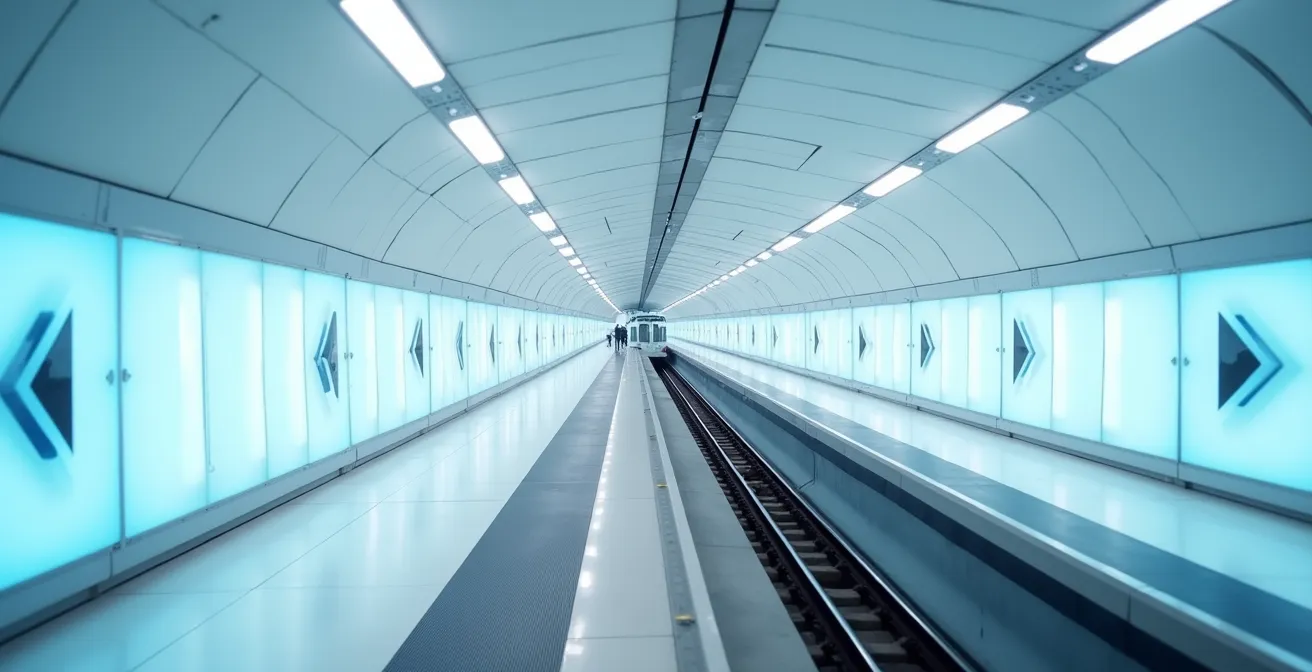
- Transfers between terminals (like B to C) are done via an underground automated train (APM), not by walking outside.
- For transport to the city, use cash (Roubles) for the Aeroexpress train and book taxis via the Yandex Go app, avoiding unofficial drivers.
Landing at Moscow’s Sheremetyevo Airport (SVO) can feel like stepping into a logistical puzzle. The sheer scale of the terminals, the Cyrillic signage, and a unique set of local rules can make standard travel advice completely irrelevant. Many travelers, especially those arriving from France, find themselves asking: how do I get from Terminal B to C? Can I even get on the Wi-Fi? How do I get a taxi without getting scammed? The usual tips to “follow the signs” or “buy a local SIM” don’t just fall short—they can lead you to a dead end.
The core of the issue is that Sheremetyevo operates on its own logic, particularly regarding digital connectivity and payments for foreign visitors. For instance, transferring between the northern terminals (B and C) and the southern ones (D, E, F) isn’t a simple walk. It requires using a specific underground automated people mover (APM) train. This is the first piece of “ground truth” you need: to get from Terminal B to C, you must follow the signs for the APM train inside the terminal; you do not exit. This journey takes less than ten minutes and is the key to all airside transfers.
This guide abandons generic advice. Instead, it provides the operational ground truth for French travelers navigating SVO’s most common challenges. We will break down the precise, non-obvious procedures for overcoming the airport’s digital firewall and logistical hurdles. From getting a Wi-Fi connection when your French SIM doesn’t roam, to understanding why you can’t just buy a SIM card anymore, this is your step-by-step operational manual for a smooth arrival in Moscow.
This article details the essential procedures for any French traveler arriving at SVO. Below is a summary of the critical points you will discover to ensure a seamless arrival and transfer experience.
Summary: A French Traveler’s Practical Guide to Sheremetyevo Airport (SVO) Arrivals
- How to get SMS code for Wi-Fi if your French SIM doesn’t roam?
- Where are the smoking areas inside Sheremetyevo arrivals?
- Megafon or MTS: Which booth at arrivals offers the best tourist data plan?
- How long is the walk from Terminal D to the train station?
- Capsule hotels: Where to nap if you land at 4 AM?
- Belorusskaya Station: How to transfer from train to metro without stairs?
- The sign board: How to find your driver in the crowded arrival hall?
- Why buying your Aeroexpress ticket online saves you time and money?
How to get SMS code for Wi-Fi if your French SIM doesn’t roam?
The first challenge upon landing is often connectivity. Sheremetyevo offers free Wi-Fi, but there’s a significant catch for international travelers: due to government regulations, you must verify your identity by receiving an SMS or a phone call. If your French SIM card doesn’t have a roaming plan activated for Russia, you simply won’t receive the code, leaving you disconnected. This is the digital firewall many travelers hit immediately.
The most effective operational procedure is to bypass this problem entirely by preparing before your flight. The best solution is purchasing an eSIM data plan for Russia before you leave France. This gives you data access the moment you land, without relying on the airport’s tricky Wi-Fi. Companies like Holafly offer Russia-specific plans that can be installed in minutes.
This image illustrates the simplicity of setting up this solution, a proactive step that can save significant frustration upon arrival.
If you haven’t prepared in advance, your options are limited but not impossible. Some cafes inside the terminals, like Burger King or Shokoladnitsa, offer their own Wi-Fi to customers. This requires making a purchase but can be a reliable alternative. As a last resort, you can try toggling between the ‘SMS’ and ‘Call’ options on the airport Wi-Fi portal; sometimes one will work when the other fails, but this is not guaranteed.
Ultimately, relying on airport Wi-Fi is a gamble. The “ground truth” is that an eSIM purchased in advance is the only guaranteed way to break through the digital firewall and stay connected.
Where are the smoking areas inside Sheremetyevo arrivals?
For travelers who smoke, finding a designated area after a long flight is a priority. Russian law is strict about smoking in public places, and airports are no exception. You will not find smoking areas in the main arrival halls or baggage claim areas. The good news is that Sheremetyevo has brought back indoor smoking rooms after they were previously banned.
Sheremetyevo Airport is officially equipped with indoor smoking cabins in all terminals. These specially ventilated glass rooms are located in the sterile (post-security) zones of the departure and transit areas. The airport is divided into the Northern Terminal Complex (Terminals B and C) and the Southern Terminal Complex (Terminals D, E, and F), and these facilities are available across both.
If you are in the arrivals stream, you will need to exit the building to smoke. Designated outdoor smoking spots are typically located at least 15 meters from terminal entrances. However, if you are in transit, you can access the indoor cabins without leaving the secure area. Look for the universal pictogram for a smoking area on the overhead signs to guide you to the nearest cabin. They are usually situated near the gates or in main concourse areas.
Therefore, the operational procedure is clear: if you are arriving and ending your journey, proceed outside. If you are transiting, stay within the secure zone and follow the signs to an indoor cabin.
Megafon or MTS: Which booth at arrivals offers the best tourist data plan?
The standard advice for any country has long been to “buy a local SIM card at the airport.” At Sheremetyevo, you’ll see booths for major Russian providers like MTS and Megafon. However, for a French tourist, this advice is now dangerously outdated. A recent regulatory change has created a significant hurdle, making this option nearly impossible for short-term visitors.
The “ground truth” is that the rules have changed. As the Russiable Travel Guide explains, this shift has profound implications for tourists:
Until the end of 2024 it was easy to buy a Russian SIM card by showing your passport at a phone store, but since January 2025 the rules have changed. You now need to register on the state platform Gosuslugi and have a SNILS (Russian social security number), procedures that are complicated for a tourist traveling for a short period. Therefore, today, the alternatives to get online in Russia are [eSIM or roaming].
– Russiable Travel Guide, Best eSIMs for Traveling to Russia
This ‘Gosuslugi’ barrier means that approaching an MTS or Megafon booth as a tourist is no longer a viable strategy. The best operational procedure is to secure an eSIM from a provider that partners with Russian networks before you travel. Holafly, for example, uses the MTS network and provides excellent coverage, even in remote regions. It is crucial to note that many popular eSIM providers, like Airalo, no longer operate in the country, so choosing the right provider is key.
This table compares the current, realistic options for a French traveler.
| Provider | Network | Setup Process | Coverage Quality | Payment Method |
|---|---|---|---|---|
| Holafly eSIM | MTS | You receive a QR code by email that you scan with your smartphone. In a few seconds a new data profile is installed. | Best option for Trans-Siberian, remote regions like Murmansk Oblast, Kamchatka Peninsula. | Pay in EUR online |
| Physical SIM (MTS/Megafon) | MTS/Megafon | Since January 2025 you need to register on Gosuslugi and have a SNILS (Russian social security number). | Good in cities | Cash (Roubles) only |
| Airalo | Not available | N/A | Many of the most popular ones, like Airalo, no longer work in the country. | N/A |
Forget Megafon or MTS at the airport. The correct and stress-free procedure is to arrive with a pre-installed eSIM from a compatible provider.
How long is the walk from Terminal D to the train station?
Navigating from your arrival gate to the Aeroexpress train station is a key part of your journey into Moscow. Terminals D, E, and F form the Southern Terminal Complex and are well-connected. The walk from Terminal D to the Aeroexpress station is straightforward and protected from the elements, taking approximately a 10-minute walk with luggage.
The airport infrastructure is designed for this transfer. After you collect your luggage and exit the customs area in Terminal D, you need to look for signs indicating “Aeroexpress” or the universal train symbol. These signs will direct you to the pedestrian galleries. Both the southern terminals (D, E, F) and the Aeroexpress railway terminal are connected by modern, interconnected by pedestrian walkways equipped with travelators (moving walkways) to speed up your journey.
This glass-enclosed walkway provides a clear path and protects you from the weather, making the transfer comfortable year-round.
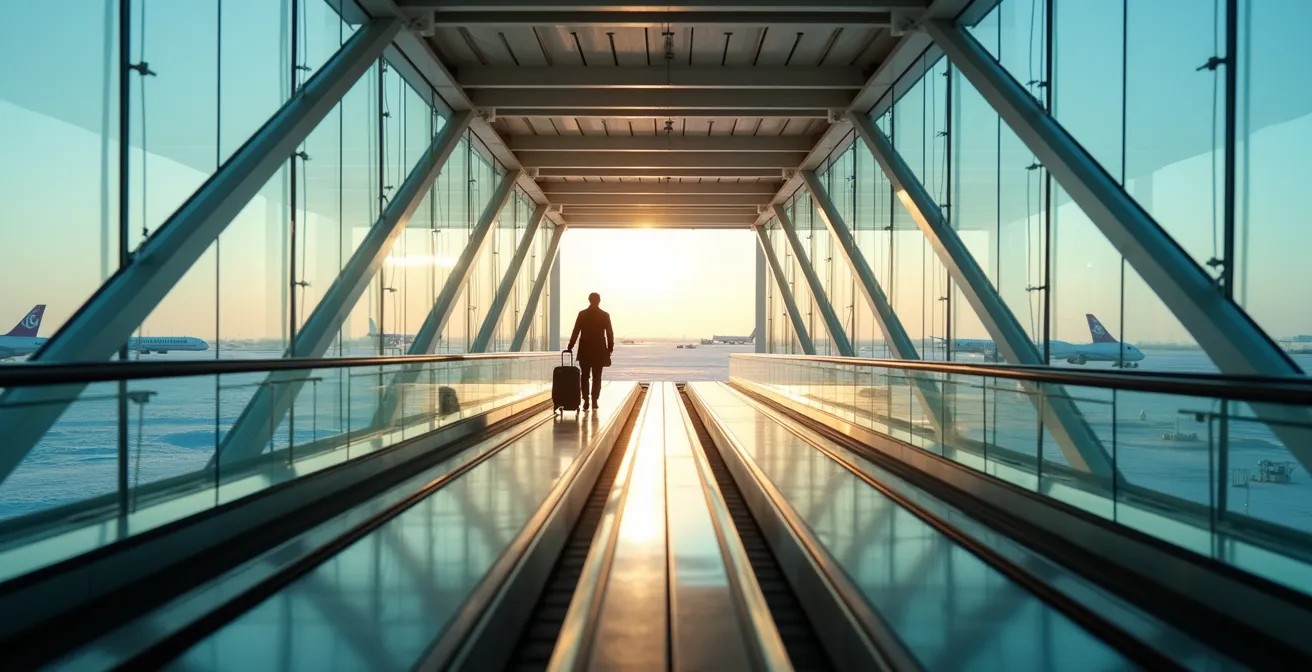
The operational procedure is simple: once landside, consistently follow the train pictograms. The path is linear and designed to funnel passengers directly from the terminal buildings to the train platform entrance. You will not need to go outside. The entire journey is indoors, passing over roadways via pedestrian bridges until you reach the multistory Aeroexpress terminal building.
In short, the transfer is efficient and well-designed. Expect a brisk 10-minute walk along a modern corridor with moving walkways to assist you.
Capsule hotels: Where to nap if you land at 4 AM?
Arriving on a red-eye flight or facing a long layover can be exhausting. Sheremetyevo offers several excellent options for rest, ranging from convenient in-terminal capsules to nearby hotels with special transit services. Your best choice depends on whether you need to stay airside (within the secure transit area) or can go landside (exit customs).
For maximum convenience, the GettSleep Capsule Hotel is the top choice. It has multiple locations within the airport. For international transit passengers, there is an airside location in Terminal C. For domestic travelers or those who have exited customs, there is a landside location in Terminal B. These capsules are more than just a bed; each unit offers an ergonomic mattress, ventilation, luggage storage, Wi-Fi, and charging points. Showers and toilets are also available. You can book them for a full night or by the hour (in 3-hour blocks), making them perfect for a quick nap.
Beyond capsules, there are other excellent rest options available:
- Novotel Moscow Sheremetyevo: This hotel is adjacent to the airport (landside) but offers a unique transit service. If you are in transit without a Russian visa, you can inquire at the “Transfer/Transit Without Visa” desk. They can arrange an escort to and from the hotel, allowing you to rest comfortably without officially entering the country.
- Sky Point Hotel: A 3-star option linked to Terminals B and C by a free shuttle bus that runs every 30 minutes. It’s a reliable choice if you have a longer layover and have cleared immigration.
- Free Family Rooms: For passengers traveling with children under 7, or for pregnant mothers, free-to-use rest rooms are available in the common areas of Terminals B, C, and D.
- 24/7 Cafes: If you just need a place to sit for an hour or two, various cafes in Terminals C and D, such as Shokoladnitsa, are open around the clock.
Whether it’s a few hours in a high-tech capsule or a full night at a hotel with a visa-free escort, SVO is well-equipped to handle early morning arrivals.
Belorusskaya Station: How to transfer from train to metro without stairs?
After a comfortable journey on the Aeroexpress train, you will arrive at Belorusskaya Station in central Moscow. The trip takes roughly 53 minutes from the airport. The next challenge is transferring to the Moscow Metro, a sprawling system that can be difficult to navigate, especially with luggage. The key concern for many is avoiding the endless flights of stairs. Fortunately, a stair-free path is possible with the right knowledge.
The operational procedure is to prioritize elevators over escalators. Upon exiting the Aeroexpress platform, your goal is to connect to either the Green Line (Line 2) or the Brown Line (Circle Line 5). Instead of following the main crowds towards the escalators, look for the universal elevator symbol. In Cyrillic, the word for elevator is “лифт”. These elevators are your key to a seamless, accessible transfer.
For navigating the broader metro system without stairs, the Yandex Metro app is an indispensable tool. It has a feature that allows you to plan a route specifically avoiding stairs, which is invaluable when you have heavy bags. Remember to purchase a Troika card from a vending machine (many accept cash) for easy access to the metro system.
Action Plan: Your Stair-Free Belorusskaya Metro Transfer
- Exit the Aeroexpress train and immediately look for elevator pictograms (“лифт”) on directional signs.
- Follow the signs to the elevators that serve the Green (2) and Brown (5) metro lines.
- Use the elevator to descend to the metro station concourse level.
- Locate a ticket machine. Select the English interface and purchase a Troika card using cash (Roubles).
- Use the Yandex Metro app and enable the “route without stairs” option to plan your onward journey throughout the city.
By using a combination of on-site signage for elevators and digital tools for planning, you can make your transfer from the Aeroexpress to the Moscow Metro system entirely stair-free.
The sign board: How to find your driver in the crowded arrival hall?
Emerging into the arrivals hall at any major international airport can be chaotic, and Sheremetyevo is no exception. You’ll be met with a crowd of people and a sea of drivers holding signs. Finding your pre-booked driver in this environment requires a clear strategy to ensure both safety and efficiency. The worst mistake you can make is engaging with the unofficial “pirate” taxi drivers who will approach you aggressively.
As travel expert Irena from the Russiable guide advises, preparation is everything:
For those who value comfort, especially if arriving with lots of luggage or with kids, a taxi is the most practical solution. My advice: use apps like iWay or Yandex Go to book, or hire one at the official airport counters and avoid ‘pirate’ taxi drivers. Duration: from 35 to 60 minutes depending on traffic.
– Irena, Russiable Guide – How to Get from Sheremetyevo Airport to Moscow
The correct operational procedure starts before you even leave France. Download the Yandex Go app (the Russian equivalent of Uber) and set up your account. Crucially, as French bank cards will not work, you must set your payment method to ‘cash’. Once you land and have a data connection (ideally via your pre-purchased eSIM), book your ride. The app will tell you the car model, license plate, and your driver’s name.
When you enter the arrivals hall, ignore anyone who approaches you directly, even if they look official. Head to the designated meeting point for ride-share apps or look for a driver holding a sign with your name. To be extra clear, you can show them this phrase on your phone: ‘У меня заказ через Яндекс Go’ (I have a Yandex Go booking). Alternatively, you can go to the official airport taxi desks, where staff generally speak English.
By using a trusted app and avoiding unofficial solicitations, you can navigate the crowded arrivals hall with confidence and start your journey into Moscow safely.
Key takeaways
- The “ground truth” at SVO often contradicts standard travel advice; specific, current operational knowledge is essential.
- Pre-travel preparation is non-negotiable: purchase a compatible eSIM and download the Yandex Go app before leaving France.
- Navigating SVO requires understanding its unique systems, from the APM train for transfers to the cash-based economy for on-the-spot transport.
Why buying your Aeroexpress ticket online saves you time and money?
The title of this section reflects a common piece of travel wisdom: “book online to save.” However, at Sheremetyevo, this is another platitude that fails the “ground truth” test for French travelers. While buying an Aeroexpress ticket online might be slightly cheaper, the reality is that Russian websites, including the official Aeroexpress site, do not accept French bank cards. Attempting to purchase online will only lead to frustration and wasted time.
Therefore, the most efficient and reliable operational procedure is to buy your ticket upon arrival. Do not try to book in advance from France. Once you have followed the signs to the Aeroexpress terminal, you will find rows of red ticket vending machines. These machines are modern, have an English language interface, and are easy to use. The standard one-way price is 420 rubles at the ticket machine.
The key to a successful transaction is to use cash (Roubles). While the machines state they accept card payments, relying on a foreign card is a gamble. Using cash guarantees success and is the fastest way to get your ticket. The machines dispense change, so you don’t need the exact amount. The trains run every 30 minutes from early morning until after midnight, so there is no need to rush.
Forget online booking. The most practical and time-saving method is to go directly to the vending machines at the Aeroexpress terminal and pay with cash. This simple, direct approach is the perfect example of how having the right on-the-ground knowledge makes all the difference.