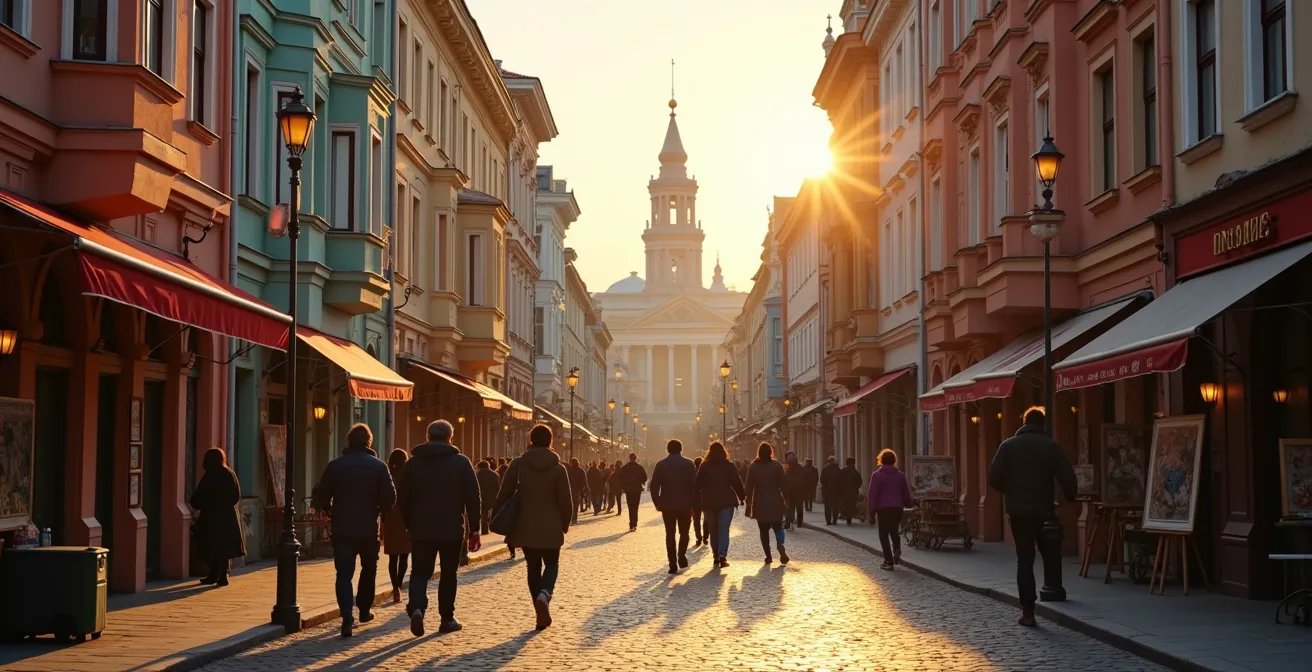
Contrary to its reputation as a mere tourist thoroughfare, Old Arbat is a historical text where Moscow’s pre-Soviet elegance, counter-cultural rebellion, and architectural ghosts are hidden in plain sight.
- The street’s true value lies not in its souvenir stalls but in its layered history, from 19th-century merchant homes to Soviet-era intellectual haunts.
- Authentic cultural sites, like the Viktor Tsoi Wall and the Melnikov House, exist just off the main path, offering a glimpse into a non-commercialized Moscow.
Recommendation: Approach your walk not as a consumer, but as a historian, learning to decipher the architectural clues and cultural echoes that most visitors overlook.
To the uninitiated, Moscow’s Old Arbat Street presents itself as a colourful, chaotic, and ultimately commercialised pedestrian artery. It’s a mile-long stage for caricature artists, amber merchants, and an endless parade of matryoshka dolls. Many guidebooks list it as an essential stop, a place to stroll, shop, and soak in a manufactured “old Moscow” atmosphere. This is the surface story, the one written for mass tourism, and it barely scratches the surface of the street’s profound and complex identity.
But what if the real Arbat is not on the main thoroughfare, but in the courtyards behind it? What if its soul is not in the souvenirs, but in the graffiti-covered walls and the ghosts of poets who once walked its cobblestones? This guide adopts a different perspective. We will treat the Arbat not as a shopping mall, but as an architectural palimpsest—a manuscript written and erased over centuries, where traces of aristocratic life, avant-garde experiments, and Soviet counter-culture can still be found by those who know where to look. It’s an exercise in seeing beyond the kitsch to find the authentic history that endures.
This article is structured to guide you on this historical excavation. We will begin by uncovering architectural and cultural landmarks hidden just off the main street, then address the practicalities of navigating Arbat safely and intelligently. Finally, we will learn how to read the very facades of its buildings to understand the district’s evolution and place it within the broader context of historic Moscow.
Summary: A Discerning Guide to Old Arbat’s Hidden Layers
- How to glimpse the avant-garde Melnikov House hidden behind Arbat?
- The Viktor Tsoi Wall: Why do fans still gather here to sing?
- Coffee on Arbat: Which historic cafe did intellectuals actually frequent?
- Is Old Arbat safe at night for solo tourists?
- Why you should walk Old Arbat but drive through New Arbat?
- How to spot the homes of 19th-century merchants hidden in plain sight?
- Cash or QR code: How to tip street musicians in a cashless society?
- Walking old Moscow: Which district offers the best pre-Soviet vibe?
How to glimpse the avant-garde Melnikov House hidden behind Arbat?
Just a five-minute walk from the bustle of Arbat, hidden in Krivoarbatsky Lane, lies one of the world’s most significant examples of Constructivist architecture: the Melnikov House. This private residence, built by architect Konstantin Melnikov in the late 1920s, is a radical statement of interlocking cylinders punctuated by nearly 60 hexagonal windows. It stands in stark contrast to both the 19th-century classicism and Stalinist grandeur that define much of Moscow, representing a brief, brilliant flash of revolutionary artistic freedom.
Glimpsing it is an essential part of understanding the creative forces that once thrived in this district. The house is not a typical walk-in museum; access has historically been restricted to protect the fragile structure. Visits are only possible via pre-booked guided tours, and it’s crucial to check the official museum website for its current status, as extensive restoration work has been ongoing. According to recent notices, the Melnikov House is expected to reopen fully to the public in the summer of 2025 after extensive restoration.
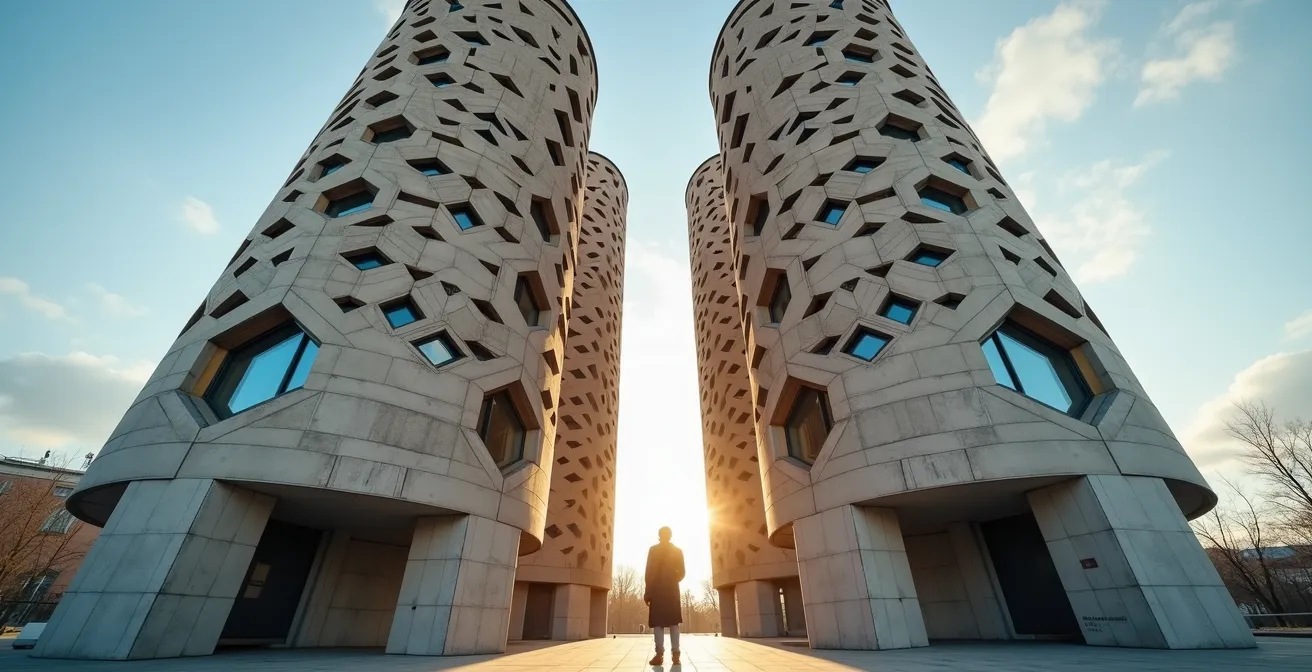
Even if you cannot get inside, the view from the lane is a powerful experience. The building’s form—two cylinders of different heights embedded in each other—was a revolutionary approach to living space, intended to be a prototype for a new kind of communal living that was never realised. It remains a poignant symbol of a utopian future that the Soviet project ultimately abandoned, making it a crucial pilgrimage for anyone interested in the intellectual geography of the Arbat district.
The Viktor Tsoi Wall: Why do fans still gather here to sing?
In a small alley just off the main Arbat thoroughfare (at house number 37), you will find one of Moscow’s most potent and living memorials: the Viktor Tsoi Wall. Tsoi was the frontman of the rock band Kino, whose poetic, brooding lyrics became the anthem for a generation of Soviet youth yearning for change (peremen) in the 1980s. After his tragic death in a 1990 car crash, this wall spontaneously became a shrine, covered in graffiti, lyrics, and portraits of the musician.
Unlike a static monument, the Tsoi Wall is a site of continuous cultural participation. The gatherings here are not solemn vigils; they are expressions of enduring community. Young musicians perform impromptu concerts of Kino’s songs, and fans from across generations add their own messages to the layers of paint. It represents the living spirit of late Soviet counter-culture, a powerful counter-cultural echo in the heart of a now-commercialised district. A local guide aptly described its unique energy to the Russiable Travel Guide.
Imagine the living, breathing equivalent of Jim Morrison’s grave at Père Lachaise, but with impromptu concerts instead of quiet contemplation.
– Local Moscow tour guide, Russiable Travel Guide
For the discerning traveler, spending time at the Tsoi Wall is more revealing than browsing any souvenir shop. It’s a place to witness the authentic and the performative clashing. While some street musicians on the main Arbat play for tourist money, the music here is played for connection and remembrance. It’s a testament to how a physical space can embody the spirit of an era, a living archive of hope and dissent that continues to resonate decades later.
Coffee on Arbat: Which historic cafe did intellectuals actually frequent?
While modern Arbat is lined with generic coffee chains and tourist-focused eateries, its past is steeped in a rich cafe culture that fueled Russia’s greatest minds. To find the authentic intellectual heart of the district, one must look past the neon signs and towards the grand facade of the Restaurant ‘Praga’. Though it may look like an imposing, formal establishment today, its history is woven into the fabric of Moscow’s intelligentsia.
Before the revolution, the ‘Praga’ was a distinguished venue frequented by the cultural elite. As noted by travel experts at Express to Russia, its former patrons included literary giants like Leo Tolstoy and Anton Chekhov, and the master painter Ilya Repin. It was a cornerstone of the district’s social and intellectual life. Following the revolution, it was transformed into a tavern and a dining hall for Mosselprom (the Moscow Rural Cooperative Administration), yet it retained its status as a cultural landmark, connecting the pre-revolutionary and Soviet eras.
Today, finding a coffee shop with that same historic weight is impossible. However, understanding that ‘Praga’ was the original hub helps reframe your perception of the street. The real intellectual life of Arbat wasn’t about quiet, solitary writing; it was about boisterous debate and community in grand establishments. When walking Arbat, look for other traces of this cultural life, such as the Vakhtangov Theatre, which has been operating since 1922 and stands as another pillar of the area’s artistic heritage. This is the authentic legacy, far removed from the modern, transient cafe experience.
Is Old Arbat safe at night for solo tourists?
For any solo traveler, particularly one navigating a large, foreign city, safety is a primary concern. Old Arbat, with its reputation as a major tourist hub, generally benefits from a high level of security. The most significant safety feature is the fact that, since 1985, the main street has been practically free of road traffic, creating a pedestrian-only environment that significantly reduces many common risks. During the day and into the evening, the street is bustling with families, tourists, and locals, and the atmosphere is overwhelmingly safe and welcoming.
However, a discerning approach is wise, especially as night falls. While the main pedestrianised stretch remains well-lit and populated until around 9 p.m., the adjacent side streets and courtyards can become quiet and poorly lit. As with any major city, these are areas to approach with caution after dark. The primary risk on Arbat itself is not violent crime, but opportunistic theft, such as pickpocketing, particularly in dense crowds or near the busy metro stations at either end of the street.
To provide a clearer picture, here is a breakdown of safety levels in different parts of the Arbat district at various times. It’s always recommended to maintain standard urban awareness: keep valuables secure, be mindful of your surroundings, and stick to well-trafficked areas late at night.
| Time/Area | Safety Level | Recommended Precautions |
|---|---|---|
| Main Arbat pedestrian street (daytime) | Very Safe | Standard tourist awareness |
| Main Arbat (evening until 21:00) | Safe | Keep valuables secure, stay in well-lit areas |
| Side alleys off Arbat | Use Caution | Avoid dark corners and quiet courtyards after dark |
| Near metro stations | Generally Safe | Busy transport hub – watch for pickpockets |
Why you should walk Old Arbat but drive through New Arbat?
The distinction between Old Arbat (Starry Arbat) and New Arbat (Novy Arbat) is fundamental to understanding Moscow’s 20th-century transformation. They are not merely two streets; they represent two opposing philosophies of urban life. Experiencing them correctly—walking one and driving the other—is key to appreciating this contrast. Old Arbat, at approximately 1.2 km long, is built on a human scale. It follows an ancient, slightly meandering path, lined with buildings of two to five storeys that create an intimate, enclosed atmosphere.
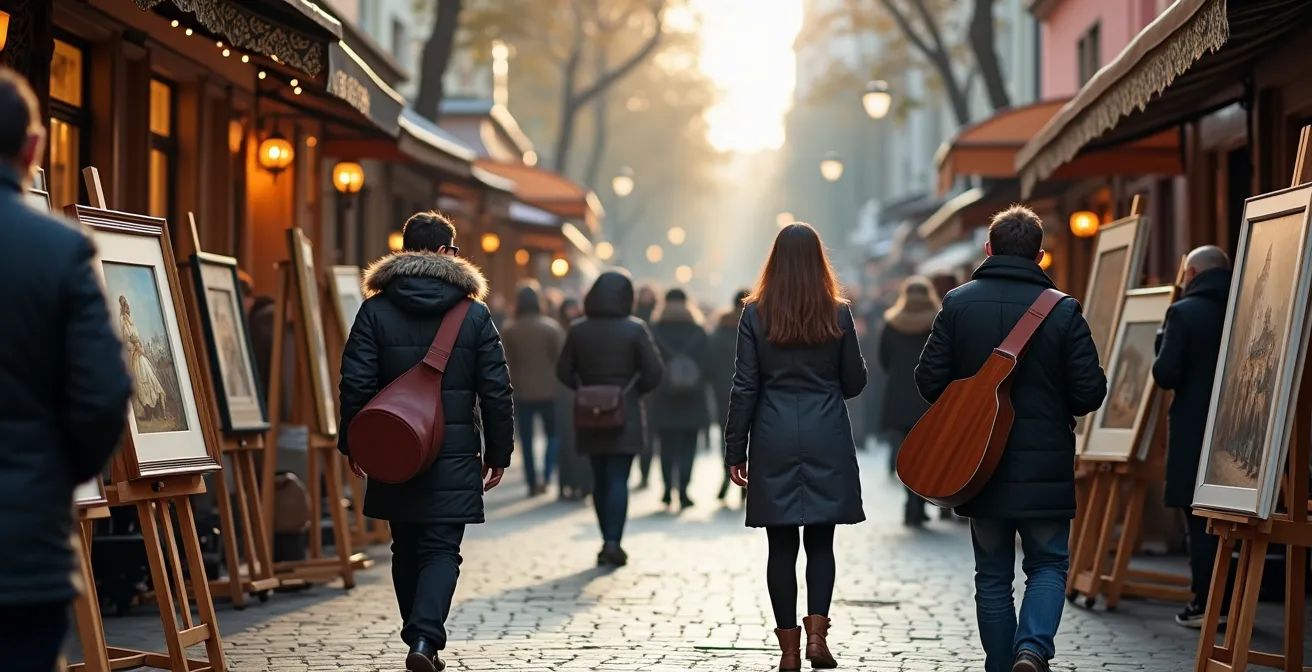
Its pedestrianisation in 1985 was a conscious act to preserve this historic character, fostering a culture of strolling, street art, and cafe society. It is a street designed to be absorbed slowly, on foot, allowing you to notice the architectural details, listen to the musicians, and feel the gentle ebb and flow of the crowd. Driving through it would be both impossible and nonsensical.
New Arbat, by contrast, is a product of the Soviet Union’s post-war ambition. Built in the 1960s, it is a multi-lane highway that slices through the old city grid. Its defining features are the monumental “book buildings”—towering, open-book-shaped apartment blocks that were a display of Soviet power and modernity. This street was not designed for pedestrians; it was built for parades, motorcades, and the efficient flow of traffic. To truly grasp its monumental scale and ideological purpose, one must experience it from a vehicle, watching the massive facades scroll past. Walking it is a noisy, windswept, and ultimately unsatisfying experience.
How to spot the homes of 19th-century merchants hidden in plain sight?
To the untrained eye, the buildings of Old Arbat can seem like a pleasant but uniform collection of historic facades. To a historian, however, they are an open book telling a story of destruction and rebirth. Many of the “old” buildings you see today were actually constructed after the great fire of 1812 during Napoleon’s occupation of Moscow. The reconstruction that followed was largely driven by a prosperous merchant class, and their homes are still visible if you know what architectural features to look for.
Learning to “read the street” involves training your eye to spot the specific details that distinguish these pre-revolutionary structures from later Soviet-era buildings. After the 1812 fire, Neoclassicism was the dominant style, but by the early 1900s, it gave way to the Russian variant of Art Nouveau, known as Stil Modern, with its flowing lines and nature-inspired motifs. These merchants’ homes were designed to project wealth and taste, often featuring decorative stucco work and wrought-iron balconies.
Many of these details were later obscured when Stalinist policies enforced a uniform, often drab grey, on the city’s facades. However, post-Soviet restoration efforts have brought back some of the original pastel colours. The following checklist will help you identify the architectural clues of Arbat’s 19th-century merchant past, transforming your walk from a simple stroll into an act of historical discovery.
Your checklist for identifying pre-Soviet architectural features
- Look for Neoclassical facades with columns and pediments, typical of the post-1812 reconstruction period.
- Spot Art Nouveau details, known as ‘Stil Modern,’ from the early 1900s, characterized by floral motifs and curved lines.
- Notice decorative stucco work (lepnina) used to create ornate patterns around windows and cornices.
- Identify wrought-iron balconies, which were a common symbol of a merchant family’s prosperity.
- Check for surviving pastel colours (pinks, blues, greens) that have been restored, contrasting with the later Soviet-era grey.
Cash or QR code: How to tip street musicians in a cashless society?
The street musicians of Arbat are an integral part of its living culture, but in an increasingly cashless world, the simple act of showing appreciation has become complicated. For international visitors, especially those from France and elsewhere in Europe, navigating the payment landscape requires some preparation, as common methods may not work.
Cash remains the most reliable and universally accepted method. While many locals use QR codes linked to Russian banking apps like Sberbank or Tinkoff, these are generally inaccessible to tourists without a Russian bank account. Therefore, carrying a small supply of 50 and 100 ruble notes is the most straightforward way to tip a performer whose music you enjoy. It’s a direct, appreciated gesture that bypasses any technological or banking hurdles.
A critical point for French and other European travelers is the current status of their bank cards. Following international sanctions, most foreign-issued Visa and Mastercard cards do not work in Russia for payments or ATM withdrawals. It is essential to check the very latest sanctions status before your trip, but the prevailing advice is not to rely on them. Some digital wallets like YooMoney may offer a potential workaround for foreigners, but setting them up can be complex. For a hassle-free experience, exchanging currency for rubles before you arrive or upon landing remains the most practical strategy.
This table, based on information from guides like the Moscow Pass, summarizes the options for supporting Arbat’s artisan culture.
| Payment Method | Availability | Notes for Tourists |
|---|---|---|
| Cash (Rubles) | Always accepted | Most reliable – carry 50-100 ruble notes |
| QR codes (Russian banks) | Common | Requires Russian bank account (Sberbank/Tinkoff) |
| French cards (Visa/Mastercard) | Currently restricted | Check current sanctions status before travel |
| Digital wallets | Limited | YooMoney possible workaround for foreigners |
Key takeaways
- Old Arbat’s authentic character is found not in its shops, but in its hidden architectural details, from avant-garde structures to merchant-era facades.
- The street’s cultural soul lives on in participatory sites like the Viktor Tsoi Wall, which stand in contrast to the commercial performances on the main promenade.
- A successful visit requires practical preparation, especially for French travelers, regarding payment methods in a largely cashless society where foreign cards are restricted.
Walking old Moscow: Which district offers the best pre-Soviet vibe?
While several Moscow districts retain pockets of the past, Old Arbat offers arguably the most concentrated and accessible journey into the city’s pre-Soviet atmosphere. Its unique evolution transformed it from a quiet aristocratic street into Moscow’s most vibrant cultural melting pot by the late 19th century. Academics, writers, composers, and artists lived in close proximity, creating a dense intellectual geography that fostered an unparalleled exchange of ideas. This is the “vibe” that lingers beneath the surface of modern commerce.
The Soviet era attempted to erase this legacy, demolishing mansions or converting them into kommunalki (communal apartments), but the street’s layout and many of its building shells survived. It is this resilience that makes Arbat such a compelling district to explore. It serves as the perfect starting point for any historical walking tour of Moscow because it contains layers from almost every significant era in one walkable stretch.
Once you have familiarised yourself with the architectural and cultural language of Arbat, you can then apply that knowledge to other historic areas. Your walk can be a gateway to exploring the literary world of Patriarch’s Ponds, the setting for Bulgakov’s “Master and Margarita,” or the quieter, leafy elegance of Tverskoy Boulevard. Arbat provides the foundational grammar for reading Old Moscow; the other districts are subsequent chapters in the same epic story.
By learning to look beyond the souvenirs and read the architectural and cultural clues, your walk along Old Arbat transforms from a simple tourist activity into a rich historical investigation, offering a deeper connection to the city’s complex soul.