To truly understand the Romanovs, one must look beyond the splendours of St. Petersburg and decode the dramatic saga hidden within Moscow’s historic sites.
- Moscow served as the dynasty’s spiritual heart, the source of its divine legitimacy, a fact reflected in its most sacred cathedrals.
- Key museums house not just treasures, but narrative artifacts that tell the story of the empire’s rise, its clash with the West, and its tragic collapse.
Recommendation: Approach each Moscow museum not as a gallery, but as a chapter in the epic and often tragic history of Russia’s last imperial family.
The story of the Romanovs is a saga of divine ambition, unimaginable opulence, and a fall so cataclysmic it still echoes through history. For most, this tale is synonymous with the glittering palaces of St. Petersburg, a city built as a testament to imperial power. Many guides will point you there, to the Winter Palace or Peterhof, to witness the dynasty’s grandest stage. They speak of the treasures, the art, and the architecture as the final word on Romanov legacy.
But what if the true soul of the dynasty, its origins, its spiritual legitimacy, and the very seeds of its destruction, are best understood in Moscow? What if St. Petersburg was the glorious performance, but Moscow was the script? This is the historian’s perspective. The key to the Romanov enigma lies not just in what they built, but in the ideological and historical foundations they desperately tried to uphold. The museums of Moscow are not mere collections; they are narrative portals into the heart of their 300-year reign.
This guide abandons the simple checklist. Instead, we will journey through Moscow’s key sites as if they were chapters in a dramatic chronicle. We will uncover how to read the story of the Tsars in the architecture of their earliest homes, find the ultimate symbols of their wealth, relive their defining military struggle, and locate the final, haunting documents that sealed their fate. This is not a tour of objects, but an immersion into a story.
For those who prefer a spoken narrative, the following discussion with historians offers deep insights into the final years of the Romanovs, providing a rich context for the artifacts and locations you are about to discover.
To navigate this historical journey, we have structured this guide to follow the dramatic arc of the Romanov dynasty itself. Each section reveals a different facet of their power, their psychology, and their ultimate tragedy, all told through the hallowed halls of Moscow’s most significant sites.
Summary: A Narrative Tour of Romanov Moscow
- The Chambers of the Romanov Boyars: What was life like before Peter the Great?
- Armory Chamber: How to locate the famous Imperial Easter Eggs?
- Borodino Panorama: Visualizing the battle against Napoleon from a Russian perspective
- The State Historical Museum: Where to find the documents of the last Tsar?
- Cathedral of the Assumption: Why were all Tsars crowned in Moscow, not St. Petersburg?
- Can you actually visit the Grand Kremlin Palace as a normal tourist?
- Novodevichy Cemetery: How to find Chekhov and Khrushchev’s graves?
- How to visit the Terem Palace typically closed to the public?
The Chambers of the Romanov Boyars: What was life like before Peter the Great?
Before the vast, geometric avenues of St. Petersburg, before the Western-style grandeur of Versailles became the model for a Russian palace, there was Old Muscovy. To understand the Romanovs, one must first step into their world before they became emperors: the world of the boyars. The Chambers of the Romanov Boyars, a quiet and often overlooked museum, is a time capsule. It is here that you feel the dynasty’s origins, not in gold and diamonds, but in the heavy scent of wood, leather, and incense.
This was a life of intimate, almost claustrophobic domesticity, steeped in Orthodox piety. The architecture itself tells a story. Forget soaring ballroom ceilings; here you find low, vaulted ceilings that force a sense of humility and closeness. The small rooms, connected by narrow passages, speak of a world where family and faith were intertwined, a stark contrast to the performative public life of the later imperial court. The mica windows cast a dim, ethereal light, a world away from the sun-flooded halls of the Winter Palace. This is not the Russia of Catherine the Great’s Enlightenment salons; it is the pious, insular Russia from which the dynasty first drew its strength.
To truly appreciate this foundational chapter of the Romanov story, one must observe the details not as decoration, but as evidence of a lost way of life. It’s an exercise in historical empathy, allowing you to build a baseline against which the later excesses of the empire can be measured.
A Historian’s Checklist: Reading the Story of Old Muscovy
- Examine the low vaulted ceilings and mica windows that characterized pre-Westernized Russian architecture.
- Study the colorful tile stoves (pechki) that served as both heating systems and decorative centerpieces.
- Observe the embossed leather wall coverings and heavy wooden chests typical of boyar households.
- Compare the intimate room sizes with the immense scale of later imperial palace grandeur.
- Note the prevalence of Orthodox icons and religious artifacts that dominated daily life before Western influences.
By immersing yourself in this earlier, more austere environment, you can begin to comprehend the seismic cultural shift that Peter the Great would later unleash upon his nation.
Armory Chamber: How to locate the famous Imperial Easter Eggs?
If the Boyar Chambers represent the humble seed of the dynasty, the Armoury Chamber is its most extravagant, dazzling bloom. Housed within the Kremlin, this is not a military museum; it is a treasure chest that holds the material proof of Romanov power and, arguably, their disconnect from reality. While the collections are vast—containing everything from coronation robes to royal carriages—the ultimate symbols of this gilded world are the Imperial Fabergé Eggs.
To locate them is to find the heart of late-imperial opulence. Proceed directly to the second floor upon entering. There, in a large, brilliantly lit display case, you will find the collection. The Moscow Kremlin’s Armoury Chamber houses the world’s second-largest collection, featuring 10 of the priceless Imperial Easter eggs. These are not merely jewels; they are narrative artifacts. Each egg, a private gift from the Tsar to his wife, contains a unique surprise, a miniature marvel that often commemorated a key event in their personal or public lives. They represent a dynasty that had turned its gaze inward, crafting a perfect, jeweled world for itself while the real world outside grew increasingly restless.
The question is not just “where” to find them, but “how” to see them. They are more than just beautiful objects. Look at the Trans-Siberian Railway Egg, a celebration of industrial achievement, or the Moscow Kremlin Egg, a fantasy of their own spiritual home. Viewing them, you witness the immense craftsmanship they commanded, but also the profound isolation of a family that could commission such intricate fantasies as their empire began to crumble. They are the ultimate symbols of a beautiful, but fragile, gilded cage.
These eggs, meant to be intimate tokens of affection, have become public symbols of an era of unimaginable luxury that could not, and did not, last.
Borodino Panorama: Visualizing the battle against Napoleon from a Russian perspective
Every great dynasty faces a trial by fire, a moment that forges its identity in the crucible of war. For the Romanovs and for Russia itself, that moment was 1812. To a French visitor, it is the “Campagne de Russie,” a tale of strategic genius undone by the unforgiving Russian winter. But in Moscow, at the Borodino Panorama museum, you are immersed in a completely different narrative: the “Patriotic War of 1812.” This is a story of national sacrifice, spiritual resilience, and heroic defense of the motherland.
The museum’s centerpiece is a colossal 360-degree painting by Franz Roubaud. It is not a simple artwork; it is an instrument of national memory. Standing on the central platform, you are not a spectator but a participant, placed directly into the heart of the bloodiest single day of the Napoleonic Wars. The canvas, combined with the three-dimensional diorama in the foreground, creates a dizzying illusion of reality. You see the desperate charges, the smoke-choked redoubts, and the sheer scale of the human cost. This is history as overwhelming experience, designed to make you feel the Russian perspective in your bones.

The experience is a powerful lesson in how history is written and remembered by the victors. The focus is not on Napoleon’s tactical brilliance but on the stoic determination of the Russian army and the strategic wisdom of General Kutuzov. It portrays the burning of Moscow not as a defeat, but as a sublime act of sacrifice that ultimately saved the nation. For any history buff, especially one familiar with the French narrative, this is an essential and jarring counterpoint.
The contrast in how this pivotal conflict is framed in France versus Russia reveals the deep ideological divides that defined 19th-century Europe, as a comparative analysis of the narratives makes clear.
| Aspect | French Narrative | Russian Narrative |
|---|---|---|
| Name of Conflict | Campagne de Russie | Patriotic War of 1812 |
| Battle Focus | Strategic retreat to Moscow | Russian heroism and sacrifice |
| Key Moment Depicted | Napoleon’s tactical brilliance | Kutuzov’s defensive strategy |
| Artistic Style | David/Gros heroic paintings | Roubaud’s 360° panorama |
| Commemorative Sites | Les Invalides, Paris | Borodino Panorama, Moscow |
This battle solidified the Romanovs’ role as defenders of Russia against the West, a theme that would resonate for the next century and beyond.
The State Historical Museum: Where to find the documents of the last Tsar?
After the opulence and the epic battles, the Romanov story takes a sharp, tragic turn. To find the evidence of this final chapter, one must go to the State Historical Museum. Dominating Red Square with its neo-Russian facade, this institution is the official keeper of Russia’s timeline. While its vast collections span the nation’s entire history, for the Romanov historian, it holds a particular, somber significance. It is here, among the relics of Tsars and patriarchs, that one can find the ghosts of the end.
The museum’s stated purpose is sweeping. As noted by its curators, its exhibitions are vast and impressive. As described on its public record:
The museum’s exhibitions range from relics of prehistoric tribes that lived in the territory of present-day Russia, to priceless artworks acquired by members of the Romanov dynasty.
– State Historical Museum, Wikipedia – State Historical Museum
Within this immense chronicle, which contains millions of objects from prehistoric times to the modern era, are the artifacts of the final collapse. While specific exhibitions rotate, this is where you are most likely to find personal effects of Nicholas II and his family, and, most chillingly, the documents that sealed their fate. You are searching for items like the Tsar’s formal abdication manifesto of March 1917. Seeing the actual document, perhaps with the Tsar’s own signature, transforms an abstract historical event into a tangible, human moment. It is the physical proof of an empire’s dissolution, the moment a divinely appointed autocrat became a simple citizen, Nicholas Romanov.
Finding these artifacts requires patience and sometimes specific inquiry, as they may be part of larger thematic displays on the early 20th century or the revolution. But the search is the point. It is a historical pilgrimage to the primary sources of a tragedy, a confrontation with the stark, bureaucratic paperwork that ended a 300-year-old dynasty.
In this museum, the grand Romanov narrative ceases to be a story of jewels and palaces and becomes a quiet, haunting study of their final days.
Cathedral of the Assumption: Why were all Tsars crowned in Moscow, not St. Petersburg?
This question is central to understanding the Romanov psyche. Peter the Great moved the political capital to St. Petersburg, a new city built in a Western image, to modernize Russia and break from its past. And yet, for the next 200 years, every single Romanov emperor, including Nicholas II, returned to Moscow for their coronation. They returned to the ancient, sacred heart of the Kremlin, to the Cathedral of the Assumption. Why?
The answer is spiritual legitimacy. St. Petersburg could be the political and cultural capital, a Russian answer to Paris or Vienna. But Moscow, and specifically this cathedral, was considered the “Third Rome,” the holy center of the Orthodox world. To be crowned here was not just a political act; it was a divine anointment. It was a way for each Tsar to connect their reign directly back to the first Tsars and, by extension, to the Byzantine emperors and God himself. It was a source of power that a secular, European-style capital could never provide.
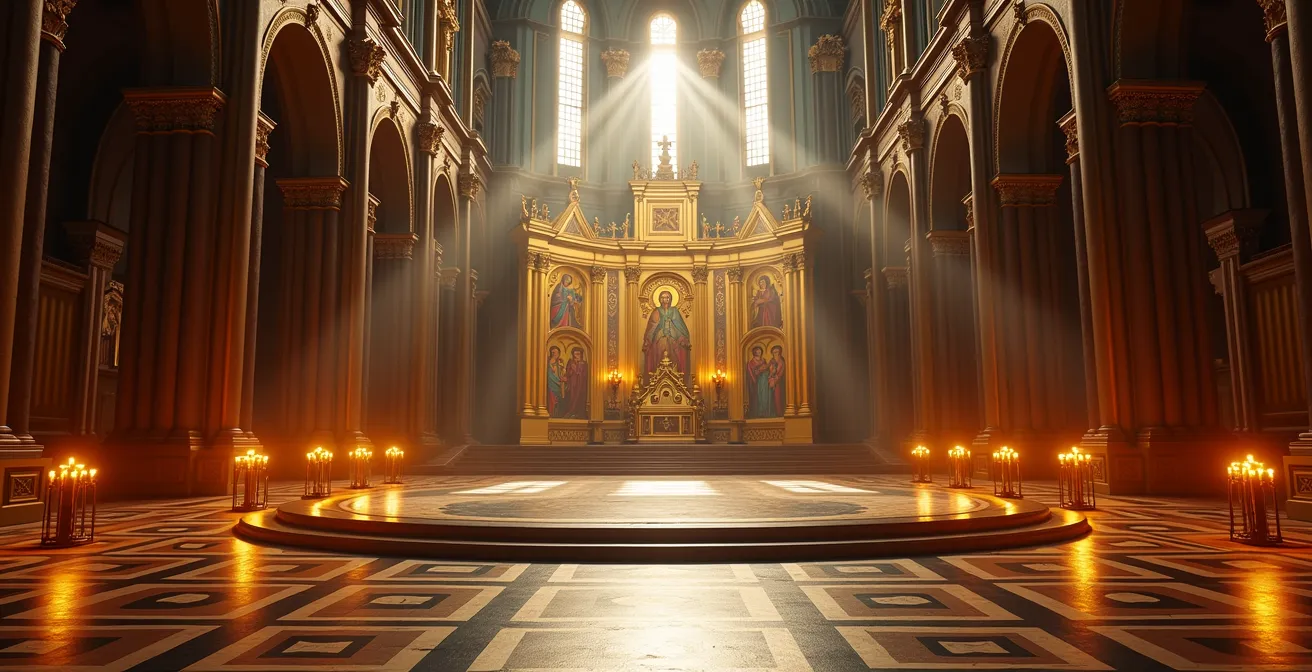
Standing inside the cathedral today, surrounded by soaring arches and a shimmering golden iconostasis, you can feel this power. This was not a public space in the modern sense; it was a sacred stage. The coronations were elaborate liturgical dramas that reaffirmed the Tsar as God’s chosen representative on Earth. This choice to maintain Moscow as the ceremonial heart preserved the dynasty’s connection to its ancient, faith-based roots, even as its leaders pursued Westernization. It highlights the fundamental duality of the Romanov empire: one foot in the modern, political world of Europe, the other firmly planted in the mystical soil of Orthodox Muscovy.
This enduring tradition reveals that, for all their imperial might, the Romanovs knew their ultimate authority flowed not from politics, but from the sacred ground of the Moscow Kremlin.
Can you actually visit the Grand Kremlin Palace as a normal tourist?
The short, and frustrating, answer is no. The Grand Kremlin Palace, the official residence of the President of Russia and the former Moscow residence of the Tsars, is not open to individual tourists. Its inaccessibility is, in itself, a powerful statement. Like the Forbidden City in Beijing, its closed doors create a mystique and reinforce the separation between the state and the people. For the Romanov historian, this barrier is symbolic of the later Tsars’ own isolation from their subjects.
However, “no” is not the final answer. Access is possible, but it is exclusive and expensive. To walk through its hallowed halls, such as the magnificent St. George’s Hall, you must book a tour through a specially accredited tour operator. These requests must be submitted months in advance to allow for security clearance, and even then, access is limited to a few ceremonial spaces. Photography is strictly forbidden, preserving the palace’s enigmatic aura. These tours are a significant investment, often costing several thousand rubles per person.
For those who cannot secure this exclusive access, there are excellent alternatives. The Armoury Chamber is located within the same palace complex and is fully accessible with a standard ticket, offering a view of the imperial treasures. Furthermore, the palace’s magnificent exterior facade can be admired up close from Cathedral Square, which is part of the general Kremlin tour. While you may not enter, you can stand where Tsars once stood and appreciate the sheer scale of the building that served as the dynasty’s Moscow heart, even if its inner sanctums remain a tantalizing mystery.
The difficulty of visiting the Grand Kremlin Palace only adds to its legend, making it one of the most coveted and symbolic sites in all of Russia.
Novodevichy Cemetery: How to find Chekhov and Khrushchev’s graves?
A dynasty’s story doesn’t end with its fall. It echoes in the world that follows. The Novodevichy Cemetery is Moscow’s answer to Paris’s Père Lachaise, a city of the dead that tells the story of Russia after the Tsars. While the Romanovs themselves are buried elsewhere (primarily in the Archangel Cathedral within the Kremlin and later in St. Petersburg), Novodevichy is where you find the people who shaped, and were shaped by, their legacy and its aftermath. With over 27,000 burials, it is a vast chronicle in stone.
Finding specific graves is a pilgrimage in itself. To locate Anton Chekhov, the great playwright whose works chronicled the twilight of the aristocracy, you must look for a modest, chapel-like monument that reflects his understated genius. His grave is a touchstone for understanding the intellectual climate that preceded the revolution. The search for Nikita Khrushchev’s grave is a political statement. His striking, modernist black-and-white memorial by Ernst Neizvestny symbolizes the duality of his reign—the “thaw” and the lingering oppression. His burial here, outside the Kremlin Wall, was a final, posthumous rebuke from the Soviet establishment.
Walking through Novodevichy is like reading the index of Russian and Soviet history. Here lies composer Dmitri Shostakovich, whose music wrestled with life under Stalin; Boris Yeltsin, the man who oversaw the end of the Soviet Union, lies under a massive, flowing Russian tricolor. You are walking among the artists, scientists, and political figures who inhabited the world the Romanovs left behind. The cemetery is not a Romanov site, but it is an essential epilogue to their story, showing who and what rose from the ashes of their empire.
Each grave is a story, and together they form a complex, often contradictory portrait of the nation that emerged after the last Tsar.
Key Takeaways
- Moscow’s role as the spiritual and ceremonial heart of the Romanov dynasty is the key to understanding their claim to divine power.
- Imperial artifacts like Fabergé eggs should be viewed not just as treasures, but as symbols of a gilded, isolated world on the brink of collapse.
- The most inaccessible palaces often have excellent, accessible alternatives that offer an authentic glimpse into the lost world of the Tsars.
How to visit the Terem Palace typically closed to the public?
The Terem Palace is perhaps the most enchanting and frustrating Romanov site in the Kremlin. A jewel of 17th-century Muscovite architecture, its fairy-tale chambers with their vibrant frescoes and tiled stoves represent the last flowering of pre-Westernized Russian culture. It is the architectural soul of Old Muscovy, a more intimate and ornate version of the Boyar Chambers. And, like the Grand Kremlin Palace, it is almost entirely closed to the public, reserved for official state functions.
For the history buff, this is a significant loss, as it represents a direct link to the world of the first Romanovs. However, where one door closes, another often opens. For those unable to secure the nearly impossible access to Terem, an extraordinary and authentic alternative exists: the reconstructed Palace of Tsar Alexey Romanov at Kolomenskoye. This sprawling wooden palace, located in a park on the outskirts of Moscow, was once called the “eighth wonder of the world.” Though the original fell into ruin, it was meticulously rebuilt in 2010 using the original 17th-century plans and drawings.
Visiting the Kolomenskoye palace is not a compromise; it is a solution. It offers a fully immersive experience of the very style and atmosphere that the closed Terem Palace represents. You can wander through its 26 recreated interiors, marveling at the same intricate wooden carvings, low vaulted ceilings, and dazzlingly colorful tiles. It provides deep insight into the architectural soul of old Russia that the Romanovs inhabited before their great pivot to the West. The experience makes the lost world of the Terem Palace tangible, allowing you to complete your journey back to the dynasty’s roots.
Ultimately, the story of the Romanovs is one of both presence and absence. Your historical journey is complete not just by seeing what is there, but by understanding what is lost and finding its powerful echoes elsewhere.
Frequently Asked Questions about Romanov History in the Kremlin
Is the Grand Kremlin Palace the same as the Kremlin complex?
No, the Grand Kremlin Palace is a specific building within the larger Kremlin complex. While you can visit many Kremlin sites freely with tickets, the Palace itself requires special arranged tours.
What can I see if I can’t get Palace access?
The Armoury Chamber, located within the palace complex, offers incredible imperial treasures including Fabergé eggs, coronation robes, and carriages. It has a separate entrance and regular visiting hours.
Are there any free viewing opportunities?
While you cannot enter the palace freely, you can admire its impressive exterior facade from Cathedral Square within the Kremlin grounds with a standard Kremlin ticket.