The key to a successful Russian visa application from France is understanding that the required “visa support letter” is a distinct administrative document, entirely separate from any hotel booking confirmation.
- A visa support letter (or “tourist invitation”) is issued by an accredited Russian tourist company and serves as the official purpose of your visit. It is not a hotel reservation.
- Most rejections for French applicants stem from technical non-compliance, such as incorrect photo specifications (matte finish, face coverage) or inadequate travel insurance.
Recommendation: Secure your accredited visa support letter online first, then proceed with the application. Book your flights and accommodation only after the visa has been issued.
For many independent French travellers, the Russian visa application process appears shrouded in administrative mystery. The most common point of confusion revolves around the requirement for an “invitation” or “tourist voucher.” Does this mean you must have a fully paid, non-refundable hotel booking before you even apply? This misunderstanding often leads to costly errors and application rejections. The reality is far more straightforward once you grasp the underlying administrative logic.
The process is not about pre-booking your entire trip, but about providing the correct, standardized documentation to the consulate. The “visa support letter” is a formal document issued by a tourist agency accredited by the Russian Ministry of Foreign Affairs (MFA). This document is composed of a tourist confirmation and a voucher, and its primary function is to officially state the purpose and itinerary of your visit for the consulate’s records. It is a compliance checkpoint, a piece of official paperwork that is entirely decoupled from your actual hotel reservations, which you can make later.
This guide demystifies the entire procedure for French citizens. We will move beyond the generic advice and focus on the specific technicalities that matter: the legality of online visa support services, the precise photo dimensions that differ from French standards, the accepted insurance providers, and the correct timelines. Understanding these compliance checkpoints is the most effective strategy to ensure your application is processed smoothly and without delay.
This article provides a detailed breakdown of each critical step in the Russian visa application process for French citizens. From initial planning to post-arrival registration, you will find the precise information needed to navigate the requirements with confidence.
Summary: Russian Visa Application Guide for French Citizens
- How many days in advance should a French citizen apply for a visa?
- Tourist vs. Private Visa: Which is easier to get if staying with friends?
- Is it legal to buy a visa support letter online for €15?
- The specific photo dimensions: Why your standard French passport photo might be rejected?
- Is the E-Visa currently available for French citizens entering Moscow?
- How to secure your Russian tourist visa in France within 10 days?
- The 7-working-day rule: Do weekends count for visa registration?
- Which travel insurance is accepted by the Russian consulate in France?
How many days in advance should a French citizen apply for a visa?
Proper timing is a critical component of a successful visa strategy. While the consulate has a standard processing time, the overall timeline for a French applicant includes several preliminary steps. The official standard processing time at VFS Global centres in France ranges from 4 to 10 working days. However, this period only begins once a complete application has been submitted. It does not account for appointment availability, document gathering, or potential postal delays.
For a stress-free process, it is recommended to initiate the application at least three months before your planned departure date. This buffer is essential for several reasons:
- Appointment Booking: VFS appointments can fill up quickly, especially during peak seasons like April-May for summer travel. Booking your slot 60-90 days in advance is a wise precaution.
- Document Preparation: You will need time to secure your tourist invitation, obtain a compliant travel insurance certificate, and take the specific Russian-format passport photos.
- National Holidays: Both French and Russian public holidays will pause the processing timeline and should be factored into your planning.
- Postal Service: If using a mail-in service via La Poste or Chronopost, you must add extra days for shipping to and from the visa centre.
Starting early mitigates the risk of unforeseen delays. In the event of an application rejection due to a technical error, this time buffer allows for correction and resubmission without jeopardizing your travel plans. For genuinely urgent travel, an express service is available, but it comes at a premium and still requires a perfectly compiled application.
Tourist vs. Private Visa: Which is easier to get if staying with friends?
A common dilemma for travellers visiting friends or family in Russia is choosing between a Tourist Visa and a Private Visa. While the idea of a Private Visa seems logical, the Tourist Visa is overwhelmingly easier, faster, and less burdensome for both the applicant and the host. The administrative logic here is that the Tourist Visa relies on a standardized process managed by accredited commercial entities, whereas the Private Visa involves a complex, non-standardized procedure through government migration offices.
A private invitation must be obtained by your Russian host from the local Federal Migration Service (FMS) office. This process is often lengthy, taking up to 20 working days, and requires the host to navigate Russian bureaucracy, pay official fees, and submit notarized documents. Furthermore, a Private Visa application from a French citizen can trigger enhanced scrutiny from the consulate to verify strong ties to France.
Conversely, a tourist invitation can be issued by an authorized company online within minutes. This path is the most efficient even if you are staying with friends and not in a hotel. You simply list the host’s address on the application form. The table below outlines the clear advantages of the tourist visa route.
This comparison highlights the administrative efficiency of the tourist visa process for French citizens.
| Criteria | Tourist Visa | Private Visa |
|---|---|---|
| Cost for invitation | ~€15 online | Host pays official stamps + migration office fees |
| Processing time for invitation | Less than 1 working day online | 12-17 working days at FMS |
| Document complexity | Simple online form | Notarized invitation from host |
| Scrutiny level | Standard verification | Enhanced ties-to-France verification |
| Maximum stay | Up to 30 days | Up to 90 days |
Unless you require a stay exceeding 30 days, the Tourist Visa is the recommended and most pragmatic choice for French citizens, regardless of their accommodation arrangements.
Is it legal to buy a visa support letter online for €15?
The term “buy” can be misleading and raises legitimate concerns about legality. However, obtaining a visa support letter (tourist invitation) from an online agency is a perfectly legal and standard part of the application process, provided the agency is officially accredited. You are not “buying a visa,” but rather paying a service fee to an authorized intermediary for the issuance of a required administrative document.
These agencies are commercial entities that have been vetted and authorized by the Russian Ministry of Foreign Affairs. This accreditation is the key to their legitimacy. As GoingRus, a visa information portal, clarifies, the system is based on official registration.
Tourist invitations must be issued by a legally authorized tourist company which has its own reference-number. Such companies are accredited by the Department of Consulate Service at the Ministry for Foreign Relations of the Russian Federation.
– GoingRus Official Documentation
The low price of around €15 is possible because these agencies streamline the process for thousands of applicants, making the cost per document minimal. The document they provide—consisting of a Voucher and a Confirmation—contains their official reference number and details, which the Russian consulate cross-references during the application review. This is why the document can be issued almost instantly and sent via email. It is a standardized compliance checkpoint. You simply print this document and include it with your application package. It fulfills the “purpose of visit” requirement, and you remain free to book your actual accommodation independently.
The specific photo dimensions: Why your standard French passport photo might be rejected?
One of the most common and frustrating reasons for a Russian visa application rejection is technical non-compliance with the photograph requirements. A standard photo from a “Photomaton” booth in France, while compliant with EU and French passport norms, will likely be rejected by the Russian consulate. The issue is not the 35mm x 45mm size, which is the same, but the subtle yet strict technical specifications that differ.
The primary differences are the required face coverage and the paper finish. Russian requirements mandate that the face must occupy between 70% to 80% of the photo’s total height, a specification not strictly enforced for French identity documents. More importantly, the photograph must be printed on matte paper. Glossy prints, which are common in France, are typically not accepted. The background colour is another critical compliance checkpoint; while French standards allow for light grey or white, the Russian consulate strongly prefers a light grey or off-white background, as pure white can sometimes cause issues with their scanning systems.
The table below clearly illustrates these critical differences, highlighting why a dedicated, compliant photo is non-negotiable.
These details may seem minor, but in the context of administrative logic, they are absolute. It is a simple pass/fail check.
| Requirement | French Standard (EU/ISO) | Russian Visa Standard |
|---|---|---|
| Photo dimensions | 35mm x 45mm | 35mm x 45mm (same) |
| Face coverage | No specific high-percentage requirement | 70-80% of photo height |
| Background | Light grey or white | Light grey (white may be rejected) |
| Paper finish | Glossy or matte accepted | Matte finish required |
| Glasses | Allowed if no glare | Often forbidden entirely to avoid any risk of glare |
To avoid rejection, French applicants should seek out a professional photo service that explicitly provides photos for Russian visas or use a verified online photo tool that guarantees compliance with these specific rules.
Is the E-Visa currently available for French citizens entering Moscow?
Yes, as of August 2023, the Russian Federation has launched a unified electronic visa (e-visa) system that is available to citizens of France and several other countries. This system has replaced the previous regional e-visas (like the one for St. Petersburg) and simplifies entry for short-term tourism or business visits. French citizens can now use the unified e-visa to enter Russia through major international airports, including all of Moscow’s airports (Sheremetyevo, Domodedovo, Vnukovo, and Zhukovsky).
The application is completed entirely online via the official website of the Russian Ministry of Foreign Affairs (MFA). According to the Consular Department of the MFA, the unified e-visa is a single-entry visa. It is issued for a validity period of 60 days from the date of issue, but the permitted period of stay within Russia cannot exceed 16 days from the date of entry. This is a crucial distinction: the visa is valid for 60 days, but your trip cannot be longer than 16 days.
One of the most significant advantages is the freedom of movement it provides. Unlike the old regional e-visas, the unified e-visa grants the right to travel throughout the entire territory of the Russian Federation, with the exception of certain restricted zones that require special permits. This makes it an excellent option for French travellers planning multi-city itineraries. The processing time is typically around 4 calendar days, and the requirements are simpler than a traditional sticker visa, though a compliant digital photo and travel insurance are still mandatory.
How to secure your Russian tourist visa in France within 10 days?
Securing a Russian visa in France within a 10-day timeframe is achievable, but it requires flawless preparation and the use of the express service. This accelerated timeline leaves no room for error. Every document must be perfectly compliant from the outset. The process hinges on submitting a complete and accurate application package to a VFS Global centre and paying the additional fee for expedited processing, which typically reduces the consulate’s review time to 1-3 working days.
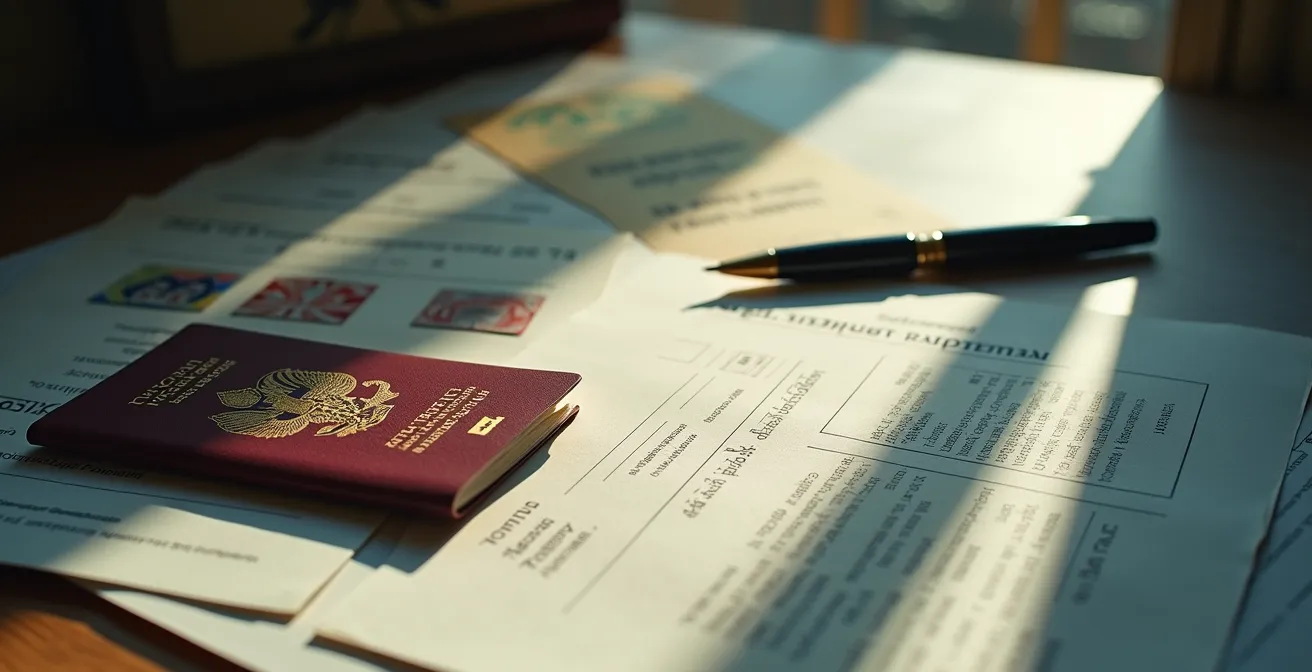
This organized package of documents is the physical representation of your application’s integrity.

As the image suggests, meticulous organization is key. Before booking your VFS appointment, you must have every required item in hand: a valid passport, the tourist invitation, a compliant insurance certificate, and the correct-format photos. The application form, completed online via the MFA’s website, must be printed, signed, and dated correctly. Any mistake, however small—such as a typo in your passport number or a signature in the wrong color ink—can lead to immediate rejection, nullifying the benefit of the express fee.
Action plan: Securing an express visa via VFS France
- Complete the official visa application form on the Russian MFA website, ensuring the date format is strictly DD/MM/YYYY.
- Print the completed form and sign it using blue or black ink only.
- Attach one 35x45mm photo on matte paper that meets all Russian specifications, particularly face size.
- Include the full tourist invitation (voucher and confirmation) obtained from an accredited agency.
- Provide the original travel insurance certificate showing your name and a minimum coverage of €30,000 for Russia.
- Submit your passport, which must have at least 6 months of validity remaining after your visa’s expiry date and contain at least two blank pages.
- At the VFS centre, explicitly request and pay the express service fee (currently an additional charge) for 1-3 working day processing.
Following this checklist precisely is the only reliable method to meet a tight deadline. It transforms the application from a matter of hope into a matter of procedure.
The 7-working-day rule: Do weekends count for visa registration?
Upon arrival in Russia, foreign citizens are subject to a mandatory registration requirement, but only if their stay in one location exceeds a specific duration. The rule states that you must register your visa if you stay for more than 7 working days at a single address. The crucial detail here is “working days.” Weekends (Saturday and Sunday) and official Russian public holidays do not count towards this 7-day total. The day of your arrival is also excluded from the count.
This registration must be done at your place of actual residence. If you are staying in a hotel, the hotel administration will handle this process for you automatically at check-in. However, if you are staying with friends or in an Airbnb-style apartment, the responsibility falls on your host or landlord. They must register you at a local post office or Multifunctional Centre (MFC). The process is straightforward but mandatory to avoid potential fines upon departure.
Understanding how to calculate the deadline is key. The table below provides clear examples of how weekends affect the 7-working-day count.
This calculation demonstrates why a 9-day stay (e.g., arriving on a Friday and leaving on the Sunday of the following weekend) might not require registration.
| Arrival Day | 7th Working Day | Effective Registration Deadline | Notes |
|---|---|---|---|
| Monday | Following Tuesday | End of day, following Tuesday | Standard 8-day period (Mon-Tues) |
| Thursday | Second Monday | End of day, second Monday | The weekend extends the deadline. |
| Friday | Second Tuesday | End of day, second Tuesday | Arrival day + weekend are excluded. |
| Before Holiday | Varies | Varies | Official Russian public holidays pause the count. |
For French travellers, it is essential to communicate with your host about this requirement before your trip to ensure they are prepared to assist with the registration if your stay exceeds the 7-working-day limit.
Key takeaways
- The Russian “tourist invitation” is an administrative document, not a hotel booking. They are decoupled.
- Application rejections are most often due to technical non-compliance, especially with photo specifications (matte paper, 70-80% face size) and insurance details.
- Using an online agency for your invitation is legal and standard, provided the agency is accredited by the Russian MFA.
Which travel insurance is accepted by the Russian consulate in France?
Travel medical insurance is a mandatory compliance checkpoint for any Russian visa application submitted in France. The policy must meet specific criteria to be accepted by the consulate. Failure to provide a compliant certificate will result in an automatic rejection of your application. The requirements are not complex, but they are absolute and must be followed precisely.
The two most critical requirements are the coverage amount and the territorial validity. The insurance policy must provide a minimum of €30,000 in medical coverage. Secondly, the policy must explicitly state that it is valid for the “Russian Federation” or “Worldwide.” A policy that is only valid for the “Schengen Area” will be rejected. The insurance certificate you submit must clearly show your full name, the policy number, the dates of validity covering your entire trip, and the territorial coverage.
While many French and international insurance companies offer compliant policies (such as AXA, Allianz, Europ Assistance), it is also possible to purchase a policy from an accredited Russian insurance company online. This can be a convenient option, as these companies guarantee their policies meet all consular requirements. Major Russian insurers like Ingosstrakh, AlfaStrakhovanie, and Sovkombank Insurance now offer visa-compliant policies that can be purchased online with foreign bank cards. The resulting PDF certificate is sufficient for the application and can be printed directly.
Whether you choose a French or a Russian provider, the key is to obtain a formal certificate of insurance that lists all the required details. A simple payment confirmation or policy summary is not sufficient; you need the official document that the consulate can verify.
Frequently Asked Questions about the Russian Visa for French Citizens
Can French citizens use the e-visa to enter Moscow?
Yes, the unified e-visa allows entry to Moscow and movement throughout Russia, except for restricted areas that require special permits. It is valid for entry at all of Moscow’s international airports.
What is the maximum stay with an e-visa?
The unified e-visa permits a maximum single-entry stay of 16 days from the date of entry into the Russian Federation. The visa itself is valid for a 60-day period from its date of issuance.
Is the St. Petersburg-only e-visa still available?
No, the previous regional e-visas, including the one for St. Petersburg and the Leningrad Region, have been discontinued and were replaced by the unified e-visa system in August 2023, which covers the entire territory of Russia.