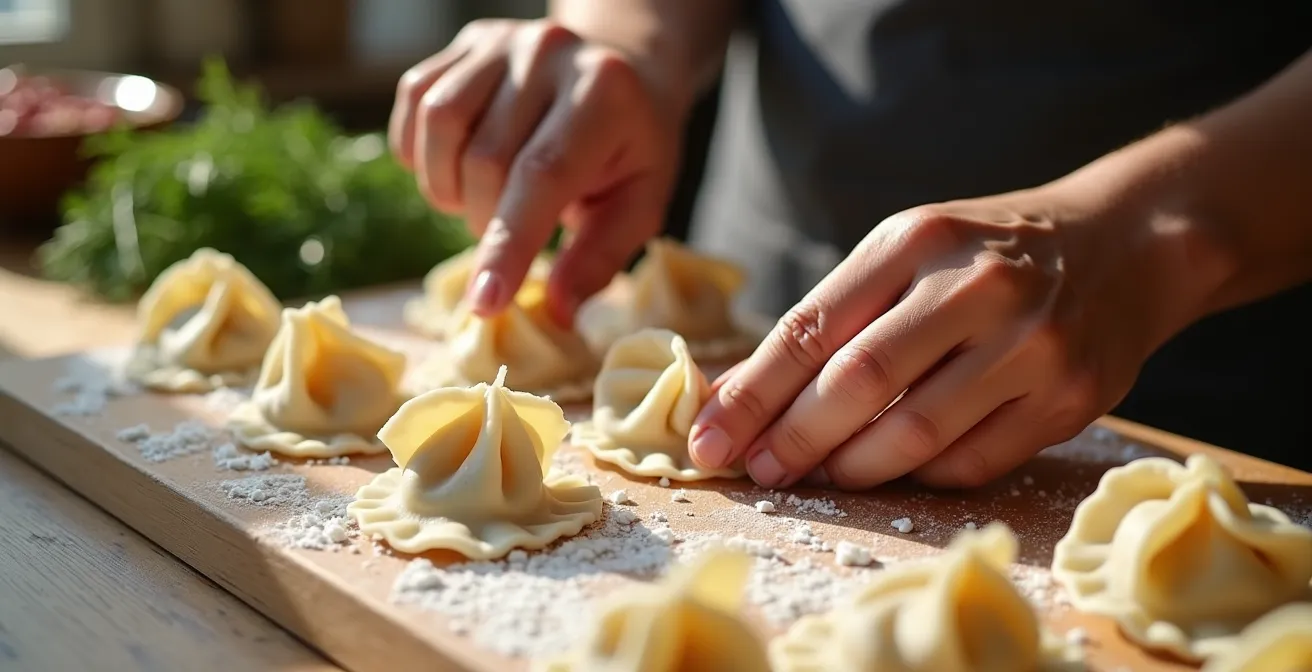
Forget generic Slavic restaurants; finding authentic pelmeni in Paris means learning to spot French quality cues in a Siberian classic.
- True quality lies in the details: look for traceable meat like ‘Kintoa Basque pork’ or ‘Red Label’ certification on menus.
- The best dumplings are often found in specialized delis (*traiteurs*) or Russian grocery stores (*épiceries*), not just mainstream restaurants.
Recommendation: Start your quest by visiting a Russian épicerie in the 16th arrondissement for high-quality imported frozen pelmeni to understand the baseline of authentic taste.
The promise of Russian comfort food in Paris often leads travelers to a predictable bowl of borscht in a tourist-heavy neighborhood. But for those seeking a more genuine taste of Siberia, the hunt for the perfect pelmeni—small, savory dumplings filled with minced meat—is a far more rewarding journey. It’s an adventure that goes beyond simply finding a Russian restaurant; it’s about learning to decode the subtle signs of quality that separate a forgettable meal from an authentic culinary experience.
Many guides will point you to general Eastern European establishments. They might mention that pelmeni are traditionally served with sour cream, a classic pairing indeed. But this approach misses the heart of the matter. The real secret to a great dumpling tasting in the French capital isn’t about where you go, but what you look for. What if the key wasn’t the restaurant’s decor, but the butcher who supplied the pork? And what if the best companion to your dumplings wasn’t vodka, but a crisp Sancerre from the Loire Valley?
This guide will equip you with the insider knowledge to do just that. We will explore the nuances of what makes a truly exceptional Siberian dumpling, from the meat inside to the sauce on top. You’ll learn how to distinguish them from their cousins, find the best options for a cozy night in your Airbnb, and even discover how to master the folding technique yourself. Prepare to taste Paris through a Siberian lens, leaving the tourist traps far behind.
This article provides a comprehensive roadmap for your tasting journey. Below, you will find a detailed table of contents guiding you through every aspect of finding and enjoying authentic pelmeni in Paris.
Table of Contents: A Foodie’s Guide to Finding Paris’s Best Pelmeni
- Beef, Pork, or Bear: What meat is actually inside authentic Siberian dumplings?
- Sour cream or Vinegar: The condiment debate for dumpling lovers
- Can you buy high-quality pelmeni in supermarkets to cook in your Airbnb?
- Pelmeni vs. Vareniki: Why are the sweet ones called differently?
- The ritual of the “Zakuska”: Why dumplings are the perfect vodka chaser?
- The secret technique to folding pelmeni that 90% of beginners get wrong
- How to eat in a Soviet-style canteen for under €3 today?
- Where to book a pelmeni cooking class in English for under €50?
Beef, Pork, or Bear: What meat is actually inside authentic Siberian dumplings?
The soul of a pelmen (the singular of pelmeni) is its filling, or *farce*. While adventurous tales from Siberia might involve bear or elk meat, the traditional combination is far more specific and balanced. The classic Udmurt recipe, for instance, calls for a very specific ratio: a filling made of 45% beef, 35% mutton, and 20% pork. This blend is crucial, with the beef providing substance, mutton adding a distinct gaminess, and pork lending essential fat and moisture. The filling is typically seasoned simply with onion, garlic, salt, and pepper, letting the quality of the meat shine.
In Paris, finding this exact Udmurt blend is rare, but the principle of a high-quality mixed-meat filling holds true. Your mission is to decode the menu. A top-tier establishment will be proud of its sourcing. Instead of a generic “meat filling,” look for descriptions that specify the origin or quality. Seeing terms like “Kintoa Basque pork” or “organic Limousin beef” is an immediate green light, signaling a chef who values terroir and quality over mass-produced fillings. This is where the French context elevates the Siberian tradition.
Many authentic spots will offer a classic “farce classique porc-bœuf” (pork-beef filling), which is the most common and reliable choice for a traditional taste. Options labeled “pur bœuf” (100% beef) are also common but can sometimes be drier if not prepared with care. Be wary of fillings that are not specified; it often implies lower-grade, pre-mixed meat. Your best tool is observation and asking questions.
Your Action Plan: Decoding a Parisian Pelmeni Menu
- Look for ‘farce classique porc-bœuf’ for the most traditional mixed meat filling available in France.
- Identify ‘pur bœuf’ labels for single-meat options, but be mindful they can be less juicy.
- Spot ‘Kintoa Basque pork’ or ‘organic Limousin beef’ as clear indicators of premium, French-sourced quality.
- Check for ‘Red Label’ certification, a French sign of superior and humanely-raised meat.
- Note that ‘organic lamb’ often indicates a gastronomic, creative take rather than a strictly traditional recipe.
Sour cream or Vinegar: The condiment debate for dumpling lovers
Once you have a plate of steaming pelmeni, the next crucial choice is the condiment. This is a topic of passionate debate. The most classic and widespread accompaniment is a generous dollop of smetana, a thick, tangy Eastern European sour cream. Its rich, cooling quality perfectly balances the savory, hot filling of the dumplings. In Paris, you’ll most often find this served as high-quality French crème fraîche, which is an excellent and readily available substitute, often sprinkled with fresh dill.
However, for many purists, especially from Siberia and the Urals, the only true way to eat pelmeni is with a splash of simple table vinegar, sometimes mixed with black pepper or mustard. This sharp, acidic kick cuts through the richness of the meat and dough in a completely different way, cleansing the palate and highlighting the delicate flavors of the filling. Some even enjoy their pelmeni served in a clear broth with a dash of vinegar added directly to the soup.
At Pelmeni Paris, a specialized dumpling spot in the 17th arrondissement, the owners navigate this debate by offering the best of both worlds. Traditional crème fraîche with fresh dill is standard, but they understand the purist’s preference. This is a great example of how authentic Parisian spots cater to both tradition and local French palates, which are accustomed to using high-grade creams and vinaigrettes. Don’t be afraid to ask for both and conduct your own taste test.
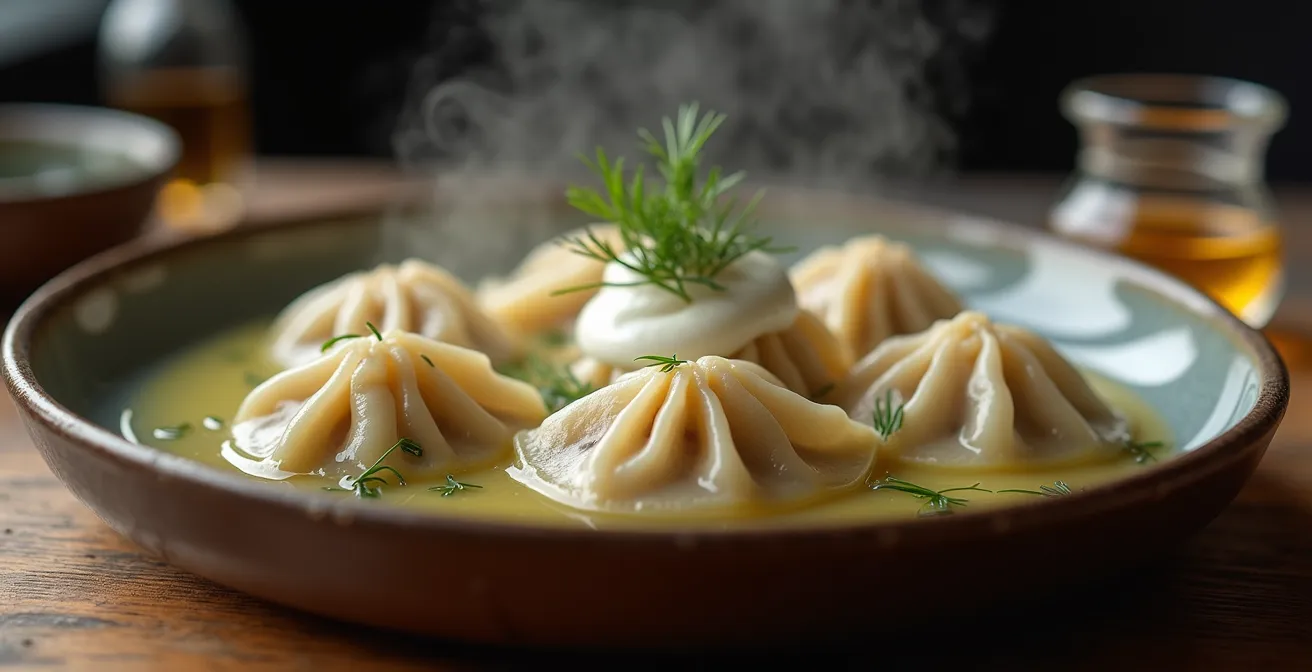
As the image suggests, the visual appeal of a glossy dumpling with melting cream is undeniable. But the choice is deeply personal. Our advice? Try them plain first to appreciate the dumpling itself, then try a few with cream, and a few with a light splash of vinegar. You’ll quickly discover your allegiance in this delicious debate.
Can you buy high-quality pelmeni in supermarkets to cook in your Airbnb?
After a long day of exploring Paris, the idea of a simple, hearty, and authentic meal back at your Airbnb is incredibly appealing. So, can you find good pelmeni in a French supermarket? The answer is nuanced. While a skilled artisan might take three days to hand-craft 6kg of pelmeni, modern pelmeni machines can produce up to 400kg per hour, which is the kind of product that lands in large-scale supermarkets.
You might find industrial-grade pelmeni in the frozen aisle of a large hypermarket like Grand Frais, and sometimes a French-made version at a frozen specialty store like Picard. These are convenient and budget-friendly, but they often lack the delicate dough and high-quality filling of their handmade counterparts. The dough can be thick and the filling texture less satisfying.
For a truly superior at-home experience, you need to think like a local and head to a specialized store. A Russian *épicerie* (grocery store), often found in areas like the 16th arrondissement, is your best bet for high-quality imported frozen brands. Even better, seek out a Russian or Eastern European *traiteur* (caterer/deli). Here, you can often buy fresh, handmade pelmeni by the kilo that are of restaurant quality. They are more expensive but offer an incomparably better taste and texture. Cooking them is simple: just boil in salted water until they float, then serve with your condiment of choice.
This table breaks down your options for a Parisian pelmeni night in.
| Option | Quality Level | Price Range | Best For |
|---|---|---|---|
| Russian Épiceries (16th arr.) | High – Imported brands | €8-15/kg | Authentic frozen options |
| Traiteurs (Caterers) | Premium – Fresh handmade | €15-25/kg | Restaurant quality at home |
| Grand Frais | Medium – Industrial | €5-10/kg | Quick convenience option |
| Picard (frozen specialty) | Medium – French-made | €6-12/kg | Reliable frozen option |
Pelmeni vs. Vareniki: Why are the sweet ones called differently?
As you explore menus, you’ll inevitably encounter another famous dumpling: vareniki. They might look similar, but they are distinct dishes with different origins and characteristics. The most crucial distinction lies in the dough and filling. As Wikipedia contributors note in the entry on Pelmeni, a key difference is that “the most important difference between pelmeni, varenyky, and pierogi is the thickness of the dough shell—in pelmeni and vareniki this is as thin as possible, and the proportion of filling to dough is usually higher.”
The most important difference between pelmeni, varenyky, and pierogi is the thickness of the dough shell—in pelmeni and vareniki this is as thin as possible, and the proportion of filling to dough is usually higher.
– Wikipedia contributors, Wikipedia entry on Pelmeni
Pelmeni are almost exclusively filled with raw, savory minced meat. Their name, from the Udmurt “pel’n’an’,” literally means “ear bread,” which describes their small, folded shape. Vareniki, on the other hand, have Ukrainian origins and are incredibly versatile. Their name comes from the word *varyty* (to boil). They are typically larger, shaped like a half-moon, and can be filled with a huge variety of pre-cooked ingredients. This is where the “sweet ones” come in; vareniki are famous for their sweet fillings like cherries, sweet farmer’s cheese (tvarog), or berries, served with cream and sugar as a dessert or a sweet main course.
But vareniki can also be savory, and this is where they serve an important purpose for travelers. In Parisian restaurants like Pelmeni Paris, vareniki are the go-to vegetarian option. They are often stuffed with potatoes, mushrooms, cabbage, or Russian cheese, providing a delicious alternative for those who don’t eat meat. So, the rule of thumb is simple: if it’s small, roundish like an ear, and filled with raw meat, it’s a pelmen. If it’s a half-moon and filled with anything else (vegetables, cheese, or fruit), it’s a varenik.
The ritual of the “Zakuska”: Why dumplings are the perfect vodka chaser?
In Russian culture, pelmeni are more than just a main course; they are a cornerstone of the *zakuska* table. Zakuski are small, savory appetizers and snacks, similar to Spanish tapas or Italian antipasti, traditionally served to accompany shots of ice-cold vodka. The idea is that you never drink vodka on an empty stomach. A small, fatty, and savory bite—the “chaser”—is taken immediately after each shot to absorb the alcohol and cleanse the palate.
Pelmeni are the perfect zakuska. They are small, hot, and satisfyingly fatty, providing the ideal ballast for strong spirits. In a classic Parisian spot like La Cantine des Tsars, these zakuski appetizers cost between €2 and €4, making them an affordable part of the ritual. The classic pairing is, of course, a shot of ice-cold vodka. The sharp, clean spirit cuts through the richness of the dumpling, preparing you for the next bite.
However, you’re in Paris, and the French context offers delightful alternatives. Instead of limiting yourself to vodka, consider pairing your pelmeni with a French beverage. The acidity and minerality of a local wine or beer can be just as effective at cutting through the richness of the dumplings. This is a fantastic way to blend the Siberian tradition with French gastronomy.
Your Action Plan: French Beverage Pairings for Pelmeni
- Try a dry Alsatian Riesling for its crisp acidity that cuts beautifully through the dumpling’s richness.
- Pair with a crisp Sancerre from the Loire Valley for a sophisticated, mineral-driven alternative to vodka.
- Select a craft ‘bière blanche’ (white beer) from a Parisian microbrewery for a refreshing and casual pairing.
- Serve ice-cold vodka in traditional style if you want the most authentic experience—the sharp spirit cleanses the palate perfectly.
- Offer Kvass (fermented rye bread drink), available at Russian épiceries, as a traditional non-alcoholic option.
The secret technique to folding pelmeni that 90% of beginners get wrong
The mark of a truly authentic, homemade pelmen lies in its shape. The signature “little ear” is not just for show; it ensures the dumpling is perfectly sealed, cooks evenly, and has a delightful chewy texture. While many beginners can manage a simple half-moon, achieving the final tortellini-like shape is where the real craft lies. The most common mistake is failing to securely seal the edges or not bringing the corners together correctly, resulting in dumplings that burst open while boiling.
The proper technique is a multi-step process that requires a bit of dexterity. It begins with a thin, round disk of dough. First, a small amount of filling—no more than a teaspoon—is placed directly in the center. Overfilling is a classic rookie error that makes sealing impossible. Then, you fold the disk in half to create a half-moon, carefully pressing the edges together to expel any air and create a tight seal. This is the critical foundation.
The final, and most-often missed, step is what creates the “ear.” You take the two pointed corners of the half-moon, bring them together, and press them firmly. Some cooks bring them together along the straight edge, while others overlap them slightly. This maneuver not only gives the pelmen its iconic shape but also reinforces the seal, making it robust enough to withstand a vigorous boil. As described in expert guides, the goal is to form a tortellini-like dumpling with securely pressed edges.
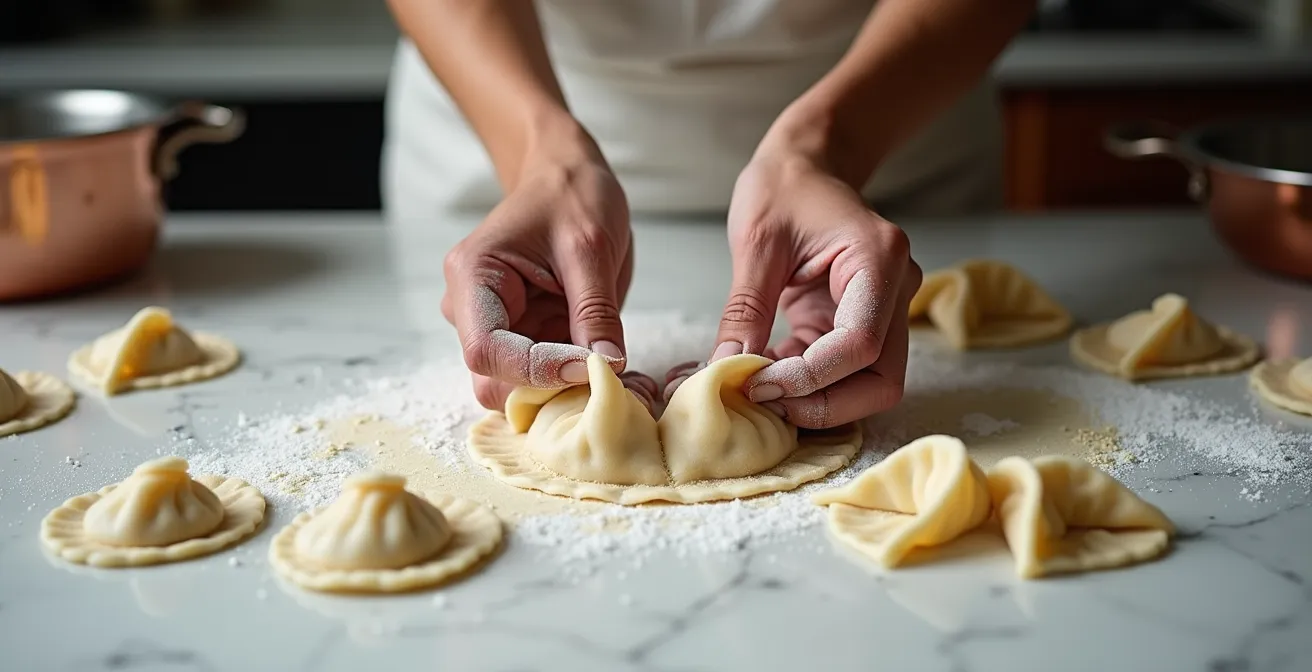
Mastering this fold is a satisfying skill. It connects you to a long tradition of communal dumpling-making, where families would gather to produce hundreds of pelmeni to be frozen for the winter. It’s a testament to the fact that with simple ingredients, technique is everything.
How to eat in a Soviet-style canteen for under €3 today?
The romantic notion of a “stolovaya,” a Soviet-era canteen serving hearty plates for a pittance, is a powerful image. The idea of finding such a place in modern-day Paris and eating for under €3 is, frankly, a myth. While these canteens were a reality in the Soviet Union, the economic landscape of Paris—one of the world’s most expensive cities—makes such pricing impossible for any business to sustain. A la carte prices at established Russian restaurants can even reach around €45 for a full meal.
So, does that mean budget-friendly pelmeni are a lost cause? Not at all. You simply need to adjust your expectations from a nostalgic €3 fantasy to a realistic Parisian budget. The *spirit* of the canteen—simple, affordable, no-frills comfort food—is very much alive. You can find it in small, specialized dumpling eateries that focus on volume and quality over fancy decor. At these spots, you can have a deeply satisfying meal for a very reasonable price.
For example, a typical specialized pelmeni restaurant in Paris will price its dumplings by the piece, in batches of 12, 18, or 25. While a plate of 12 meat pelmeni might cost around €9.90, this breaks down to a cost of just €0.83 per dumpling. This is far from €3 for a whole meal, but it represents excellent value for a handmade, filling, and delicious dish in the heart of Paris.
Here’s a look at what realistic pricing looks like at a dedicated Parisian pelmeni counter, showing that while the total isn’t €3, the per-dumpling cost is still very low.
| Portion Size | Vegetarian Price | Meat Price | Per Dumpling Cost |
|---|---|---|---|
| 12 pieces | €8.90 | €9.90 | €0.74-0.83 |
| 18 pieces | €13.90 | €14.90 | €0.77-0.83 |
| 25 pieces | €18.90 | €19.90 | €0.76-0.80 |
Key takeaways
- Authenticity is in the details: prioritize places that specify meat origin (‘Kintoa pork’) over generic descriptions.
- The best at-home pelmeni come from specialty *traiteurs* or *épiceries*, not large supermarkets like Grand Frais or Picard.
- Embrace the French context by pairing your dumplings with local beverages like Alsatian Riesling or Sancerre for a unique Franco-Siberian experience.
Where to book a pelmeni cooking class in English for under €50?
After tasting and decoding the perfect pelmeni, the final step for a true food enthusiast is to learn how to make them. Finding a cooking class in Paris that is taught in English and fits a traveler’s budget can be a challenge, but it’s entirely possible if you know where to look. The key is to look beyond traditional culinary schools and explore platforms that connect locals with visitors for authentic experiences.
Platforms like EatWith are an excellent starting point. They often feature workshops hosted by passionate local cooks in their own homes. For example, you can find a Pelmeni Making Workshop where a host from Russia, Ukraine, or Siberia guides you through the process for a couple of hours. These experiences are wonderful because they are intimate, hands-on, and you get to enjoy the meal you prepared together at the end. These workshops are often priced within the €36 to €50 range, making them a perfect fit for the budget-conscious traveler seeking an authentic cultural exchange.
When searching for a class, certain keywords can help you identify the most authentic options. Look for phrases that promise a “recette de babouchka” (grandma’s recipe), as this suggests a focus on traditional, time-honored techniques rather than a sterile professional class. Verifying that the experience includes a “repas complet” (full meal) and not just a small tasting is also important to ensure you get good value. Some of the best classes will also include a “dégustation de vodka” to complete the cultural immersion.
Your Checklist: Vetting a Parisian Pelmeni Workshop
- Search for ‘recette de babouchka’ (grandma’s recipe) in class descriptions for a sign of authenticity.
- Look for workshops mentioning ‘ingrédients du marché’ (market ingredients) for a fresh, local approach.
- Check if ‘dégustation de vodka’ is included to ensure a full cultural experience.
- Verify classes offer a ‘repas complet’ (full meal) and not just a small tasting portion.
- Compare prices: authentic, budget-friendly workshops start from around €36, with the average being €50-90.