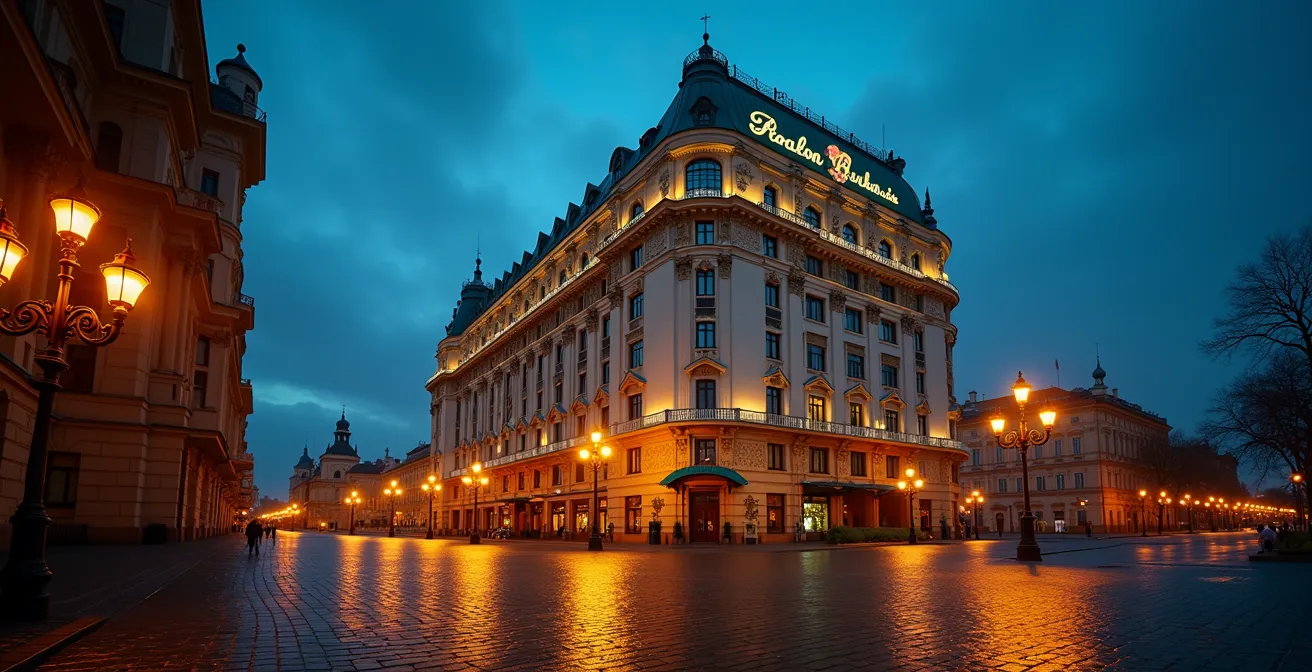
The premium for Moscow’s historic hotels is not for modern amenities, but for an immersive, theatrical experience of Russian history—a form of cultural time-travel.
- Service is not ‘cold’ but formal and theatrical, a key part of the “living museum” atmosphere that defines the stay.
- Direct booking often unlocks significant discounts and, more importantly, access to unique historical rooms unavailable on third-party sites.
Recommendation: Judge these hotels not against a Parisian Four Seasons, but as a unique cultural product. The real luxury is the story you inhabit.
For the discerning French traveler, the definition of luxury is often a tale of two cities. On one hand, there is the familiar, impeccable service of a modern five-star chain—the kind you find near Place Vendôme. On the other, there is the allure of the unknown, the weight of history that emanates from the grand dames of European capitals. In Moscow, this choice is starkly personified. Do you opt for the predictable comfort of an international brand, or do you surrender to the enigmatic pull of a legend like the Hotel Metropol or the National, where every corridor whispers stories of tsars, commissars, and poets?
The common debate often circles around a perceived trade-off: historic atmosphere versus modern efficiency. Many assume that these storied properties, with their opulent but aging facades, cannot compete with the seamless technology and standardized service of their newer rivals. They anticipate stiff service, outdated plumbing, and a premium price tag that seems to pay for a name rather than an experience. But what if this entire framework is flawed? What if the true value of these institutions isn’t found by measuring them against contemporary benchmarks, but by learning to decode their unique language of luxury?
This guide proposes a different perspective. We will argue that the €300-per-night question is not about justifying a premium for amenities, but about investing in an unparalleled form of cultural time-travel. We will explore how to appreciate the theatricality of the service, secure the most coveted rooms with Kremlin views, and understand the subtle power dynamics of booking directly versus using an aggregator. The key is not to expect a Russian version of a Parisian palace hotel, but to embrace an experience that is a destination in itself.
This article dissects the tangible and intangible value of Moscow’s most iconic historic hotels. We will move from the quantifiable—room views and booking rates—to the experiential, such as the unique service culture and the myths that have literally built some of the city’s most famous establishments.
Summary: Unlocking the Secrets of Moscow’s Legendary Accommodations
- Hotel National views: Which room numbers have the direct Kremlin view?
- The Hilton Leningradskaya: What is it like to sleep inside a Stalin skyscraper?
- Historic charm vs. Modern service: What to expect at the Savoy Moscow?
- How to have tea at the Metropol glass roof without booking a room?
- Booking direct vs. Booking.com: Where to find the best rates for Moscow historic hotels?
- Why is Café Pushkin famous because of a French song, not the poet?
- Is the Ritz-Carlton rooftop accessible without being a hotel guest?
- Is dinner at Café Pushkin worth the €100 price tag per person?
Hotel National views: Which room numbers have the direct Kremlin view?
For many luxury travelers, the ultimate Moscow prize is a room with a direct, unobstructed view of the Kremlin. The Hotel National, a Luxury Collection Hotel, is arguably the premier stage for this spectacle. Its location at the corner of Tverskaya Street and Mokhovaya Street places it directly opposite the northern wall of the historic fortress. However, securing this iconic view is not as simple as booking a “city view” room. Out of the hotel’s entire inventory, the most coveted panoramas are reserved for specific room categories.
The hotel is a significant property; the National features 202 rooms and 56 suites, but only a fraction offer the head-on Kremlin perspective. The most famous is Room 107, where Lenin himself stayed for a week in 1918. While you can request this specific room, the guaranteed way to secure the view is by booking a Kremlin Suite. These spacious accommodations, ranging from 60 to 87 square meters, are explicitly designed to frame the historic landmark. When booking, it is crucial to specify a preference for a room with a direct view of the Kremlin’s north wall, not just a generic “Red Square view,” which might be angled or partial.
To put this in perspective, here is how the National’s offering compares to other historic properties regarding this singular, high-value feature. The table below highlights that while other hotels offer luxury and history, the National’s primary currency is its unparalleled proximity to the heart of Russian power.
| Hotel | Total Rooms | Kremlin View Rooms | Key Features |
|---|---|---|---|
| Hotel National | 258 (202 rooms + 56 suites) | Kremlin Suites (60-87 sqm) | Direct north wall Kremlin views, Lenin stayed in room 107 |
| Hotel Metropol | 365 rooms | Select suites only | Bolshoi Theatre views, Art Nouveau architecture |
| Ritz-Carlton Moscow | 332 rooms | O2 Lounge rooftop access | Modern luxury, rooftop terrace views |
Ultimately, the premium for a room at the National is directly tied to this visual currency. It’s a tangible asset that few other properties can match, transforming your room from a simple place to sleep into a private theater overlooking history. This focus on a singular, powerful feature is the first clue in decoding the value of these grand hotels.
The Hilton Leningradskaya: What is it like to sleep inside a Stalin skyscraper?
Moving from the imperial grandeur of the National to the Hilton Leningradskaya is to trade a view of history for the experience of sleeping inside it. Located in one of the iconic “Seven Sisters” skyscrapers, this hotel is not just a building but a monument to Stalinist ambition. To stay here is to participate in a piece of architectural theatre, a far cry from a standard Hilton experience anywhere else in the world. The exterior’s imposing scale gives way to an interior of almost overwhelming opulence, designed to project Soviet power.
The lobby itself is a destination, with soaring ceilings, immense bronze sculptures, and intricate socialist-realist details that transport you to another era. The contrast between the monumental, almost intimidating, public spaces and the modern, comfortable guest rooms is a core part of the experience. You are constantly reminded that you are a guest in a structure with a profound and complex past.
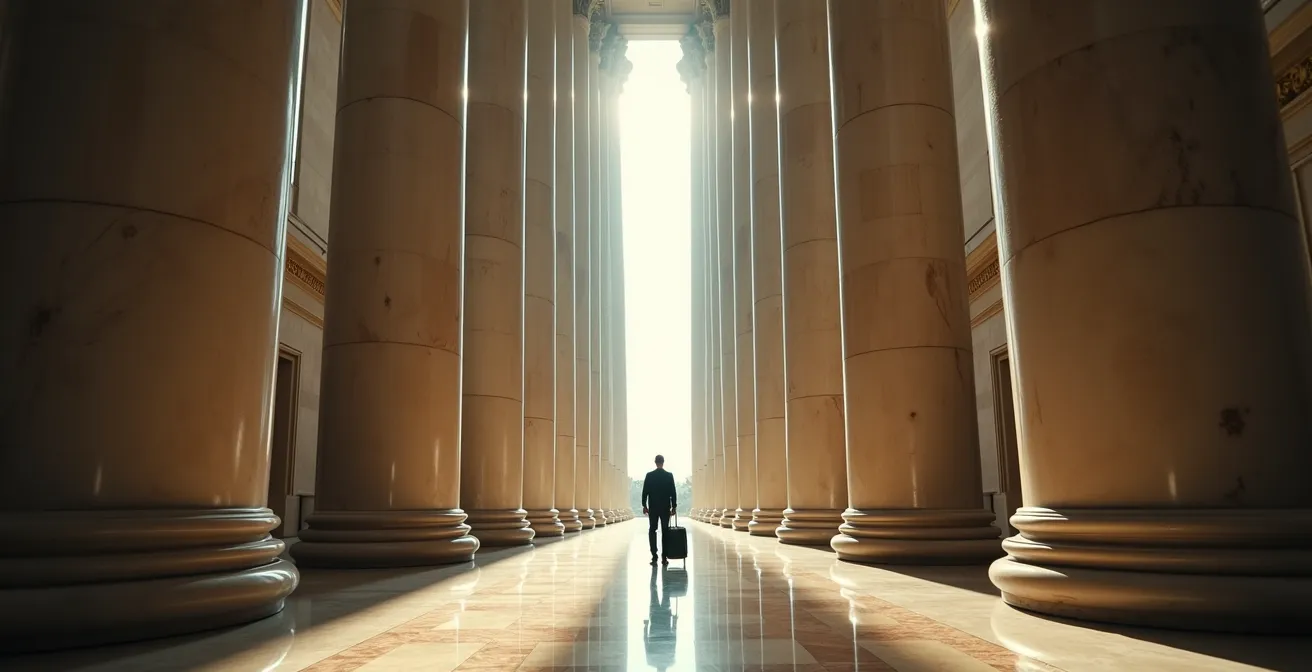
This image captures the essence of the Leningradskaya experience: the modern traveler dwarfed by the sheer scale and weight of Soviet history. It’s a visual metaphor for the stay itself, where personal comfort coexists with monumental ideology. This is not the chic, understated luxury of a contemporary hotel; it is grand, declarative, and deeply rooted in its time.
Case Study: Stalinist Architecture Transformation
The Leningradskaya Hotel, opened in 1954, was conceived as the most luxurious hotel in Soviet Russia. It was the last and smallest of the Stalinist neoclassical skyscrapers, intended to be a showcase of socialist achievement. In 2008, Hilton undertook a massive renovation. The challenge was to update the property to international five-star standards while preserving its unique historical assets. The result is a “living museum” where guests can find modern amenities alongside monumental bronze sculptures and original Socialist Realist murals, preserving the historic Soviet atmosphere within a functional luxury hotel.
Sleeping inside a Stalinist skyscraper is therefore less about the room itself and more about the narrative. It’s for the traveler who is fascinated by the tension between past and present, and who finds luxury not in minimalist design but in the maximalist expression of a bygone empire. It’s an experience of cultural immersion that no modern glass tower can replicate.
Historic charm vs. Modern service: What to expect at the Savoy Moscow?
One of the biggest hesitations for travelers considering a historic hotel like the Savoy or the Metropol is the question of service. The stereotype of stern, cold Russian service lingers, creating a fear that the “historic charm” comes at the cost of the warm, intuitive hospitality expected from a five-star property. This is a fundamental misunderstanding. The service in these establishments is not cold; it is formal and theatrical, a performance that complements the historic setting.
Staff may not greet you with the effusive friendliness of a North American concierge, but their professionalism is deep-rooted and their care for guests is genuine, albeit expressed with a certain gravitas. This formality is part of the “living museum” experience. You are not just a customer; you are an audience member in a century-old play. As one guide astutely notes, the atmosphere is the main event.
The Metropol may not have all the modern facilities of its more expensive 5-star rivals, for historic atmosphere in Moscow it’s unbeatable
– Moscow Hotels Guide, Historic grand hotels in Moscow review
This distinction is crucial. Judging the service by the standards of a W Hotel is like critiquing an opera for not being a pop concert. The value lies in its authenticity to the environment. Expect meticulous attention to detail, multiple daily room cleanings, and a concierge service deeply knowledgeable about cultural, not commercial, experiences. In many of these hotels, English is spoken fluently by all guest-facing staff, dispelling another common myth. The key is to decode the performance, not to wish for a different script.
Your Checklist for Understanding Russian 5-Star Service
- Observe the style: Expect a formal yet warm service style. Staff who may appear stern initially are often deeply caring and professional.
- Appreciate the details: Service often includes multiple daily room cleanings and a traditional turn-down service, a classic luxury touch.
- Leverage the concierge: Concierge services are focused on high culture and can arrange exclusive museum tours or secure prime ballet tickets.
- Experience the traditions: A traditional Russian breakfast service might include delicacies like caviar, blinis, and even live harp or piano music.
- Check for modern integration: In renovated historic rooms, look for Smart Home systems allowing single-touch control of lighting and temperature, blending old-world charm with new-world convenience.
Ultimately, the service in Moscow’s grand hotels is a feature, not a bug. It requires a slight adjustment in expectation from the traveler, rewarding those who appreciate its deliberate, dignified rhythm. This is not a place for casual banter, but for a level of service that respects the gravitas of the surroundings.
How to have tea at the Metropol glass roof without booking a room?
For those intrigued by the grandeur of the Hotel Metropol but not ready to commit to a full stay, there is a perfect solution: taking breakfast or tea in the Metropol Hall. This allows you to immerse yourself in the hotel’s breathtaking Art Nouveau atmosphere for a fraction of the cost of a room, making it one of Moscow’s most accessible luxury experiences. The main draw is the magnificent stained-glass dome, an engineering marvel by Vladimir Shukhov that bathes the room in ethereal light.
The hall is open to non-guests, primarily for its famous breakfast service. While not a traditional “afternoon tea” in the British sense, the breakfast buffet is a lavish affair, often accompanied by live harp music, creating an unforgettable ambiance. This is not just a meal; it is an event. It’s an opportunity to feel the pulse of the hotel, observe its clientele, and soak in the architectural splendor that has captivated guests for over a century. For a French visitor, it evokes the grand dining rooms of the Belle Époque, but with a distinctly Russian soul.
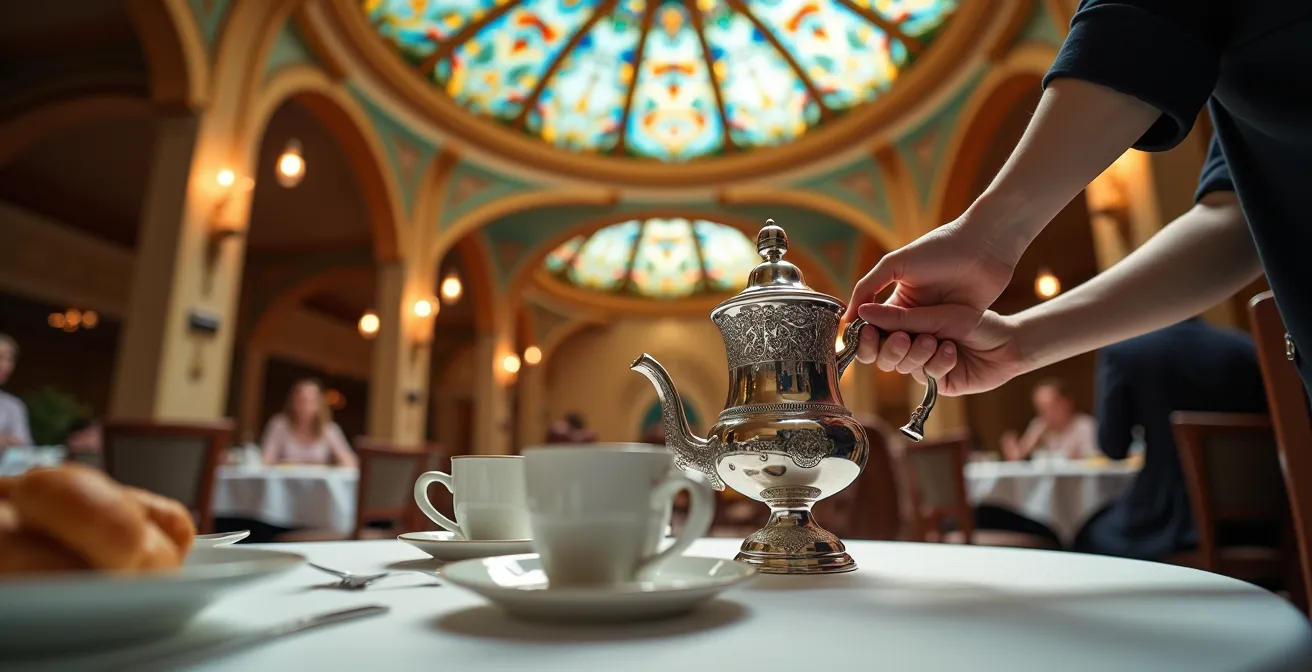
This experience is about the ritual and the setting. The focus is on the elegance of the moment—the fine china, the ornate samovar, the play of light through the glass—all framed by one of the world’s most beautiful dining rooms. Booking is highly recommended, especially on weekends. It’s important to adhere to the smart casual dress code, which is interpreted more formally here than in many Parisian equivalents; think understated elegance rather than trendy chic.
Visiting for breakfast or tea provides a “taster” of the Metropol’s magic. It’s a strategic way to evaluate if the hotel’s unique brand of theatrical luxury is right for you on a future visit. You get to experience the core of its charm—the architecture and atmosphere—without the full financial commitment, making it a savvy choice for the discerning cultural explorer.
Booking direct vs. Booking.com: Where to find the best rates for Moscow historic hotels?
In the age of online travel agencies (OTAs), the default for many travelers is to use platforms like Booking.com for convenience. However, when dealing with Moscow’s historic hotels, this can be a significant mistake, both financially and experientially. While OTAs are useful for comparing general market rates—where the average daily rate in Moscow hotels reached 7,800-12,500 rubles in 2023—they often fail to capture the real value offered by booking directly with the property.
The primary reason is access. Historic hotels are not made of uniform, cookie-cutter rooms. Each room can have a unique character, view, or original architectural details. OTAs sell standardized room categories (“Deluxe Room,” “Junior Suite”), but they cannot guarantee you the specific room with the original Art Nouveau furniture or the perfectly centered Bolshoi Theatre view. These special requests are best handled directly with the hotel’s reservation department, who understand their unique inventory.
Furthermore, booking direct is often more financially advantageous, a counter-intuitive fact for many. These hotels are actively trying to reclaim their customer relationships from intermediaries and offer powerful incentives to do so. This goes beyond a simple “best rate guarantee” and into tangible, immediate benefits.
Case Study: The Metropol’s Direct Booking Advantage
The Hotel Metropol provides a clear example of this strategy. Through their own loyalty program, guests who book directly on the hotel’s website can receive instant benefits, including discounts of up to 30%. More importantly, direct reservations facilitate better communication for special requests, which are paramount in a historic property. This includes securing a specific historic room allocation, such as those with original early-20th-century interiors, or getting access to exclusive hotel-run historical tours that are not offered to guests who book through third parties.
The lesson is clear: for generic modern hotels, an OTA might suffice. But for a “living museum” where the room itself is a key part of the experience, the direct channel is non-negotiable. It is the only way to ensure you are not just booking a bed, but a specific piece of history, often at a better price.
Why is Café Pushkin famous because of a French song, not the poet?
For many French visitors, a trip to Moscow is incomplete without a pilgrimage to Café Pushkin. They arrive expecting a historic literary haunt, a place where the great poet Alexander Pushkin might have penned his verses. The reality is far more fascinating: the café is famous in France almost entirely because of a French song, and it didn’t exist until 35 years after the song was released. This is a unique case of pop culture literally building a landmark.
The story begins in 1964 with Gilbert Bécaud’s beloved song, “Nathalie.” In it, he sings of a beautiful Russian guide, a tour of Red Square, and a dream of meeting her later “au Café Pouchkine” for a hot chocolate. The song became a sensation in France, a romanticized vision of Moscow during the Cold War. French tourists began arriving in Moscow, asking their guides to take them to the non-existent Café Pushkin. For decades, guides had to explain that the café was a beautiful fiction.
Andrey Dellos built the café in 1999 specifically because tourists were looking for the non-existent place from the song, making it a unique monument to a piece of French pop culture
– Russia Beyond, Moscow’s historic hotels and their celebrated guests
This origin story is the key to appreciating the Café Pushkin experience. It is not a historical site, but a brilliant, theatrical recreation of a fantasy. The restaurateur Andrey Dellos masterfully designed the space to look like a 19th-century aristocrat’s mansion, complete with a “Library” and “Pharmacy” hall, creating the very atmosphere French tourists had been searching for. It’s an experience that resonates deeply with visitors from France.
Many French tourists specifically seek out Café Pushkin believing it to be the historic location from Gilbert Bécaud’s song ‘Nathalie,’ not realizing it was built in 1999 as a response to their searches for a place that never existed – a fascinating example of fiction creating reality in Moscow’s hospitality scene.
– French visitor perspective, Russia Beyond
Therefore, visiting Café Pushkin is to participate in a shared Franco-Russian cultural story. The luxury here is not in its historical authenticity, but in its perfect execution of a dream. It’s a testament to the power of a song and a must-visit for any French traveler wanting to understand the unique cultural ties that bind Paris and Moscow.
Is the Ritz-Carlton rooftop accessible without being a hotel guest?
Yes, the O2 Lounge, the famous rooftop bar at the Ritz-Carlton Moscow, is accessible to non-guests, offering one of the city’s most glamorous panoramic views of the Kremlin and Red Square. For travelers staying at a historic hotel without a comparable vantage point, it provides an excellent opportunity to experience this iconic perspective. However, access comes with certain expectations that are important for a French visitor to understand.
Unlike some of the more bohemian or casual rooftop bars in Paris, such as Le Perchoir, the O2 Lounge is unapologetically upscale and operates with the polished veneer of an international luxury hotel bar. This means a strict dress code is enforced. “Smart casual” here leans more towards glamorous and elegant than trendy or relaxed. During peak times, especially on weekend evenings, a “face control” policy (discretionary entry by door staff) may be in effect to maintain the exclusive atmosphere. It is always best to book in advance.
The prime time to visit is just before sunset. This allows you to witness the city’s transition from day to night, capturing photographs in the golden hour and then seeing the Kremlin and St. Basil’s Cathedral illuminated against the night sky. The experience is undeniably spectacular, but it is a curated, high-end one. It offers a modern, luxurious counterpoint to the historic, atmospheric experiences of the Metropol or National.
For a French traveler, the O2 Lounge can be seen as Moscow’s answer to the rooftop bar of a Parisian palace hotel. It’s less about rustic charm and more about impeccable service, expensive cocktails, and a world-class view. It serves as a perfect complement to a stay in a historic hotel, allowing you to enjoy the best of both worlds: the immersive history of your accommodation and the breathtaking panorama of a modern luxury icon.
Key takeaways
- The perceived “imperfections” of historic hotels, such as formal service or older fittings, are often integral parts of their authentic charm and should be viewed as features, not flaws.
- Service in these grand hotels is better understood as formal and theatrical rather than cold; adapting to this mindset is key to appreciating the experience.
- Booking directly with the hotel is often crucial for securing not only better rates but also specific, unique rooms with historical character or premium views that are unavailable through third-party sites.
Is dinner at Café Pushkin worth the €100 price tag per person?
With its fairy-tale origin and theatrical decor, Café Pushkin has cemented itself as a Moscow institution. But with a price tag that can easily exceed €100 per person for dinner, the discerning traveler is right to ask: is it worth it? The answer depends entirely on what you are paying for. If you seek a cutting-edge culinary experience, perhaps not. But if you are paying for an unforgettable theatrical performance, the value proposition becomes much clearer.
The €100 buys you a ticket to an immersive historical play. From the moment you enter, you are transported to a pre-revolutionary Russian nobleman’s house. The staff are actors in period costume, the service is a grand, choreographed presentation, and the menu itself is a curated journey through 19th-century Franco-Russian cuisine. Dishes like the Pozharsky cutlet are executed flawlessly, but the food is a supporting character; the atmosphere is the star. It is an experience designed to delight the senses and create a powerful, lasting memory.
For a French diner, a direct comparison to a Parisian establishment is helpful. The price is similar to that of a mid-range Michelin-starred restaurant or a high-end brasserie in Paris, but the experience is fundamentally different.
| Aspect | Café Pushkin | Comparable Parisian Experience |
|---|---|---|
| Price per person | €100 | €80-120 (mid-range Michelin) |
| Atmosphere | Theatrical 19th-century Russian mansion | Classic French bistro elegance |
| Signature dish | Pozharsky cutlet | Sole meunière |
| Best seating | Library or Pharmacy Hall | Window tables |
| Service style | Grand theatrical presentation | Discreet professionalism |
Modern Alternatives for the Sophisticated Foodie
For French visitors whose priority is innovative cuisine over historical theatre, Moscow offers compelling alternatives. Restaurants like White Rabbit or Twins Garden present a modern, inventive interpretation of Russian food. Positioned as Moscow’s “neobistrot” counterpoints to Café Pushkin’s “grand-siècle” experience, they offer sophisticated tasting menus and panoramic city views at similar price points, appealing directly to the international foodie looking for the future, not the past, of Russian gastronomy.
So, is dinner at Café Pushkin worth it? Yes, but only if you embrace it for what it is: a magnificent, edible piece of theatre. It’s a one-of-a-kind performance that you can’t find anywhere else, and for the lover of stories and grand gestures, that is a price well worth paying.
Frequently Asked Questions about Moscow’s Luxury Experiences
Can non-guests access the Metropol Restaurant for tea?
Yes, the Metropol Restaurant with its famous glass dome is open to non-guests. Breakfast service runs daily from 7 AM to 10:30 AM with a special atmosphere featuring live harp music, offering a perfect opportunity to experience the hotel’s ambiance.
What is the dress code for afternoon tea at the Metropol?
Smart casual is required. The historic ambiance calls for more formal attire than typical Parisian ‘chic-décontracté’ standards, so it’s best to err on the side of elegance.
How much does the experience at the Metropol cost?
The breakfast buffet, which serves as the primary non-guest experience in the hall, starts from 5,500 rubles (approximately €55). This price includes access to the stunning Art Nouveau dining room under its iconic glass ceiling designed by engineer Shukhov.
Can non-guests access the O2 Lounge at Ritz-Carlton?
Yes, the O2 Lounge rooftop is accessible to non-guests, though a “face control” (discretionary entry) policy may apply during peak times. The dress code is strictly enforced and is best described as glamorous international rather than trendy local.
What’s the best time to visit the Ritz-Carlton rooftop for Kremlin views?
Booking for sunset hours is ideal to capture both daylight and illuminated views of the Kremlin. Summer evenings offer the longest golden hour for photography, a schedule that is particularly appealing for French visitors accustomed to late summer dining.
How does the O2 Lounge compare to Parisian rooftops?
Unlike more casual Parisian terraces like Le Perchoir, the O2 Lounge is decidedly upscale, focusing on international glamour. Think less bohemian artist loft, more high-end luxury hotel bar with impeccable service and panoramic city views.