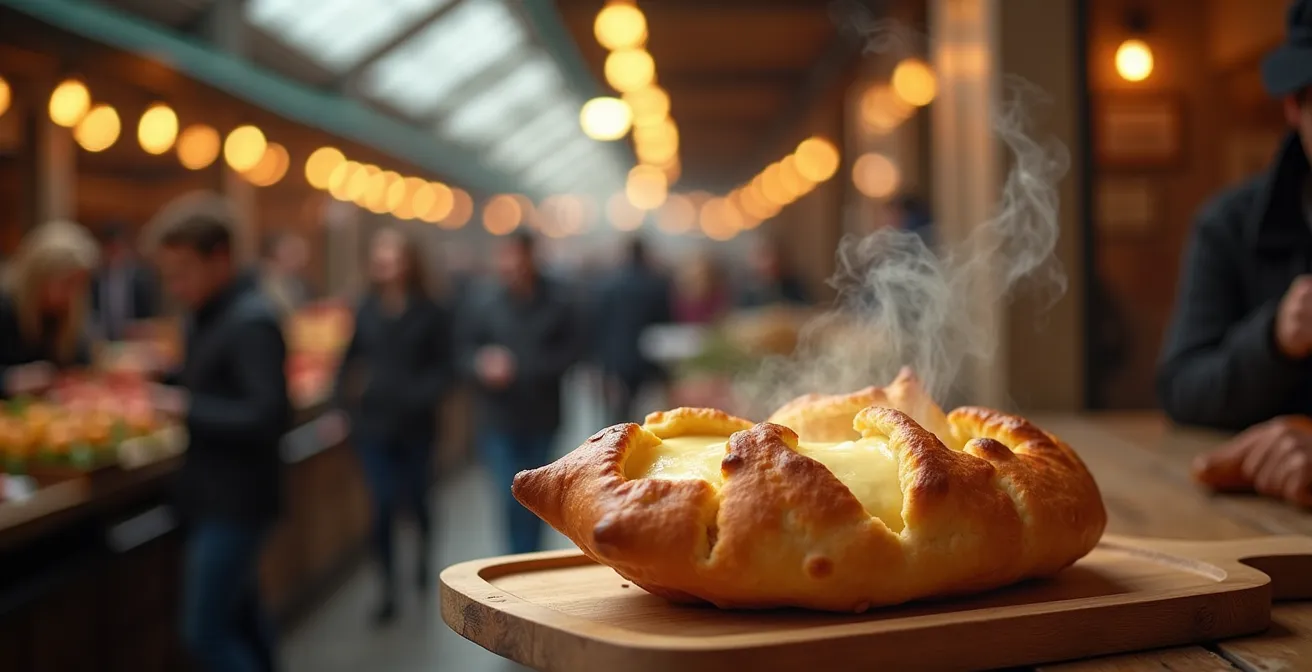
Khachapuri’s dominance in Moscow isn’t just about taste; it’s a reflection of a culinary grammar that mirrors France’s own reverence for terroir and comfort.
- The dish’s success relies on high-quality regional ingredients and a clear “appellation” system (Adjarian vs. Imeretian), much like French cheese and wine.
- Its integration into Moscow’s dining scene follows a pattern familiar to Parisians: from authentic “bistronomie” spots to modern chef-driven reinterpretations of tradition.
Recommendation: To truly understand Moscow’s modern food soul, one must look beyond the Kremlin and into its bubbling cheese boats.
Imagine walking through Moscow, a city of grandiose history and imposing architecture, and discovering that the most sought-after dish isn’t borscht or Beef Stroganoff, but a bubbling, cheese-filled bread boat from Georgia. This is the reality of Khachapuri, a dish that has so thoroughly seduced the Russian capital it has become a culinary staple. For a French foodie, this phenomenon is both curious and deeply familiar. It speaks to a universal truth: the irresistible power of authentic, regional comfort food.
Many will quickly label Khachapuri as “Georgian pizza,” a simple and somewhat lazy comparison. The truth, as any gourmand would suspect, is far more nuanced and fascinating. The story of its popularity isn’t just about Soviet-era connections; it’s a modern tale of terroir, culinary ritual, and the search for authentic satisfaction in a bustling metropolis. It’s the story of how a peasant dish, through the sheer quality of its ingredients—specifically its unique, tangy cheeses like Sulguni—and its comforting nature, achieved a status that rivals that of quiche in a Parisian brasserie or fondue in a mountain chalet.
But to truly grasp this culinary conquest, we must look at it through a lens we understand best: the principles of our own gastronomy. We will deconstruct Khachapuri not as a foreign novelty, but as an expression of a culinary grammar we know by heart. This article will explore the different ‘appellations’ of this cheese bread, teach you the proper ‘art de la table’ for eating it, and guide you to the Muscovite equivalent of ‘bistronomie’ gems where it is served. We will then broaden our view to see how this trend fits into Moscow’s surprisingly dynamic food scene, from tipping etiquette to the elevation of its own humble ingredients.
This journey will reveal why Khachapuri isn’t just a snack in Moscow; it’s a cultural phenomenon. The following sections break down every facet of this Georgian delicacy’s reign, offering a complete guide for the discerning palate eager to understand the city’s modern flavour.
Summary: The Georgian Cheese Boat That Conquered Moscow
- Adjarian vs. Imeretian: Which cheese boat suits your appetite?
- How to eat the egg-filled boat Khachapuri without making a mess?
- Chain restaurants vs. Family spots: Where to find the cheesiest Khachapuri?
- Wine or Lemonade: What do locals drink with heavy cheesy bread?
- Is Khachapuri a calorie bomb: How to fit it into a balanced diet?
- Why is Vietnamese Pho the surprising bestseller at a Russian market?
- Do Muscovites tip in cash or by card in the digital age?
- How are Moscow chefs transforming buckwheat into a luxury dish?
Adjarian vs. Imeretian: Which cheese boat suits your appetite?
Just as one must distinguish between a Brie de Meaux and a Camembert de Normandie, understanding Khachapuri begins with recognizing its principal “appellations.” The two dominant styles you’ll find in Moscow are Imeretian and Adjarian, each offering a completely different experience rooted in its regional origin. They are not interchangeable; they are distinct expressions of Georgia’s rich culinary terroir, defined by their shape, cheese, and occasion.
The Imeretian Khachapuri is a closed, round flatbread, filled with a salty, slightly tangy cheese from the Imereti region. It is the most ubiquitous version in Georgia, functioning much like a slice of quiche lorraine or a savoury tart: perfect for sharing, ideal for a light lunch, or served as an entrée. Its self-contained nature makes it neat and easy to eat, cut into wedges like a pizza.
The Adjarian Khachapuri, on the other hand, is pure spectacle and indulgence. Hailing from the coastal region of Adjara, it’s an open-faced, boat-shaped bread filled with a lava of molten cheese, crowned with a raw egg yolk and a pat of butter added just before serving. This is not an appetizer; it’s a rich, decadent main course, the Georgian equivalent of a tableside fondue savoyarde. Its consumption is a hands-on, communal ritual, a far cry from the simple slicing of its Imeretian cousin. Choosing between them is a matter of appetite and ambition.
To put it in a context familiar to a French palate, the following comparison clarifies the character of each dish, helping you decide which Khachapuri experience you are craving.
| Characteristic | Adjarian (Open Boat) | Imeretian (Closed Round) | French Equivalent |
|---|---|---|---|
| Shape & Style | Open boat with egg on top | Closed round flatbread | Adjarian: Like fondue savoyarde Imeretian: Like quiche lorraine |
| Calories per serving | 680 calories | 560-631 calories | Similar to a generous slice of quiche (600-700 cal) |
| Cheese texture | Molten, mixed with egg & butter | Enclosed, melted inside | Adjarian: Fondue-like Imeretian: Croque-monsieur filling |
| Best for | Main meal, dinner | Apéro, lunch, sharing | Adjarian: Plat unique Imeretian: Entrée to share |
| Eating method | Tear bread, dip in center | Cut into triangular slices | Adjarian: Like moules-frites Imeretian: Like pizza |
How to eat the egg-filled boat Khachapuri without making a mess?
Ordering an Adjarian Khachapuri is one thing; eating it with grace is another. This is not a dish for the timid or the fork-and-knife purist. It requires engagement, a hands-on approach that is part of the pleasure. The process transforms the raw ingredients into a cohesive, creamy delicacy right at your table. For the uninitiated, it can seem daunting, but mastering the technique is a satisfying ritual that unlocks the dish’s true character.
The moment the steaming boat arrives, the performance begins. At its center sits a glistening raw egg yolk atop a sea of molten Sulguni cheese. Your first move is crucial: using a fork, you must immediately stir the egg and butter into the hot cheese. This action is akin to mounting a beurre blanc; the heat of the cheese cooks the egg, creating a rich, velvety emulsion. Hesitate, and the cheese will cool, leaving you with a stubbornly separate egg. You must stir vigorously for about 30 seconds until the mixture is uniform and decadent.
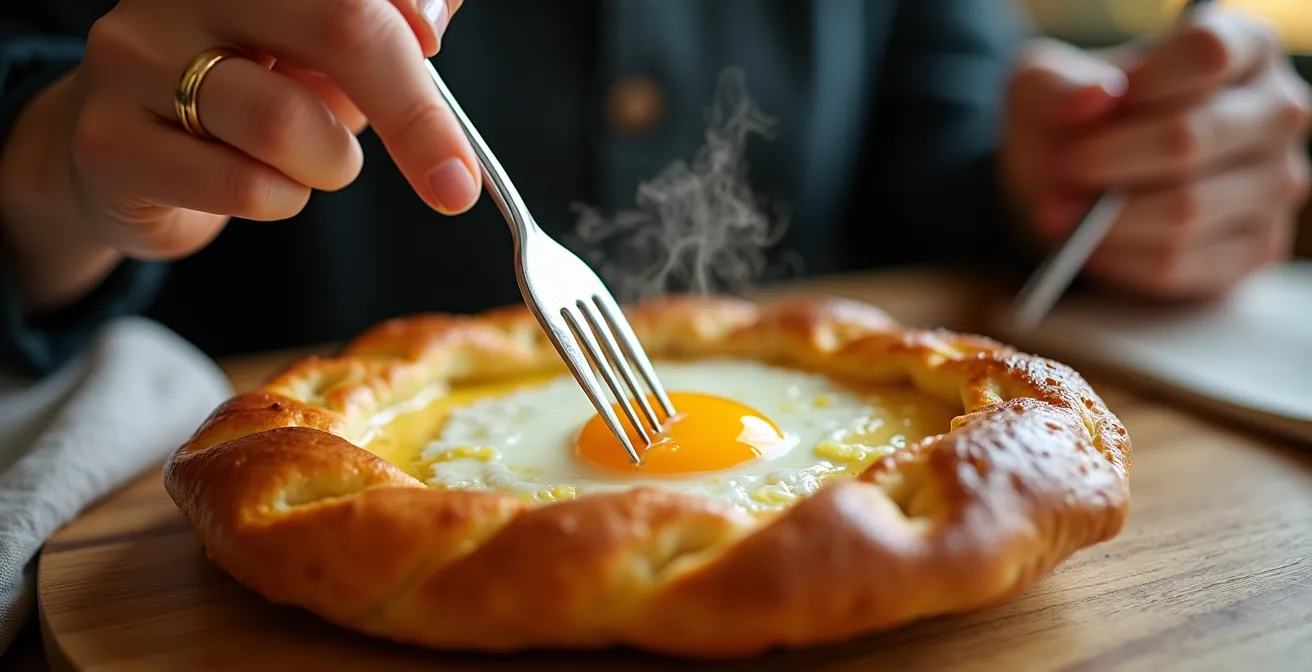
Once the creamy center is prepared, the bread itself becomes your utensil. You tear off the crusty, twisted ends of the boat—its “bow” and “stern”—and use them to scoop up the molten filling. The method is reminiscent of using a piece of bread to gather the last of a rich sauce or the way one might use an empty mussel shell to scoop up the broth from moules marinières. You work your way around the vessel, tearing off pieces of the soft, cheese-soaked walls, until all that remains is a well-cleaned-out hull. It’s a messy, satisfying, and deeply communal way of eating.
Your Action Plan: The Art of Eating Adjarian Khachapuri
- When the khachapuri arrives hot, immediately remove any extra butter if desired—the cheese and egg are rich enough.
- Using a fork, quickly mix the raw egg into the hot cheese center to create an instant emulsion, similar to mounting a beurre blanc.
- Stir vigorously for 30 seconds until the egg cooks from the cheese’s heat and forms a creamy, uniform mixture.
- Tear off one of the twisted bread ends (the ‘bow’ of the boat) with your hands to use as your first ‘spoon’.
- Continue tearing pieces from the sides, using the bread to scoop the cheese-egg mixture as you work your way around the boat.
Chain restaurants vs. Family spots: Where to find the cheesiest Khachapuri?
In Moscow, as in Paris, the discerning diner faces a choice: the reliability of a well-known chain or the unique soul of an independent, family-run establishment. The quest for the perfect Khachapuri is no different, leading you through a landscape of slick, modern eateries and cozy, hidden gems. Both have their merits, but they offer distinct interpretations of Georgian hospitality and cuisine.
The larger Georgian restaurant chains in Moscow provide consistency. You know what you’re getting: a solid, well-executed Khachapuri, a broad menu, and often, the convenience of digital tipping and English-speaking staff. They are a safe bet, especially for a first-timer. However, what they sometimes lack is the intangible warmth and specific character that defines true “bistronomie.”
For that, one must seek out the smaller, family-run spots. These are the places where the recipes feel a generation older and the atmosphere is buzzing with local energy. As one Moscow food expert notes, the passion for this cuisine is personal and widespread. As they state in the Spotted by Locals Moscow Guide, “Moscow loves Georgian cuisine, and everyone I know seems to have their favorite place for khinkali. Mine is Khachapuri, a cozy restaurant with assorted chairs, a friendly staff and an overall cheerful atmosphere.” This sentiment captures the essence of the city’s love affair with these intimate eateries.
A French visitor to one such popular spot, Cafe Khachapuri, perfectly articulated the appeal of these bustling establishments:
Even though the restaurant seats around 60-70 guests with both downstairs and upstairs seating, it was completely packed at 6pm on a Saturday evening. The place was filled with mostly 20 and 30 somethings, creating an authentic local atmosphere. This bustling environment reminded me of popular bistros in the Marais district of Paris – you know you’ve found a gem when locals queue up.
– A French visitor, TravelSort
This is the heart of the matter. The best Khachapuri is often found where the atmosphere is as authentic as the cheese—in places that feel less like a restaurant and more like a crowded, joyous extension of a Georgian family’s dining room. It’s in these bustling, slightly chaotic spots that you find the Muscovite equivalent of Parisian bistronomie.
Wine or Lemonade: What do locals drink with heavy cheesy bread?
The art of pairing is central to any sophisticated culinary culture. Just as a heavy cassoulet demands a robust red from Cahors, the formidable richness of Khachapuri requires a beverage that can cut through the fat and complement its flavour. Georgians, as the inventors of wine, have naturally perfected this balance over 8,000 years. In Moscow’s Georgian restaurants, you’ll find a fascinating array of both alcoholic and non-alcoholic options designed to achieve this perfect harmony.
On the wine front, Georgia offers unique varietals that are a revelation. For the lighter, enclosed Imeretian Khachapuri, a dry, mineral-driven white wine like Rkatsiteli is a classic choice, serving a similar function to a French Sancerre or Muscadet. For the intensely rich Adjarian Khachapuri, with its egg and butter, a more robust red is in order. Saperavi, a deep, tannic red, provides the structure and acidity needed to slice through the richness, much like a Malbec from Cahors would stand up to confit de canard.
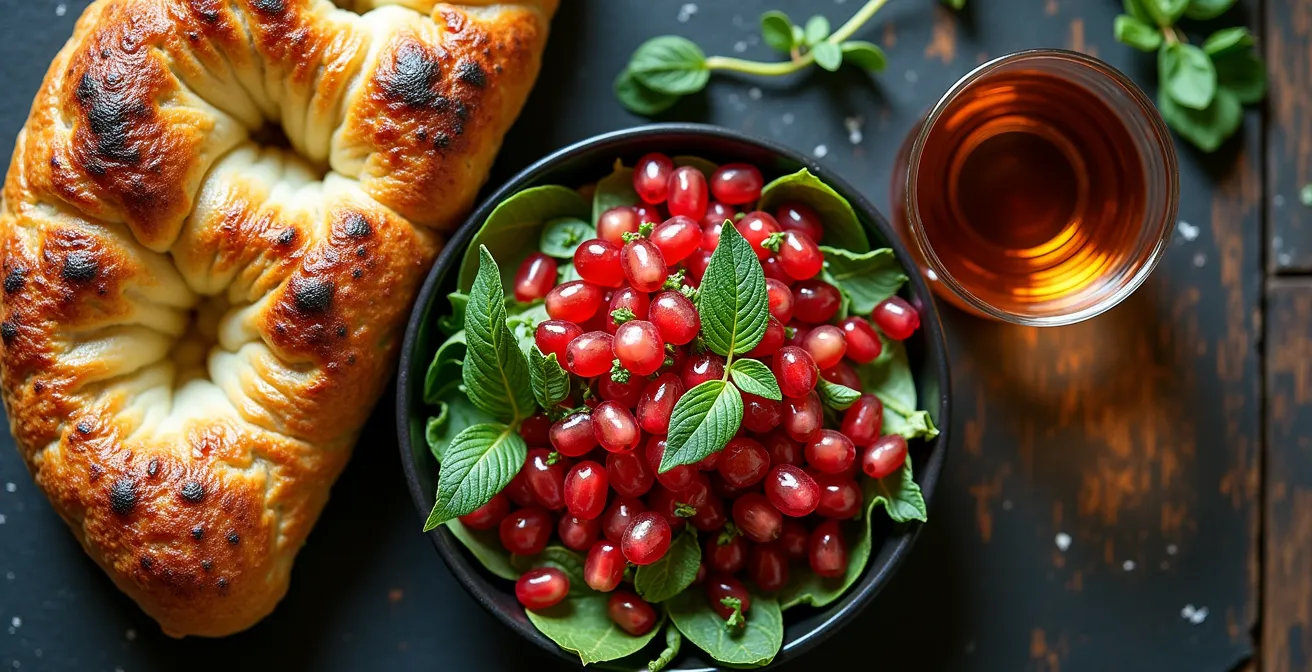
But perhaps even more interesting are the traditional non-alcoholic drinks. The most famous is Tarkhun, a vibrant green tarragon-flavoured lemonade. Its sweet, slightly aniseed taste is startlingly refreshing and acts as a brilliant counterpoint to the salty cheese, reminiscent of a non-alcoholic pastis. Another popular choice is a pear lemonade, whose gentle sweetness and round flavour profile recall a classic French *sirop de poire Williams*. These lemonades are not mere soft drinks; they are an integral part of the meal’s “art de l’équilibre,” cleansing the palate between cheesy bites. Finally, for a true Georgian experience, the meal concludes with a shot of Chacha, a potent pomace brandy that serves as a digestif, akin to a Marc de Bourgogne.
Is Khachapuri a calorie bomb: How to fit it into a balanced diet?
Let’s be direct: Adjarian Khachapuri is not a light salad. It is a dish of pure, unadulterated comfort, and with that comes a certain caloric heft. A typical serving is a formidable affair, a hearty meal in its own right. A nutritional analysis confirms that a single Adjarian khachapuri contains around 680 calories, a figure that places it firmly in the category of indulgence. However, to label it a “calorie bomb” and dismiss it would be a mistake, especially for a French person accustomed to the rich pleasures of our own cuisine.
The key, as always, lies in context and balance. When viewed alongside beloved French comfort foods, Khachapuri’s nutritional profile seems less shocking and more familiar. It’s an indulgence on par with our own regional classics. The dish is meant to be a fulfilling, soul-warming experience, not an everyday snack. The Georgian approach to eating it reflects this: it’s often the centerpiece of a shared meal, balanced with an abundance of fresh salads, tangy pickles, and grilled vegetables. This is not about deprivation, but about intelligent composition of a meal.
To truly understand its place, one only needs to compare it to our own celebratory dishes. It is no more of a “bomb” than a generous serving of tartiflette or a classic raclette dinner with friends. The table below puts this into perspective, showing that Khachapuri sits comfortably among its French comfort food brethren.
| Dish | Calories | Protein (g) | Fat (g) | Carbs (g) |
|---|---|---|---|---|
| Adjarian Khachapuri (1 serving) | 680 | 24 | 36 | 64 |
| Croque Monsieur (1 sandwich) | 500-600 | 25 | 30 | 35 |
| Quiche Lorraine (1 slice) | 600 | 20 | 45 | 30 |
| Tartiflette (1 portion) | 750 | 25 | 40 | 60 |
| Raclette (typical serving) | 700-800 | 30 | 50 | 40 |
Why is Vietnamese Pho the surprising bestseller at a Russian market?
The obsession with Khachapuri is not an isolated phenomenon. It is, in fact, the most visible symptom of a broader, more profound transformation in Moscow’s culinary landscape. The city’s palate has become remarkably adventurous. To understand why a Georgian dish reigns supreme, one must also look at the other foreign cuisines that Muscovites have embraced. The surprising success of Vietnamese Pho in the city’s markets offers a perfect parallel.
Just as Georgian food has become more ‘Muscovite’ than many traditional Russian dishes, so has this steaming Vietnamese noodle soup. According to one observer of Moscow’s food culture, this embrace of global flavours is a defining characteristic of the modern city. The success of both Khachapuri and Pho is rooted in the same core principles: they are affordable, deeply comforting, and soul-warming—perfect antidotes to Moscow’s long, harsh winters. They are also dishes brought to the city by entrepreneurial immigrant communities, infused with an authenticity that locals crave.
This dynamic is not unique to Moscow. It mirrors the culinary evolution of Paris itself, which adopted North African couscous and Vietnamese bánh mì decades ago, transforming them from immigrant foods into beloved local staples. In Moscow, the love for Georgian and Vietnamese food reflects the city’s emergence as a multicultural hub. Khachapuri and Pho are not just food; they are symbols of a new, more open and globally connected Moscow. They prove that the most powerful culinary trends are often born from the simple, heartfelt cooking of diaspora communities.
Do Muscovites tip in cash or by card in the digital age?
Now that you are ready to embark on a Khachapuri pilgrimage in Moscow, there is a crucial piece of practical etiquette to master: tipping. For a French visitor accustomed to the straightforward “service compris” system, where the service charge is included in the bill, Moscow’s tipping culture requires a mental adjustment. The rules are different, and navigating them correctly is a sign of a respectful and savvy traveler.
The most important thing to know is that, unlike in France, service is almost never included in the price shown on the menu. A tip is expected and constitutes a significant part of the server’s income. The standard rate is between 10% and 15% of the bill—10% for adequate service, and 15% or more for excellent service. Simply paying the amount on the bill and leaving is considered poor form.
The method of tipping is also evolving. While cash is still widely appreciated and sometimes preferred, especially in smaller, family-run establishments, the digital age has made its mark. Most modern restaurants and chains now offer the option to add a tip when paying by card at the terminal. A newer trend, particularly in trendier spots, is the use of QR codes printed on the bill, which link to a service for leaving a digital tip directly for your server. Regardless of the method, the tip should be given at the time of payment, not left on the table afterwards. It is a direct and appreciated gesture of thanks for the service received.
Your Tipping Guide for Moscow Restaurants
- Check the bill: Assume service is NOT included, as this is the norm, unlike France’s ‘service compris’.
- Calculate the amount: Plan to add 10% for standard service and 15% for good service.
- Prepare your method: Keep small ruble bills for cash tips, or be ready to use the card terminal’s tipping option. Look for a QR code for digital tipping.
- Execute the tip: Add the tip when you pay the bill. Do not leave cash unattended on the table.
- Offer thanks: A simple ‘spasibo’ (thank you) when handing over the payment with the tip is always a valued gesture.
Key takeaways
- Khachapuri’s appeal lies in its simple, high-quality ingredients, mirroring the French concept of “terroir.”
- The two main types, Adjarian and Imeretian, offer distinct experiences comparable to French classics like fondue and quiche.
- Properly enjoying Khachapuri involves specific rituals and pairings that balance its richness, an “art de l’équilibre” familiar to any gourmand.
How are Moscow chefs transforming buckwheat into a luxury dish?
The story of Moscow’s food scene does not end with the embrace of global cuisines like Georgian Khachapuri or Vietnamese Pho. The final, most exciting chapter is now being written: the rediscovery and elevation of Russia’s own culinary heritage. Inspired by the success of authentic, ingredient-focused cooking from abroad, a new generation of Moscow chefs is now turning its attention inward, applying modern techniques to humble, traditional Russian ingredients. The transformation of buckwheat, or ‘grechka,’ is the most compelling example of this néo-terroir movement.
For generations, buckwheat was a simple, rustic staple—a porridge, a side dish, the food of babushkas and Soviet canteens. It was nutritious and ubiquitous, but never glamorous. Today, in the hands of innovative Moscow chefs, it is being reborn. They are treating it with the same reverence a French chef might afford a Puy lentil or a Breton artichoke. They are exploring its nutty, earthy depths and its surprising versatility.
You can now find buckwheat in Moscow’s high-end restaurants transformed into creamy risottos, crunchy granola for elaborate desserts, flour for delicate blinis, or even as a ‘popcorn’ garnish adding texture to a complex dish. This is not about nostalgia; it is a creative renaissance. It reflects a global trend, seen in Nordic cuisine’s focus on foraged ingredients or the revival of ancient grains across Europe, where chefs find luxury in the local and humble. By elevating buckwheat, Moscow’s chefs are not just creating new dishes; they are forging a new, confident Russian gastronomy that honors its roots while looking to the future. The love for Khachapuri taught them the power of terroir; now, they are applying that lesson to their own soil.
This culinary journey through Moscow reveals a city with a vibrant and evolving palate. To truly understand its heart, one must experience it firsthand, from the bubbling cheese boats to the innovative plates of new Russian cuisine. Start planning your own gastronomic exploration today.