In summary:
- Moscow’s transport fares are complex, but understanding the system’s rules allows for significant cost optimization, particularly for longer journeys on the MCD.
- Mastering the 90-minute free transfer rule is the single most effective strategy for reducing per-trip costs.
- Advanced features like Face Pay and wearables offer convenience, but require a careful cost-benefit analysis regarding privacy and upfront investment.
- Practical knowledge, from cash top-ups to navigating rush hour, is essential for a truly efficient travel experience.
For the uninitiated, navigating Moscow’s vast public transport network can feel like an equation with too many variables. The efficiency is world-renowned, yet the fare structure, especially with the integration of the Moscow Central Diameters (MCD), presents a complex cost-optimization puzzle. Most travellers simply buy a Troika card and hope for the best, accepting whatever fare is deducted. This passive approach, however, leaves significant savings on the table, often amounting to 30% or more on longer, multi-modal journeys.
The common advice revolves around basic tips: use the metro, avoid taxis. But these are tactical suggestions, not a cohesive financial strategy. The true key to unlocking substantial savings doesn’t lie in simply using the system, but in mastering its underlying logic. It requires shifting from a tourist’s mindset to that of a transport economist—viewing every trip not as a single expense, but as a component in a larger, optimizable system of transfers, zones, and timed events.
This guide abandons generic advice. Instead, it provides a mathematical and systematic framework for making your Troika card work for you. We will dissect the rules that govern the system, from the precise timing required for free transfers to the cost-benefit calculus of adopting new technologies like Face Pay. By understanding the “why” behind the fares, you can engineer your travel patterns for maximum economic efficiency, turning a potentially costly part of your trip into a model of fiscal prudence.
This article will deconstruct the essential components of Moscow’s transport system. We will analyze everything from basic financial transactions, like the card deposit, to advanced strategies for navigating peak hours and leveraging technology, providing a complete playbook for the thrifty commuter.
Summary: A Mathematical Approach to Moscow’s Public Transport Fares
- Can you get your 50-ruble deposit back when leaving Moscow?
- Metro plus Bus: How to trigger the free transfer within 90 minutes?
- Face Pay: Is it safe to give your biometric data to the Moscow Metro?
- How to top up Troika with cash at the yellow terminals?
- Troika rings and keychains: Where to buy wearable transport passes?
- How to bypass the SMS verification for Metro Wi-Fi with a foreign number?
- The scenic tram route to Danilovsky: Seeing the quiet south of Moscow
- How to survive the Moscow Metro rush hour without getting crushed?
Can you get your 50-ruble deposit back when leaving Moscow?
The first transaction when acquiring a Troika card is the 50-ruble deposit. From a purely economic standpoint, this amount is a sunk cost for most short-term visitors. The process of returning the card to a metro cashier to reclaim the deposit introduces a time cost that often outweighs the monetary value. To make an informed decision, a simple cost-benefit analysis is required. Consider the time it takes to find a non-busy cashier, complete the transaction, and the opportunity cost of that time. For a sum equivalent to roughly €0.50, the effort is rarely justifiable unless your departure point coincides with a quiet metro station and you have ample time.
The more pragmatic approach is to view the 50 rubles as the base price of the card. A functional, undamaged card can be kept as a souvenir or for future visits. The balance on a Troika card remains valid for an extended period, making it a viable long-term asset if a return trip to Moscow is anticipated. The deposit becomes less of a “deposit” and more of a fixed-cost investment in future transport efficiency. Therefore, the optimal strategy for most travellers is to disregard the refund possibility and focus on maximizing the utility of the card during their stay.
Ultimately, the decision to reclaim the 50-ruble deposit is less a financial one and more a question of personal principle versus practical time management.
Metro plus Bus: How to trigger the free transfer within 90 minutes?
The single most powerful tool for fare engineering in Moscow is the 90-minute free transfer rule. This feature allows for unlimited transfers between the metro, Moscow Central Circle (MCC), buses, trams, and trolleybuses within 90 minutes of the first tap-in. Activating this benefit isn’t automatic; it requires understanding the system’s logic. The 90-minute countdown begins the moment you tap your Troika card at the first turnstile or validator. Any subsequent tap on a different mode of transport within that window will register as a transfer and will not deduct a new fare. This transforms multiple short trips into a single, consolidated journey cost.
For example, a common tourist itinerary demonstrates the power of this rule. A journey starting at Belorusskaya station (a frequent entry point from Sheremetyevo via the Aeroexpress) with a metro ride to Teatralnaya for the Bolshoi Theatre, followed by a bus trip to the modern Zaryadye Park, can be completed as a single fare. If the bus is boarded within 90 minutes of entering the metro at Belorusskaya, the bus ride is effectively free. This principle is the cornerstone of optimizing travel across the city, especially when combining the speed of the metro with the surface reach of buses and trams.
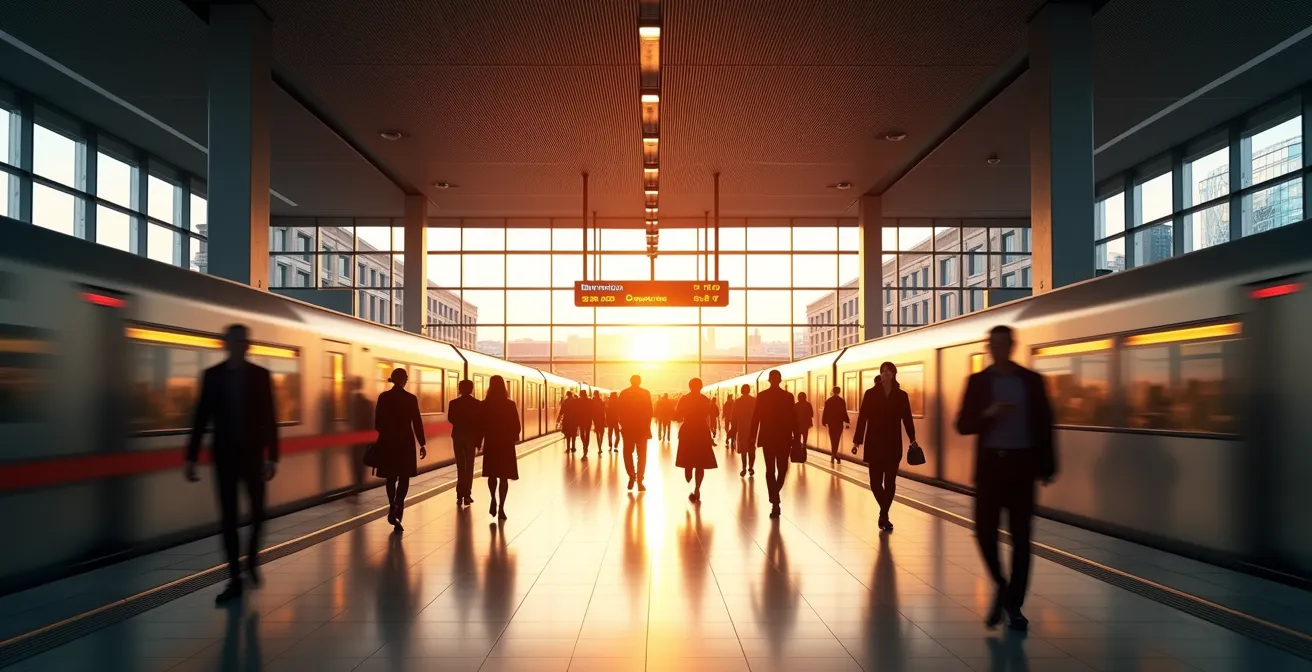
As the visualization of a modern MCD station suggests, the system is designed for seamless movement. To leverage it financially, travellers must plan their multi-stage journeys with temporal precision. Before embarking, estimate the travel time for each leg. This allows you to confirm that your final transfer will fall within the 90-minute window, turning a complex route into a simple, cost-effective trip. Failure to time this correctly resets the fare, nullifying any potential savings.
This isn’t just about saving a few rubles; it’s a systematic approach to reducing your total transport expenditure by treating time as a critical variable in your cost equation.
Face Pay: Is it safe to give your biometric data to the Moscow Metro?
Moscow’s transport system is a pioneer in frictionless transit technology, most notably with its large-scale implementation of Face Pay. As Maxim Liksutov, Deputy Mayor of Moscow for Transport, has stated, “Moscow is the first city in the world where the system is working on such a scale”. For a French citizen accustomed to the strict data privacy regulations of GDPR, the proposition of providing biometric data to a non-EU entity warrants a careful risk-reward analysis. The primary benefit is undeniable: unparalleled convenience, allowing passage through turnstiles without reaching for a card or phone. This is particularly valuable during rush hour or when carrying luggage.
Moscow is the first city in the world where the system is working on such a scale
– Maxim Liksutov, Deputy Mayor of Moscow for Transport
The decision to opt-in hinges on a cost-benefit calculus where the “cost” is potential data exposure. While Russian law prohibits third-party sharing (with exceptions for security services), the data is stored on Russian servers, outside the jurisdiction of EU privacy protections. For a clear-eyed comparison, it’s useful to examine the key differences between the Moscow system and GDPR standards.
| Aspect | Moscow Face Pay | EU/GDPR Standards |
|---|---|---|
| Data Storage | Russian servers, encrypted biometric keys | EU servers with right to deletion |
| Consent | Opt-in via app registration | Explicit consent required |
| Data Retention | 10 days automatic deletion (unless complaint filed) | User-controlled deletion rights |
| Third-party sharing | Prohibited by law (with security exceptions) | Strictly prohibited without consent |
The table, based on an analysis of the system’s privacy implications, highlights a key trade-off. While Moscow’s system is opt-in and includes data retention limits, it does not offer the same level of user control and legal recourse as GDPR. The choice is therefore a personal one: is the marginal utility of faster gate passage worth the calculated risk of storing your biometric data in a different legal framework? For the security-conscious traveller, the traditional Troika card remains the zero-data-risk alternative.
For a short trip, the setup time for Face Pay combined with privacy concerns may lead an economist to conclude that the net benefit is negative.
How to top up Troika with cash at the yellow terminals?
While digital top-ups are possible, using cash at the ubiquitous yellow terminals remains a reliable and anonymous method for funding your Troika card. These machines are a critical piece of infrastructure for any traveller, especially those wishing to avoid linking foreign bank cards to local apps. The process is straightforward, but knowing the parameters and optimal strategy is key to efficiency. The primary constraint to know is that you can load up to 3,000 rubles onto a card, which is typically sufficient for a week or more of heavy travel.
The operational procedure at a yellow terminal is designed for simplicity. Following a few key steps ensures a smooth transaction:
- Locate a yellow terminal, typically found near the entrance of every metro station.
- Press the English language flag on the touchscreen to switch the interface.
- Place your Troika card flat on the designated circular reader area. The screen will display your current balance.
- Select the “Top-up” or “Add value” option.
- Insert cash bills into the acceptor slot. It is advisable to use smaller denominations like 100 or 500 ruble notes, as terminals may not provide change for larger bills.
- Wait for the screen to confirm the new balance has been written to the card before removing it. Taking a receipt is a good practice for record-keeping.
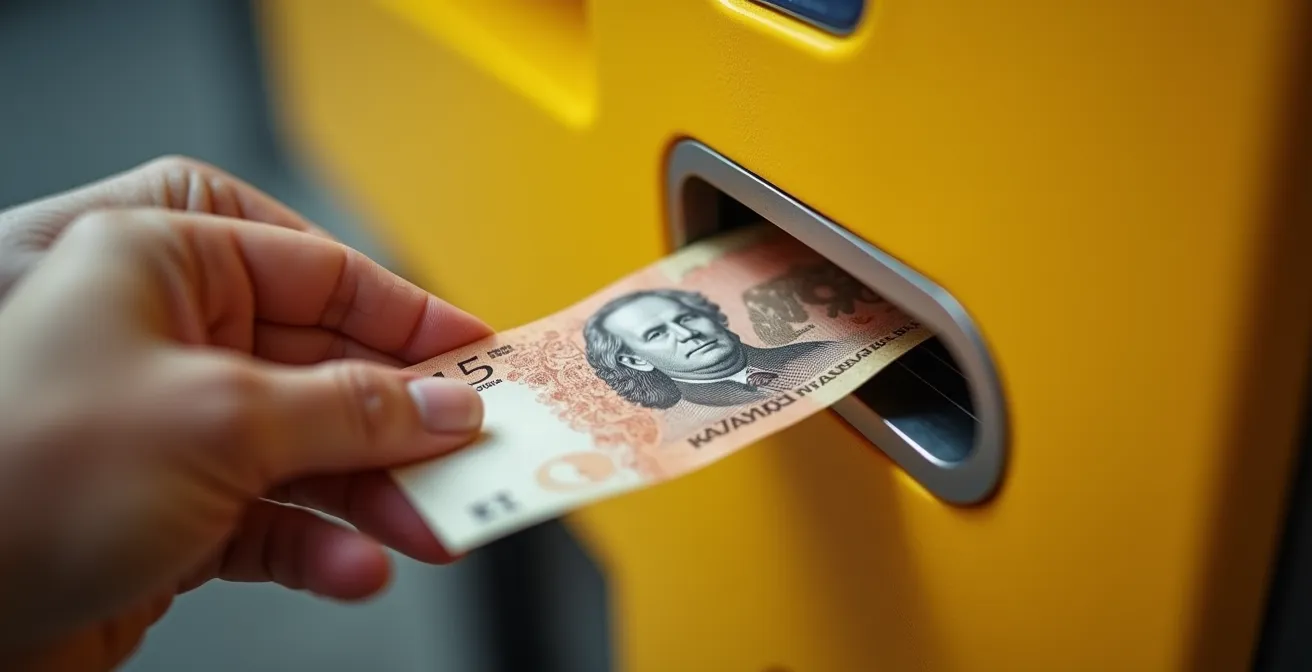
This manual process provides full control over your expenditure without creating a digital footprint. For the cost-conscious traveller, using cash helps in budget management, as you can physically allocate a set amount for transport. While less “frictionless” than app-based solutions, it is a robust and universally available method that requires no prior setup, making it the most efficient option for a first-time cash top-up.
This method ensures you are always prepared, relying on physical currency rather than the potential complexities of international digital payments.
Troika rings and keychains: Where to buy wearable transport passes?
Beyond the standard card, the Troika system extends to wearable form factors such as rings, bracelets, and keychains. These items merge functionality with fashion, offering a method of payment that eliminates the need to handle a wallet or phone. The decision to purchase one is a classic cost-benefit analysis. The upfront cost is significantly higher than the 50-ruble card deposit, positioning these items as a premium convenience or a functional souvenir. An analysis of the market shows that a bracelet costs around 450 rubles, a keychain 350 rubles, and a ceramic ring a substantial 2,200 rubles.
The “benefit” in this equation is purely one of convenience and style. For a commuter navigating crowded stations with hands full, the ability to tap a wrist or a key fob against a reader can be a meaningful time-saver and stress-reducer. For a tourist, it can be a unique and practical memento of their visit. The “cost” is the direct financial outlay. Is the marginal convenience worth an additional 350-2,200 rubles? From a purely mathematical perspective, for a short trip, the answer is likely no. The payback in terms of time saved is minimal compared to the initial investment.
However, if one incorporates the non-monetary value of novelty and the utility of a souvenir, the calculation changes. These wearable Troika devices are available for purchase at specific, high-traffic locations. The primary points of sale are the flagship souvenir stands within the Mayakovskaya and Trubnaya metro stations, as well as the famous GUM department store located on Red Square. This limited availability adds an element of exclusivity. For those who value seamless interaction and are willing to pay a premium for it, these wearables represent the peak of frictionless transit within the Moscow system.
The choice ultimately depends on whether you prioritize minimal upfront cost or maximal daily convenience.
How to bypass the SMS verification for Metro Wi-Fi with a foreign number?
For a French traveller, accessing free public Wi-Fi in the Moscow Metro can be frustrating. The default authentication method requires an SMS verification code, which often fails to arrive on foreign mobile numbers. However, the system contains an alternative, more reliable method specifically useful for international visitors. This “call-back” authentication bypasses the unreliable SMS channel entirely. Mastering this simple procedure provides a valuable utility—free, stable internet access throughout the metro system—at zero cost.
The process is a logical workaround built into the system’s login portal. It does not require any special software, only a functional French mobile number capable of receiving a phone call. The steps are as follows:
- Connect your device to the ‘MT_FREE’ Wi-Fi network, which will appear automatically in any metro station or train.
- A captive portal will open in your browser, prompting you for a phone number to receive an SMS.
- Ignore the SMS field and look for a small link or button labeled ‘Alternative methods’ or a similar phrase.
- Select the option to ‘Receive a call’ (‘Получить звонок’).
- Enter your full French mobile number, including the country code (e.g., +33 6…).
- You will receive an immediate call from a Russian number. You only need to answer it for a second; no conversation is needed. The system verifies the connection and hangs up.
- Return to your browser. The page will refresh, granting you internet access.
This method has proven effective with all major French carriers, including Orange, SFR, Free Mobile, and Bouygues Telecom. The call simply acts as a digital handshake to confirm you control the phone number. It is a far more robust solution than relying on international SMS delivery. This small piece of system knowledge transforms a common tourist frustration into a reliable, free utility for planning your next move, checking maps, or communicating while underground.
This ensures you remain connected without having to rely on expensive mobile data roaming.
The scenic tram route to Danilovsky: Seeing the quiet south of Moscow
A transport system is not merely a tool for getting from A to B; it can also be a platform for exploration. The Tram 39 route offers a perfect case study in using the Troika system for a cost-effective and scenic journey. This route connects the bustling city center near Chistye Prudy with the calmer, residential districts of southern Moscow, terminating near the famous Danilovsky Market. This foodie paradise is an attraction in itself, featuring a vibrant mix of international food stalls and local Russian farm products. This trip demonstrates how a single, low-cost fare can facilitate a rich cultural experience.
Your Troika card is the key to this journey. The same card used for the high-speed metro works seamlessly on the city’s extensive tram network. An important financial detail for longer-stay visitors is that according to official sources, a balance of up to 3,000 roubles can be kept on the card for five years after its last use, making it a persistent asset. This makes it ideal for spontaneous explorations like the Tram 39 ride. By combining the journey with the 90-minute transfer rule, you can even visit the nearby Donskoy Monastery after the market at no additional transport cost.
Your action plan: A Complete Danilovsky Tram Itinerary
- Start Point: Begin at the Chistye Prudy metro station on the Red Line.
- Find the Tram: Exit the station and locate the nearby stop for Tram 39.
- Validate Your Fare: Board the tram and tap your Troika card on one of the yellow validators inside.
- Enjoy the Scenery: The ride takes approximately 25 minutes, offering a glimpse into Moscow’s non-touristic residential life.
- Destination: Alight at the ‘Danilovsky Market’ (Даниловский рынок) stop and explore the market.
This itinerary provides a structured way to experience a different side of Moscow. It leverages the public transport system not just for efficiency, but for discovery. The cost of this entire multi-hour excursion can be as low as a single metro fare if planned correctly, representing an exceptional return on investment in terms of cultural experience per ruble spent.
This demonstrates the true potential of the Troika card when used with strategic intent.
Key takeaways
- The 90-minute free transfer is your most powerful cost-saving tool; plan multi-modal trips within this window.
- Advanced tech like Face Pay offers convenience but requires a personal risk assessment, especially for those accustomed to GDPR.
- Mastering basic logistics, from cash top-ups to understanding rush hour patterns, is fundamental to a smooth and economical trip.
How to survive the Moscow Metro rush hour without getting crushed?
The Moscow Metro’s efficiency is most palpable during peak hours (approximately 7:00-10:00 AM and 5:00-7:00 PM on weekdays). During these times, the system operates at maximum capacity, with trains arriving at intervals that can be as short as 80 seconds. For an unprepared traveller, this period can be an overwhelming physical and psychological experience. Surviving it requires adopting local etiquette and a set of defensive strategies. From an economist’s perspective, the primary goal is to minimize friction and stress, which are non-monetary costs that detract from the travel experience.
The most effective strategy is avoidance. If your schedule is flexible, plan museum visits or leisurely activities during these hours instead of travelling. If travel is unavoidable, employ the following tactics to navigate the crowds:
- Positional Strategy: The first and last metro cars are often significantly less crowded than those in the middle of the train.
- Navigational Aids: At major transfer stations like Biblioteka Imeni Lenina, follow the painted lines on the floor. They are designed to channel crowd flow and will guide you to your connection more efficiently than fighting against the current.
- Personal Space Management: Hold your backpack in front of you. This protects your belongings and creates a small buffer of personal space.
- Social Etiquette: Avoid smiling or making direct eye contact with strangers, as this is not common local custom in crowded public spaces.
- The ‘Babushka Push’: Observe and adopt the local technique of moving through a crowd—a firm, steady, but polite forward momentum, not aggressive shoving.
Mastering rush hour is the final test in understanding the Moscow transport system. It’s not about saving money, but about preserving your personal energy and sanity. The ability to navigate these intense periods calmly and efficiently is a sign that you have moved beyond being a simple tourist and have begun to understand the operational dynamics of the city.
The optimal solution, when possible, remains strategic avoidance, treating rush hour itself as a logistical obstacle to be planned around.
Frequently Asked Questions about Moscow Transport for French Travellers
Will my French mobile plan (Orange, SFR, Free, Bouygues) work for Wi-Fi authentication?
Yes, the ‘receive a call’ authentication method for the metro’s free Wi-Fi works reliably with all major French mobile carriers. You will receive a call from a Russian number that you simply need to answer for a moment to complete the verification.
Is the Gosuslugi login option for Wi-Fi available for tourists?
No, the Gosuslugi (Public Services) portal is not a viable option for foreign tourists. It requires Russian residency documents and a local social security number (SNILS) for registration.
Are there data limits on the free Metro Wi-Fi?
While there are no official hard data limits for the free Wi-Fi service in the metro, speeds may be throttled during peak hours to manage network load. For basic browsing, mapping, and messaging, the service is generally sufficient.