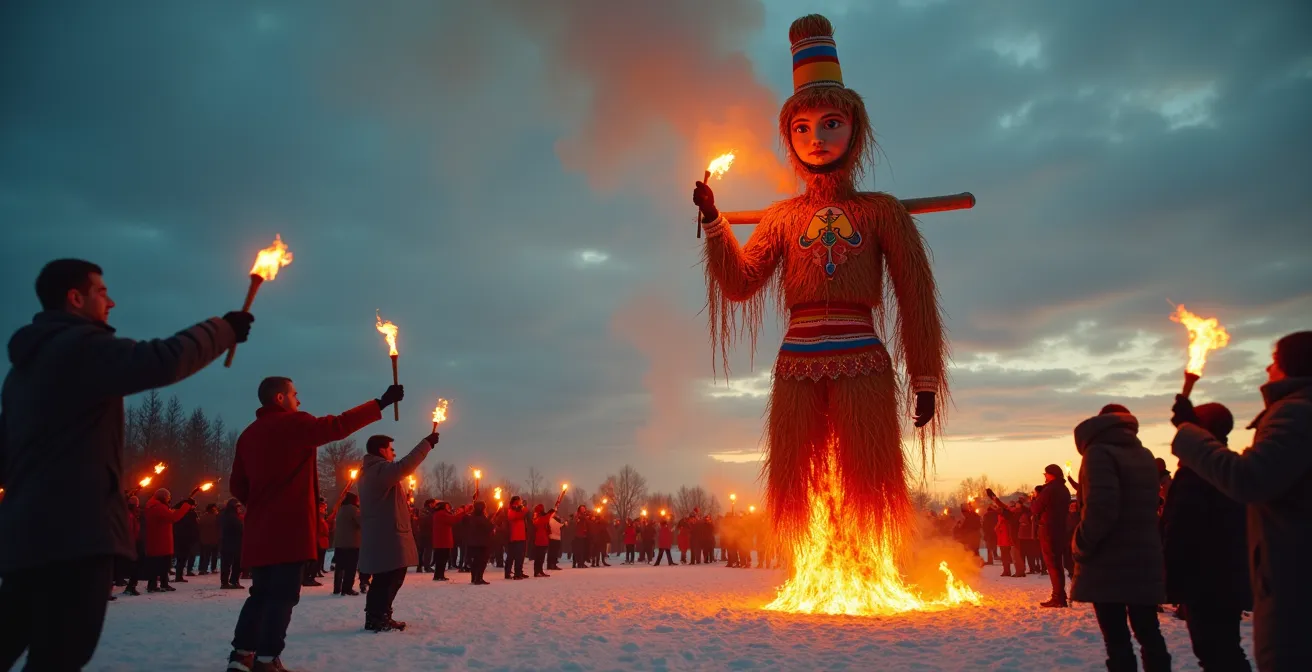
Contrary to the common belief that it’s just a farewell to winter, the burning of the Maslenitsa doll is a profound ritual of purification. This guide reveals how the effigy acts as a symbolic scapegoat, absorbing a community’s hardships before being destroyed in a cathartic fire, offering a much deeper cultural experience for the curious traveler.
Imagine the scene: a crowd gathered in a snowy park, the air filled with the scent of pancakes and honeyed wine. At the center of it all, a giant straw doll, ten feet tall and dressed in bright folk costume, is set ablaze. As flames engulf the figure, cheers erupt. For many tourists, this spectacle is the most memorable—and perhaps perplexing—part of the Russian Maslenitsa festival. The simple explanation is that this act says goodbye to winter and welcomes spring. But this barely scratches the surface of a tradition rooted in deep folkloric symbolism.
While the burning effigy might evoke images of European carnivals, such as the burning of “Sa Majesté Carnaval” in Nice, its meaning is distinctly Slavic. It’s not just about marking a seasonal change; it’s an act of ritual purification. This article moves beyond the postcard image to explore the anthropological heart of the ceremony. We will see the doll not just as “Lady Maslenitsa,” a personification of the festival, but as a scapegoat effigy, a vessel for the past year’s misfortunes, which are then annihilated by fire. Understanding this transforms the experience from watching a curious folk custom into witnessing a powerful act of social catharsis and communal renewal.
For those who prefer a visual summary, the following video offers an immersive look into the atmosphere and key moments of a Maslenitsa celebration.
This guide will deconstruct the festival’s most iconic moments, offering practical advice for the cultural tourist. From choosing the most authentic location for the final ceremony to understanding the etiquette of a Slavic tea party, you will discover how to experience Maslenitsa not just as an observer, but as an informed participant.
Summary: Your Guide to the Deeper Meaning of Maslenitsa
- Sweet or Savory: Which pancake filling is traditional for Maslenitsa?
- Red Square or Kolomenskoye: Where is the most authentic Maslenitsa celebration?
- Climbing the ice pole: Can a tourist join the traditional strength contests?
- Why does the date of Maslenitsa change every year relative to Easter?
- Medovukha: Is the hot honey drink alcoholic or safe for kids?
- Maslenitsa in Moscow: How to enjoy the pancake week like a local?
- VDNKh or Sokolniki: Which park has the safest tubing slides for kids?
- Why participating in a Slavic tea ceremony changes your trip perspective?
Sweet or Savory: Which pancake filling is traditional for Maslenitsa?
The culinary symbol of Maslenitsa is the blin (singular of blini), a thin, round, golden pancake. Their circular shape and warm color are no accident; they represent the sun, a central element in this ancient pagan festival celebrating the end of winter’s darkness. But what goes inside them is a story of social history. While today you’ll find stands overflowing with sweet fillings like condensed milk, jam, and honey, the most traditional options tell a deeper story.
Historically, the most authentic blini were yeasted and made with buckwheat flour, a peasant staple. The fillings were often savory and simple. A classic combination that endures today is smetana (sour cream) and fresh herbs. Another beloved pairing is tvorog, a type of farmer’s cheese similar to cottage cheese. The most luxurious filling, now a symbol of the festival, is caviar. However, what we consider “caviar” has changed. Russian peasants enjoyed “red caviar” from affordable river fish like pike perch, not the expensive salmon or sturgeon roe of today. These simple, earthy flavors connect the modern celebration back to its agrarian roots.
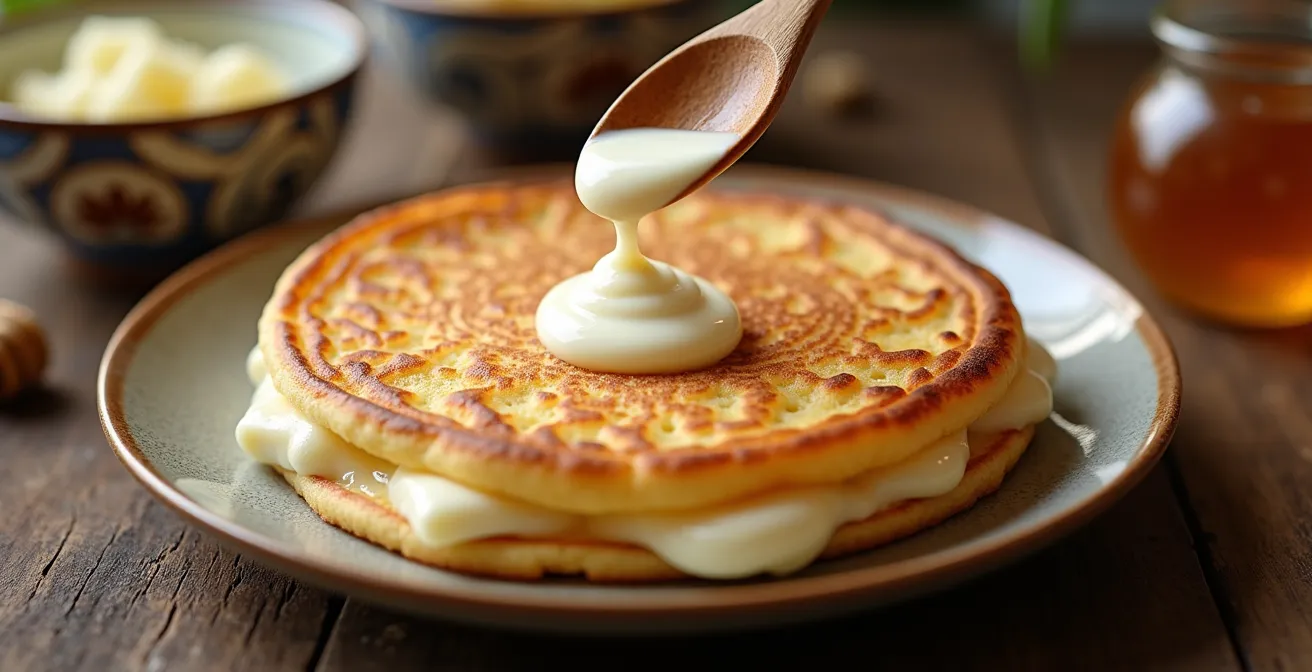
For the visiting tourist, trying a variety is essential. Start with a simple smetana or tvorog blin to taste the tradition, then indulge in one with red salmon caviar to experience the modern festive spirit. This culinary journey from peasant food to celebratory delicacy is a delicious way to understand the evolution of Russian culture itself.
Red Square or Kolomenskoye: Where is the most authentic Maslenitsa celebration?
In Moscow, Maslenitsa unfolds across the city, but the experience can vary dramatically depending on the venue. For a first-time visitor, the festivities on Manezhnaya Square, right next to the Kremlin, are a dazzling spectacle. With professional performances and grand decorations, it feels like the official heart of the celebration. However, this grand scale can sometimes feel more like an organized show than a folk festival. The Moscow Times highlights a compelling alternative for those seeking a more genuine experience.
If celebrating a folk holiday in the city center seems a bit artificial to you, why not make your way out to one of Moscow’s most beautiful and historic parks? Here you will find dancing, singing, games and also one tradition that you won’t be able to find in Moscow’s more populated areas. To mark the end of Maslenitsa, celebrate as giant effigy is burnt.
– The Moscow Times, Maslenitsa in Moscow Guide 2018
That park is Kolomenskoye, a former royal estate and now a sprawling historical park. This is where you’ll find the soul of Maslenitsa. The atmosphere is less about polished performance and more about communal participation, with sleigh rides, folk games, and, most importantly, the authentic effigy burning ceremony. While the central festivals can attract huge crowds— Moscow’s Red Square Maslenitsa festival attracts around 300,000 visitors—Kolomenskoye offers a more spacious and family-friendly environment to witness the festival’s climax.
| Venue | Atmosphere | Best For | Unique Features |
|---|---|---|---|
| Red Square/Manezhnaya | Grand spectacle, organized events | First-time visitors seeking iconic backdrop | Professional performances, Tsarskaya Maslenitsa theatrical show |
| Kolomenskoye Park | Historical, traditional, spacious | Families wanting authentic folk experience | Effigy burning ceremony, sleigh rides, UNESCO church setting |
| Revolution Square | 19th century reenactment theme | History enthusiasts | Era of Alexander I reconstruction, etiquette school, croquet games |
| Izmailovsky Park | Local neighborhood feel | Budget travelers, craft seekers | Handicraft markets, folk workshops, less touristy |
For the cultural tourist, the choice is clear. While Red Square offers an unforgettable photo opportunity, Kolomenskoye offers the chance to witness the communal performance of renewal that lies at the heart of the festival and its fiery conclusion.
Climbing the ice pole: Can a tourist join the traditional strength contests?
Absolutely. One of the most thrilling aspects of Maslenitsa is the boisterous public games, or *zábavy*. These aren’t just for show; they are a vital part of the celebration, symbolizing the triumph of life and strength over the dormancy of winter. The most iconic of these is the pole climb, where daring men attempt to scale a tall, often greased or icy, wooden pole to retrieve a prize from the top. But other games are common too, including tug-of-war, sack races, and even organized fistfights (*stenochny boy*), which are more of a historical reenactment today.
The spirit of these games is one of communal fun and friendly competition. Organizers and locals are generally delighted to see tourists participate. It’s seen as a sign of genuine interest in the culture. Feats of strength are associated with fertility and rebirth, so your participation is, in a small way, part of the larger ritual. There’s no need to be a champion athlete; the goal is cultural exchange and shared laughter, not necessarily winning. Accepting a loss with a good-natured smile is as much a part of the tradition as the competition itself.
However, these are physical activities, often taking place in snow and ice. Common sense and a bit of preparation are essential for anyone wanting to join in. Dressing in warm, flexible layers and sturdy boots is a must. It’s also wise to observe a game first to understand the unspoken rules and the level of intensity before jumping in.
Your 5-Step Plan for Safely Joining the Folk Games
- Observe and Assess: Watch a full round of the game first to understand its rules, intensity, and the spirit of friendly competition. Identify the organizers or key local participants.
- Request Permission: Politely ask an organizer or a local if tourists are welcome to join. A simple “Mozhno?” (Can I?) with a smile is often enough. This shows respect for the community tradition.
- Prepare Physically: Remove any sharp jewelry, secure your valuables, and ensure you’re dressed appropriately in warm, non-restrictive clothing and boots with good grip. A quick stretch can prevent minor injuries.
- Check Your Coverage: Before your trip, confirm that your travel insurance policy covers participation in amateur sports or traditional festival activities. It’s a small check for major peace of mind.
- Participate with Grace: Engage with the primary goal of cultural exchange, not winning. Congratulate the winner, laugh at your own stumbles, and accept that being a good-natured participant is the real victory.
Why does the date of Maslenitsa change every year relative to Easter?
The shifting date of Maslenitsa can be confusing for travelers trying to plan their trip. The key to understanding this lies in the festival’s unique position as a bridge between its ancient pagan roots and the Orthodox Christian calendar. Maslenitsa is a “moveable feast,” and its timing is entirely dependent on the date of Orthodox Easter (*Paskha*).
Specifically, Maslenitsa week is the last week before the start of Great Lent, the strict 40-day fasting period that precedes Easter. Because the date of Easter changes each year, calculated using a complex lunar and solar formula, Maslenitsa’s date shifts with it. The festival always concludes on the Sunday before Lent begins, a day known as “Forgiveness Sunday.” This direct link to the religious calendar is why you cannot find Maslenitsa on a fixed date in March or February.
Further complicating matters for Western visitors, the Orthodox Church calculates Easter differently from Catholic and Protestant churches, which follow the Gregorian calendar. The Orthodox Church still uses the older Julian calendar for its calculations. This often results in Orthodox Easter falling on a different date—sometimes up to five weeks later—than Western Easter. Consequently, Maslenitsa, a pre-Lenten festival, can occur significantly later than its Western Christian equivalent, Carnival or Mardi Gras.
This “syncretism”—the blending of the pre-Christian sun festival with the Christian liturgical year—is what makes Maslenitsa so fascinating. It retains its joyful, feasting nature while serving the structured religious purpose of being the final indulgence before the austerity of Lent.
Medovukha: Is the hot honey drink alcoholic or safe for kids?
Wandering through a frosty Maslenitsa fair, you’ll inevitably be drawn to vendors selling steaming, fragrant drinks. The most famous of these is Medovukha, a traditional honey-based beverage. For a French tourist, the name might evoke *hydromel* (mead), and that comparison is accurate. Medovukha is an alcoholic drink and is definitely not safe for children. It is made from fermented honey, water, and yeast, and its strength can vary significantly. Data shows that traditional medovukha typically contains between 2% to 14% alcohol content, a range similar to beer or a strong wine.
So, what is the warm, sweet-smelling drink that you see families and children enjoying? That is most likely Sbiten. For centuries before tea became popular, Sbiten was Russia’s quintessential hot beverage. In its traditional form, it’s a non-alcoholic infusion of water, honey, spices (like cinnamon and cloves), and herbs. It has a warming, complex flavor profile that can be compared to a non-alcoholic *vin chaud épicé* (spiced mulled wine). As one source notes, Sbiten had a reputation as a “Russian Glühwein, although it normally contains no alcohol.”
To avoid confusion, it’s crucial to ask the vendor what you are buying. The following table breaks down the key differences between the most common hot drinks you’ll find at a winter festival in Russia.
| Drink | Alcohol Content | Base Ingredients | Safe for Children |
|---|---|---|---|
| Medovukha | 2-14% ABV | Fermented honey, water, yeast | No – always alcoholic |
| Sbiten | 0% (non-alcoholic) | Honey, water, spices, herbs | Yes – traditional children’s drink |
| Wine-based Sbiten | Variable | Red wine substitute for water | No – alcoholic variant |
| French Vin Chaud | 7-14% ABV | Red wine, spices, citrus | No – always alcoholic |
When ordering, simply asking “Bez alkogolya?” (Without alcohol?) will ensure you get the family-friendly Sbiten. Enjoying a cup of hot, spiced Sbiten while watching the festivities is an essential and perfectly safe part of the Maslenitsa experience for all ages.
Maslenitsa in Moscow: How to enjoy the pancake week like a local?
To experience Maslenitsa like a Muscovite, you need to think beyond a single day’s visit and embrace the rhythm of the entire “pancake week.” Each day has its own traditional theme and activity, building towards the climax on Sunday. A local’s approach involves visiting different locations throughout the week, balancing smaller neighborhood gatherings with the larger park festivities.
A French expat’s guide offers a valuable perspective, noting that to fully enjoy the festival, one should dress warmly and consider a pass like the MoscowPass, which can simplify access to sites like Kolomenskoye. The guide also makes a key cultural comparison: French visitors often find the festival reminiscent of carnival celebrations but with a “distinctly Slavic tradition and a more family-oriented atmosphere than Nice’s carnival.” This insight helps set the right expectation: expect less raucous parades and more communal, participatory joy. This is confirmed by first-hand accounts from French visitors who highlight the unique family atmosphere.
Here is a suggested itinerary, adapted for a French traveler, that combines iconic sites with local flavor:
- Monday (Welcoming): Start the week gently. Explore the smaller celebrations in the charming Patriarch’s Ponds area for a more intimate atmosphere and your first blini of the week.
- Tuesday-Wednesday (Games & Workshops): Head to Kolomenskoye Park during the week when it’s less crowded. Participate in traditional craft workshops and enjoy a sleigh ride.
- Thursday (Wide Maslenitsa): The festivities officially go “wide.” This is a great day to visit Revolution Square to see the historical reenactments.
- Friday (Mother-in-law’s Eve): Explore the Izmailovsky Kremlin and market. You’ll find fantastic handicrafts and less touristy blini stands, offering a more authentic taste.
- Saturday (Sister-in-law’s Gathering): Experience the grand spectacle at Red Square and Manezhnaya Square. See the professional theatrical shows against the iconic backdrop of the Kremlin.
- Sunday (Forgiveness Sunday): Return to Kolomenskoye Park in the late afternoon. This is the day. Find a good spot to witness the powerful climax: the burning of the Maslenitsa effigy as dusk falls.
- Daily Tip: Navigate the city with ease using a Troika card, the Moscow equivalent of a Navigo pass. Load it with 500-1000 RUB for several days of hassle-free metro travel.
VDNKh or Sokolniki: Which park has the safest tubing slides for kids?
For families traveling with children, Maslenitsa offers more than just pancakes and folk music. A highlight of any Moscow winter is careening down enormous, specially-built ice slides on inflatable tubes, an activity called *vatrushka*. Several major parks offer this, but for parents, safety is the top priority. The two best options, VDNKh and Sokolniki, both offer excellent, well-managed experiences comparable to family ski zones in the Alps.
VDNKh (Vystavka Dostizheniy Narodnogo Khozyaystva) is known for its impressive scale. The slides can be quite high, but the park manages this with professional attendants and separate zones for different age groups, ensuring that younger children aren’t on the same slopes as adventurous teenagers. French parents have compared the setup to the well-organized kids’ areas at a large resort like Val Thorens. The availability of indoor pavilions for warming up is a significant plus.
Sokolniki Park offers slightly gentler slopes, making it an excellent choice for younger children or first-timers. The focus here is on a secure family experience, with rubber safety barriers and a clearly marked first aid station. The feel is often likened to the family zones in a resort like Font-Romeu. The choice between them often comes down to your children’s age and appetite for adrenaline.
| Park | Slide Heights | Safety Features | Family Amenities | French Parent Rating |
|---|---|---|---|---|
| VDNKh | 3-8 meters | Professional attendants, separate zones by age | Indoor warming pavilions, cafes nearby | Similar to Val Thorens kids area |
| Sokolniki | 2-6 meters | Gentler slopes, rubber safety barriers | Equipment rental, first aid station | Comparable to Font-Romeu family zone |
| Gorky Park | 3-5 meters | Modern tubing equipment, supervised lanes | Premium facilities, restaurant options | Like Courchevel village slopes |
Just as crucial as choosing the right park is dressing for the conditions. Moscow’s damp cold and wind chill can feel more penetrating than the dry cold of the Alps. A layering system is essential, but with some Russian adjustments. Local parents swear by waterproof mittens over gloves and always pack a spare set of dry clothes.
Key Takeaways
- The burning of the Maslenitsa effigy is a deep ritual of purification and scapegoating, not just a simple farewell to winter.
- For an authentic experience, prioritize traditional venues like Kolomenskoye Park for the effigy burning over the grand but more artificial spectacles in the city center.
- The Slavic tea ceremony offers a profound cultural insight into hospitality and connection, a stark contrast to the quick pace of Western café culture.
Why participating in a Slavic tea ceremony changes your trip perspective?
After the exuberant crowds and fiery spectacle of the Maslenitsa festival, stepping into the warmth of a Russian home for a traditional tea ceremony offers a profound shift in perspective. It moves you from the public and performative to the private and intimate. This experience is not just about drinking tea; it is a lesson in a different form of social connection, one that stands in stark contrast to the familiar café culture of France.
As cultural anthropologist Marina Fedorova explains, the two rituals operate on opposite principles:
The Russian tea ceremony with a samovar represents the opposite of Parisian café culture – it’s about slowing down, staying in one place for hours, and building deep connections through unhurried conversation over multiple rounds of tea diluted from concentrated zavarka.
– Cultural Anthropologist Marina Fedorova, Comparing French and Russian Social Rituals
The centerpiece is the samovar, a heated metal urn that keeps water hot for hours, facilitating endless refills. Tea is not served in individual cups but brewed as a strong concentrate called *zavarka*. Guests then dilute this powerful essence with hot water from the samovar to their preferred strength. This method itself is a metaphor for Russian social interaction: an intense core that is generously shared and tempered among trusted company.
A French Blogger’s Cultural Revelation
A French travel blogger documented her first Russian tea ceremony: ‘The concentrated tea essence (zavarka) perfectly represents Russian character – intensely strong at its core, but diluted and shared generously with trusted guests. Unlike our quick espresso culture, Russians use tea as an excuse for three-hour conversations where real connections form. The abundance of food served alongside – not just sweets but pickles, bread, cheese – shows hospitality that goes beyond our measured French portions.’
Participating in this ritual changes your trip. It’s a moment where you are no longer a tourist observing a culture, but a guest participating in it. The unhurried pace and genuine hospitality recalibrate your understanding of the country, revealing a warmth and depth that the grand, public festivals can only hint at.
By shifting your focus from simply seeing the sights to understanding the rituals—from the fiery public catharsis of the effigy burning to the quiet intimacy of the tea ceremony—you don’t just visit Russia; you begin to connect with it.