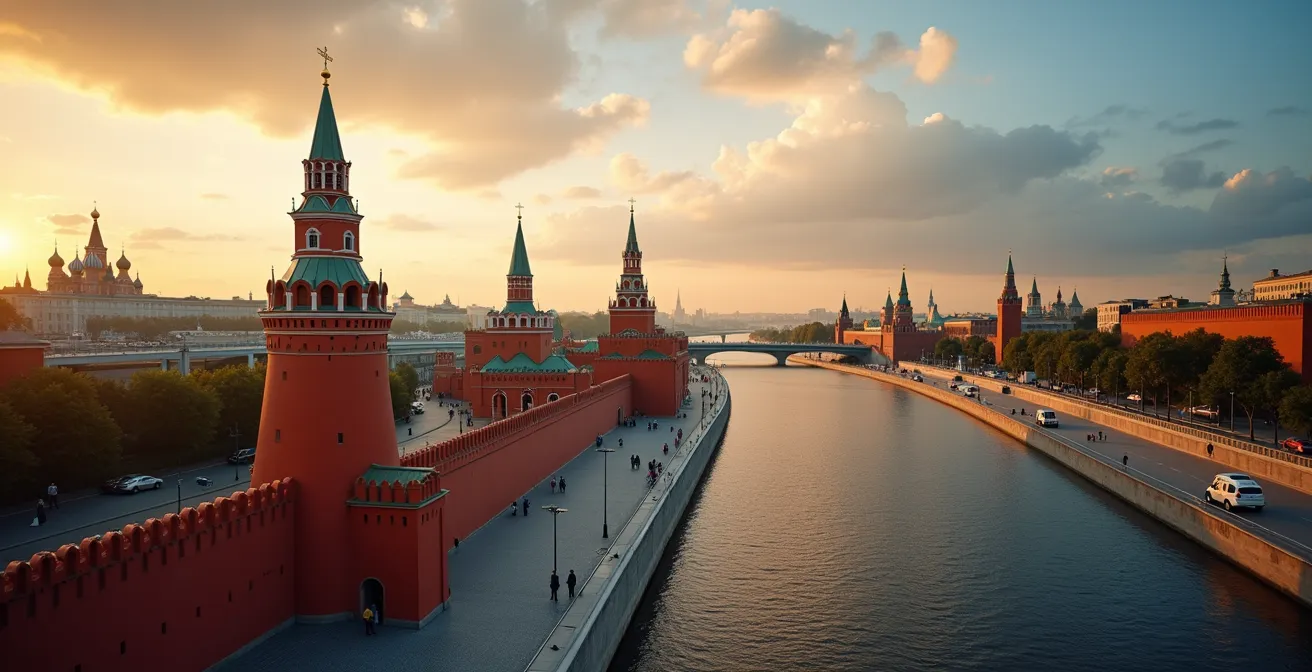
In summary:
- Seeing Moscow’s three UNESCO sites in a day is a logistical challenge, not a simple tour.
- Success depends on strategic planning: pre-booking tickets, optimizing transport, and hacking time windows.
- The biggest bottlenecks are the Kremlin Armoury queue and travel to the remote Kolomenskoye estate.
- This guide provides a step-by-step operational plan to navigate these challenges efficiently.
The idea of seeing all of Moscow’s UNESCO World Heritage sites in a single day seems daunting. You have the sprawling Kremlin and Red Square, the serene Novodevichy Convent, and the distant, historic estate of Kolomenskoye. Most guides offer vague suggestions, leading to wasted hours in queues or on the metro. The typical approach of simply “visiting” them in a list is a recipe for failure, especially for the efficiency-focused traveler who wants to tick off these major sites without sacrificing the experience.
Many will advise you to just “buy tickets online” or “start early,” but they fail to address the core logistical bottlenecks. They don’t explain why one site is on the list and a similar one isn’t, or how to navigate the complex ticketing system of the Kremlin. This leaves you unprepared for the reality on the ground. But what if the key wasn’t just to visit, but to execute a strategic operation? The secret to conquering Moscow’s UNESCO trio in 24 hours lies in treating your itinerary as a mission, prioritizing time, access, and crowd avoidance above all else.
This itinerary is your operational plan. We will deconstruct the “why” behind each site’s status, provide a precise logistical path for transport and ticketing, and reveal the optimal time windows to avoid the crowds. This is not a leisurely stroll; it is a masterclass in travel efficiency, designed to make your 24-hour UNESCO quest a definitive success.
This article provides a detailed, step-by-step plan to navigate Moscow’s three UNESCO sites in under 24 hours. Below, you will find the complete itinerary, breaking down each logistical challenge into a manageable solution.
Summary: A 24-Hour UNESCO Itinerary for Moscow
- Why is the Novodevichy Convent a UNESCO site and not the Cathedral of Christ the Savior?
- Getting to Kolomenskoye: The easiest route to see the UNESCO Church of the Ascension
- Kremlin and Red Square: How to buy one ticket for the whole complex?
- The specific hour to visit Red Square to avoid the tour bus crowds
- 3 documentaries to watch before visiting Moscow’s UNESCO sites
- When is Lenin’s Mausoleum actually open (and why is it free)?
- Moscow Baroque style: What makes the Novodevichy bell tower unique?
- How to enter the Kremlin Armory without queuing for 2 hours?
Why is the Novodevichy Convent a UNESCO site and not the Cathedral of Christ the Savior?
The core of this distinction lies in one word: authenticity. UNESCO’s World Heritage status is not just about beauty or scale; it’s about integrity, originality, and historical testimony. The Novodevichy Convent is an exceptionally well-preserved example of 16th and 17th-century Moscow architecture, having maintained its function and form with remarkable continuity. In contrast, the grandiose Cathedral of Christ the Savior, while visually impressive, is a complete reconstruction from the 1990s. The original was demolished in 1931 under Stalin.
This fundamental difference is a deal-breaker for heritage status. To be inscribed, a site must meet strict tests of authenticity in materials, design, and workmanship, according to UNESCO’s latest Operational Guidelines. The Convent passes this test, representing the unique Moscow Baroque style. The Cathedral, being a modern replica, fails. The following comparison makes this distinction crystal clear.
| Criterion | Novodevichy Convent | Cathedral of Christ the Savior |
|---|---|---|
| Construction Period | 16th-17th century (original) | 1990s (reconstruction) |
| Authenticity Test | ✓ Passed – Original materials & techniques | ✗ Failed – Modern reconstruction |
| Architectural Style | Moscow Baroque (unique) | Neoclassical (common) |
| Historical Continuity | Continuous since 1524 | Demolished 1931, rebuilt 1995-2000 |
| UNESCO Criteria Met | i, iv, vi | None |
Understanding this criterion is the first step in appreciating the value of the sites on your itinerary. It’s not just about what you see, but about the authentic history embodied within the stones.
Getting to Kolomenskoye: The easiest route to see the UNESCO Church of the Ascension
Kolomenskoye is the most geographically challenging site on this 24-hour itinerary. Located southeast of the city center, it requires a dedicated metro trip. Wasting time with incorrect routes is not an option. The most efficient method is using Moscow’s incredibly effective metro system. The key is taking the correct line and knowing the short walk from the station to the park entrance.
The Church of the Ascension, with its iconic white stone and tent-roof design, is the centerpiece of this former royal estate. The visual reward after the short journey is immense, especially during the spring when the surrounding apple orchards are in bloom.
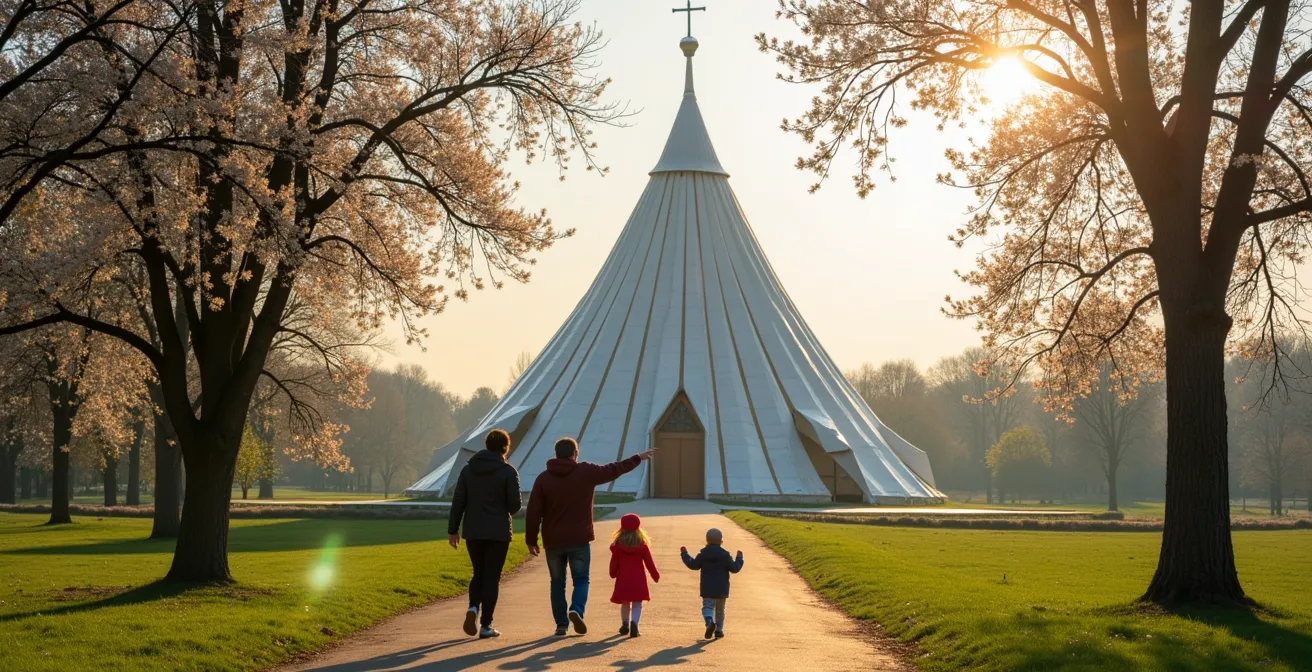
As you can see, the architecture stands out dramatically against the park’s natural beauty. To get there without any logistical friction, follow this precise sequence of steps. This route minimizes walking and navigational confusion, taking roughly 30-40 minutes from the city center to the church itself.
- Step 1: Take Moscow Metro Line 2 (the green line) from any central station like Teatralnaya or Tverskaya.
- Step 2: Exit at Kolomenskaya station. The journey time is a swift 15-20 minutes from the center.
- Step 3: Use the exit at the rear of the train (if coming from the center) and turn right upon exiting the station building.
- Step 4: Walk straight towards the main park gates, a brief 5-minute walk from the metro.
- Step 5: Once inside the park, follow the main, paved path uphill for approximately 10-15 minutes.
- Step 6: The distinctive, soaring white silhouette of the Church of the Ascension will become visible on your right.
Kremlin and Red Square: How to buy one ticket for the whole complex?
Here is the first and most critical logistical point for the Kremlin: there is no single “one ticket for everything.” Attempting to find one will waste valuable time. The complex is managed as a collection of separate museums and areas, and you must purchase tickets accordingly. An efficient visit requires a strategy of “ticket sequencing.” You must decide your priorities and book the correct combination of tickets in advance.
Red Square itself, along with the exterior views of St. Basil’s Cathedral and the Kremlin walls, is free and open to the public. The paid experience is inside the walls. For a 24-hour itinerary focused on the UNESCO essentials, your goal is to see the architectural heart of the Kremlin (Cathedral Square) and its most famous collection (the Armoury Chamber). Other attractions, like the Diamond Fund, are separate and should be skipped on a tight schedule.
The key is to use the official website, kreml.ru, to purchase tickets for the two essential components. This allows you to bypass the long, time-consuming queues at the physical ticket office in the Alexander Garden. Here is the breakdown of the tickets you need to create your “all-access” pass:
- Ticket 1: Architectural complex of Cathedral Square (500 RUB). This is the main ticket that grants access to the Kremlin grounds and the five cathedrals within: the Dormition, Archangel, and Annunciation Cathedrals, the Church of the Deposition of the Robe, and the Patriarch’s Palace.
- Ticket 2: Armoury Chamber timed-entry (1000 RUB). This is a separate ticket for a specific time slot. It is the most in-demand ticket and must be booked online, often up to two weeks in advance.
- Free Access: Red Square, GUM department store, and the exterior views of all surrounding buildings require no ticket.
- Skip on a tight schedule: The Diamond Fund exhibition has its own ticket (500 RUB) sold only on-site inside the Armoury. It requires an additional time commitment that is not feasible in 24 hours.
The specific hour to visit Red Square to avoid the tour bus crowds
Time-window hacking is your most powerful tool for experiencing Red Square. This iconic space can transform from a serene, almost private plaza into a chaotic sea of tour groups in a matter of minutes. The logistical pivot point for crowds is 10:00 AM. Data on visitor flow shows that the peak for tour group arrivals is around 10:00 AM, when buses unload and organized tours of the Kremlin begin. To have the square to yourself for photography and quiet appreciation, you must operate outside this window.
The optimal strategy is to make Red Square your first stop of the day, capitalizing on the “golden window” for visitors. Arriving before the city fully wakes up provides an unparalleled experience. An alternative, though more crowded, is the “blue hour” after sunset, when the crowds thin out and the building illuminations create a different kind of magic. The midday period, especially around 11:00 AM, should be avoided as crowds from the Changing of the Guard ceremony at the Tomb of the Unknown Soldier spill into the square.
For the efficiency-focused traveler, timing is everything. Use this schedule to plan your approach:
- 7:00-9:00 AM: The Golden Window. The square is open, but crowds are minimal. This is the absolute best time for unobstructed photos of St. Basil’s Cathedral and the Kremlin walls. The light is soft and ideal for photography.
- 11:00 AM: Avoid at all costs. This is peak crowd time, with spillover from the Changing of the Guard ceremony.
- Sunset (“Blue Hour”): The second-best option. Crowds begin to disperse for dinner, and the lights turn on, offering a dramatic and atmospheric view.
- After 10:00 PM: For night owls, the square is often accessible until midnight and takes on a majestic, quiet atmosphere.
- Winter Tip: An early morning visit in winter can reward you with frost-covered domes and dramatic, low-angle sunlight.
3 documentaries to watch before visiting Moscow’s UNESCO sites
A hyper-efficient visit should not be a superficial one. To truly appreciate the historical weight of what you’re seeing, “contextual priming” is essential. Spending a few hours before your trip with high-quality documentaries transforms your visit from a visual checklist into a meaningful encounter with history. As the UNESCO committee states, the Kremlin is not just a building; it is a place “inextricably linked to all the most important historical and political events in Russia since the 13th century.”
The Kremlin was the residence of the Great Prince and also a religious center, inextricably linked to all the most important historical and political events in Russia since the 13th century.
– UNESCO World Heritage Committee, Official UNESCO World Heritage Site Description
Watching these films will allow you to recognize architectural details, understand the power struggles that played out within these walls, and connect the abstract history to the physical spaces you are standing in. The intricate details of the cathedrals in the Kremlin, for example, become far more resonant when you understand their role in the coronations and burials of Czars.
For a rich and informed visit, this curated list provides historical, cultural, and artistic context. It includes productions highly regarded in Europe, making them particularly accessible for a French-speaking audience familiar with these broadcasters.
- ‘The Last Czars’ (Netflix): A docu-drama that, while focused on Nicholas II, vividly illustrates the Kremlin’s central role in imperial power and the daily lives of the Romanovs.
- Arte’s ‘Invitation au Voyage’ Moscow episode: This French/German production offers deep cultural insights, connecting history with modern Moscow in a visually compelling format.
- Eisenstein’s ‘Ivan the Terrible’ (1944): A cinematic masterpiece. Though a work of art and not a strict documentary, it was partially filmed inside the Kremlin and offers a powerful, artistic vision of the site’s medieval past.
- BBC’s ‘Russia’s Lost Princesses’: This series provides excellent context for the Novodevichy Convent, focusing on the lives of the royal women who were often confined there.
- France Culture’s ‘Le Cours de l’Histoire’ podcast: Look for episodes on Ivan the Terrible and Peter the Great to understand the key figures who shaped these sites.
When is Lenin’s Mausoleum actually open (and why is it free)?
Lenin’s Mausoleum operates on a logic entirely separate from any other tourist site in Moscow. The key to understanding its bizarre opening hours and free admission is to see it not as a tourist attraction, but as a state-sponsored ideological monument. Its purpose is preservation and reverence, not revenue. This is why access is free, but also highly restricted and subject to a rigid protocol. There is no booking; you simply queue.
The mausoleum’s opening hours are notoriously limited and can change without warning. It is typically open from 10:00 AM to 1:00 PM on Tuesday, Wednesday, Thursday, and Saturday. It is always closed on Monday and Friday for maintenance and official functions. During peak season, the queue can stretch for up to two hours, a significant time investment that must be weighed carefully in a 24-hour itinerary. If you choose to visit, you must adhere to a strict set of rules.
The visit itself is a swift, somber affair. The protocol inside is absolute: no talking, no stopping, and a complete ban on photos and mobile phones. Visitors file past the embalmed body in a continuous, silent procession. While a unique Cold War relic, its unpredictable closures and potential for long queues make it a high-risk, low-flexibility addition to a tight schedule. It’s an “optional side-quest” to be considered only if your primary objectives are well ahead of schedule.
Moscow Baroque style: What makes the Novodevichy bell tower unique?
The Novodevichy bell tower is not just a beautiful structure; it’s a political statement rendered in brick and stone. Its uniqueness comes from its status as a pinnacle of the Moscow Baroque style and the ambition of the woman who commissioned it, regent Sophia Alekseyevna. Before being overthrown and confined to the very same convent by her half-brother, Peter the Great, Sophia initiated the construction of this 72-meter tower, making it the tallest structure in 18th-century Moscow.
The style itself is a vibrant fusion of traditional Russian architecture and Western European Baroque influences. Unlike the more formal, monochrome grandeur of French Baroque seen at Versailles, Moscow Baroque is characterized by its color, ornamentation, and verticality. The bell tower features distinctive octagonal tiers stacked like a wedding cake, a feature known as an “octagon on a cube.” The contrast between the rich red brick and the intricate white limestone details (a style called ‘uzorochye’) creates a dynamic, almost fabric-like texture. The design is crowned with ‘kokoshnik’ gables, which resemble the shape of traditional Russian women’s headdresses.
This table highlights the key differences that make the Moscow Baroque style of the Novodevichy bell tower so distinct from its Western European counterpart.
| Feature | Moscow Baroque (Novodevichy) | French Baroque (Versailles) |
|---|---|---|
| Orientation | Vertical ‘wedding cake’ stacking | Horizontal grandeur |
| Color Palette | Red brick with white limestone | Pale stone monochrome |
| Ornamentation | Uzorochye (intricate patterns) | Classical symmetry |
| Cultural Elements | Kokoshnik gables, onion domes | Columns, pediments |
| Visual Effect | Vibrant, ornamental | Formal, regulated |
This architectural blend made the tower a powerful symbol of Sophia’s rule—rooted in Russian tradition yet looking towards European power.
Key Takeaways
- Authenticity is key: UNESCO prioritizes original, well-preserved structures over modern reconstructions.
- Logistical planning is paramount: The most remote site (Kolomenskoye) should be tackled with a clear metro plan.
- Master the ticketing: There is no single Kremlin ticket; you must strategically book separate entries for Cathedral Square and the Armoury online.
How to enter the Kremlin Armory without queuing for 2 hours?
The Kremlin Armoury Chamber queue is the single greatest logistical bottleneck for any visitor. Stories of two-hour waits are not an exaggeration. The solution is simple in theory but requires precise execution: you must book a timed-entry ticket online, exactly when they are released. This is not a casual suggestion; it is the only way to guarantee entry without a debilitating wait. Tickets for the Armoury are in extremely high demand and sell out within hours, sometimes minutes, of becoming available.
The official Kremlin website, kreml.ru, is your only reliable source. According to booking patterns, tickets are released exactly two weeks in advance of the visit date. You must be online at that time to secure your slot. Once you have your e-ticket (saved on your phone or printed), you can bypass the main ticket office entirely and proceed directly to the Armoury entrance at your designated time. This strategy alone can save you up to two hours.
Any other approach is a high-risk gamble. Buying tickets from street resellers is a recipe for disaster, as they are often fake. The only other reliable, albeit far more expensive, alternative is to book a private tour where the guide has pre-purchased the tickets for you. For the independent, efficiency-focused traveler, mastering the online booking system is the mission.
Action Plan: Securing Your Kremlin Armoury Slot
- Identify your visit date and calculate the date exactly 14 days prior.
- Set an alarm for the ticket release time (check kreml.ru for the exact hour, it can vary).
- Have your payment information ready and book your timed-entry slot on the official kreml.ru website the moment they become available.
- Save the e-ticket PDF to your phone and also keep a printed copy as a backup.
- On the day of your visit, go directly to the Armoury entrance at the Borovitskaya Tower, completely bypassing the physical ticket office in Alexander Garden.
By treating your 24-hour visit as a strategic operation and executing this logistical plan, you can efficiently experience the full scope of Moscow’s UNESCO World Heritage. Begin planning your ticket sequencing now to ensure your mission is a success.