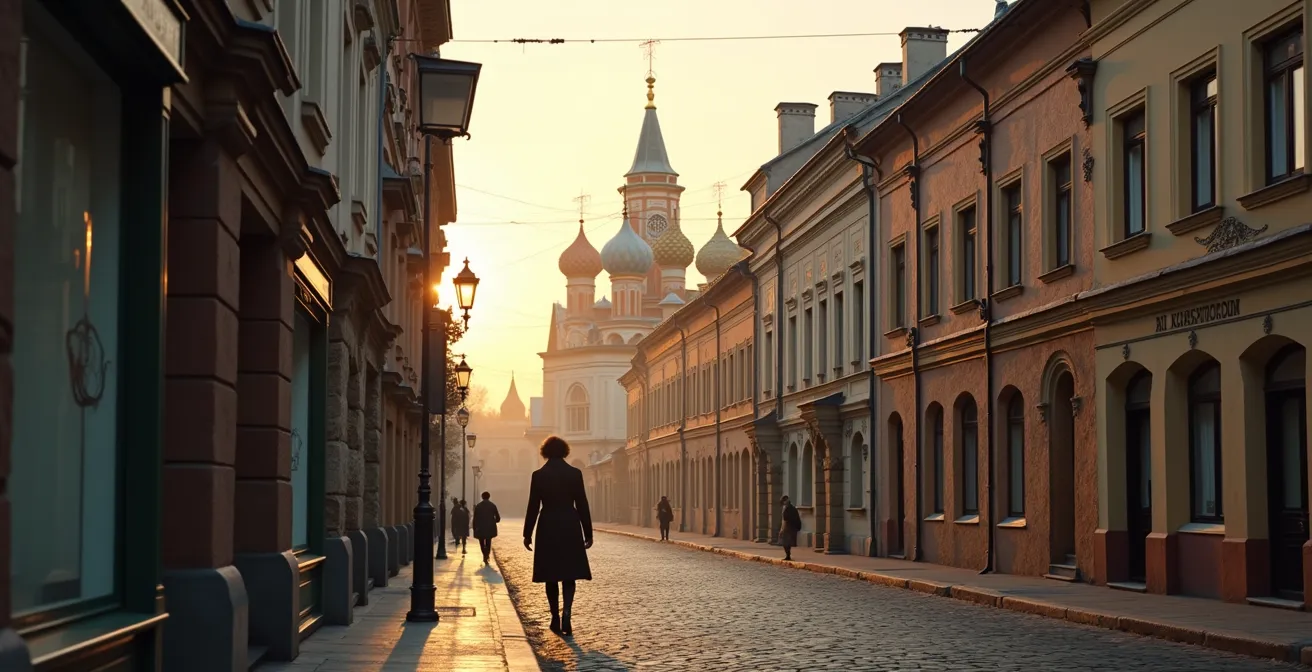
To find Moscow’s authentic pre-Soviet charm, you must look beyond the monumental facades and into the quiet, layered urban fabric that survived centuries of change.
- The city’s true 19th-century atmosphere is found not in grand squares, but in the merchant district of Zamoskvorechye and the hidden “dvors” (courtyards).
- Identifying key architectural details, from Art Nouveau flourishes to the domestic scale of merchant manors, is the secret to reading the city’s history.
Recommendation: Adopt a “two-lane” walking strategy: first experience the main streets, then double back through the parallel quiet lanes to discover the preserved historical soul.
Moscow today presents a dazzling, often overwhelming, face to the world. A modern megalopolis thrumming with energy, it draws millions of visitors eager to witness its iconic grandeur. While the grandeur of the Kremlin and the vastness of the Red Square are undeniable, the discerning traveller, the true architecture lover, often feels a sense of loss. Where, amidst the Stalinist skyscrapers and post-Soviet glass towers, is the soul of the 19th-century city? How can one connect with the more intimate, pre-revolutionary Moscow of merchants, artists, and intellectuals? Is Moscow even a walkable city for those seeking history?
Most guides will point you towards Arbat Street, a pedestrian thoroughfare now largely defined by souvenir shops and caricaturists. But this is a performance of history, not the real thing. The true pre-Soviet vibe is more elusive. It exists as an urban palimpsest, where layers of history are visible to those who know where—and how—to look. It survived not by being monumental, but by being overlooked. Much like Paris’s Marais district, which resisted the sweeping boulevards of Haussmann, pockets of Old Moscow survived the ambitious, often brutal, reconstructions of both Tsarist and Soviet regimes.
This article is your guide to that surviving city. We will not dwell on the obvious landmarks. Instead, we will act as urban preservationists, peeling back the layers to find the authentic 19th-century fabric. Our journey will take us through the quietest merchant districts, teach us to spot the homes of the wealthy bourgeois, reveal the secrets of legendary literary haunts, and even uncover entire buildings physically moved to make way for a new world. This is a walk through a Moscow that whispers its history, rather than shouting it.
This guide offers a curated path through the city’s surviving pre-Soviet pockets, providing a framework for seeing Moscow not as a collection of monuments, but as a living museum of architectural history. Follow along as we explore the districts and details that hold the key to the city’s past.
Summary: A Historian’s Tour of Pre-Soviet Moscow
- Why is Zamoskvorechye the best area for a quiet Sunday walk?
- How to spot the homes of 19th-century merchants hidden in plain sight?
- Ostozhenka Street: How did it become the “Golden Mile” of Moscow?
- The secret courtyards of Chistye Prudy tourists never find
- Walking the Patriarch’s Ponds: Following the steps of Bulgakov’s Master and Margarita
- How to glimpse the avant-garde Melnikov House hidden behind Arbat?
- Savvinskoye Podvorye: How to find the building hidden behind Tverskaya?
- Old Arbat walking tour: Avoiding the tourist kitsch to find history
Why is Zamoskvorechye the best area for a quiet Sunday walk?
In a city that saw nearly 26 million tourists in 2024, finding tranquility can feel like an impossible task. Yet, just across the Moskva River from the Kremlin lies Zamoskvorechye—”the land beyond the Moscow River.” This district is the city’s best-kept secret for a quiet, atmospheric immersion into the 19th century. While other areas were razed and rebuilt, Zamoskvorechye was uniquely fortunate, miraculously avoiding the most destructive of the communists’ urban “shenanigans” and thus preserving its deep historical character.
What makes it so special is its preserved domestic scale. Unlike the imperial grandeur north of the river, this was the domain of the wealthy merchant class. They built substantial but relatively low-profile urban manors (usadby), often with private gardens and ornate but not ostentatious facades. Walking its numerous lanes and side streets feels like stepping into a Tolstoy novel. Carefully restored mansions stand next to trendy but discreet cafés and bakeries, creating a living neighborhood rather than an open-air museum. It is one of the few places in central Moscow where the dominant sound is not traffic, but the chime of church bells and distant conversation.
The unique atmosphere of this district was perfectly captured by one observer:
Located south of the Kremlin, across the Moskva River, Zamoskvorechye has retained the distinctive atmosphere of Old Merchant Moscow. This district feels lower in profile, quieter, and deeply atmospheric.
– Moscow Districts Guide, MoscowPass Travel Blog
To walk here on a Sunday morning is to experience a rare sense of peace. The low-slung buildings allow sunlight to fill the streets, and the labyrinthine layout encourages unhurried exploration. It is, without a doubt, the heart of pre-Soviet Moscow’s quiet, bourgeois soul.
How to spot the homes of 19th-century merchants hidden in plain sight?
Walking through Zamoskvorechye is one thing; reading its architectural language is another. The homes of the 19th-century merchant class are not always obvious. They don’t scream for attention like palaces, but instead display a “quiet luxury” through specific details. Training your eye to spot these features transforms a simple walk into an act of historical discovery. These are not grand apartment blocks, but single-family urban manors, often set back slightly from the street with a small front garden—a rarity in dense Moscow.
The most telling feature is the architectural style. While Neoclassicism was popular, the late 19th and early 20th centuries saw the rise of Style Moderne, Russia’s breathtakingly beautiful answer to Art Nouveau. Look for flowing, organic lines, floral motifs in plasterwork or iron railings, and large, unusually shaped windows. These details signaled a family that was not only wealthy but also culturally sophisticated and forward-thinking. Many of these details are best appreciated up close, where the craftsmanship and texture become apparent.
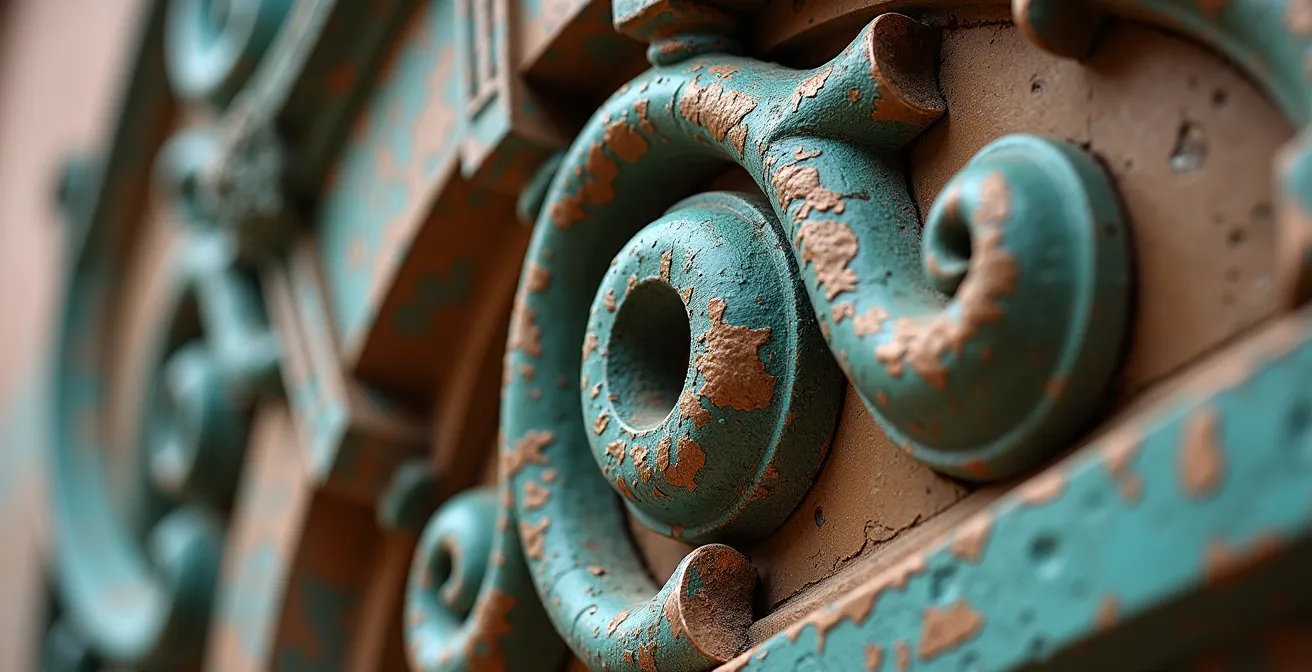
As the image above illustrates, the beauty is in the material and the form—the whiplash curves of a wrought-iron gate, the ceramic tiles framing a doorway, the carved wooden elements of a preserved mansion. To find these houses, you must look for the following signs:
- Wooden Mansions: Seek out authentic 19th-century wooden structures, often painted in soft pastels, which have been preserved in their original state.
- Urban Manors (‘Usadba’): Identify single-family homes rather than multi-story apartment buildings. They have a more intimate, personal scale.
- Art Nouveau Details: Spot ‘Style Moderne’ details on facades, entrances, and window frames—think curved lines and nature-inspired ornamentation.
- Houses with Gardens: Notice homes with small front or side gardens, creating rare pockets of green in the bustling city.
- Lower Building Profile: The classic merchant house is only one or two stories high, a stark contrast to the towering Soviet-era structures that often surround them.
Ostozhenka Street: How did it become the “Golden Mile” of Moscow?
Just northwest of Zamoskvorechye lies Ostozhenka Street, a name synonymous with modern Muscovite luxury. Dubbed the “Golden Mile,” it is now one of the most expensive residential streets in the world. At first glance, its gleaming contemporary architecture and high-end boutiques seem to be the antithesis of the pre-Soviet vibe. However, Ostozhenka offers a fascinating, if sometimes jarring, lesson in urban evolution. It is a prime example of an architectural dialogue between the 19th and 21st centuries.
Unlike Zamoskvorechye, which was largely preserved, Ostozhenka underwent a radical transformation in the post-Soviet era. Yet, its development didn’t completely erase the past. Instead, it often embraced a strategy known as “facadism”: preserving the historic 19th-century facade of a building while constructing a completely new, modern structure behind it. The result is a street where a delicate Art Nouveau frontispiece might be flanked by imposing glass and steel. For the architecture lover, this creates a unique, if controversial, visual tension.
This approach differs dramatically from the preservation strategies in cities like Paris, where historic districts are more strictly protected. The following comparison with Paris’s own “Golden Triangle” highlights the divergence.
| Feature | Ostozhenka (Moscow) | Avenue Montaigne (Paris) |
|---|---|---|
| Development Era | 21st-century luxury layer on 19th-century base | Consistent luxury since 19th century |
| Architectural Approach | Modern glass/steel beside preserved facades | Historically protected, minimal modern intrusion |
| Heritage Strategy | ‘Facadism’ – preserve front, rebuild behind | Full preservation of historic structures |
| Visual Impact | Stark dialogue between old and new | Harmonious historic continuity |
While some preservationists lament the loss of structural integrity, Ostozhenka’s “Golden Mile” provides a powerful case study in how a city grapples with its history while rushing towards the future. It may not be a peaceful Sunday walk, but it is an essential stop for understanding the economic and cultural forces that have shaped modern Moscow.
The secret courtyards of Chistye Prudy tourists never find
Beyond the main avenues and named streets, the true secret of Old Moscow lies within its courtyards, or dvors (дворы). These are not merely back alleys but semi-private, enclosed worlds that function as the city’s living rooms. The Chistye Prudy (Clean Ponds) area, known for its elegant boulevard and pond, is particularly rich with these hidden spaces. To find them, you must be willing to step off the beaten path and peer into the archways that punctuate the grand street-facing buildings.
Passing through an archway is like crossing a threshold. The city’s roar fades, replaced by a distinct “sound bubble” of domestic life—children playing, a distant piano, neighbors chatting. Here, the urban palimpsest is at its most vivid. You might see a 19th-century brick manor forming one side of the courtyard, a zigzagging Soviet-era fire escape on another, and contemporary playground equipment in the center. These courtyards are where Moscow’s layers of history cease to be abstract and become a tangible, lived-in reality.
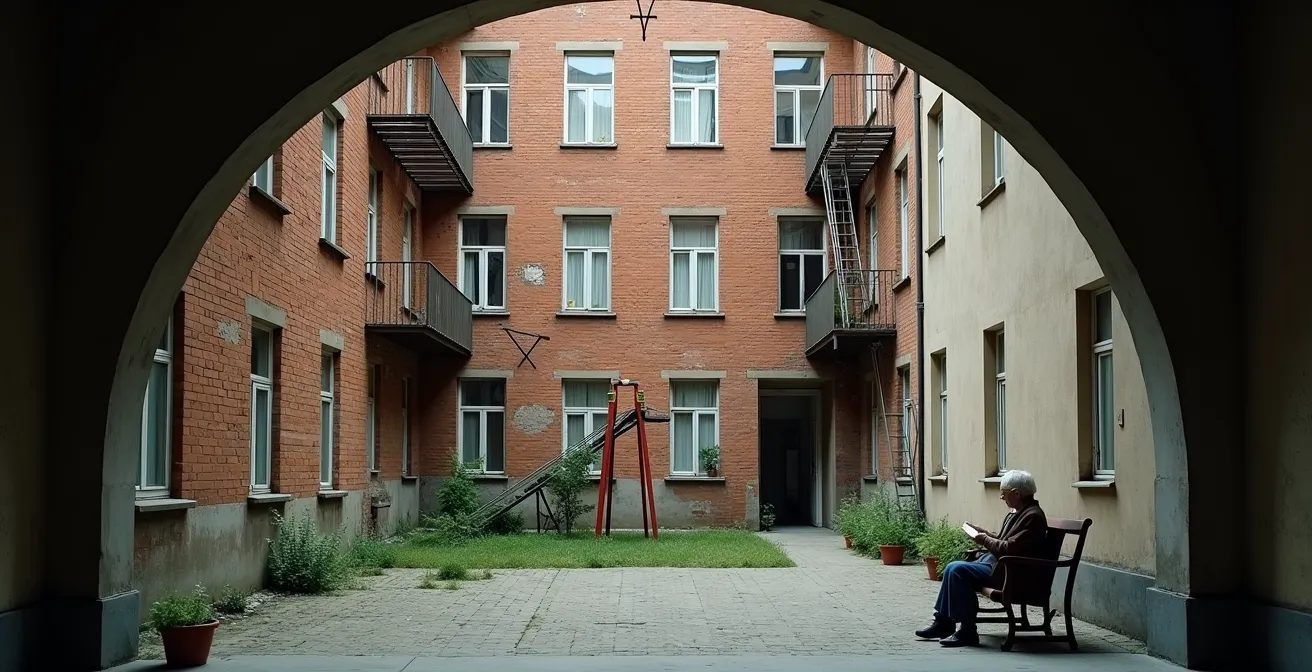
Discovering these dvors is an art, not a science, but certain principles apply across all of Moscow’s historic districts, from Chistye Prudy to Zamoskvorechye. They require a curious and observant eye.
- Enter Through Archways: Look for open passages and tunnels between buildings on the main streets. These are the public gateways to semi-private worlds.
- Explore on Foot: The best courtyards are found in districts with interconnected streets, like Zamoskvorechye’s 73 lanes or the web of alleys around Chistye Prudy.
- Notice Layers of History: Pay attention to how 19th-century main buildings have been augmented with Soviet-era extensions or modern additions within the courtyard space.
- Listen for the “Sound Bubble”: The acoustic shift from the loud street to the quiet courtyard is one of the most magical aspects of the experience.
- Use Metro Stations as Anchors: Start your explorations near historic metro stations like Novokuznetskaya (for Zamoskvorechye) or Chistye Prudy itself.
Walking the Patriarch’s Ponds: Following the steps of Bulgakov’s Master and Margarita
No literary work is more deeply woven into the fabric of Moscow than Mikhail Bulgakov’s The Master and Margarita. The novel’s unforgettable opening scene—where the devil appears to two literary men—is set at Patriarch’s Ponds, cementing this small, elegant park and its surrounding neighborhood as a site of pilgrimage. For the architecture lover, a walk here offers a unique blend of literary history, bohemian culture, and beautifully preserved pre-revolutionary buildings.
The area, technically part of the Presnensky district but spiritually tied to the Arbat’s intellectual culture, has evolved significantly. What was once a relatively quiet, intellectual neighborhood has become one of Moscow’s trendiest districts, brimming with fashionable restaurants and bars. Yet, it has not lost its soul. The transformation demonstrates how a city’s heritage can adapt and thrive, attracting a new generation of “intellectual visitors” who come seeking an authentic experience beyond the typical tourist trail. The pond itself remains the serene, contemplative heart of the district.
The walk around Patriarch’s Ponds is a lesson in atmosphere. The buildings are a handsome mix of Style Moderne apartment houses and earlier Neoclassical structures. Unlike the merchant manors of Zamoskvorechye, these were often built as upscale rental properties for the pre-revolutionary intelligentsia. As you stroll, it’s easy to imagine Berlioz and Ivan Bezdomny on that fateful bench, arguing about the existence of Jesus. The neighborhood is dotted with subtle and overt references to Bulgakov, from quirky statues to cafés named after characters. It’s a place where the physical architecture and the literary imagination are in constant dialogue.
The enduring appeal of Patriarch’s Ponds shows that a neighborhood’s “vibe” is a combination of its physical structures and the stories it holds. The buildings provide the stage, but it is the cultural memory, powerfully anchored by Bulgakov’s masterpiece, that gives the area its unique and haunting magic.
How to glimpse the avant-garde Melnikov House hidden behind Arbat?
Just a short walk from the bustling Arbat district, tucked away in a quiet lane, is one of the world’s most radical and important works of residential architecture: the Melnikov House. Built between 1927 and 1929, this interlocking pair of cylinders with its sixty hexagonal windows is a masterpiece of the Soviet avant-garde. It stands in stark opposition to the 19th-century classicism and Art Nouveau styles, offering a glimpse into a brief, explosive moment of utopian architectural experimentation that occurred just before the imposition of rigid Stalinist classicism.
Its architect, Konstantin Melnikov, was a visionary whose work was defined by a powerful and imaginative symbolism. While he designed famous public buildings, his own home was his most personal and revolutionary statement. As one analysis of his work notes, his philosophy was built on powerful visual statements.
Symbolic expression in construction was a feature in works designed by Konstantin Melnikov (1890–1974), notably the Rusakov Workers’ Club (1927–1929) in Moscow. Visually, the building resembles part of a gear; each of the three cantilevered concrete ‘teeth’ is a balcony of the main auditorium. The sharpness of its composition made it one of the most important examples of Soviet architecture.
– Wikipedia, Architecture of Russia
The Melnikov House applies this same imaginative force to a domestic space. It was an experiment in living, with open-plan spaces, carefully controlled light, and a structure that was both highly rational and deeply poetic. Finding it feels like a genuine discovery. Hidden on Krivoarbatsky Lane, it is not a building that announces itself. You must seek it out. Today it is a museum, but even viewing it from the outside is a profound experience. It represents a future that never quite happened, a testament to a brief period when Moscow was the global epicenter of architectural innovation.
Including the Melnikov House in a “pre-Soviet” tour might seem contradictory, but it is essential. It is a product of the early Soviet years, but its spirit is one of rebellion and artistic freedom—a final, brilliant flare of the pre-Stalinist era’s creative energy.
Savvinskoye Podvorye: How to find the building hidden behind Tverskaya?
Tverskaya Street is Moscow’s equivalent of the Champs-Élysées—a grand, wide boulevard lined with imposing Stalinist buildings. It feels a world away from the quaint lanes of the 19th century. Yet, hidden in a courtyard just behind the monolithic facade of Number 6 is one of the city’s most astonishing secrets: the Savvinskoye Podvorye. This ornate, fairy-tale-like building from 1907, a whimsical blend of Art Nouveau and pseudo-Russian styles, seems utterly out of place. And for good reason: it wasn’t originally here.
The story of the Savvinskoye Podvorye is a breathtaking tale of Soviet engineering and the sheer ambition of Stalin’s reconstruction of Moscow in the 1930s. To widen Tverskaya Street (then Gorky Street), entire buildings were demolished. Some, however, were deemed too valuable to destroy. The Podvorye, weighing an estimated 23,000 tons, was one of them. In 1939, in an almost unbelievable feat, engineers placed the entire building on rollers and, over one night, moved it 50 meters back from the street line. The most incredible detail? The residents were not evacuated and supposedly slept through the entire operation.
This event was part of a larger, audacious plan. As one historical account describes, the relocation of buildings was a key, if extreme, part of creating the new Moscow. The Savvinskoye Podvorye represents one of many buildings relocated during this period, moved on rails to make way for the monumental avenue we see today. Finding it requires you to walk down Tverskaya, pass through an archway next to the main Stalinist block, and step into the courtyard behind. The sudden appearance of its colorful, intricate facade is a moment of pure urban magic.
The Podvorye is more than just an architectural curiosity; it is a physical monument to Moscow’s turbulent 20th-century history. It is a pre-Soviet gem that survived by being hidden, a beautiful relic literally pushed into the background to make way for a new political and aesthetic order.
Key takeaways
- Moscow’s true pre-Soviet character is best found in the “domestic scale” of merchant districts like Zamoskvorechye, not around the monumental Kremlin.
- Learning to identify architectural details, like the “Style Moderne” (Art Nouveau) on facades, transforms a walk into an act of historical discovery.
- The city is an “urban palimpsest” where history is layered; exploring hidden courtyards (“dvors”) and seeking out moved buildings reveals the dramatic story of its survival.
Old Arbat walking tour: Avoiding the tourist kitsch to find history
The Old Arbat is perhaps the most famous street in Moscow after Red Square, and for many visitors, it is their primary experience of “Old Moscow.” A lively, mile-long pedestrian street, it is undeniably an experience, filled with street performers, portrait artists, and an endless array of souvenir shops selling matryoshka dolls and ushanka hats. But for the historian or architecture lover, this spectacle can be disappointing. The genuine history feels buried under a thick layer of commercial kitsch.
However, to dismiss the Arbat entirely would be a mistake. The key is not to avoid it, but to approach it with a strategy. The history is still there, but it resides in the side lanes and behind the brightly lit facades. This district was once the heart of Moscow’s nobility and intelligentsia, home to writers like Alexander Pushkin and Marina Tsvetaeva. Their homes, now museums, are located in the quiet alleys that run parallel to the main street.
The secret to an authentic Arbat experience is what I call the “Two-Lane Strategy.” It involves walking the street twice, with two different mindsets. This method allows you to acknowledge the modern spectacle while also discovering the deep historical roots that lie just beneath the surface.
Action Plan: The 2-Lane Strategy for an Authentic Arbat Experience
- First Walk (The Spectacle): Walk the length of the main Arbat Street. Embrace the energy. Watch the street performers, browse the souvenir stalls, and see the tourist-centric facade for what it is. This is the modern Arbat.
- Second Walk (The History): Return via the quiet, parallel alleys, specifically lanes like Sivtsev Vrazhek. This is where the real 19th-century atmosphere survives.
- Visit Authentic Spots: On your second walk, seek out institutions that maintain a high-culture atmosphere, such as the magnificent Vakhtangov Theatre, a beacon of artistic integrity amidst the kitsch.
- Find Literary Landmarks: Locate the memorial apartments of Pushkin and Tsvetaeva in these side lanes. These museums offer a powerful, intimate connection to the area’s intellectual past.
- Time Your Visit: To minimize the crowds and experience a more contemplative atmosphere, explore the Arbat in the early morning or late evening.
Ultimately, walking Old Moscow is an exercise in perception. It requires looking past the grand, obvious statements and tuning into the subtler whispers of history. By exploring its merchant lanes, its hidden courtyards, and the stories of its surviving buildings, you connect with a city far more complex and resilient than any postcard can convey. The next step is to take this mindset with you and start your own exploration, seeing the city not just for what it is, but for all the layers it has been.