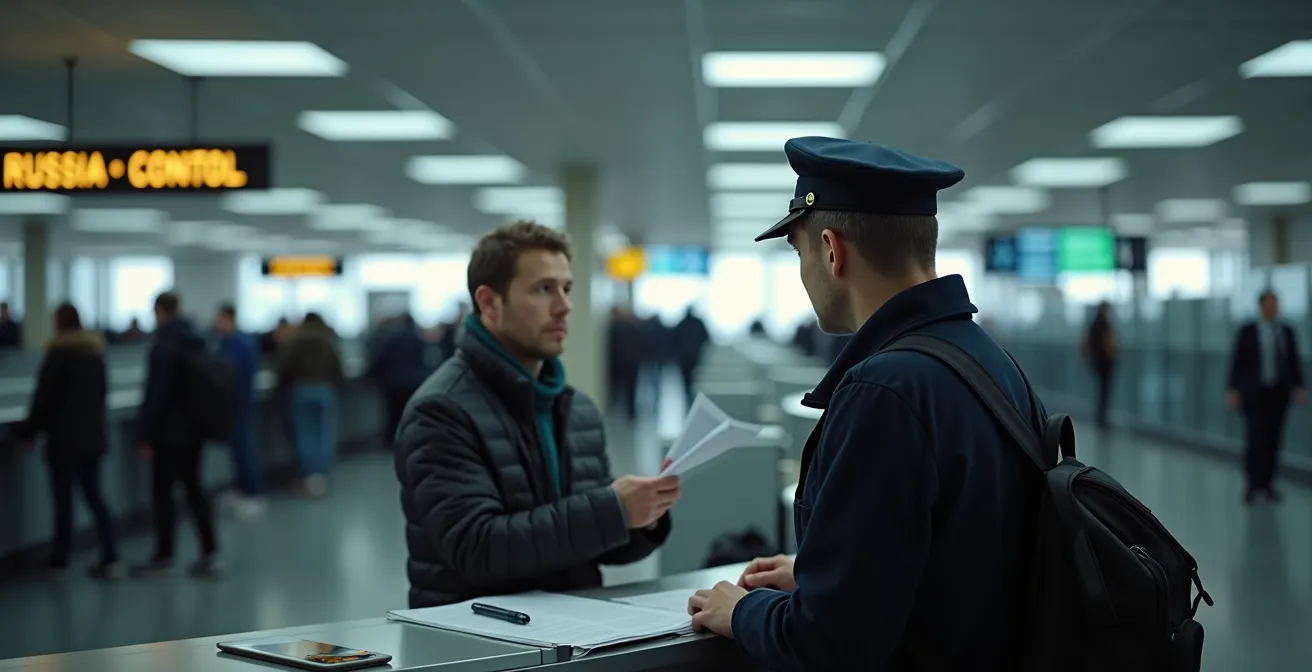
Forgetting your visa registration is not a minor oversight; it is a direct breach of Russian immigration law with consequences that go far beyond a simple fine at the border.
- Hotels handle this automatically and legally; private hosts (like Airbnb) are often unwilling or legally unable to, placing the burden and risk entirely on you.
- The “7-day rule” means seven business days, and the registration process is a significant legal imposition on a private host, not a simple favor.
Recommendation: For any stay in Russia over seven business days, the only risk-free and compliant option is booking a hotel that guarantees registration.
The cold sweat moment often arrives a day before departure. You’re enjoying a coffee in a trendy Moscow loft, booked via Airbnb, when a vague memory surfaces: something about visa registration. A quick search on a travel forum might yield dangerously comforting advice: “Don’t worry, it’s just a small fine,” or “I never did it and had no problems.” This is the worst possible information you could act upon. For French travellers, like all foreign nationals, underestimating this requirement is a critical error.
Let’s be unequivocally clear: Russian visa registration is not a travel hack to be bypassed or a quaint bureaucratic formality. It is a strict legal requirement enforced by the Main Directorate for Migration Affairs (GUVM). The leniency you might find on an online forum will not be present at the immigration counter. The belief that this is a simple issue to resolve is a fundamental misunderstanding of the system. The obligation is real, the process is rigid, and the consequences of non-compliance are severe.
This guide will not offer you loopholes or clever tricks. It will outline your non-negotiable obligations as a foreign guest and the stark legal and logistical reality of failing to comply. We will dissect the rules, clarify the immense difference between hotel and private stays, and provide a clear, compliance-focused path forward. Your trip to Russia ends when you successfully pass through exit control, and ensuring you meet every legal requirement is your sole responsibility.
To navigate this critical aspect of your travel, this article provides a structured breakdown of the rules, risks, and required actions. Understanding each component is essential for a legally compliant and stress-free departure from Russia.
Summary: Navigating Russian Visa Registration Compliance
- How to convince your Airbnb host to go to the post office for you?
- The 7-working-day rule: Do weekends count for visa registration?
- Do you need to carry the registration slip with you on the street?
- Do you need to re-register if you take a train to St. Petersburg?
- How to fill out the registration form at a Russian Post office?
- Why do hotels need your migration card to check you in?
- Does your Airbnb host legally register your visa for a 7-day stay?
- Modern lofts vs. Hotels: Which is better for a 1-week stay in Moscow?
How to convince your Airbnb host to go to the post office for you?
The question is framed incorrectly. It is not a matter of “convincing” but of compensating for a significant legal and logistical burden. A private host is not a hotel service desk. To register you, they must personally go to a designated post office or local migration office, fill out complex forms, and submit them. This is not a quick errand. For your host, this process can require them to take half a day off work to submit the request and wait about 20 days for processing. You are asking for a substantial personal and professional sacrifice.

Therefore, approaching this as a negotiation is essential. You must immediately offer to compensate them for their time and effort. A standard offer is 1500-2000 rubles (€20-25), in addition to covering all postal fees. You should also have a backup plan. Ask if they are willing to provide you with a letter of authorization, along with copies of their passport and property ownership documents, so you can attempt the process yourself. Be aware that this is also a significant request for sensitive personal documents.
A final, and often safer, alternative is to book your first one or two nights in a legitimate hotel. The hotel will perform the initial registration, covering you legally. You can then move to your Airbnb for the remainder of your stay. This strategy mitigates your risk and removes the immense pressure placed upon your private host.
The 7-working-day rule: Do weekends count for visa registration?
This is a point of critical importance where miscalculation leads to non-compliance. The law states that a foreign citizen must be registered within seven working days of their arrival in Russia. The key term is “working days.” The rule explicitly clarifies that the 7-business-day period starts from the day following arrival and excludes weekends (Saturdays and Sundays) and official Russian public holidays. This detail provides a small but crucial window for planning.
For example, if you are a French citizen arriving in Moscow on a Saturday for a short trip and you depart on the following Tuesday, you will not require registration. Your time in the country, for legal purposes, would only count Monday and Tuesday—well within the seven-day limit. This calculation is vital. You must have access to a calendar of Russian public holidays for the year of your travel to calculate your deadline accurately.
However, this rule should not be seen as a loophole to exploit. It is a precise legal definition. If your stay is eight business days, you are in breach of the law on the eighth day. There is no grace period. A common mistake is to count seven calendar days, arrive on a Monday, and assume you have until the following Monday. In reality, your deadline would be the end of the business day on Tuesday of the following week. Ignorance of this calculation is not a valid defense.
Do you need to carry the registration slip with you on the street?
The short answer is no, but the compliant answer is more nuanced. According to official sources, the police do not have the right to demand your registration certificate (the detachable part of the form, known as the ‘отрывная часть бланка уведомления’) during a routine stop on the street. When you exit Russia, immigration officers will only require your passport and visa; the registration slip is typically not requested at the border for departure. However, this does not mean the document is unimportant.
While you are not legally required to carry the original slip, you absolutely must be able to prove your legal status if questioned. A police stop, while uncommon for tourists, can happen. Not having any proof of your identity or legal entry can escalate a simple check into a lengthy and stressful visit to a local police station. The most prudent strategy is to carry digital copies of all essential documents.
This approach balances security with compliance. Your original, irreplaceable documents remain safe, while you retain the ability to immediately present clear evidence of your identity, visa, and registration status to an official. This simple preparation can de-escalate most situations instantly.
Your mandatory document carrying protocol
- Store clear, high-resolution photos of your passport (photo page), your Russian visa, your migration card, and your registration slip on your smartphone.
- Keep the original physical documents locked in a secure place, such as your hotel safe. Do not carry them while sightseeing.
- Make physical photocopies of all documents and keep one set separate from the originals as a backup.
- If stopped by police, remain calm, polite, and present the digital copies from your phone. This is usually sufficient to resolve any questions.
- Only carry physical documents during situations with heightened security, such as major public holidays, political events, or protests.
Do you need to re-register if you take a train to St. Petersburg?
Yes, under specific circumstances. The registration requirement is tied not only to your total time in the country but also to your location. The law is clear: the registration process must be repeated if a foreigner travels to a different city or region of Russia and intends to stay there for more than seven business days. This is a critical detail for travellers planning multi-city itineraries, such as the popular Moscow to St. Petersburg route.
If you are registered in Moscow and take a three-day trip to St. Petersburg before returning to Moscow, you do not need to re-register. Your primary registration in Moscow remains valid. However, if you travel to St. Petersburg and plan to stay there for eight business days or more, your host in St. Petersburg (whether a hotel or private individual) must register you with the local migration authorities there. Your Moscow registration becomes void for this new, extended stay in a different region.
This rule is confirmed by multiple official sources, including guidance from foreign embassies. For example, the U.S. Embassy in Russia explicitly states that the process must be repeated if a foreigner travels to a different region of Russia for more than seven days. Failure to re-register in a new city is the same as failing to register in the first place. Each extended stay in a new region resets the clock and the obligation.
How to fill out the registration form at a Russian Post office?
The process of filling out the Arrival Notification form (Уведомление о прибытии о прибытии иностранного гражданина или лица без гражданства в место пребывания) is meticulous and unforgiving. This is not a task to be taken lightly. Post office officials are trained to reject documents with even minor errors, and you will be sent away to start over. It is not an exaggeration to state that a person with no experience will require at least 45 minutes to fill out the form accurately.
You or your host must complete the form in Russian, using capital letters, with one letter per box. Absolute precision is required. Your name, for instance, must be written in Latin characters exactly as it appears in the machine-readable zone at the bottom of your passport photo page, not as it is printed in the main section. For nationality (‘Гражданство’), a French citizen must write ‘Франция’.
To even begin this process, your host must bring a folder of documents: the originals and copies of their own passport and property ownership documents, as well as the originals and copies of your passport, visa, and migration card. You cannot simply show up alone. Without the host and their documents, the post office will not accept the notification. The phrase to use at the counter is ‘Мне нужно отправить уведомление о регистрации’ (Mnye nuzhna atpravit’ uvedomleniye o registratsii). Be prepared for a long wait and intense scrutiny.
Why do hotels need your migration card to check you in?
A hotel’s request for your passport, visa, and migration card is not a mere internal policy; it is the first step in fulfilling their legal obligation to register you. The migration card you receive at the airport is the foundational document of your legal presence in Russia. Without it, a hotel cannot and will not check you in, because they would be unable to legally register your stay with the authorities.

Upon your arrival at the hotel, the front desk staff will execute a professional and systematic process. They will take your passport, your visa, and your migration card. They will make copies of all three documents and return the originals to you. This is the information they are legally required to submit to the local migration office within one business day of your check-in. This seamless procedure is a core part of the service they provide and is mandated by law.
This is the fundamental difference between a hotel and a private stay. Hotels are accredited entities with a streamlined, digital process for registering guests. They do this for hundreds of guests a week. A private Airbnb host has no such system. The migration card is your proof of legal entry, and the hotel uses it to officially log your place of residence. Losing this card is a major issue, as you cannot legally exit the country without it.
Does your Airbnb host legally register your visa for a 7-day stay?
It is highly unlikely, and you must operate under the assumption that they will not. The term “host” on Airbnb is a broad one. It can range from a professional property management company to an individual renting out a spare room. The vast majority of these individuals are not “accredited entities” with the authority or knowledge to handle visa registrations. Many are not even aware of this legal obligation for their foreign guests. In a case documented by a traveller, they had to pay their Moscow apartment host 1700 rubles (about €30) per person for documents and were forced to list a random hotel on their visa application, which is a fraudulent act.
You cannot simply book a private loft and assume this critical legal step will be handled. The burden of verification is entirely on you, and it must be done before you book. You must contact the host directly and ask a very specific question: “I am a French citizen and will require official visa registration (регистрация). Are you able and willing to provide this service and give me the official registration slip (‘отрывная часть бланка уведомления’)?”
If they hesitate, seem confused, or say “it’s not necessary,” this is an immediate red flag. It means they either do not know how to do it or are unwilling to undertake the significant effort involved. Some may offer to help but have no idea of the real process. A verbal “yes” is not enough. You must have a clear, written confirmation of their ability and willingness to complete this legal procedure on your behalf.
Key takeaways
- Visa registration is a mandatory legal obligation, not an optional formality. Failure to comply is a breach of immigration law.
- Hotels offer guaranteed, automatic, and legally compliant registration. Stays in private accommodations like Airbnb carry a high risk of non-compliance.
- The “7-day rule” refers strictly to business days (excluding weekends and holidays), and the registration process is a major time and legal burden for a private host.
Modern lofts vs. Hotels: Which is better for a 1-week stay in Moscow?
For a French traveler on a tourist visa staying in Russia for more than seven business days, the choice between a modern loft and a hotel is not a question of style or comfort. It is a question of legal compliance and risk management. From a purely legal standpoint, a hotel is unequivocally the superior and only safe choice. The reason is simple: hotels guarantee visa registration; private hosts do not.
While an Airbnb or a private loft may offer a more “authentic” or spacious experience, it introduces a massive variable into your legal status: a host who is likely unfamiliar with, unwilling to, or legally incapable of registering you. As one traveler reported, their host was willing to help, but another had to pay their host a significant sum for documents and list a fraudulent address on their application. This is a precarious situation that rests entirely on the goodwill and knowledge of a private individual.
In contrast, a hotel is a legally accredited entity with a non-negotiable duty to register you. The process is automatic, professional, and included as part of your stay. This removes 100% of the risk, stress, and uncertainty from the equation. The small fee a hotel might charge (typically €3-5) is insignificant compared to the potential fines, legal trouble, or compensation you might have to offer a private host (€25-35 or more).
The following table breaks down the critical differences for a French traveler concerned with legal compliance. The choice becomes self-evident when risk is the primary consideration.
| Aspect | Hotels | Airbnb/Lofts |
|---|---|---|
| Registration Process | Automatic within 1 business day | Host may need to visit post office personally |
| Legal Compliance | 100% guaranteed by law | Depends on host’s willingness and knowledge |
| Additional Cost | Free or minimal fee (€3-5) | May need to compensate host (€25-35) |
| Documentation Provided | Official registration slip guaranteed | May not receive proper documentation |
| Risk Level for 7+ day stays | Low – hotel handles everything | High – potential registration issues |
| French Embassy Recommendation | Strongly advised | Not specifically recommended |
Do not gamble with your travel status and risk a fine, deportation, or future entry ban. If your stay exceeds seven business days, your only compliant course of action is to secure accommodation with a hotel that provides guaranteed visa registration.