
Successfully navigating Russian immigration is less about fear and more about understanding the procedural logic behind the officer’s questions.
- Your documents (passport, visa, migration card) must tell a perfectly consistent story about the purpose and duration of your visit.
- Slow processing is often due to systematic checks like biometrics, not personal suspicion. Calm, patient compliance is your best strategy.
Recommendation: Treat every step, from checking your entry stamp to declaring your purpose of visit, as a legal formality. This mindset shifts anxiety into confident, informed preparation.
The image of a stern Russian border guard in a stoic grey booth is a potent one, capable of unnerving even seasoned travelers. For a French citizen visiting for the first time, this apprehension can feel overwhelming. You’ve likely heard the common advice: have your papers ready, be polite, answer briefly. While true, this advice only scratches the surface. It tells you *what* to do, but not *why*, leaving you to guess at the motivations behind the questions and procedures.
As an immigration lawyer, I can tell you that the key to a smooth entry is not just obedience, but informed compliance. The process is not arbitrary; it is a sequence of legal and security checks, each with a specific purpose. Understanding this “procedural logic” is the most powerful tool you have to transform anxiety into confidence. It’s about recognizing that the officer is not trying to trick you, but to verify that your journey complies with Russian federal law. This is the jurisdictional shift: the moment you are at that counter, your documents and answers must align perfectly with the visa you were granted.
This guide will move beyond generic tips. We will dissect the most common and challenging aspects of the Russian immigration check, from the slow-moving queues at Sheremetyevo (SVO) to the critical importance of the entry stamp. We will explore the high-stakes question of your “purpose of visit” and what to do if you are a dual Franco-Russian national. By demystifying the process, we will prepare you not just to answer questions, but to understand the system you are entering, ensuring your arrival in Russia is as smooth and stress-free as possible.
To navigate these crucial steps with clarity, this article breaks down each stage of the immigration process you will face upon landing.
Summary: Your Guide to Russian Immigration Procedures
- Why is the queue for foreigners so slow at SVO?
- Purpose of visit: Why you should never say “Journalism” if you have a tourist visa?
- Why you must check the entry date stamp immediately after passing?
- Entering with two passports: Which one to show if you are Franco-Russian?
- What happens if you are asked to wait in a separate room?
- How many days in advance should a French citizen apply for a visa?
- Why do hotels need your migration card to check you in?
- How to transfer between Terminal B and C at Sheremetyevo without exiting?
Why Is the Queue for Foreigners so Slow at SVO?
Your first test of patience at a Moscow airport like Sheremetyevo (SVO) will be the immigration line. The perception is that the delay is due to intense, individual scrutiny. While officers are diligent, the primary reason for the slow pace is systemic and technological, not personal. The key is understanding that this is a procedural delay, not a sign that you are under suspicion. Knowing this helps you manage your anxiety and maintain a calm demeanor, which is crucial.
A major factor is the implementation of enhanced security protocols. This is a direct result of mandatory biometric registration, including fingerprints and facial recognition, for all foreign nationals entering through Moscow’s airports since December 1, 2024. This data collection process is methodical and adds several minutes to each person’s interaction. Furthermore, officers may perform identity checks and, in some cases, request to inspect electronic devices, which can extend wait times significantly. These are standard procedures applied broadly, not just to you.
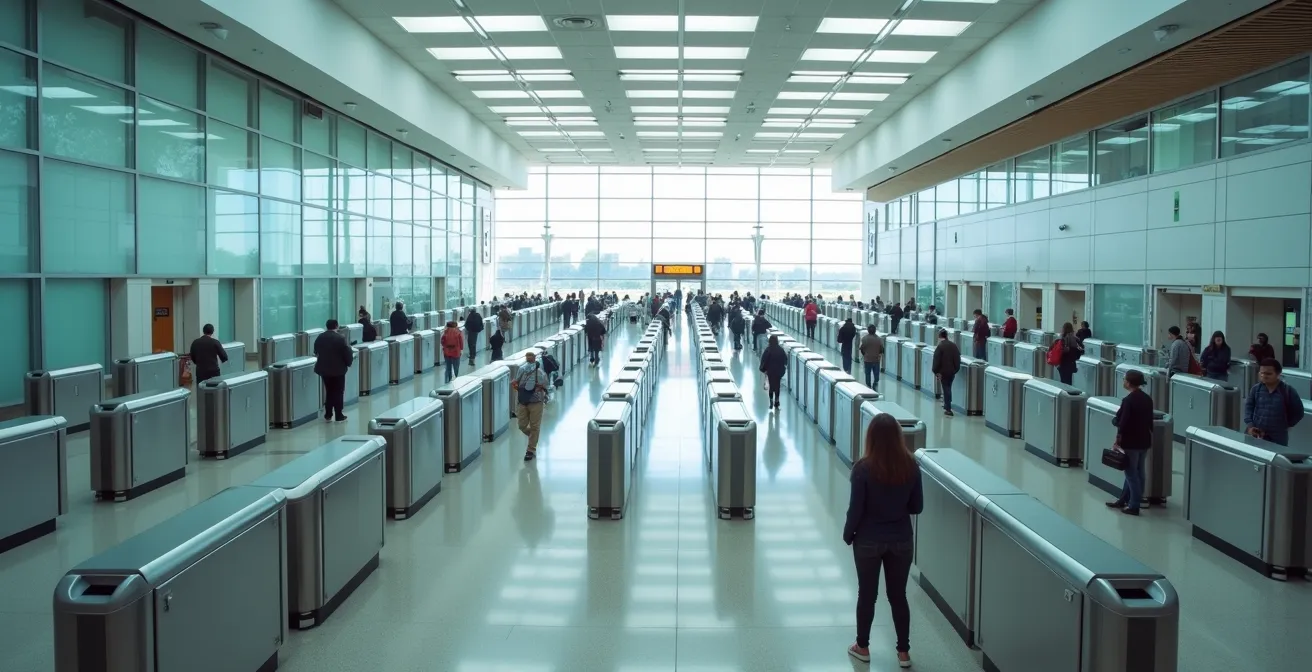
As the image above illustrates, the process is highly organized. The best way to navigate it is to be prepared. Have your passport, visa, and a filled-out migration card (if provided on the flight) in your hand long before you reach the counter. Avoid using your phone in the queue, as it can be seen as disrespectful or suspicious. Project patience. The officer is processing hundreds of people and appreciates travelers who make their job more efficient. A minimum of two hours for this process is a safe buffer if you have a connecting flight.
Purpose of Visit: Why You Should Never Say “Journalism” if You Have a Tourist Visa?
After the wait, you will face the most critical verbal exchange of your entry process: answering the officer’s questions. The most important of these is about your “purpose of visit.” Your answer must align perfectly with the visa category stated in your passport. There is zero room for ambiguity. If you hold a tourist visa, you are a tourist. Stating any other purpose, especially one related to work like “journalism,” “business meetings,” or “research,” is a direct violation of visa law and a red flag for immediate refusal of entry.
This principle is known as documentary integrity. The story told by your documents (a tourist visa) must match the story you tell verbally. Any discrepancy, however innocent it seems to you, breaks this integrity and signals a potential misrepresentation of your intentions to the authorities. Russian authorities are particularly sensitive to foreign media activities and political engagement. As The Moscow Times advises, the questions are designed to quickly categorize you.
Questions may include the purpose of your visit, your place of stay, your occupation and whether you have traveled to Ukraine.
– The Moscow Times Editorial, The Moscow Times – Travel Guide to Russia
The consequences of a mismatch are severe, as official government advisories make clear. It is not a matter for debate or persuasion at the border; the officer’s decision is final.
UK Government Advisory on Entry Questioning
British nationals have reported being stopped at the Russian border and questioned about their political views or contacts with Ukraine and Ukrainians. The UK government warns that some travelers have been denied entry for activities the Russian authorities deem to be against Russian interests—even if those activities occurred outside of Russia. Officials stress they cannot interfere in Russian immigration decisions, highlighting the finality of a border officer’s judgment.
Your answer should be simple, confident, and truthful within the scope of your visa: “Tourism.” If asked for details, mention the cities you plan to see (e.g., “Visiting museums in Moscow and St. Petersburg”). This demonstrates clear intent that matches your legal status as a tourist.
Why You Must Check the Entry Date Stamp Immediately After Passing?
Once the officer is satisfied, they will stamp your passport and your migration card. In that brief moment of relief, many travelers rush away from the counter. This is a critical mistake. The single most important action you must take before leaving the immigration booth is to immediately verify the entry date stamp on both documents. An incorrect date is not a minor clerical error; it is a legal time bomb that can lead to severe consequences, including fines and future travel bans.
Your visa and migration card dictate the maximum legal duration of your stay. The entry stamp starts this clock. If the officer accidentally stamps the wrong date, your legal period of stay could be incorrectly calculated, making you an “overstayer” in the eyes of the law without you even knowing it. The burden of proof is on you, and correcting this error becomes nearly impossible once you have left the immigration zone. The penalties for overstaying are not taken lightly; as stated in updated Russian immigration enforcement policies, foreign nationals who exceed their legal stay can face mandatory deportation and a re-entry ban.
Therefore, inspecting the stamp is not optional; it is a mandatory act of self-protection. If you find an error, you must address it on the spot. Here is the exact procedure to follow to handle this delicate situation without causing alarm.
Action Plan: Verifying Your Entry Stamp
- Before leaving the immigration counter, verify the date stamp on both your passport AND migration card match the current date exactly.
- If you spot an error, immediately alert the officer by politely saying ‘Izvinite, pozhaluysta’ (Excuse me, please). DO NOT leave the immigration area.
- Point to the incorrect date and clearly say ‘Oshibka v date’ (Mistake in the date) while showing both documents.
- After correction, take a clear photo of your correctly stamped migration card for your personal records as a backup.
- Keep the physical migration card safe with your passport throughout your stay; it is required for hotel registration and to exit Russia.
Entering With Two Passports: Which One to Show if You Are Franco-Russian?
For French citizens who also hold Russian citizenship, navigating border control involves an additional layer of complexity. It’s a common point of confusion: which passport should you present, and when? The answer is governed by a strict legal principle: Russia considers its citizens as exclusively Russian while on its territory. This means you must enter and exit Russia using your Russian passport. Attempting to enter on your French passport as a Russian citizen can lead to significant delays, questioning, and potential fines.
This is not a matter of choice but a legal obligation. The process requires you to strategically use both passports at different stages of your journey from France to Russia. Your French passport proves your right to return to the Schengen Area, while your Russian passport proves your right to enter Russia. Mismanaging this sequence can create complications at every checkpoint.
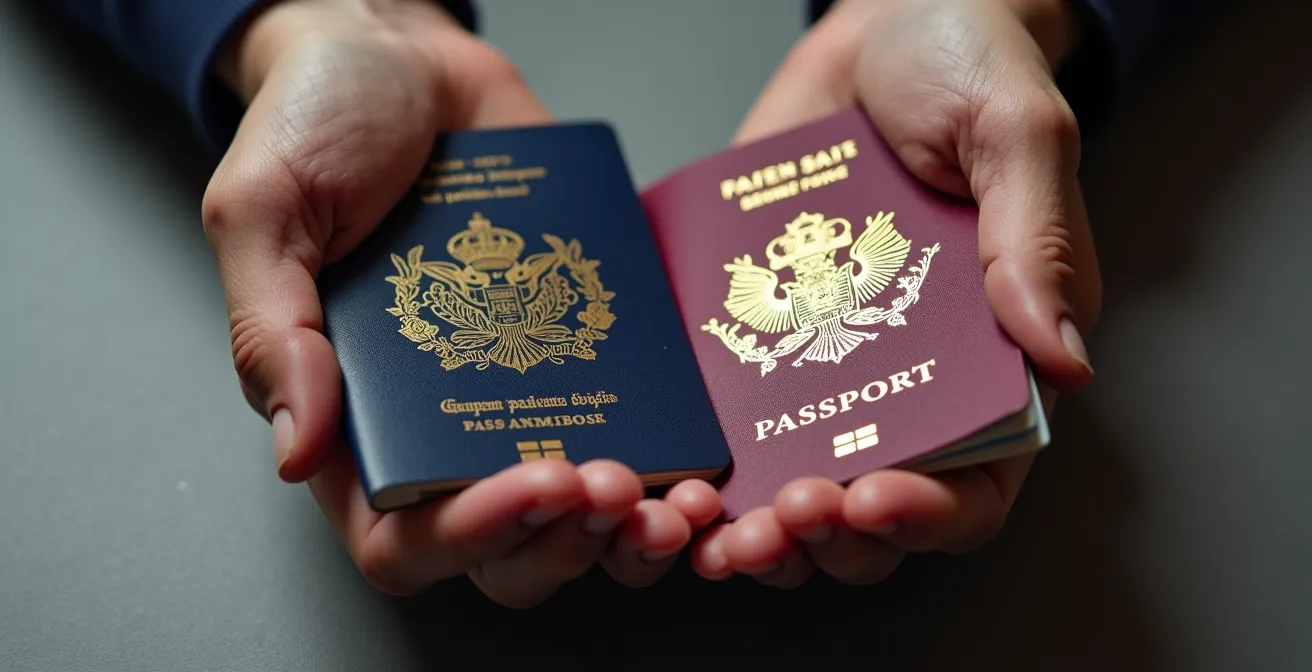
To ensure a seamless experience, you must present the correct document at each specific control point. The logic is to satisfy the legal requirements of the jurisdiction you are currently in. When leaving France, you are an EU citizen. When entering Russia, you are a Russian citizen. The following table breaks down the precise protocol.
| Location | Passport to Show | Legal Requirement |
|---|---|---|
| Check-in France | Both passports | Prove entry to Russia + return to EU |
| French Exit Control | French passport | EU citizen right to exit |
| Russian Entry Control | Russian passport ONLY | Mandatory by Russian law |
| Russian Exit Control | Russian passport | Must exit on same document |
| French Re-entry | French passport | EU citizen right to enter |
What Happens if You Are Asked to Wait in a Separate Room?
Of all the potential scenarios at immigration, being gestured towards a separate room for “secondary inspection” is perhaps the most anxiety-inducing. Your mind might race with worst-case scenarios. However, from a procedural standpoint, this is often a routine administrative step. It does not automatically mean you are suspected of wrongdoing. The key is to remain calm, compliant, and prepared.
There are several reasons you might be asked to wait: a need to verify your visa details with a supervisor, a random spot check, a system slowdown, or a question about your documents that the frontline officer is not authorized to resolve. The process is designed to handle exceptions without holding up the main queue. Panicking or becoming confrontational is the worst possible response; it will only escalate the situation. Instead, you should follow the officer’s instructions quietly and wait patiently. Do not use your phone unless you are given explicit permission to do so.
Real-world experiences show that these checks, while unnerving, often resolve without any major issue for legitimate travelers. The goal is simply to get additional verification.
A British Traveler’s Experience at SVO Secondary Screening
A British citizen arriving at Moscow SVO reported being asked to wait for about one hour while officers “checked the passport,” in addition to answering standard questions about their hotel booking and return flight. The traveler was not questioned further and was not required to fill out any additional forms. Upon their departure from another Moscow airport, passport control took only a couple of minutes with no questions asked. This common experience illustrates that secondary checks can be lengthy but are often a standard procedure that resolves without incident.
To expedite the process, have a folder with all your travel documents ready: your passport, visa, migration card, printed hotel confirmations for your entire stay, your return flight ticket, and proof of travel insurance. When an officer eventually speaks with you, presenting a well-organized file demonstrates preparedness and transparency, contributing to a quicker resolution.
How Many Days in Advance Should a French Citizen Apply for a Visa?
A smooth immigration experience in Russia begins long before you arrive at the airport; it starts with a timely and correctly filed visa application in France. Underestimating the processing time is a common mistake that creates unnecessary stress and can jeopardize your entire trip. The official timelines are often just a baseline, and various factors can cause significant delays.
As a French citizen, you can apply at a Russian visa center in Paris, Marseille, or Strasbourg. While standard processing is often cited as 15 calendar days, this is the best-case scenario. Russian consulates have been known to have longer-than-expected processing times, especially during peak travel seasons or due to public holidays in either France or Russia. For this reason, relying on the minimum timeline is unwise. Current data suggests a much wider window is more realistic; you should expect a processing time of 15 to 45 days in some cases.
To eliminate stress, the most prudent legal advice is to apply far in advance. A buffer period is not a luxury; it’s a necessity. You must account for the time it takes to first obtain your tourist invitation or voucher (which can take a couple of days), secure an appointment at the visa center, the processing itself, and any potential postal delays if you are not collecting it in person. A conservative and safe timeline is to apply at least 6 to 8 weeks before your planned departure date. Applying 3 months in advance is the gold standard for peace of mind.
Why Do Hotels Need Your Migration Card to Check You In?
Upon arriving at your hotel, you might be surprised when the receptionist insists on taking both your passport and your migration card for registration. This is not a hotel policy; it is a legal requirement mandated by Russian federal law. Every foreign visitor must be registered with the local migration authorities, and your hotel is legally responsible for completing this process on your behalf. Failure to comply can result in heavy fines for the hotel and significant legal problems for you.
The law states that this registration must be completed within a specific timeframe. The hotel is obligated to register you within the legal deadline of 7 working days of your arrival in that city. Your migration card, with its crucial entry stamp, is the primary document that proves when you legally entered the country and starts the clock on this registration period. Without it, the hotel cannot fulfill its legal duty, and you cannot be legally registered as staying there.
This is why protecting your migration card is as important as protecting your passport. Losing it can create a bureaucratic nightmare. The process of obtaining a replacement is complex and time-consuming, and during that period, you are technically an unregistered, and therefore illegal, visitor. A real-world case illustrates just how serious the consequences can be, reinforcing why hotels are so strict about this procedure.
After the hotel completes the registration, they will return your migration card along with a separate registration slip. You should keep both of these documents with your passport until you leave the country. While you may not be asked for the registration slip again, you absolutely will need the migration card to exit Russia. You cannot pass exit passport control without surrendering it.
Key Takeaways
- Your visa is not a suggestion; your stated purpose of visit must match your visa type exactly. “Tourism” means tourism only.
- The entry date stamp on your passport and migration card is legally binding. Verify it for accuracy before leaving the immigration booth.
- Your migration card is a critical legal document. It is required for hotel registration and to exit the country. Guard it as you would your passport.
How to Transfer Between Terminal B and C at Sheremetyevo Without Exiting?
Navigating a large international airport like Sheremetyevo can be a source of anxiety, especially when you have a connecting flight from a different terminal. A common concern for travelers is whether they will need to exit the secure zone and pass through immigration again to make their connection. For many common transfers at SVO, such as between the modern Terminals B and C, this is fortunately not the case. The airport is designed with an “airside” transit system specifically to avoid this hassle.
If you are transferring from one international flight to another within the northern terminal complex (which includes B and C), you can remain within the international transit zone. The key is to follow the signs for “Inter-terminal Passage” immediately after you deplane. Do not follow the signs for “Arrivals” or “Baggage Claim,” as this will lead you to immigration control. The airside connection is facilitated by an underground Automated Passenger Mover (APM) train, a quick and efficient system that shuttles passengers between terminals in minutes.
This distinction between airside and landside transfers is crucial. Different connections have different requirements, and it’s vital to know which applies to you to avoid unnecessary stress or a missed flight. The table below clarifies the most common transfer scenarios at SVO.
| Transfer Type | Method | Duration | Immigration Required? |
|---|---|---|---|
| International to International (B-C) | Underground APM train | 4 minutes | No – remains airside |
| North to South terminals | Complimentary bus service | 15-20 minutes | Depends on flight type |
| Domestic to International | Various | Varies | Yes – must clear immigration |
| Walking within terminal area | Internal corridors | 5-15 minutes | No |
For a direct, stress-free transfer from Terminal B to C, the process is simple: deplane, follow the signs for inter-terminal transit, take the 4-minute APM train ride, and proceed to your next gate, all without ever seeing a passport control booth. This final piece of practical knowledge helps ensure your journey through Russia is smooth from start to finish.
To put these legal and procedural insights into practice, the next logical step is to meticulously organize your travel documents into a dedicated folder, ensuring every piece of paper—from your visa to your hotel bookings—is printed and ready for inspection. This preparation is your final and most important act of de-escalation.
Frequently Asked Questions on Russian Immigration
How long does secondary inspection typically take?
Wait times vary from 20 minutes to several hours. One traveler reported waiting about 20 minutes at immigration with no questions asked, while others experienced longer delays for document verification.
Can I use my phone while waiting?
Do not use your phone unless given explicit permission. Keep it switched on but in your pocket, as officers may request to inspect it.
What documents should I have ready?
Keep your passport, visa, migration card, hotel bookings, return ticket, and travel insurance easily accessible. Having everything organized speeds up the verification process.