In summary:
- Look for “Stolovaya” (столовая) signs to find authentic, low-cost Soviet-style canteens.
- Evaluate specialized sites like the Taganka Cold War Bunker based on their specific, theatrical experiences versus historical displays.
- Focus on specific metro stations like Mayakovskaya, Kiyevskaya, and Komsomolskaya for the most impressive propaganda art.
- Prioritize flea markets like Vernissage for authentic memorabilia, but use an authentication guide to avoid fakes.
- Understand that major landmarks like the “Seven Sisters” skyscrapers were built as ideological statements against the West.
For many, Moscow’s Soviet history is confined to the grandeur of Red Square, the stoic Kremlin walls, and the iconic onion domes of St. Basil’s. This postcard image, while powerful, only scratches the surface of a much deeper and more complex story. History buffs and nostalgia seekers often arrive looking for the hammer and sickle aesthetic but find it either commercialized or hidden in plain sight, its original meaning lost to time. The usual travel advice points to the main attractions, leaving a thirst for something more authentic unquenched.
The real legacy of the USSR isn’t just in monumental landmarks; it’s a city-wide ideological blueprint. But if the key to understanding this era isn’t just about seeing the sights, but learning how to *read* them? What if every metro mosaic, every skyscraper, and even every canteen menu was a deliberate piece of a larger narrative? This article moves beyond the tourist trails to reveal how to decode the materialised ideology of the Soviet Union. We will explore not just where to go, but how to interpret what you see, turning your visit into a historical investigation.
This guide will equip you to navigate Moscow like a historian, uncovering the tangible remnants of a future that never happened. We will delve into the art, architecture, and daily life that defined the Soviet experience, providing the tools to see the city not as a museum, but as a living palimpsest of ambition, propaganda, and memory.
Summary: A Guide to Moscow’s Soviet Past
- How to eat in a Soviet-style canteen for under €3 today?
- Is the Taganka Cold War Bunker worth the €40 entrance fee?
- Which 3 metro stations have the most impressive propaganda mosaics?
- Dry Bridge vs. Vernissage: Where to find real Soviet watches?
- Worker and Kolkhoz Woman: Why is this statue an icon of Mosfilm?
- The 24 hours of Soviet Sky: How to read the ceiling domes of Mayakovskaya?
- Why did Stalin build 7 identical skyscrapers across the city?
- Why do Soviet mosaics depict a future that never happened?
How to eat in a Soviet-style canteen for under €3 today?
One of the most immersive ways to experience the Soviet past is through its food culture, specifically within a *stolovaya* (столовая), or dining hall. These are not trendy retro-themed restaurants but functional canteens that have preserved the model of affordable, state-subsidised meals. For less than the price of a coffee in Western Europe, you can have a full three-course meal, providing a genuine taste of Soviet-era daily life. The key is knowing how to spot an authentic one from a modern imitation. An authentic stolovaya is defined by its self-service cafeteria format, where diners take a tray and queue past various stations offering salads, soups, main courses, and desserts.
The pricing structure is a direct holdover from the Soviet system, with each item priced individually. A bowl of borscht might cost less than 70 rubles (€0.70), and a main dish like *kotleta* (a meat patty) with buckwheat could be around 150 rubles (€1.50). Beyond the food, the décor is a crucial indicator. Look for utilitarian furniture, propaganda posters, and sometimes even an abacus at the checkout counter. Famous examples include Stolovaya 57 in the GUM department store, but many authentic gems are found near factories or administrative buildings, having served the same local workforce for decades.
Finding these places requires looking for the Cyrillic word ‘Столовая’ on unassuming building fronts. The experience is a stark contrast to a typical restaurant; it is fast, efficient, and fundamentally communal. It’s a culinary journey back in time, offering a direct connection to the everyday realities of Soviet citizens. To ensure you’re in the right place, listen for the traditional call from the staff: “Next order, please!” It’s a small detail that confirms you’ve stepped into a genuine piece of living history.
Is the Taganka Cold War Bunker worth the €40 entrance fee?
For those fascinated by the Cold War’s nuclear paranoia, Moscow’s Bunker-42, located at Taganka, presents a compelling proposition. This sprawling 7,000-square-meter facility, buried 65 meters beneath the city, was once a top-secret Soviet communications centre. However, its €40 entrance fee often raises the question of its value, especially when compared to similar historical sites. The answer depends entirely on what the visitor is seeking: a technical-military history lesson or a theatrical, immersive experience. The Taganka bunker heavily leans towards the latter.
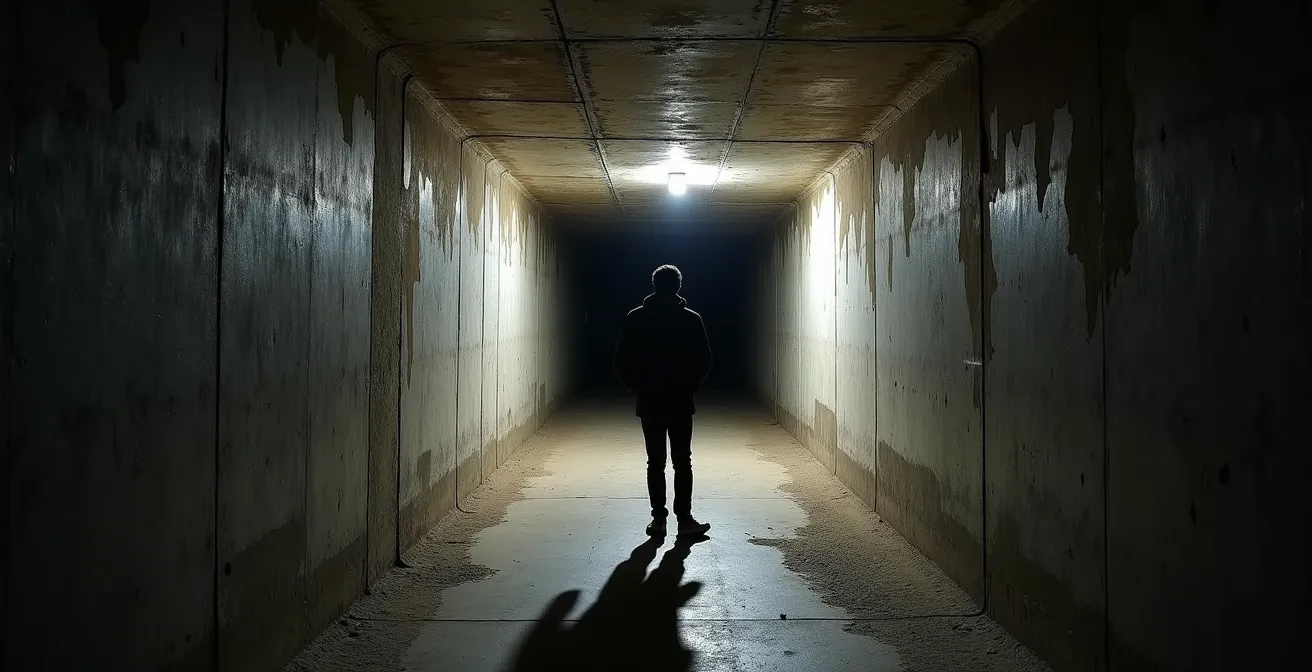
Unlike many preserved military sites in Europe, such as France’s former *Force de frappe* command posts, Bunker-42 focuses on interactive drama. Tours often culminate in a simulated nuclear missile launch, complete with flashing lights, sirens, and actors in Soviet uniforms. This approach prioritizes atmosphere and entertainment over a dry presentation of facts. The sheer scale and depth of the declassified 1950s facility are undeniably impressive, offering a visceral sense of the immense resources poured into nuclear preparedness. The long, oppressive concrete corridors provide a powerful metaphor for the era’s psychological weight.
The comparison with French Cold War sites highlights this difference in philosophy. French sites are typically smaller, cheaper to enter (€10-€20 on average), and maintain a stronger focus on the technical and strategic aspects of nuclear deterrence. They offer a more sterile, museum-like experience. The table below illustrates the key distinctions:
| Feature | Bunker-42 (Moscow) | French Cold War Sites |
|---|---|---|
| Depth | 65 meters (213 feet) underground | Varies (20-40 meters typical) |
| Original Purpose | Soviet communications center | Force de frappe command posts |
| Size | 7,000 square meters | Smaller facilities |
| Experience Type | Interactive/theatrical with missile launch simulation | Technical/military focus |
| Entry Cost | €40 (guided tour) | €10-20 average |
| Authenticity | Declassified 1950s facility | Preserved military sites |
Ultimately, Bunker-42 is worth the price for those who want to *feel* the Cold War tension rather than just learn about it. It is less a museum and more a piece of historical theatre. For history buffs seeking pure technical detail, the cost may seem high, but for an unforgettable, atmospheric descent into the heart of Soviet paranoia, it delivers a unique and memorable experience.
Which 3 metro stations have the most impressive propaganda mosaics?
The Moscow Metro is often called an “underground palace,” but it is more accurately an art gallery dedicated to Soviet ideology. While many stations are beautiful, a few stand out for their breathtaking propaganda mosaics that narrate the nation’s story. For the most impactful experience, history buffs should prioritize Mayakovskaya, Kiyevskaya, and Komsomolskaya stations. Each represents a different facet of Soviet artistic and political ambition. Mayakovskaya, opened in 1938, is a masterpiece of pre-war Stalinist Art Deco. Its ceiling is adorned with 34 mosaics by Alexander Deineka titled “A Day in the Soviet Sky,” depicting an idealized vision of peaceful, prosperous life under Soviet power, from parachutists to joyful athletes. This station even served as a bomb shelter where Stalin himself delivered speeches during WWII.
Kiyevskaya (on the Circle Line) offers a different narrative. Completed in 1954 under Khrushchev, its ornate mosaics celebrate the 300th anniversary of the “reunification” of Russia and Ukraine. The 18 panels depict scenes of friendship, shared labour, and cultural exchange between the two peoples. Today, these images carry a heavy, poignant irony, transforming the station from a celebration of unity into a historical document of a relationship now fractured. They are a powerful reminder of how political art’s meaning can shift dramatically with time.
Finally, Komsomolskaya (Circle Line) is the apotheosis of Stalinist grandeur. Its theme is Russian military glory and patriotism. The vast yellow ceiling is punctuated by eight massive mosaics depicting national heroes like Alexander Nevsky and Dmitry Donskoy, culminating in a portrayal of Soviet soldiers at the Reichstag in 1945. The message is clear: the Soviet state is the rightful heir to a long history of Russian strength. As architecture historian Nikolai Vassiliev notes, these historical stations remain central to the city’s identity. In an interview with CityLab, he explains their enduring power:
For today’s typical Metro user, the modern stations prevail as the standard image of the system. But the historical stations still play a very special role in the city’s image, like its Stalin-era skyscrapers
– Nikolai Vassiliev, CityLab interview on Moscow Metro Architecture
These three stations are not just transport hubs; they are curated ideological journeys designed to inspire awe and loyalty in the Soviet citizen. They are essential stops for anyone wishing to understand how art was used to construct a national mythology.
Dry Bridge vs. Vernissage: Where to find real Soviet watches?
For collectors and history enthusiasts, acquiring a Soviet-era watch is a tangible way to connect with the past. Moscow’s flea markets are the primary hunting grounds, but navigating them requires knowledge and caution. The two most famous are the Izmailovo Market (often called Vernissage) and the Dry Bridge Market in Tbilisi, Georgia (a key post-Soviet hub). In Moscow, Vernissage at Izmailovo is the main destination. It’s a sprawling complex where you can find everything from matrioshka dolls to genuine military memorabilia. However, the market is rife with replicas and “Frankenwatches”—watches assembled from various non-original parts.
Finding an authentic timepiece from brands like Raketa, Poljot, or Vostok requires a discerning eye. The key is authentication. Serious buyers should arm themselves with knowledge before venturing out. For example, genuine Soviet watches feature Cyrillic text on the case and USSR quality marks, not Latin letters. A watch’s movement is its heart, and recognizing authentic calibers like the Poljot 3133 is crucial. As one French collector noted after a trip to Moscow, the negotiation culture is also a major factor. Prices are not fixed, and a basic understanding of Russian can make a significant difference.
As a vintage watch collector from Lyon, I spent three days hunting at both Izmailovo Market and smaller venues. The key difference from French brocantes is the negotiation culture – prices aren’t fixed, and speaking basic Russian helps enormously. I found authentic Raketa ‘Big Zero’ watches for €80-120, while the same pieces sell for €300+ in Paris. The most important advice: bring a loupe to check movement authenticity, as 60% of watches I examined were Frankenwatches with replaced parts.
– French collector’s experience at Moscow flea markets, TripAdvisor
This testimony underscores the need for preparation. To avoid being sold a convincing fake, it is essential to follow a verification process. The following checklist can help you authenticate a potential purchase on the spot.
Your Action Plan: Soviet Watch Authentication Checklist
- Check the movement: Authentic Soviet watches typically use Vostok 2414A, Poljot 3133, or Raketa 2609 movements. Research these beforehand.
- Examine case markings: Look for Cyrillic text and official USSR quality marks. Latin letters are a red flag.
- Verify serial numbers: Pre-1991 watches have specific number patterns depending on the manufacturer.
- Test the crown: Original Soviet watches often have distinctive threaded crowns that screw down securely.
- Inspect the dial: The paint should show signs of natural aging (patina), not artificial distressing or perfect newness.
- Ask about provenance: A legitimate seller should be able to provide some history about the watch and its factory of origin.
- Price check: Be wary of deals that are too good to be true. If a supposedly “rare” Soviet watch is priced under €50, it is almost certainly a replica.
Worker and Kolkhoz Woman: Why is this statue an icon of Mosfilm?
The monumental statue of the *Worker and Kolkhoz Woman* is one of Moscow’s most powerful Soviet landmarks, but its fame is inextricably linked to its role as the logo for Mosfilm, the USSR’s largest film studio. This 24.5-meter stainless steel sculpture, designed by Vera Mukhina, is more than just a piece of public art; it is a symbol of ideological confrontation and cultural power. Its journey began not in Moscow, but in Paris. The statue was created as the crowning feature of the Soviet pavilion for the 1937 Paris International Exposition. There, it was strategically placed to directly face the pavilion of Nazi Germany, creating a dramatic visual stand-off between communism and fascism.
The sculpture, depicting a male factory worker and a female collective farmer raising the hammer and sickle in unison, embodied the ideal of a unified proletariat. After its triumph in Paris, the 185-ton structure was dismantled and painstakingly reassembled in Moscow. In 1947, it was officially adopted as the logo for Mosfilm studios. From that point on, nearly every one of the over 3,000 films produced by the studio opened with the image of this soaring monument. For generations of Soviet citizens, this statue became as instantly recognizable as MGM’s roaring lion was to American audiences. It was the symbol of the nation’s cinematic storytelling.

The statue’s dual identity as both a historical monument and a piece of popular culture iconography gives it a unique status. It represents both a specific historical moment—the ideological battles of the 1930s—and the broader cultural output of the entire Soviet era. After falling into disrepair, it underwent a major restoration in 2009 and was placed on a new, taller pedestal, raising its total height to 60 meters and restoring its original monumental presence. Today, it stands not just as a relic of 1937, but as a testament to the enduring power of symbols in shaping a nation’s collective memory through film.
The 24 hours of Soviet Sky: How to read the ceiling domes of Mayakovskaya?
Mayakovskaya station is more than just a stop on the Moscow Metro; it’s a narrative artwork. The 34 ceiling mosaics, collectively known as “24 Hours in the Land of the Soviets” or “A Day in the Soviet Sky,” are a masterclass in propaganda through idealization. Designed by artist Alexander Deineka, these panels are not meant to be viewed as a random collection of images. Instead, they form a chronological and ideological progression that tells the story of a perfect Soviet day, from dawn to dusk. Reading these domes is to understand the future the state promised its citizens.
The series begins with images of the morning: airplanes soaring in a clear sky, athletes diving into water, and pioneers marching. These scenes represent youth, health, and technological prowess. As the day progresses, the mosaics depict industrial work, bountiful harvests, and happy families, all bathed in a golden, optimistic light. The sky is a recurring motif, always bright and filled with symbols of progress like planes and parachutes. There are no depictions of hardship, struggle, or even bad weather. It is a perpetually perfect 24-hour cycle of productive and joyful life, a stark contrast to the realities of the 1930s when the station was built.
This deliberate optimism served a profound psychological purpose. The Moscow Metro is a colossal network, with recent data showing that its 300 stations across 525.8 km serve billions annually. For the daily commuter, descending into the metro meant leaving the gritty reality of Moscow above ground and entering a subterranean paradise. Photographer David Burdeny, who documented the metro’s art, observed this effect, stating in an interview that this was a conscious design choice.
The ornamentation forced people to physically ‘look up’ to the light, giving thanks to Stalin, or so he assumed
– David Burdeny, Photographer’s interview about Moscow Metro mosaics
Reading the domes of Mayakovskaya is therefore an exercise in deconstruction. You are not just looking at pretty pictures; you are seeing a carefully constructed fantasy. Each panel is a chapter in a state-sponsored storybook, designed to lift the spirits and reinforce the idea that citizens were part of a grand, successful, and ascendant project. It is propaganda at its most beautiful and insidious.
Why did Stalin build 7 identical skyscrapers across the city?
The “Seven Sisters,” the seven colossal skyscrapers erected in Moscow between 1947 and 1953, were not an architectural accident but a calculated ideological statement. In the aftermath of World War II, Stalin sought to project an image of Soviet power and superiority on a global scale. These buildings were his direct answer to the skylines of American cities, particularly Manhattan. They were designed to prove that the socialist system could not only compete with but surpass Western capitalism in ambition and grandeur. Each structure is a towering example of the Stalinist Empire style, a unique blend of Russian Baroque, neoclassical elements, and Gothic spires.
This architectural style was a deliberate rejection of both the functionalism popular in the West and earlier, more experimental forms of Soviet architecture. The goal was to create a distinctly national, monumental aesthetic. The largest of the seven, Moscow State University, stands at 240 meters and was the tallest building in Europe until 1997. The seven buildings were not just monuments; they formed a strategic network of power across the city, housing government ministries, luxury hotels (Hotel Ukraina), and elite apartments (Kotelnicheskaya Embankment Building). This project of urban reconfiguration mirrors other historical examples, such as Haussmann’s 19th-century renovation of Paris, where urban design was used to project state power and control.
Living in one of these buildings was a symbol of immense privilege, but it came at a price. The prestige of high ceilings and marble staircases was coupled with constant surveillance, a reality of life for the Soviet elite. A resident whose grandmother was awarded an apartment in the Kotelnicheskaya Embankment Building described it as a “golden cage.”
My grandmother received an apartment in the Kotelnicheskaya Embankment Building in 1952 as a reward for her work as a chief engineer. Living there meant constant surveillance – every visitor was logged, and neighbors reported on each other. Yet the prestige was undeniable: marble staircases, high ceilings, and views over the Moscow River. It was like living in a golden cage – beautiful but suffocating. Today, these apartments sell for millions, but they still carry that complex legacy of privilege and paranoia.
– Resident’s perspective on living in elite Stalinist apartments
The Seven Sisters, therefore, are not identical monuments but seven pillars of a unified vision. They were built to dominate Moscow’s skyline, forever stamping it with Stalin’s ambition and creating a powerful, enduring symbol of Soviet might that was visible from every corner of the city.
Key takeaways
- Authentic Soviet heritage is found less in famous landmarks and more in the “ideological blueprint” of the city’s design and daily life.
- Decoding Soviet art and architecture—from metro mosaics to skyscrapers—reveals a narrative of a future that was promised but never fully arrived.
- Engaging with everyday relics like canteens (stolovayas) and flea market watches offers a more tangible connection to the past than monumental tourism alone.
Why do Soviet mosaics depict a future that never happened?
Across Moscow and the former Soviet Union, countless mosaics on public buildings, bus stops, and metro stations depict a radiant, technologically advanced future. They show heroic cosmonauts exploring space, powerful atoms being harnessed for peaceful energy, and multicultural communities working in perfect harmony. Yet, this gleaming future of collective achievement never fully materialized. These artworks are not just decorations; they are artifacts of Soviet retro-futurism, a sincere and powerful artistic expression of hope and state-directed ambition.
Unlike Western futurism, which often focused on individualistic fantasies of flying cars or personal gadgets, Soviet futurism was almost always collective. The mosaics celebrated shared scientific progress, the triumph of the community over the individual, and the inevitable march of history towards a communist utopia. The artists were not simply fulfilling a propaganda brief; many were true believers in the transformative power of science and socialism. They were creating visual prayers for a world they genuinely believed was just around the corner. The mosaics were a form of public reassurance, promising citizens that their present-day sacrifices were building towards a glorious tomorrow.
Today, these images are poignant relics of a lost dream. They depict a path not taken, a world of scientific rationalism and social cohesion that gave way to economic stagnation and political collapse. The debate over whether to preserve or remove these mosaics is ongoing. In Moscow, the current approach is to preserve them as important historical artifacts, viewing them as sincere expressions of a past era’s hopes rather than purely as instruments of a failed political regime. They serve as a powerful reminder that the future is never guaranteed and that the visions we create today will one day become the haunting, beautiful ruins of tomorrow.
Exploring this legacy is more than a historical exercise; it is an act of urban archaeology. By learning to decode the city, you can transform a simple visit into a profound journey through the hopes, dreams, and contradictions of the Soviet century.
Frequently Asked Questions about Exploring the USSR legacy
How does Soviet retro-futurism compare to French visions of the future?
While French futurism (like 1960s Pierre Cardin designs) focused on individual expression and lifestyle, Soviet futurism emphasized collective achievement and state-directed progress. Both imagined futures that never fully materialized.
Should these mosaics be preserved or removed?
This debate mirrors France’s discussions about colonial monuments. Moscow currently preserves them as historical artifacts while adding contextual information, viewing them as sincere artistic expressions of hope rather than just propaganda.