
In summary:
- Your passport must be valid for at least six months *after* your planned departure from Russia, not your entry date.
- Printed documents are non-negotiable; digital copies are insufficient for Russian border control.
- Certain French prescription medications require a notarized Russian translation.
- Bringing over $10,000 USD (or its euro equivalent) requires a dual declaration process starting in France.
Preparing a visa application for Russia from France often feels less like a formality and more like a high-stakes examination. The core anxiety for most applicants isn’t the cost or the travel itself, but the pervasive fear of a simple mistake leading to a denial. You’ve likely heard the standard advice: get a specific insurance policy, double-check your dates, and fill out the forms correctly. This is the baseline, but it is not enough to guarantee a smooth process.
The real challenge lies in navigating the unwritten rules and the strict, literal interpretation of regulations by consular and border officials. A minor discrepancy that might be overlooked elsewhere can become a significant point of bureaucratic friction. The key isn’t just to meet the requirements, but to build a “zero-failure dossier”—a collection of documents so meticulously prepared that it preempts any potential questions or doubts. This approach requires shifting your mindset from merely providing information to demonstrating unwavering compliance.
But what if the secret to a successful application isn’t just in the insurance policy, but in mastering every peripheral detail that officials scrutinize? This guide moves beyond generic advice to focus on the critical, often-overlooked specifics. We will dissect the logic behind each requirement, from passport validity to medication protocols, to ensure your file is not just complete, but irrefutable. We will explore the nuances of document presentation, payment methods on the ground, and how to confidently navigate the final hurdle: the border control interview.
This article provides a structured path to building that perfect dossier. The following sections break down each potential pitfall, offering specific, actionable advice to ensure your journey begins long before you board the plane.
Summary: Navigating the Russian Visa Application from France
- The 6-month rule: Will you be denied entry if your passport expires in 5 months?
- Why you must print your return ticket before arriving at border control?
- What prescription drugs are illegal to bring into Russia?
- The veterinary certificate: How to bring your dog to Moscow from the EU?
- Do you need to declare cash if you bring more than €10,000?
- Passport cover hacks: The best way to keep the loose slip from falling out
- Why does Yandex Go reject French cards and how to pay with cash?
- What questions will the Russian border officer ask you upon arrival?
The 6-month rule: Will you be denied entry if your passport expires in 5 months?
Yes, you will almost certainly be denied. This is the first and most unforgiving checkpoint in the entire process. The rule is not merely a suggestion; it is a strict regulation. The critical detail that many applicants miss is that your passport must be valid for at least six months from your planned date of departure from Russia, not your date of entry. A five-month validity upon arrival is an immediate red flag for both the consulate and the border officer.
The logic behind this rule is to ensure that a traveler has a valid travel document for a significant period beyond their intended stay, covering unforeseen circumstances like medical emergencies or travel disruptions. Attempting to proceed with insufficient validity is seen as a failure to follow basic instructions, which undermines the credibility of your entire application. Do not risk it. Renewing a French passport can take between two to three weeks according to standard timelines in France, so this check should be your top priority.
To be absolutely certain, follow this simple calculation:
- Note your planned date of departure from Russia.
- Add six months to that date.
- Your passport’s expiry date must be on or after this calculated date.
If you fall short even by a single day, initiate the renewal process immediately. This is the foundational element of your zero-failure dossier.
Any ambiguity here can invalidate your entire trip before it even begins, making it the most important date to verify in your preparations.
Why you must print your return ticket before arriving at border control?
In an era of digital wallets and mobile boarding passes, the insistence on printed documents can seem archaic. However, for Russian border control, a physical copy is a non-negotiable proof point. The primary reason is to ensure documentary integrity and to create a simple, unalterable paper trail for their records. An officer cannot file a screenshot or rely on a phone that might have a dead battery. A printed ticket, along with your hotel voucher and insurance policy, serves as tangible evidence that your stated purpose of visit—tourism—is genuine and that you have a clear intention to leave the country.
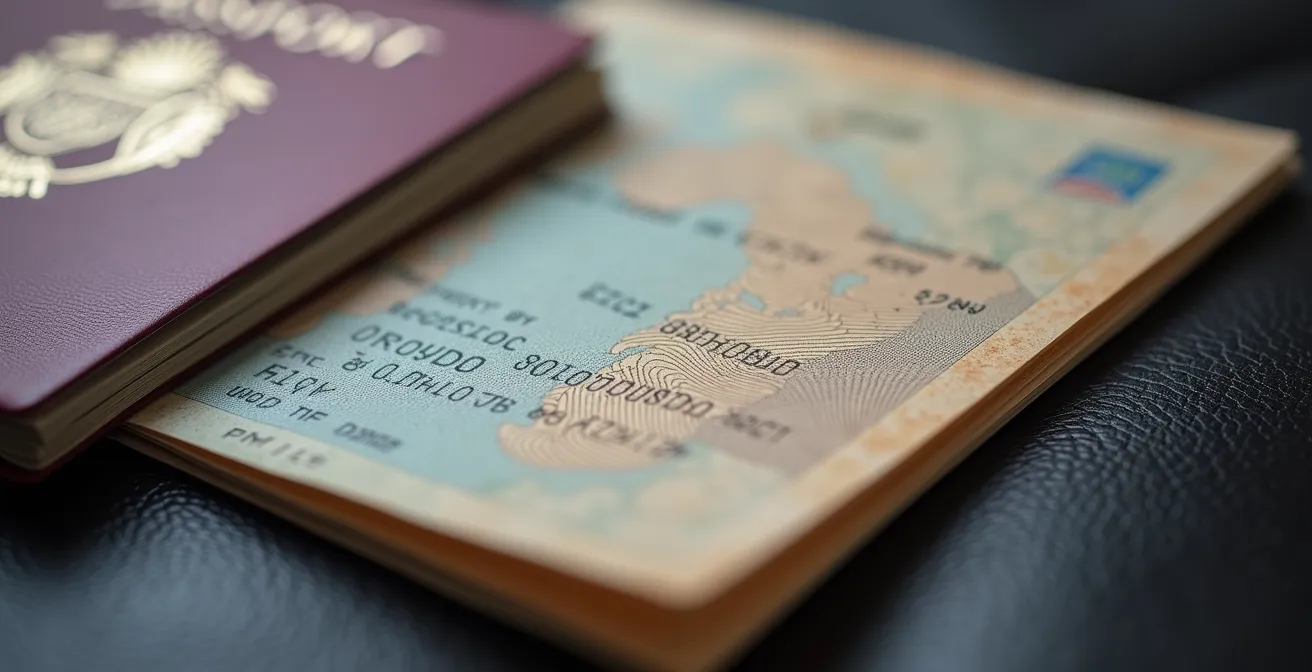
As the image above suggests, presenting an organised folder of printed documents conveys preparedness and respect for the process. This tangible file is reviewed alongside another critical document you receive upon arrival: the immigration card. This is a paper form in two parts. As one traveller noted, the process is straightforward but critical: the border police keep one part, and you must keep the other with your passport at all times. They will ask for it upon your departure, and losing it can cause significant delays. Having all your other documents printed and organised makes managing this extra slip of paper much easier.
Consider your printed dossier as your primary communication tool with the border officer. It speaks of your thoroughness before you’ve even said a word.
What prescription drugs are illegal to bring into Russia?
Navigating the rules for bringing personal medication into Russia requires extreme caution, as some common French prescription drugs are classified as controlled or psychotropic substances there. Medications containing substances like Tramadol, methylphenidate (found in Ritalin), or various benzodiazepines (like Xanax or Lexomil) are under strict control. Bringing them without proper documentation is illegal and can lead to severe consequences.
The Russian authorities require irrefutable proof that the medication is for personal medical use and has been legally prescribed. This means you cannot simply carry your prescription box. You must undertake a formal process of documentation and translation to ensure preemptive compliance. Standard over-the-counter medications from France, such as Doliprane (paracetamol) or Spasfon, are generally not restricted and do not require this level of paperwork.
If you need to travel with a controlled medication, follow this procedure meticulously at least one month before your trip:
- Check the official list of narcotic and psychotropic substances banned or restricted in the Russian Federation.
- Obtain a detailed prescription from your *médecin traitant* listing the drug’s international non-proprietary name, dosage, and the total quantity needed for your trip.
- Have this prescription translated into Russian by a certified translator (*traducteur assermenté*).
- Get this translation officially notarized.
- Keep all original documents, translations, and notarizations with the medication in your hand luggage.
This bureaucratic step is non-negotiable for controlled substances. It demonstrates that you have respected Russian law and are not attempting to import illegal drugs.
Failure to comply with these strict pharmaceutical regulations is one of the quickest ways to encounter serious trouble at the border.
The veterinary certificate: How to bring your dog to Moscow from the EU?
Traveling with a pet to Russia from the EU involves a separate, highly regulated documentation process that cannot be overlooked. Your dog will need an international veterinary certificate, issued no more than five days before your departure. This document must confirm the animal is healthy, has been vaccinated against rabies (at least 21 days but no more than one year prior), and is microchipped. It is essential that the microchip is ISO 11784/11785 compliant, as this is the standard used in Russia.
Beyond the certificate, the airline you choose will have its own strict rules for animal transport, which are generally based on the standards set by the IATA Live Animals Regulations (LAR). These regulations provide a global benchmark for transporting animals safely and humanely. Each airline then implements its own specific requirements for container size, weight, and booking procedures.
The following table provides a comparative overview of the rules for major airlines flying from France to Russia. Pay close attention to these details, as a non-compliant carrier will result in your pet being denied boarding.
| Airline | Max Weight (Pet + Carrier) | Container Requirements | Additional Rules |
|---|---|---|---|
| Aeroflot | 110 lbs (50 kg) | IATA compliant containers required | One animal per carrier |
| Air France | 75 kg (165 lb) | Must fit under the seat for cabin travel (if small) | Requires phone declaration when departing from CDG |
| KLM | 75 kg (165 lb) | 122 x 81 x 89 cm maximum | No flight transfers over 3 hours |
Always double-confirm the specifics with your chosen airline well in advance, as rules can be updated and capacity for pet transport is often limited.
Do you need to declare cash if you bring more than €10,000?
Yes, and the process is more complex than a simple declaration upon arrival. Any amount of cash (in euros, dollars, or other currencies) exceeding the equivalent of $10,000 USD must be declared upon entry to Russia. However, for travelers departing from France with over €10,000, there is a dual-declaration requirement. You must first declare the funds to the French authorities before you even leave.
This “exit declaration” in France is a mandatory step to combat money laundering and is done online through the *Douane*’s ‘DALIA’ service. You must complete this before your trip and carry proof of the declaration. Upon arrival in Russia, you will then complete a second, separate declaration using the paper customs form (the “red channel”). You must state the exact amount in its USD equivalent. This dual process ensures full transparency with both jurisdictions.
Ignoring either step can lead to fines or confiscation of the funds. The border control logic is simple: undeclared large sums of cash are automatically suspicious. By declaring everything proactively, you demonstrate compliance and remove any ambiguity about the source and purpose of your money.
Action Plan: The Dual Cash Declaration Process (France to Russia)
- Calculate the precise USD equivalent of the euros you are carrying using the current exchange rate.
- Before leaving France, complete the French *Douane’s* online ‘DALIA’ declaration for any amount over €10,000.
- Print the confirmation receipt from the DALIA service and keep it in your travel folder.
- Upon arrival in Russia, obtain a paper customs declaration form and proceed to the red channel.
- Fill out the form, declaring the exact amount you are carrying, converted to its USD equivalent.
- Keep the stamped Russian declaration receipt along with your DALIA receipt for the duration of your stay.
This meticulous approach to financial transparency is a cornerstone of a well-prepared travel dossier and avoids serious complications at customs.
Passport cover hacks: The best way to keep the loose slip from falling out
The Russian migration card, a small but vital slip of paper handed to you at border control, must be kept with your passport until you depart. Losing it is a common mistake that creates significant bureaucratic headaches. While it may seem like a trivial issue, ensuring this document’s safety is a practical part of maintaining your documentary integrity throughout your trip. A simple passport cover is often insufficient, as the slip can easily fall out.
The most effective solution is to use a passport cover that has an internal vertical flap or a secure pocket specifically designed to hold loose papers against the passport itself. When you receive the migration card, immediately tuck it securely inside this flap. This prevents it from accidentally slipping out when you present your passport at hotels or for other identity checks.
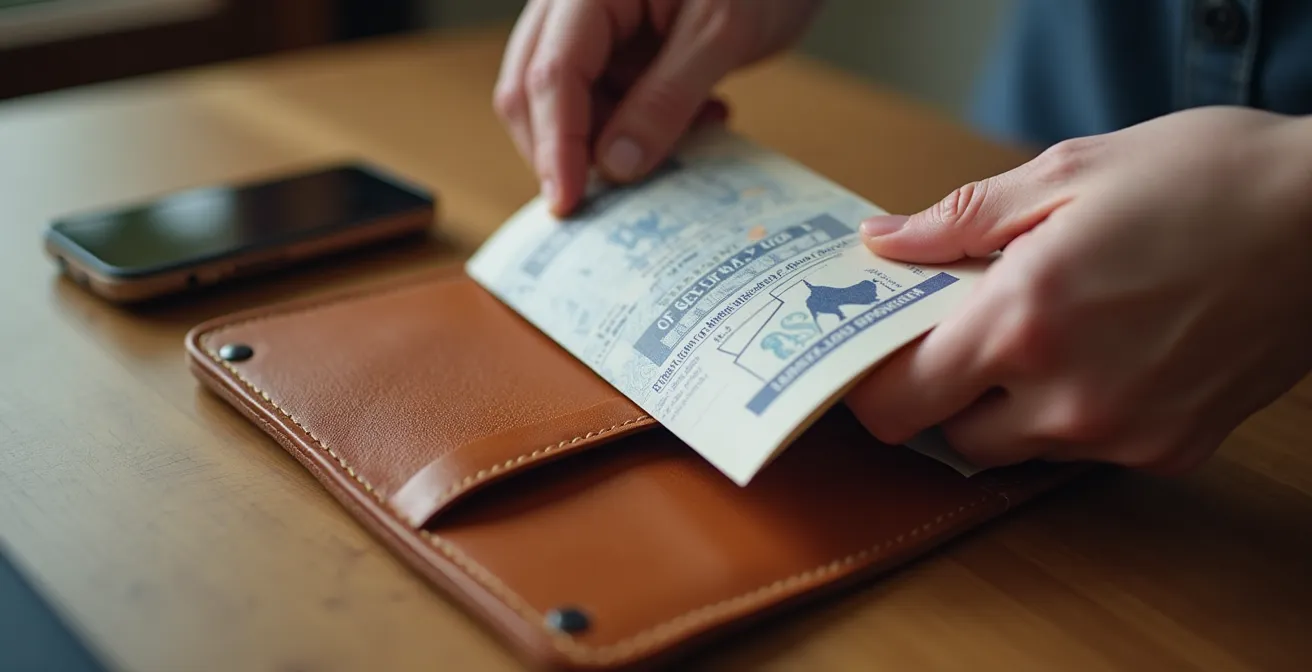
The importance of this small document cannot be overstated. As many experienced travelers and official guides point out, it’s a mandatory part of your legal presence in the country.
Along with your Russian Visa, you will need to obtain a Migration Card at your point of entry into Russia. This is a form in English and Russian which you must complete and present at passport control. Half will be stamped and returned to you, and you must keep it with your visa until your departure.
– St-Petersburg.com, Step-by-Step Visa Guide
This simple organizational “hack” is a practical measure that prevents a common and easily avoidable problem, keeping your essential documents together and secure.
Treat the migration card with the same importance as your passport and visa; its safekeeping is your responsibility.
Why does Yandex Go reject French cards and how to pay with cash?
One of the most immediate practical challenges you will face upon arrival in Russia is payment. Due to ongoing international sanctions, French and other Western-issued bank cards (Visa, Mastercard) are not accepted in Russia. This applies to everything from ATMs to ride-sharing apps like Yandex Go. The app will reject your card not because of an error, but because the underlying financial networks are disconnected.
This payment barrier extends to many travel services, including the purchase of travel insurance itself. As noted in a recent analysis, many Russian insurance companies do not allow payment with Western cards, which is why securing your policy from a French or EU-based provider before your trip is essential. For daily expenses, this means cash—specifically rubles—is your only reliable option. Fortunately, using cash with Yandex Go is straightforward if you prepare in advance.
Before confirming your first ride, you must manually switch the payment method within the app. Here’s how:
- Open the Yandex Go app and enter your destination.
- Before tapping to order, locate the payment method option, which usually defaults to ‘Card’.
- Tap on it and select ‘Cash’ (it may appear in Cyrillic as ‘Наличные’).
- Confirm your ride. The app will show you a fare estimate in rubles.
- Ensure you have small bills (e.g., 100 or 500 ruble notes) to pay the driver directly, as they may not have change for large notes.
This simple switch is crucial for navigating the city. Arriving without a plan for this will leave you stranded and unable to use essential services.
Having a sufficient amount of rubles in small denominations from the moment you arrive is a critical piece of on-the-ground preparation.
Key Takeaways:
- A visa application for Russia is a test of precision; every detail, from passport dates to printed documents, is scrutinized literally.
- Proactive documentation, such as notarized translations for medications and dual cash declarations, is not optional but a mandatory part of a risk-free application.
- On-the-ground logistics, like securing rubles for cash payments, are as crucial as the pre-travel paperwork due to financial sanctions.
What questions will the Russian border officer ask you upon arrival?
The interview with the Russian border officer is the final checkpoint where your preparation is put to the test. The officer’s goal is to quickly verify that your identity, documents, and stated intentions are all perfectly aligned. The questions are typically direct and simple, but your answers must be concise, confident, and consistent with your visa application. There is no room for ambiguity.
The most common questions you should be prepared to answer are:
- “Purpose of visit?” (Tsel’ vizita? / Цель визита?): Your answer must be a single word that matches your visa type. For most, the correct and only answer is “Tourism.”
- “How long?” (Na skol’ko? / На сколько?): State the exact number of days of your stay. This must match the dates on your return ticket and hotel bookings precisely.
- “Where are you staying?” (Gde ostanovites’? / Где остановитесь?): Provide the name of your primary hotel. It is highly advisable to have your hotel voucher printed with the address also listed in Cyrillic for clarity.
The officer will be simultaneously checking your passport, visa, and the automatically printed migration card. If you enter via a land border, you may still need to fill out this card by hand, so having a pen ready is wise. The key is to present your organised folder of documents and answer calmly. Any hesitation or conflicting information can lead to further questioning and delays.
Your goal is to make the officer’s job as easy as possible by presenting a case that is clear, consistent, and requires no further investigation. Review your documents one last time before approaching the counter.
Frequently Asked Questions about Preparing for Travel to Russia
Can I bring common French over-the-counter medications?
Yes, medications like Doliprane/Dafalgan (paracetamol) and Spasfon are not restricted and do not require special paperwork. The stringent rules apply to substances classified as narcotic or psychotropic in Russia.
What happens if I need to bring controlled medications?
You must have a prescription from your doctor that has been translated into Russian by a certified translator and then notarized. You may also need additional authorization depending on the specific substance. This process should be started at least a month before your trip.
How much medication can I bring?
As a general rule, a personal supply intended to last for the duration of your trip (up to 3 months) is considered acceptable, provided you have all the necessary supporting documentation for any controlled substances.