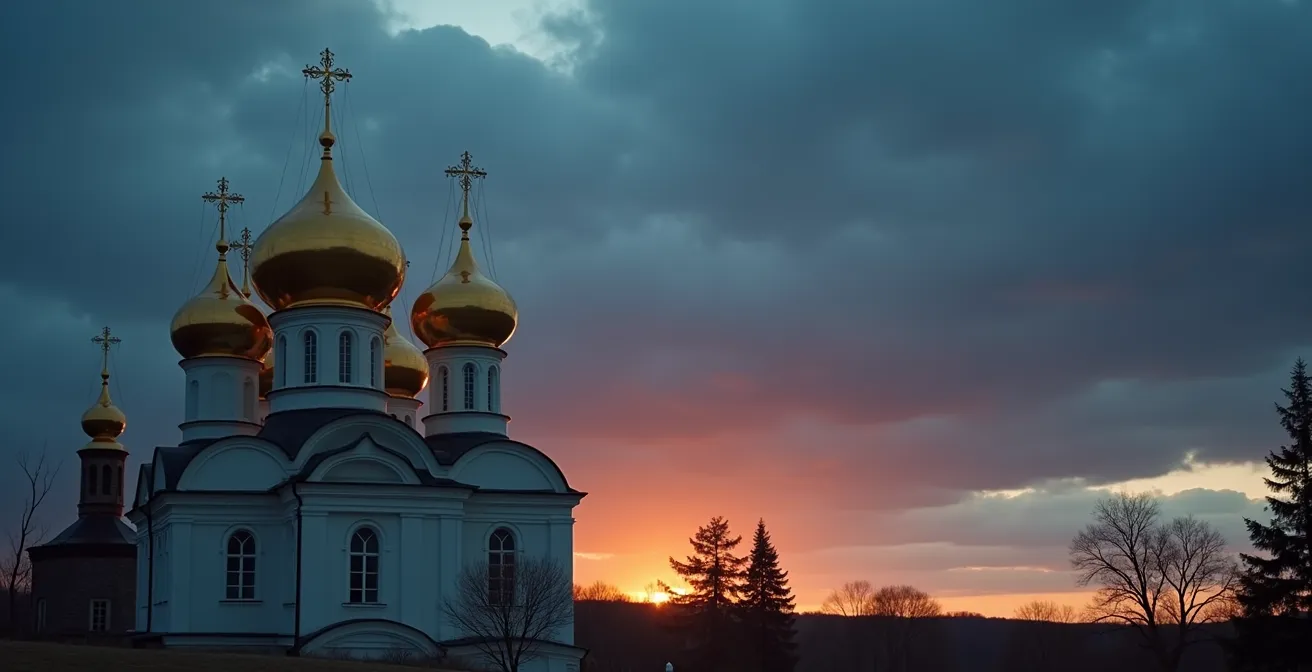
The iconic onion shape of Russian church domes is not a clever trick to shed snow. It’s a powerful visual manifesto of Russia’s spiritual and national identity, born from a dynamic dialogue between Byzantine tradition, native wooden craftsmanship, and the political ambitions of its tsars. This architectural form tells a story of a nation forging its own unique path to heaven.
Gazing upon the Moscow skyline, a curious traveler is inevitably struck by the constellation of shimmering, brightly colored domes that punctuate the cityscape. Swelling upwards before tapering to a fine point, these “onion domes” are the quintessential symbol of Russian architecture. The most common explanation you’ll hear is a practical one: the shape helps shed the heavy Russian snow. Others suggest it represents the flame of a candle, a symbol of prayer reaching toward the heavens. While these ideas hold a certain logic, they barely scratch the surface of a much deeper and more fascinating story.
The truth is, the onion dome is not a single invention but the culmination of a centuries-long architectural dialogue. It’s a narrative written in stone and gold, reflecting Russia’s struggle to define its own spiritual and political identity in the shadow of the Byzantine Empire. To understand why these domes look the way they do, we must look beyond simple function and symbolism. We must learn to read them as a visual manifesto, a declaration of a unique Russian worldview where faith, power, and art are inextricably intertwined.
This guide will peel back the layers of this architectural mystery. We will explore the symbolic language of their colors, debunk common myths about their origins, and uncover the political dramas that shaped their very form. By the end, you will see these structures not just as beautiful landmarks, but as profound storytellers of Russian history.
To fully decipher the visual language of these iconic structures, we will delve into the specific details that give them meaning, from the symbolism of their colors to the regional variations that tell a local story. The following sections offer a comprehensive look into this unique architectural world.
Summary: Unraveling the Mystery of Russia’s Iconic Domes
- Black, Gold, or Blue: What does the color of a dome signify?
- How much real gold is used to cover the domes of Christ the Savior?
- Moscow vs. Yaroslavl: How do the dome shapes change across regions?
- The best angle to capture the sun reflecting off golden domes
- Did the onion shape really evolve to shed heavy Russian snow?
- Why did Ivan the Terrible ban the construction of tent-roof churches?
- Why do Orthodox churches hide the altar behind a wall of icons?
- Did Ivan the Terrible really blind the architects of Saint Basil’s?
Black, Gold, or Blue: What does the color of a dome signify?
The vibrant colors of Russian church domes are not random aesthetic choices; they form a complex symbolic code, a “spiritual topography” that communicates the dedication of each church. This visual language allows the faithful to understand the sacred purpose of a building from a distance. The most prominent and powerful of these colors is gold. Golden domes symbolize divine light and heavenly glory, and for this reason, they are reserved for the most important cathedrals. According to Orthodox tradition, golden domes are used to crown cathedrals dedicated to Christ or one of the Twelve Great Feasts of the Orthodox Church.
The color palette extends far beyond gold, with each hue holding a specific theological meaning. As Russia Beyond explains in its analysis of church symbolism, this chromatic code is remarkably consistent:
Blue domes with stars are used on churches dedicated to the Mother of God or the Birth of Christ. Green domes are typical of churches dedicated to the Holy Trinity or to individual saints.
– Russia Beyond, Why do Russian churches have onion-shaped domes?
Black domes, the most austere, are typically found on monastery cathedrals, symbolizing monastic humility and renunciation of the worldly. Silver domes are associated with saints. Therefore, a city’s collection of domes is not merely an architectural display but a map of its sacred geography, telling stories of Christ, the Theotokos (Mother of God), and the saints who watch over it. This symbolic system transforms the skyline into a theological text, readable by all who know the language of its colors.
How much real gold is used to cover the domes of Christ the Savior?
While the exact quantity of gold on a specific cathedral like Christ the Savior is a closely guarded figure, the process itself reveals the immense value placed on these heavenly symbols. The glittering surfaces are not solid gold but are covered through a meticulous process called gilding. This ancient craft involves applying incredibly thin sheets of gold leaf, often just a few micrometers thick, onto the dome’s surface. The goal is not just opulence but creating a surface that reflects divine light and withstands the harsh Russian climate.
This paragraph introduces the intricate process of gilding. To truly appreciate the craftsmanship, it’s helpful to visualize the delicate application. The illustration below showcases this detailed work.

As this image highlights, the process is one of immense skill and patience. The gold leaf is so delicate that it must be applied by hand in windless conditions. Restorations of historic cathedrals often reveal fascinating details about their original construction. For instance, work on Saint Basil’s Cathedral in the 1960s, when its tin roofing was replaced with copper, showed that many of its domes were originally gilded. It was only later, during the 17th and 18th centuries, that the cathedral acquired the vibrant, multicolored pattern it’s famous for today, demonstrating the evolving “political aesthetics” of the time.
Moscow vs. Yaroslavl: How do the dome shapes change across regions?
The onion dome is not a monolithic form; it engaged in an “architectural dialogue” across Russia, developing distinct regional “dialects.” While Moscow’s domes are famous, the style found its most exuberant expression elsewhere. Architectural records show that the largest onion domes were erected in the 17th century in the area around Yaroslavl, a wealthy trading city northeast of Moscow. This regional variation was a direct reflection of local prosperity and identity.
The merchants of Yaroslavl, flush with wealth from trade routes, sponsored the construction of churches with larger, more ornate, and often green-enameled domes to showcase their status, contrasting with the golden domes of Moscow that signified central state and religious power. This table, based on historical architectural characteristics, breaks down the key differences in this regional conversation.
| Characteristic | Moscow | Yaroslavl |
|---|---|---|
| Dome Size | Moderate scale | Largest in Russia |
| Typical Color | Golden (power centers) | Green (merchant wealth) |
| Historical Period | 16th century onwards | Peak in 17th century |
| Design Complexity | Symmetrical clusters | More ornate patterns |
This divergence shows that Russian church architecture was not a top-down, centrally-mandated style. Instead, it was a living language that local communities adapted to express their own unique identity and pride. The “Yaroslavl style” became a testament to merchant power, creating a distinct spiritual topography that differed from the imperial center in Moscow. These regional differences are crucial to understanding the full story of the onion dome’s evolution from a simple form to a complex symbol of Russian culture.
The best angle to capture the sun reflecting off golden domes
Capturing the ethereal glow of a golden dome is a photographic challenge that rewards patience and an understanding of light. It’s not just about pointing a camera; it’s about positioning yourself to catch the sun at the perfect moment, transforming the metallic surface into a beacon of liquid light. The most coveted time for this is the “golden hour,” the period shortly before sunset when the sunlight is warm, soft, and directional. This low-angled light strikes the curved surface of the dome, creating a spectacular, fiery reflection that stands out against the deepening sky.
Finding the right vantage point is key to this visual pursuit. A photographer must think like an artist, composing the scene to balance the brilliant domes with the surrounding architecture and sky, often using silhouettes to create a sense of scale and drama.
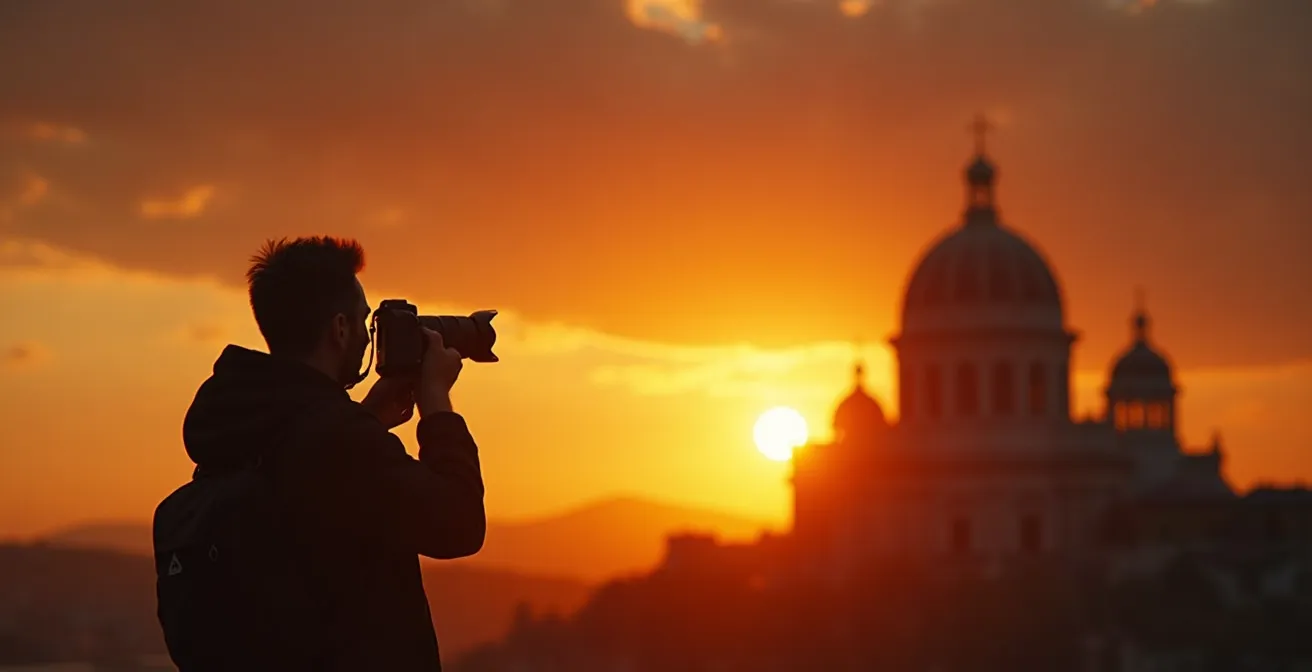
To move from a simple snapshot to a breathtaking photograph, a more structured approach is needed. Mastering the technical aspects of photography allows you to translate the scene’s emotional impact into a powerful image. The following checklist provides a practical framework for capturing these architectural wonders in their best light.
Your Action Plan: Perfect Golden Dome Photography
- Position yourself southwest of the cathedral during golden hour (1 hour before sunset) to catch the direct reflection.
- Use a wide-angle lens (24-35mm) to capture multiple domes and provide architectural context.
- Frame the domes against the sky using the rule of thirds for a balanced and compelling composition.
- Shoot at an aperture of f/5.6-f/8 to ensure optimal sharpness across the entire frame.
- Return during the “blue hour” (just after sunset) for a dramatic contrast between the still-warm domes and the cool, deep blue sky.
Did the onion shape really evolve to shed heavy Russian snow?
The most persistent and widespread theory about onion domes is that their shape is a clever functional adaptation to Russia’s harsh winters, designed to prevent snow from accumulating. While it sounds plausible, this explanation is largely a modern rationalization, a folk etymology for a shape whose origins are far more symbolic and complex. Many architectural historians argue that the steep pitch is no more effective at shedding snow than other pitched roof designs common in the region.
The search for a purely rational explanation often misses the spiritual heart of the matter. As the religious philosopher Prince Evgenii Troubetzkoy argued at the turn of the 20th century, the form’s true meaning transcends simple utility. He posited that the onion dome was a visual prayer, an embodiment of the fervent spirit of the Russian faith reaching for the heavens.
In 1917, religious philosopher Prince Evgenii Troubetzkoy argued that the onion shape of Russian church domes may not be explained rationally.
– Prince Evgenii Troubetzkoy, Wikipedia – Onion dome
The more likely architectural ancestor of the onion dome lies not in masonry but in wood. Some scholars believe that the shape first appeared in Russian wooden architecture, which featured tall, tent-like churches. These structures, built by local craftsmen, used layered wooden tiles (lemekh) to create curved, protective coverings. As Russian architecture evolved in the 16th and 17th centuries, these native, tent-like forms were translated into stone, and the bulbous shape atop a cylindrical drum emerged as a powerful and uniquely Russian alternative to the flatter Byzantine domes. This was a clear example of “craftsmanship vs. canon,” where local building traditions created a new visual language.
Why did Ivan the Terrible ban the construction of tent-roof churches?
This question contains a common historical misunderstanding. Ivan the Terrible did not ban tent-roof churches; on the contrary, his reign was the very period that saw this style rise to its most spectacular prominence. Architectural history documents that the reign of Ivan the Terrible (1533-1584) marked the introduction and popularization of tented roofs in stone. This uniquely Russian form, likely derived from earlier wooden structures, was a radical departure from the traditional cross-in-square plan and low domes inherited from Byzantium. It was a bold statement of “political aesthetics,” a national style for a newly powerful and unified Russian state.
The most famous example of this style is, of course, Saint Basil’s Cathedral on Red Square, commissioned by Ivan himself. It is not a single church but an agglomeration of individual chapels, each crowned with a fantastically designed roof. These steeply pitched conical roofs were a celebration of Russian victory and identity. So, if Ivan championed this style, why did it disappear? The ban came a century later, not from a tsar, but from the Church itself. In the mid-17th century, the deeply conservative Patriarch Nikon, as part of his sweeping reforms to align Russian Orthodoxy more closely with its Greek roots, outlawed the construction of tent-roof churches. He saw them as an improper, nationalistic deviation from the true Byzantine canon. He decreed that all new churches must return to the more traditional, hemispherical dome design, inadvertently paving the way for the onion dome to become the dominant—and officially sanctioned—form of Russian church architecture.
Why do Orthodox churches hide the altar behind a wall of icons?
The structure that separates the main body of an Orthodox church from the altar is called the iconostasis. To a visitor from a Western Christian tradition, it can appear like a barrier, hiding the most sacred rituals from view. However, its function is not to hide but to reveal a profound theological truth. The iconostasis is a physical and spiritual boundary that distinguishes the earthly realm of the parishioners (the nave) from the heavenly realm of the altar, where the mystery of the Eucharist is performed. It is not a wall, but a screen covered in icons that acts as a window into heaven.
The Function of the Iconostasis in Orthodox Worship
Church architecture defines certain spaces as more holy than others so as to distinguish the space of the clergy (behind the iconostasis) and that of the parishioners (in front of the iconostasis). The iconostasis serves not as a barrier but as a theological statement about the separation and connection between the earthly and heavenly realms. The icons themselves—of Christ, the Virgin Mary, John the Baptist, and various saints—form a bridge, allowing the faithful to see into the celestial world and inviting the saints to be present in the worship of the congregation.
The entire church interior is designed to be a holistic sensory and spiritual experience, a microcosm of the cosmos where every element works in concert. The architecture, the icons, the light, and even the scent of incense are all part of an integrated “visual manifesto” of the faith. The philosopher Pavel Florensky eloquently captured this immersive quality:
In a church everything is interlinked: church architecture takes into account even so apparently minor an effect as the ribbons of bluish incense curling across the frescoes and entwining the pillars of the dome.
– Pavel Florensky, Russian church architecture – Wikipedia
Key Takeaways
- The onion dome is a symbol of Russian national and spiritual identity, not a practical solution for snow.
- Dome colors follow a symbolic code: gold for Christ, blue for the Mother of God, and green for the Trinity or saints.
- The style evolved from native wooden architecture and was later codified after the church banned the rival “tent-roof” style.
Did Ivan the Terrible really blind the architects of Saint Basil’s?
The story is one of Russia’s most enduring and chilling legends: upon the completion of the magnificent Saint Basil’s Cathedral, an awestruck Ivan the Terrible ordered its architects, Postnik and Barma, to be blinded. Why? So that they could never again create a work of such surpassing beauty. This tale has been told for centuries, cementing the image of Ivan as a brilliant but monstrously cruel tyrant. It serves as a powerful metaphor for the absolute and terrifying power of the tsar. But as compelling as the story is, it is almost certainly a myth.
Historical evidence directly contradicts this dramatic legend. Far from being blinded, at least one of the architects remained highly active for years after the cathedral’s completion. The case for this being a myth is strong, as later records confirm the architect’s continued work on major state projects.
Debunking the Blinding Myth
Many historians are convinced that the blinding story is a fabrication. The primary architect, Postnik Yakovlev, is documented as having participated in major construction projects after Saint Basil’s was finished. Historical records confirm Postnik Yakovlev remained active at least throughout the 1560s, contributing to the construction of the Kazan Kremlin. The legend likely originated from a much earlier and possibly true account concerning Ivan III (Ivan the Great), who may have blinded the architect of a fortress. Over time, this story was likely embellished and transferred to his more infamous grandson, Ivan the Terrible, to enhance his fearsome reputation.
The survival of this legend speaks volumes about how history is shaped by narrative. The myth of the blinded architect was more powerful and more useful—as a cautionary tale about absolute power—than the more mundane reality of a respected architect continuing his career. It became part of the “visual manifesto” of Ivan’s reign, a story that defined his legacy as much as the cathedral itself. The legend persists not because it’s true, but because it tells a deeper truth about how we remember power and genius.
By understanding the rich tapestry of history, symbolism, and myth woven into these structures, you can begin to read the Moscow skyline not just as a collection of buildings, but as a profound declaration of a nation’s soul. The next step is to take this knowledge and apply it as you explore these incredible sites for yourself.