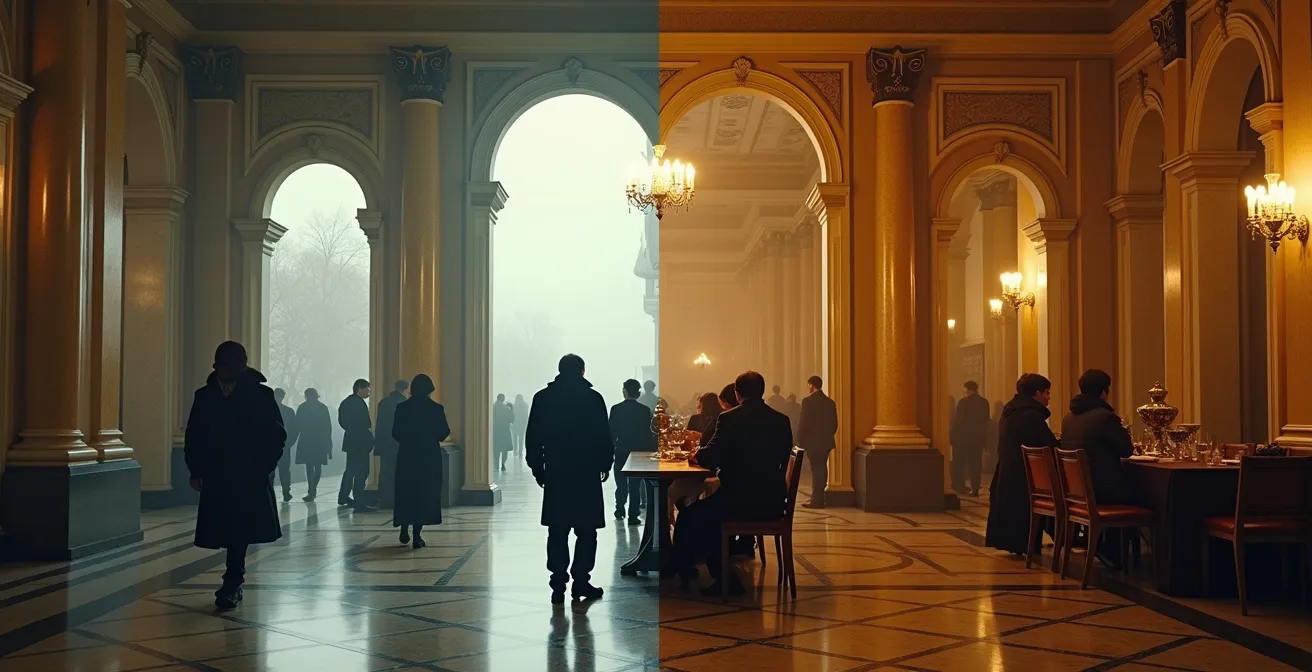
Contrary to the stereotype of coldness, Muscovites operate on a strict public/private social code. The absence of a public smile isn’t hostility; it’s a sign that smiles are reserved for genuine, private connection. This guide decodes that system, providing the cultural keys—from gift-giving to language—to move beyond the formal facade and experience the profound warmth of Russian hospitality, a concept surprisingly similar yet distinctly different from French social norms.
The first impression of Moscow for many travelers, especially those accustomed to the casual courtesies of Western cities, can be disconcerting. The metro, the streets, the shops—all are filled with faces that appear stern, focused, and notably unsmiling. This public mask can feel intimidating, leading to the conclusion that Muscovites are cold or unwelcoming. It’s a common feeling, but one that misses the intricate social dance happening just beneath the surface.
Simplistic explanations often point to the Soviet past or the harsh climate, but these are only small parts of a more complex cultural reality. The truth is not about a lack of warmth, but about where and to whom that warmth is expressed. In this, Russian culture has a fascinating parallel with French society’s own distinctions between public formality and private intimacy. However, the rules of engagement are entirely unique.
This guide moves beyond the cliché of the “unsmiling Russian.” It acts as a sociological roadmap to an entirely different social operating system. The key isn’t to simply learn a few phrases; it’s to understand the fundamental distinction between the public façade (Публичное лицо) and the private sphere (Частная сфера). Mastering this concept is the difference between being a tourist observing from the outside and a guest welcomed warmly on the inside.
By exploring the logic behind the “smiling myth,” conversation etiquette, and the rituals of home life, this article will equip you with the cultural intelligence to not just visit Moscow, but to genuinely connect with its people. You will learn how to interpret signals, avoid common pitfalls, and earn your place in the cherished private sphere where the true, legendary Russian hospitality resides.
Summary: A Traveler’s Guide to Understanding Moscow’s Social Codes
- The “Smiling Myth”: Why do Muscovites seem cold on the street but warm at home?
- How to meet locals in Moscow without knowing fluent Russian?
- Vy vs. Ty: When can you switch to informal language with a new friend?
- Is it safe to discuss current events with a taxi driver in Moscow?
- Even numbers are for funerals: The flower mistake to avoid at all costs
- How to make a proper Russian toast that impresses your hosts?
- How to say “Thank You” without sounding like a Hollywood spy villain?
- Do Muscovites tip in cash or by card in the digital age?
The “Smiling Myth”: Why do Muscovites seem cold on the street but warm at home?
The most pervasive and misleading stereotype about Russians is their supposed lack of friendliness, based almost entirely on the absence of smiles in public spaces. As a sociologist, I can assure you this is a profound misinterpretation. In Russia, a smile is not a social lubricant or a default expression of politeness as it is in many Western cultures. Instead, it is treated as a valuable, genuine expression of personal feeling, reserved for friends, family, and meaningful interactions. Offering a smile to a stranger without a specific reason is often viewed as strange, or worse, insincere. This is perfectly encapsulated by a famous Russian proverb.
Smiling with no reason is a sign of stupidity.
– Russian proverb, as cited in a Journal of Nonverbal Behavior study
This cultural norm creates a stark contrast between public and private behavior. The impassive public face is a neutral mask of non-interference, not a sign of hostility. It’s a way of respecting others’ personal space in a crowded urban environment. Research from Lomonosov Moscow State University highlights this, finding that Russians primarily use smiles in personal communication. The study specifically notes the parallel with the French distinction between public formality and private warmth, though the Russian version is often more pronounced. The moment you are invited into someone’s home—the private sphere—this public façade dissolves instantly, replaced by a level of warmth, generosity, and emotional openness that can be astonishing.
Understanding this dichotomy is the first and most crucial step. The absence of a public smile is not a rejection of you; it is the cultural backdrop against which a genuine, earned smile becomes an incredibly meaningful sign of acceptance.
How to meet locals in Moscow without knowing fluent Russian?
Cracking the code of the public/private sphere is the key to connecting with Muscovites. While a stern exterior may seem impenetrable, several cultural gateways exist for travelers willing to step off the beaten path. Language barriers can be daunting, but shared interests and specific local customs provide a bridge. The goal is to find contexts where the transition from public formality to private interaction is encouraged. Facebook is not the primary tool here; you must adopt local platforms and concepts.
This is where ‘Antikafes’ (anti-cafés) come in. These are unique Russian establishments where you pay for the time you spend there, not for what you consume. Coffee, tea, and snacks are typically free. They are designed as social spaces for students, freelancers, and young people to work, play board games, and socialize. They offer a relaxed, low-pressure environment perfect for striking up a conversation with locals who are already in an open mindset. Similarly, digital communities on platforms like Telegram and VKontakte (VK) are far more prevalent than their Western counterparts for organizing local events and meetups based on hobbies.
For French travelers, there’s a surprising cultural shortcut. Classic French culture holds a special place in the Russian heart. Mentioning beloved figures like singer Joe Dassin, actress Mylène Farmer, or the comedic films of Louis de Funès can be a powerful and unexpected icebreaker, signaling a shared cultural appreciation that transcends language. Attending an event at the Institut Français de Russie is another excellent way to meet Russians who are specifically interested in French culture and language.
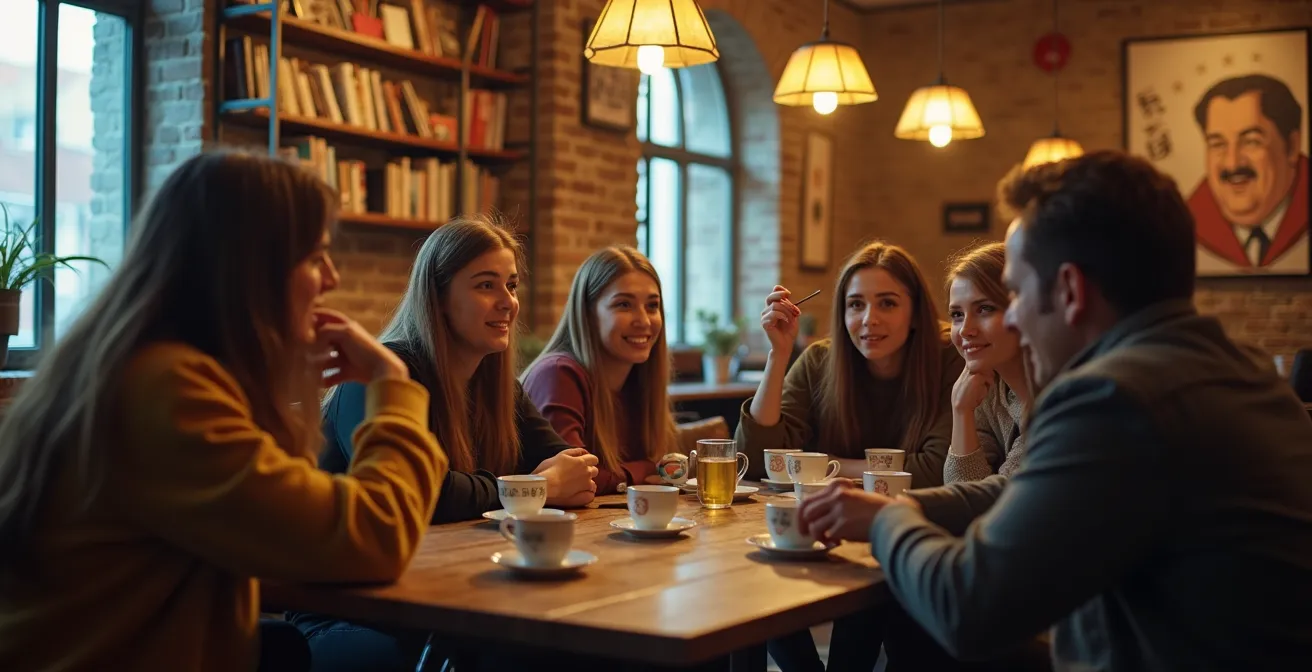
As the image suggests, these spaces are designed for warmth and connection, a world away from the impersonal nature of the street. They are the physical embodiment of the transition into the private sphere, where shared activities and genuine interest replace the need for formal introductions. By choosing the right environment, you can bypass the initial reserve and find the welcoming side of Moscow.
Ultimately, meeting locals is less about fluent Russian and more about showing genuine interest and navigating to the right social arenas where interaction is the norm.
Vy vs. Ty: When can you switch to informal language with a new friend?
For a French speaker, the distinction between “vous” and “tu” is second nature. Russia has a parallel system with “Vy” (Вы – formal/plural ‘you’) and “Ty” (ты – informal ‘you’), but the social weight and rules governing the switch are significantly different and more rigid. While in modern France, particularly among younger generations, the shift to “tu” can happen quickly and casually, the move from Vy to Ty in Russia is a major social milestone. It signifies a genuine transition from acquaintance to friend and a formal entry into someone’s private sphere. Rushing this can be perceived as disrespectful and overly familiar.
The power dynamic is crucial. The universally accepted rule is to always wait for the older person, or the person in a more senior position (be it by age, professional rank, or even as your host), to initiate the switch. Suggesting it yourself, especially to someone older, is a serious breach of etiquette. As one Moscow etiquette guide stresses:
Always wait for the other person, especially if they are older or in a senior position, to suggest the switch to ‘ty’.
– Moscow etiquette guide, Moscow Private Tours – Cultural Tips
The invitation is often explicit, with a phrase like “Davay na ty?” (“Let’s switch to ty?”). Sometimes, this transition is even sealed with a specific ritual called ‘drinking bruderschaft’ (пить на брудершафт), where two people link arms, drink their glasses, and then share a kiss (usually a friendly peck on the cheek). While not always practiced, its existence highlights the ceremonial importance of this linguistic shift.
This table clearly shows that while the concept is familiar, the application and social significance are far more profound in Russia. It’s a formal rite of passage in a relationship.
| Context | French (Vous/Tu) | Russian (Vy/Ty) |
|---|---|---|
| Switching significance | Increasingly casual in modern France | Major social milestone |
| Age factor | Less rigid among younger generation | Still strictly observed |
| Professional setting | Often remains ‘vous’ indefinitely | May switch after years of collaboration |
| Who initiates | Either party acceptable | Always wait for elder/senior to suggest |
| Ritual | Simple verbal agreement | Sometimes sealed with ‘bruderschaft’ drink |
As a traveler, your default should always be “Vy.” Using it shows respect and cultural awareness. If a Muscovite friend suggests switching to “Ty,” understand that it’s not a casual offer; it’s a genuine invitation into their world.
Is it safe to discuss current events with a taxi driver in Moscow?
Navigating conversations with strangers in Moscow requires a different kind of social radar, especially on sensitive topics like politics and current events. While a French traveler might be used to spirited political debate being a national pastime, this does not translate to casual encounters in Russia. For many Muscovites, discussing politics with someone you don’t know is considered deeply inappropriate, invasive, and potentially confrontational. The line between public and private extends strongly to conversation topics. A brilliant cultural comparison makes this clear: discussing politics with a Russian stranger is akin to a very specific French faux pas.
For many Russians, discussing politics with a stranger is as inappropriate as asking a French person their salary during a first meeting.
– Cultural etiquette comparison, Russia Travel Guide – Cultural Norms
This single analogy explains everything. It’s not about secrecy or fear, but about a deeply ingrained sense of privacy and propriety. Such topics are reserved for the trusted inner circle of the private sphere. Attempting to broach them with a taxi driver or a shopkeeper puts them in an uncomfortable position. The safest and most respectful approach is to steer clear entirely. This doesn’t mean your ride has to be silent. There is a vast landscape of safe, engaging, and genuinely interesting topics that can create a positive connection.
Focus on subjects of shared national pride or universal human experience. Excellent neutral ground includes:
- The stunning architecture of the Moscow metro stations (asking for a favorite is a great opener).
- The history of the Russian space program, a source of immense pride.
- Classic Russian literature and music, which are universally revered.
- Discussions about food, sports, or the weather—these are safe harbors in any culture.
Modern technology also offers a buffer. Using a ride-hailing app like Yandex Go, which is the local standard, allows most communication about the destination to be handled digitally, minimizing the pressure to make conversation if you don’t feel comfortable.
The goal is connection, not interrogation. By respecting these conversational boundaries, you show cultural sensitivity and are more likely to have a genuinely pleasant and insightful exchange.
Even numbers are for funerals: The flower mistake to avoid at all costs
Once you successfully cross the threshold into the private sphere and receive an invitation to a Muscovite’s home, the rules of engagement shift again. This is where generosity and attentiveness are paramount, and bringing a gift is expected. However, this seemingly simple gesture is fraught with one of the most critical cultural traps for an unsuspecting foreigner: the number of flowers. In Russia, you must never, ever give an even number of flowers. Bouquets of 2, 4, 6, or 8 stems are strictly reserved for funerals and cemeteries. Giving a host a bouquet with an even number of flowers is, at best, a horrifyingly awkward mistake and, at worst, a symbolic death wish.
This tradition is not a modern quirk; it is deeply rooted in pre-Christian Slavic beliefs and numerology. In this ancient system, even numbers represented completion, finality, and therefore death. Odd numbers, conversely, symbolized life, continuation, and positive energy. This powerful symbolism has survived for centuries and remains a non-negotiable social rule. It’s a fascinating example of how ancient beliefs shape modern etiquette, much like French superstitions about not being 13 at a table or never placing bread upside down—both are subconscious rituals tied to luck and avoiding bad omens.
If you choose to give flowers—a wonderful gesture—always count the stems carefully. A bouquet of 3, 5, or 7 is perfect. If the bouquet is very large and uncountable, the rule doesn’t apply, but for any standard bouquet, counting is essential. However, to avoid any anxiety, there are several foolproof gift alternatives that are deeply appreciated, especially when they come from France. Consider bringing high-quality French chocolates, macarons from a famous patisserie, or a bottle of good French wine (if you know your hosts drink alcohol). A specialty item from your home region in France is also a fantastic and personal touch. These gifts are not only safe but also demonstrate thoughtfulness and a touch of cultural prestige.
Ultimately, the act of giving a gift is about showing gratitude and respect. By being aware of this one critical rule, you ensure your kind gesture is received with the warmth and appreciation it was intended to convey.
How to make a proper Russian toast that impresses your hosts?
The Russian dinner party, or ‘zastolye’ (застолье), is the heart of the private sphere. It’s an elaborate affair filled with abundant food, flowing drinks, and deep conversation. Central to this experience is the ritual of the toast (тост). For a French person accustomed to a quick “Santé!” or “Tchin-tchin!”, the Russian toast is a different universe. It is not a brief clinking of glasses; it is a miniature theatrical performance, a heartfelt speech that can last for several minutes. Understanding and participating in this ritual is one of the deepest ways to show respect and connect with your hosts.
Unlike a simple French toast at the beginning of a meal, Russian toasts are numerous and occur throughout the evening. The first is usually proposed by the head of the household (‘tamada’), but afterwards, guests are expected to contribute. The content is key: a toast is never just “to health.” It is a personal story, a philosophical reflection, a poetic wish, or a heartfelt expression of gratitude towards the hosts. It should be sincere, elaborate, and delivered with sustained eye contact with the person or people being toasted. This is not a time for brevity or casualness; it is a moment for genuine emotional expression.

As a guest, you are not expected to deliver a masterpiece on your first try, but putting in the effort will be immensely appreciated. Prepare a short, sincere thought in advance. You might toast to your hosts’ hospitality, to the friendship between your countries, or to the health of the children. The effort is what matters. The following table, based on an analysis of cultural communication styles, highlights the stark differences.
| Aspect | French Custom | Russian Custom |
|---|---|---|
| Duration | Quick ‘Santé!’ or ‘Tchin-tchin!’ | 1-3 minute heartfelt speech |
| Content | Simple good wishes | Personal story or meaningful reflection |
| Eye Contact | Brief during clink | Maintained throughout the toast |
| Non-drinkers | May abstain from toasting | Participate with juice/water – ritual matters more than alcohol |
| Frequency | Usually once at beginning | Multiple throughout the meal |
Don’t be intimidated. Your sincerity will be valued far more than your eloquence. Participating in the toast is participating in the very fabric of Russian social life.
How to say “Thank You” without sounding like a Hollywood spy villain?
Even the simplest expressions of gratitude can carry unexpected cultural weight. As a traveler, you will likely learn “Spasibo” (Спасибо) as the standard word for “Thank you.” While it is correct and universally understood, relying on it exclusively is like only ever using “merci” in French without ever employing more nuanced phrases like “je vous remercie” or “c’est très gentil à vous.” In Russia, there is a subtle but powerful distinction between the common “Spasibo” and the more formal, heartfelt “Blagodaryu” (Благодарю).
“Spasibo” originates from the phrase “Spasi Bog,” meaning “God save you.” It’s the everyday, transactional thank you—for a purchase, for someone holding a door. “Blagodaryu,” on the other hand, comes from “blago daryu,” which literally means “I give you good” or “I bestow a blessing.” This second form conveys a much deeper, more personal sense of gratitude and sincerity. Using it in the right context demonstrates a significant level of cultural understanding and respect. It signals that you are not just reciting a memorized word, but are genuinely expressing a heartfelt sentiment.
The key to using these correctly lies in context and delivery. For routine, impersonal interactions, “Spasibo” is perfectly fine. But when someone has shown you a genuine kindness, offered you a gift, or extended their hospitality, using “Blagodaryu” combined with direct, sustained eye contact will create a noticeably warmer and more positive reaction. To make your gratitude truly authentic, follow a simple three-step process:
- First, make direct eye contact before you speak. This is the non-verbal signal of sincerity that gives your words weight.
- Second, choose your word: use “Blagodaryu” for meaningful gestures and “Spasibo” for everyday transactions.
- Third, learn the expected response. When someone thanks you, the correct reply is “Pozhaluysta” (Пожалуйста), which confusingly also means “please.” A simple nod is not sufficient.
This nuanced use of language is a small detail that makes a huge difference, transforming a simple courtesy into a moment of genuine human connection.
By learning to distinguish between “Spasibo” and “Blagodaryu,” you are no longer just a tourist with a phrasebook; you are someone who understands and respects the currency of sincerity in Russian culture.
Key Takeaways
- The “public smile” is not a social norm; smiles are reserved for genuine, private interactions.
- Respect conversational boundaries: avoid politics with strangers, just as you’d avoid asking a French person their salary.
- Never give an even number of flowers. Odd numbers (3, 5, 7) are for celebration; even numbers are for funerals.
Do Muscovites tip in cash or by card in the digital age?
After navigating the complex world of smiles, toasts, and flower numerology, the practical matter of tipping can feel refreshingly straightforward, yet it comes with its own local customs. The most important thing for a European traveler to know is that, unlike in France where service is generally included in the bill (‘service compris’), tipping in Moscow restaurants is not optional; it is expected. The model is closer to the American system, where tips form a significant part of a server’s income. A tip of 10-15% of the bill is the standard for good service in a sit-down restaurant.
The challenge in the digital age is how to leave this tip. As Russia is a highly digitized society, paying by card is the norm, but this often leaves no straightforward way to add a tip to the transaction. Muscovites have developed a clever solution: ‘online-chaevie’ (онлайн-чаевые), or online tips. It is now very common to find a QR code printed on your bill. By scanning this with your phone, you are taken to a simple web page where you can leave a tip for your specific server via a card payment or mobile transfer. It’s an elegant solution to a modern problem. While cash is always appreciated, don’t be surprised if the QR code is the default method presented.
For other services, the rules are a bit more fluid but generally follow a pattern of rewarding personal service. In taxis, especially when using an app like Yandex Go, it’s common to simply round up the fare within the app as a small gesture. For a personal tour guide who has spent several hours with you, a more substantial tip of 10-15% in cash is expected and greatly appreciated. For hotel staff, small notes (50-100 rubles) for porters or housekeeping are a welcome courtesy. In cafes and bars, rounding up or leaving small change is usually sufficient.
Your Action Plan: A Tipping Guide for Moscow
- Restaurants: Scan the bill for a QR code for “online-chaevie” to tip 10-15% digitally. If not available, use cash.
- Yandex Go rides: Use the in-app feature to round up the fare or add a small tip after the ride is complete.
- Tour guides: Prepare to tip 10-15% of the tour cost in cash for good service.
- Hotel staff: Keep small bills (50-100 rubles) handy for porters and to leave for housekeeping.
- Bars & Cafes: For counter service, it’s not required. For table service, rounding up the bill or leaving 5-10% is polite.
By approaching Moscow with this cultural “user manual,” you can move beyond the intimidating facade and discover the rich, warm, and deeply rewarding world of Russian hospitality that awaits those who take the time to understand its unique language of connection.