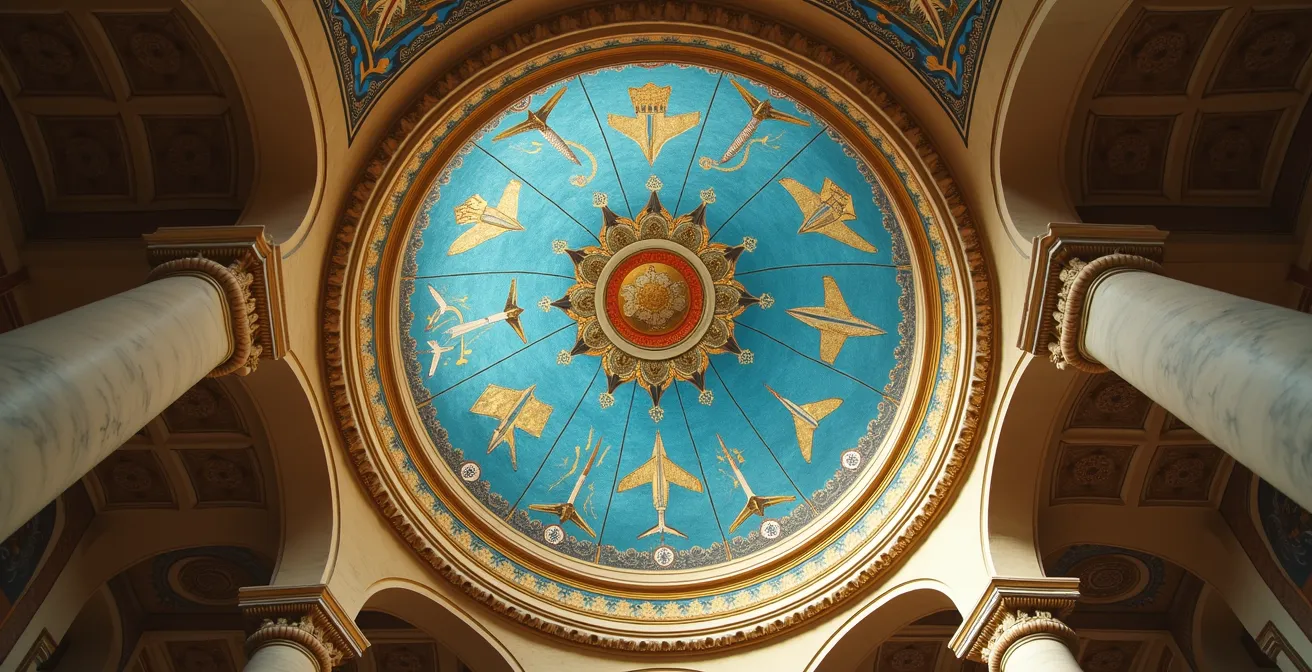
The dazzling mosaics of the Soviet Union are often dismissed as simple propaganda, but they are in fact a complex visual language for a future that was willed into existence and then lost.
- These artworks function as a “semiotic blueprint,” using specific materials and symbols to encode ideological values into the fabric of daily life.
- The style frequently co-opts religious iconography in a form of “Sacred Secularism,” elevating the state and its ideals into a new kind of faith.
Recommendation: To truly understand them, one must learn to read these works not as historical relics, but as haunting “stone prophecies” of a world that never was.
To descend into the Moscow Metro is to enter a subterranean world of marble, bronze, and shimmering light. For any art and history lover, particularly one accustomed to the functional elegance of the Paris Métro, the first impression is one of overwhelming grandeur. The common refrain is that these are “palaces for the people,” a simple and satisfying explanation. Yet, as your eyes adjust to the light and begin to trace the lines of the vast mosaics overhead, a deeper, more complex question emerges. Why do these scenes of heroic pilots, jubilant athletes, and futuristic cityscapes feel so poignant, so imbued with a sense of a future that feels both magnificent and irretrievably lost?
The answer lies beyond the surface-level reading of “propaganda.” These artworks are not mere decoration; they are a meticulously constructed ideological grammar, a semiotic blueprint designed to shape the consciousness of the millions who passed beneath them every day. Much like France’s own Grands Projets were conceived to project a specific vision of national identity onto the urban landscape, the Soviet state used art as an engineering tool for the human soul. It was a visual prophecy, written in stone and glass, of a communist utopia that was meant to be willed into existence through constant, subliminal reinforcement.
This article moves beyond the clichés to act as a decoder for this lost language. We will analyse the specific artistic choices—from the symbolism of the sky at Mayakovskaya to the use of stained glass at Novoslobodskaya—to understand how ideology was translated into aesthetics. By examining how this visual prophecy was created, then altered, and now contested, we can begin to understand why these mosaics, depicting a future that never happened, continue to haunt our modern imagination.
This guide delves into the hidden stories and artistic codes of the most significant Soviet monumental art. We will explore the grand visions, the erased histories, and the lingering power of these underground masterpieces.
Contents: Decoding the Ideological Grammar of Soviet Art
- The 24 hours of Soviet Sky: How to read the ceiling domes of Mayakovskaya?
- Where can you still find hidden profiles of Stalin in the metro mosaics?
- The celebration of Ukraine: How current politics affects the view of Kiyevskaya mosaics?
- Smalt vs. Marble: Why are the mosaics at Novoslobodskaya stained glass?
- Novokuznetskaya: Why are there mosaics of war heroes making tanks?
- Which 3 metro stations have the most impressive propaganda mosaics?
- Why did Stalin build 7 identical skyscrapers across the city?
- Where to find authentic Soviet heritage beyond the Red Square crowds?
The 24 hours of Soviet Sky: How to read the ceiling domes of Mayakovskaya?
Mayakovskaya station, opened in 1938, is perhaps the purest expression of the early Soviet utopian dream. Its Art Deco elegance and stainless-steel columns feel futuristic even today. But to understand its message, one must look up. The central hall’s ceiling is punctuated by a series of oval domes, each containing a brilliant mosaic against a deep cobalt-blue background. This collection, titled “24-Hour Soviet Sky,” was designed by the prominent socialist realist artist Alexander Deyneka. It is a perfect example of the “semiotic blueprint” in action, presenting an idealized vision of a day in the life of the nation.
The cycle begins with the morning sky, featuring planes flying over the Kremlin, and progresses through the day with scenes of athletic prowess: high divers, parachutists, and smiling athletes. This is not a random collection of images; it is an ideological grammar of progress. The sky, a traditional symbol of heaven and the divine, is here reclaimed as a Soviet space—a realm of technological mastery and human perfection. The viewer, standing in the “palace” below, is invited to gaze upon this new heaven. The artwork consists of 34 cobalt blue panels, each a window into a perfect day in a perfect state.
Reading these domes is to read a visual prophecy. They depict a world without conflict, without labor in the traditional sense, a world where life is a joyful performance of physical and national excellence. The figures are not individuals but archetypes: the Pilot, the Athlete, the Builder of Socialism. They exist in a perpetual, sunlit present, forever moving forward and upward. It is the foundational text of the Soviet utopian project, establishing the visual language of a future that seemed, at the time, not just possible but inevitable. It is the promise against which all subsequent Soviet art, and its eventual decay, must be measured.
Where can you still find hidden profiles of Stalin in the metro mosaics?
If Mayakovskaya represents the pure, initial prophecy, other stations reveal how that prophecy was violently edited. The cult of personality around Joseph Stalin led to his image being incorporated into numerous mosaics, positioning him as the patriarch and visionary of the Soviet project. However, following his death and Nikita Khrushchev’s “Secret Speech” in 1956 denouncing his excesses, a sweeping campaign of de-Stalinization began. This process was not just political; it was brutally physical, playing out on the very walls of the metro.
Finding Stalin’s profile today is an exercise in historical archaeology. In most cases, his image was painstakingly removed, tile by tile, and replaced with neutral or alternative patriotic symbols. At Dobryninskaya, a grand mosaic originally showed a parade of athletes marching towards a banner held by Stalin; his figure was expertly excised and replaced with a simple coat of arms. At Arbatskaya, medallions bearing his profile were replaced with floral motifs or, in a move of deep irony, symbols of peace like doves. These alterations are a form of iconoclasm, the destruction of images for political or religious reasons, and they tell a story of ideological rupture.
The erasures are often imperfect, leaving ghostly traces for the keen-eyed observer. A slight discoloration in the smalt, a subtle disruption in the pattern of the tiles, or a stylistic mismatch in the replacement imagery can betray the original composition. These “redacted” mosaics are arguably more fascinating than the originals. They are no longer a simple statement of power, but a complex, layered text about the rise and fall of a political deity and the malleability of state-sanctioned history. They are a physical manifestation of the future “not happening” as planned, requiring a hasty rewrite of its visual scripture.
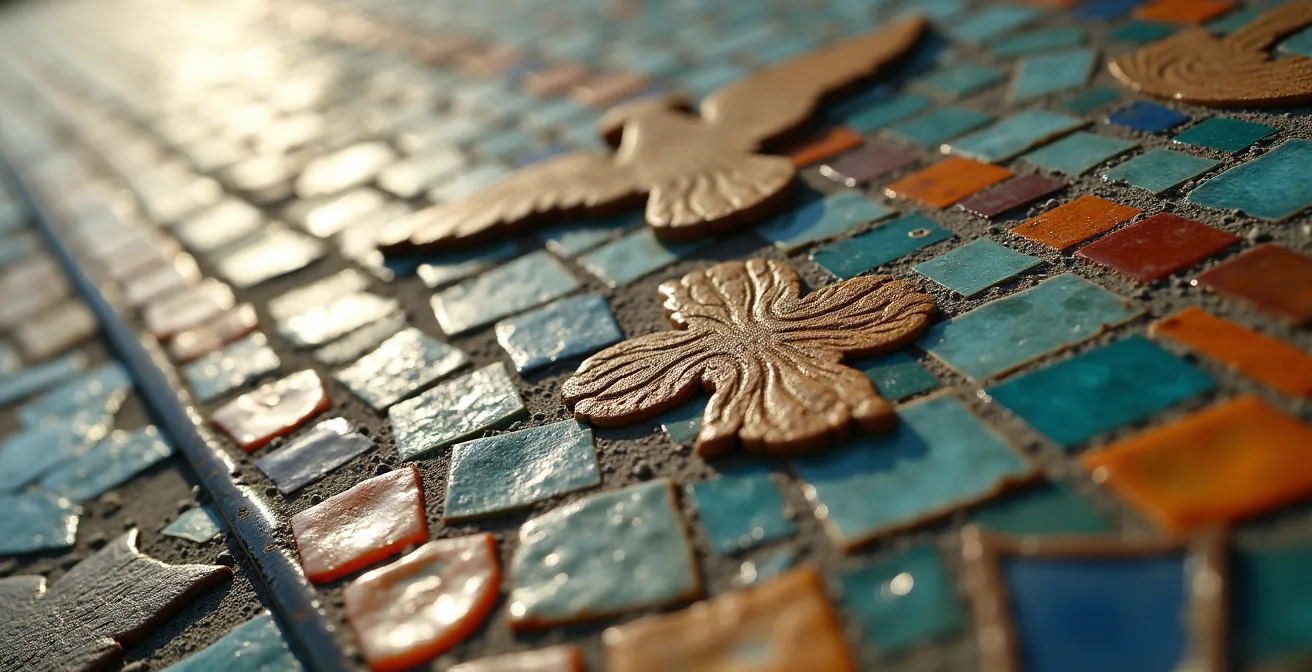
This process of erasure demonstrates that the semiotic blueprint was a living document, subject to the violent whims of political succession. The “god” of this secular religion could be, and was, removed from the pantheon, leaving behind a scarred but telling narrative of a fractured ideology.
The celebration of Ukraine: How current politics affects the view of Kiyevskaya mosaics?
The mosaics at Kiyevskaya station, dedicated to the theme of Russo-Ukrainian unity, have become one of the most politically charged artistic sites in Moscow. Created in 1954 to celebrate the 300th anniversary of the treaty that brought Ukraine under Moscow’s rule, the 18 panels depict a shared, prosperous history: Ukrainian farmers harvesting wheat, engineers building together, and folk dancers celebrating a common culture. The overarching theme is one of fraternal harmony, a perfect illustration of the Soviet “friendship of peoples” doctrine. For decades, these were simply beautiful examples of socialist realist art.
Today, it is impossible to view them outside the context of current events. The once-benign images of unity now carry a heavy, dissonant weight. The depiction of a joyous, unified existence stands in stark contrast to the reality of conflict, annexation, and a brutal war. The mosaics have transformed from a celebration into a political artifact, a piece of a historical narrative that is now fiercely contested. For a visitor, they are a powerful lesson in how the meaning of art is not fixed but is constantly re-negotiated by the present.
This re-negotiation is happening in reverse within Ukraine itself. Following the 2014 annexation of Crimea, the country passed a series of “decommunization” laws in 2015, mandating the removal of Soviet symbols. This has led to the destruction of countless mosaics across the country. However, this process is not without its own controversy. Organizations like Izolyatsia are working to document and, in some cases, protect these artworks, arguing that they are a part of Ukraine’s complex history, not just remnants of an occupying power. They make the case that to erase them is to erase a chapter of their own national story, however painful. The mosaics at Kiyevskaya and their counterparts in Ukraine are thus two sides of the same coin: art caught in the crossfire of a battle over history, identity, and the very future that was once so confidently depicted.
Smalt vs. Marble: Why are the mosaics at Novoslobodskaya stained glass?
While most metro stations rely on the opaque, reflective qualities of smalt (a form of coloured glass) and marble to create their mosaics, Novoslobodskaya (1952) offers a stunning deviation. Here, the primary artistic medium is not mosaic but stained glass. The station is lined with 32 luminous, backlit panels, turning the underground space into something resembling a cathedral nave. This choice of material is a profound statement, representing a key aspect of my “Sacred Secularism” concept—the co-opting of religious artistic forms to serve an atheistic ideology.
The panels were designed by artist Pavel Korin and crafted in Latvia, using glass from Riga’s cathedral. This lineage is no accident. The station intentionally borrows the visual language of sacred architecture to bestow a sense of reverence and gravitas upon its subjects. Instead of saints and biblical scenes, however, the figures depicted are Soviet professionals: an architect, a musician, an agronomist, a scientist. Each is rendered in rich, jewel-toned glass, surrounded by intricate floral patterns and topped with a small medallion showing a classic socialist realist scene (e.g., happy workers). The effect is to elevate these secular professions to the level of a holy calling. The architect is not just designing buildings; he is a high priest of construction.
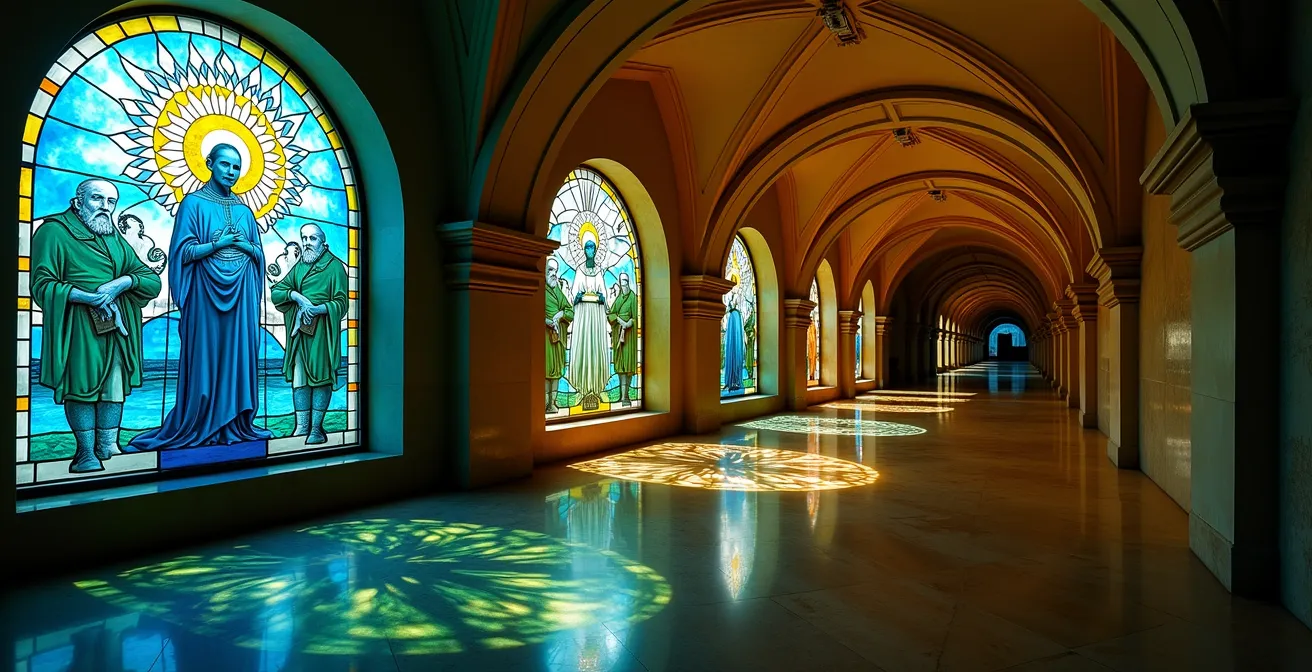
At the end of the platform, a massive mosaic titled “Peace Throughout the World” depicts a mother holding a child, a clear visual echo of the Madonna and Child archetype. This is the ideological grammar at its most sophisticated. By using stained glass, the state didn’t just build a station; it consecrated a temple to Soviet achievement. It offered its citizens a new set of saints to venerate, transforming the daily commute into a form of pilgrimage through the articles of a new, materialist faith. The future depicted here was not just prosperous; it was sacred.
Novokuznetskaya: Why are there mosaics of war heroes making tanks?
The mosaics at Novokuznetskaya station serve as a stark and crucial corrective to the idyllic visions seen elsewhere. Opened in 1943, at the height of the Great Patriotic War (World War II), its art is not about a peaceful, futuristic utopia. It is about the brutal, industrial sacrifice required to defend the motherland and earn that future. The ceiling panels depict scenes of wartime industry: workers forging steel, assembling tanks, and building aircraft. This is the engine room of the prophecy, the gritty reality underpinning the gleaming dream.
The imagery is heroic, but it is a heroism of sweat, fire, and steel. The figures are muscular, determined, and focused, their faces illuminated by the glow of furnaces. The mosaics celebrate the military-industrial complex as the guarantor of Soviet survival. They send a clear message to the commuters of war-torn Moscow: victory is forged through relentless labor and industrial might. This art doesn’t promise a leisurely future; it demands a totalizing present commitment. It is a visual call to arms, reminding citizens that the “radiant future” must first be secured through blood and iron.
Case Study: The Siege of Leningrad Mosaics
The story behind these mosaics adds an incredible layer of poignancy. Many of the panels were designed by Vladimir Frolov in Leningrad during the city’s horrific siege. According to historical accounts, Frolov continued to assemble the mosaics in the nearly unheated, freezing Academy of Arts building while the city around him starved. He worked almost entirely alone, a singular act of artistic creation amidst mass death. In a feat of logistical heroism, the finished panels were then transported out of the besieged city across the frozen Lake Ladoga—the famous “Road of Life”—in the winter of 1942 to be installed in Moscow. Knowing this, the mosaics transform from propaganda into a testament to human resilience and the defiant power of art in the face of annihilation.
Novokuznetskaya thus complicates the narrative. It reveals that the utopian future was not a gift but a prize to be won through immense suffering. The station’s art grounds the entire Soviet project, reminding us that behind the images of smiling parachutists were workers toiling in unimaginable conditions, convinced their sacrifice was building a better world.
Which 3 metro stations have the most impressive propaganda mosaics?
For the art lover looking to experience the full spectrum of Soviet monumental art, navigating the vast network of the Moscow Metro can be daunting. While dozens of stations contain noteworthy art, three in particular stand out as essential stops on any propaganda tour, each representing a different facet of the “ideological grammar.” The Moscow Metro operates 236 stations, but these three offer a concentrated dose of the grandeur and complexity of the Soviet artistic project. A focused visit to these sites provides a powerful introduction to the visual language of the era.
First is Komsomolskaya (1952) on the Circle Line. This is the apotheosis of the High Stalinist style. With its soaring Baroque yellow ceilings, immense chandeliers, and triumphalist mosaics, it is the most unapologetically palatial of all the stations. The mosaics depict great Russian military heroes and pivotal victories, from medieval Prince Alexander Nevsky to the storming of the Reichstag in 1945. The message is one of an unbroken line of national strength, with the Soviet state as its ultimate, glorious culmination.
Second, as previously discussed, is Mayakovskaya (1938). Its importance cannot be overstated. Its sleek, Art Deco design and the “24-Hour Soviet Sky” mosaics represent the optimistic, pre-war vision of a technocratic and athletic utopia. It is less bombastic than Komsomolskaya, offering a more lyrical and futuristic vision of the communist project. Finally, no tour is complete without a stop at Ploshchad Revolyutsii (1938). While its mosaics are less prominent, it is famous for its 76 larger-than-life bronze sculptures depicting idealized Soviet citizens: soldiers, farmers, students, and workers. These figures are not just art; they are interactive talismans. Decades of commuters have rubbed the noses of the dogs or the guns of the soldiers for good luck, polishing the bronze to a brilliant gold and creating a fascinating intersection of state propaganda and popular folklore.
Action Plan: Decoding a Soviet Mosaic
- Points of Contact: List all visual elements where the message is broadcast. Note the central figures, the background details (factories, fields), the architectural framing, and any symbolic objects (books, tools, weapons).
- Collection: Inventory the explicit symbols present. Look for the hammer and sickle, red stars, sheaves of wheat, specific military or professional uniforms, and their frequency and placement.
- Coherence: Compare the mosaic’s message with official Soviet values. Does this image of a happy, robust family align with state policies on population growth? Does it reflect the doctrine of collectivization or industrialization?
- Memorability/Emotion: Identify the core emotion the art aims to evoke—be it heroism, collective joy, security, or awe. Analyze what compositional or color choices make it powerful versus simply generic propaganda.
- Integration Plan: Reconstruct the intended narrative. How do all these collected elements combine to build a story about the Soviet past, present, and the radiant future it was designed to create?
Why did Stalin build 7 identical skyscrapers across the city?
The Soviet semiotic blueprint was not confined to the underworld of the metro. It exploded onto the skyline itself with the construction of the “Seven Sisters,” a set of seven colossal, tiered skyscrapers built between 1947 and 1953. These buildings, which still dominate Moscow’s cityscape, were a direct and deliberate projection of state power. They include Moscow State University, the Ministry of Foreign Affairs, and several residential buildings. Their uniformity was the point: they were designed to impose a singular, Stalinist aesthetic across the entire city, creating a unified and unmistakable socialist skyline.
This architectural project was a key front in the ideological Cold War. The Seven Sisters were Stalin’s direct response to the skyscrapers of America. They were built to prove that the communist system could not only compete with but surpass capitalism, creating “palaces for the people” that dwarfed the commercial towers of New York. Their style, often called Stalinist Gothic, blends Russian Baroque with American skyscraper design, but crowns it all with a massive, unavoidable central spire topped with a red star. This was ideological grammar on a monumental scale, rewriting the city’s silhouette to permanently signal Soviet dominance.
The intention behind this visual dominance was explicitly stated by the regime’s leader. As one analysis of the era’s art notes, Stalin’s vision was all-encompassing:
Built under the command of Stalin, the iron-fisted leader ordered the metro’s artists and architects to design a structure that embodied svet (radiance or brilliance) and svetloe budushchee (a radiant future). He directed his architects to design structures which would encourage citizens to look up, admiring the station’s art, as if they were looking up to admire the sun and—by extension—him as a god.
– Art History Archives, Art and Decor of Moscow Metro Stations
The Seven Sisters were the ultimate fulfillment of this directive. They forced the entire city to “look up” and witness the power and permanence of the state. They were architectural anchors for the visual prophecy, ensuring that the utopian future was visible from every corner of the capital, both above and below ground.
Key Takeaways
- Soviet monumental art is an “ideological grammar,” a complex visual language designed to construct a utopian future, not just reflect a reality.
- The narrative of this art evolved, from the pure prophecy of the 1930s to its physical erasure during de-Stalinization and its political contestation today.
- The power of these artworks now lies in their failure, serving as haunting reminders of a “lost future,” a phenomenon known as the hauntology of progress.
Where to find authentic Soviet heritage beyond the Red Square crowds?
While the metro and the Seven Sisters are the most famous examples, the Soviet semiotic blueprint was woven into the fabric of the entire union. To truly understand its scope, one must look beyond the monumental centerpieces of Moscow. This visual language was a systemic requirement. For a significant period, official policy dictated that up to 5% of the budget for any new public building had to be allocated to artistic works. This resulted in an explosion of mosaics, murals, and bas-reliefs on the walls of schools, factories, bus stops, and apartment blocks across hundreds of cities.
One of the most important sites beyond Red Square is the VDNKh (Exhibition of Achievements of the National Economy). This sprawling park in Moscow is a veritable open-air museum of Soviet propaganda. Its monumental pavilions, each dedicated to a specific Soviet republic or industry (like “Cosmos” or “Atomic Energy”), are adorned with lavish mosaics, statues, and fountains. It is a preserved ecosystem of the Soviet visual prophecy, immersing visitors in the technological and agricultural ambitions of the USSR’s industrial age.
However, the most poignant encounters with this heritage often happen unexpectedly, on the side of a forgotten building in a provincial city. These are the works that truly speak to the “future that never happened.” Weathered by decades of neglect, with tiles missing and colors faded, these mosaics of heroic workers and smiling cosmonauts now exist in a state of melancholic decay. They are a perfect illustration of the concept of the hauntology of progress—the feeling of being haunted by the “lost futures” that the past promised. The contrast between their original, brilliant utopianism and their current state of disrepair is incredibly powerful. They are no longer broadcasting a confident future, but whispering of a world that could have been.
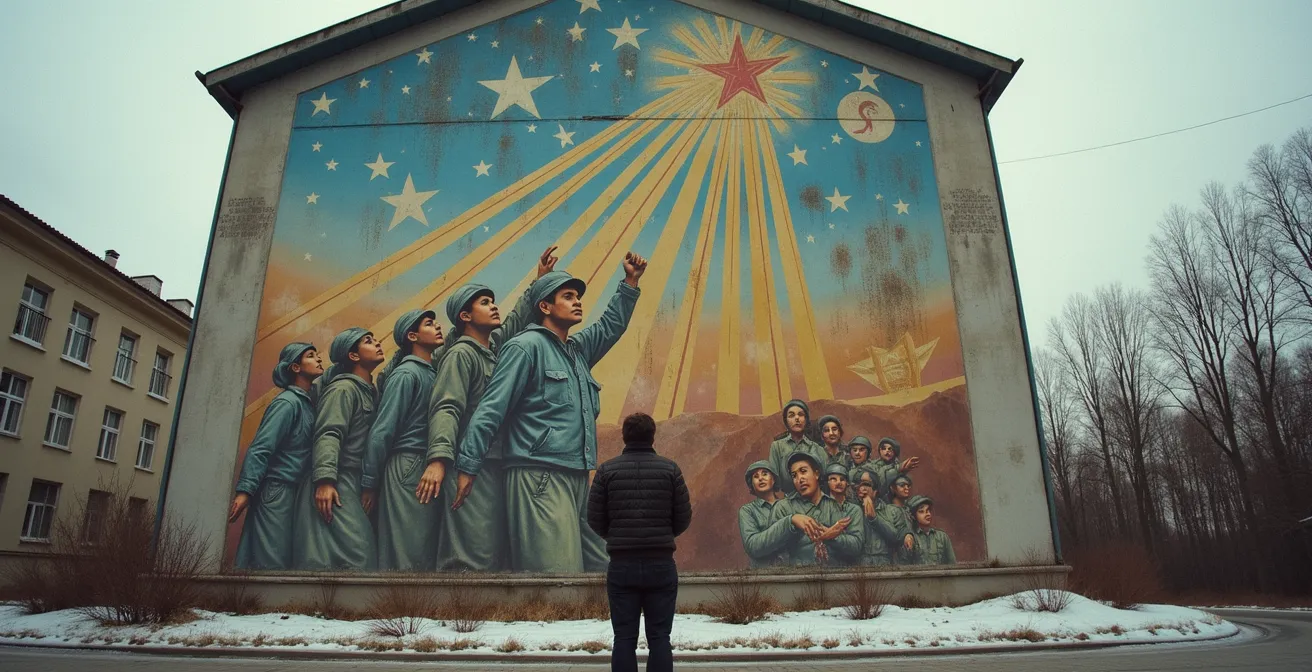
To truly grasp this vanished world, the next step is to explore these sites not as a tourist, but as a visual archaeologist, equipped with the tools to read the stories cemented into the walls.