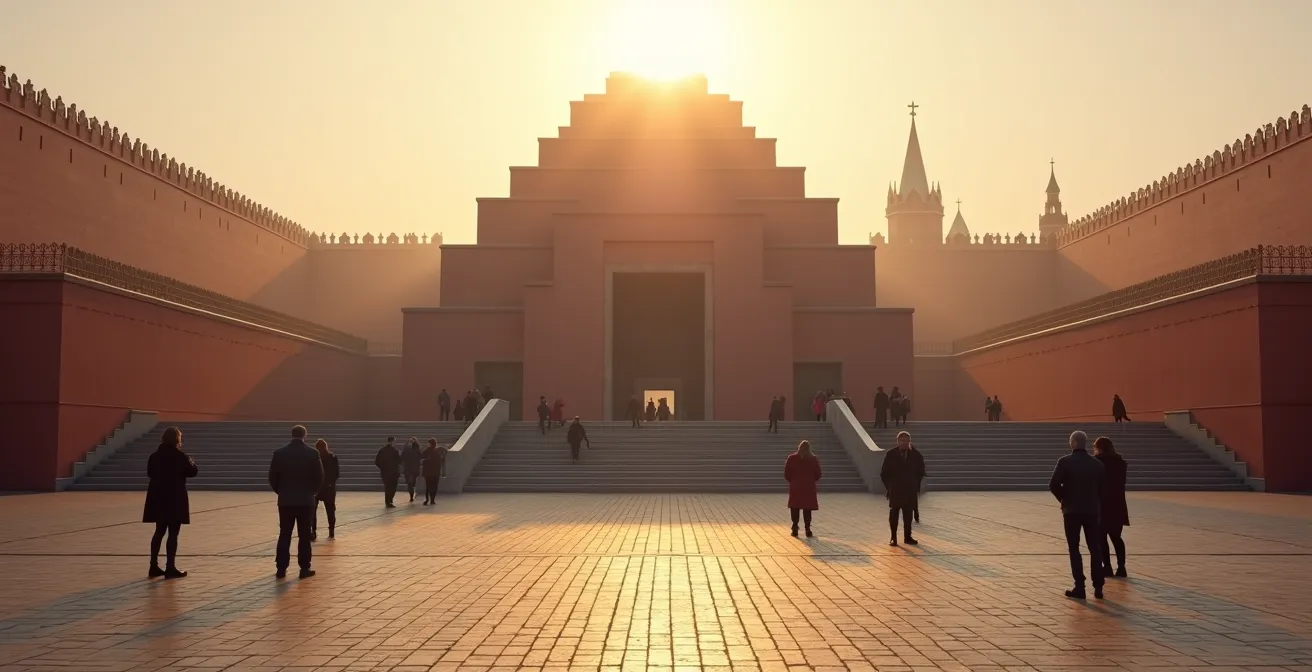
Many see Lenin’s Mausoleum as a macabre relic of a bygone era. However, this analysis reveals it as an active political instrument, meticulously maintained to stage Russia’s unresolved dialogue with its Soviet past. From its rigid visitor rules to the multi-million ruble science preserving the body, every detail serves a modern political purpose, making a visit less about seeing a corpse and more about witnessing history in action.
For a century, the granite pyramid on Red Square has posed a silent, enduring question at the heart of modern Russia. Inside, the body of Vladimir Lenin lies in state, a seemingly permanent fixture from a supposedly defunct ideology. Each year, it draws visitors who navigate a strict, solemn ritual to spend a few moments in his presence. For many, the site is a source of macabre curiosity—a bizarre holdover from the Soviet Union. But to dismiss it as merely a ghoulish tourist trap is to miss the point entirely.
The standard explanations—that he was preserved to create a communist icon or a secular saint—are true but incomplete. They fail to capture why, 30 years after the USSR’s collapse, this state-sponsored necropolis continues to function with such precision. The real story is not about the past, but about the present. The Mausoleum is a living political instrument, a carefully managed piece of theatre where Russia’s complex, often contradictory, relationship with its Soviet identity is performed daily.
This analysis moves beyond the typical travel guide to deconstruct the Mausoleum as a political historian would. For a French visitor, accustomed to the grand national narratives enshrined in monuments like the Panthéon or Napoleon’s tomb at Les Invalides, the site offers a fascinating parallel. It is an exploration of how a nation uses its dead to shape the identity of the living. We will examine the choreographed visitor rituals, the costly science of ideological maintenance, the ongoing political debate over burial, and its place within Moscow’s wider Soviet heritage. This is not just a guide to visiting a tomb, but a key to understanding a nation’s soul.
For those who prefer a visual format, the following documentary provides an excellent overview of the historical context surrounding Lenin and the Russian Revolution, setting the stage for the monument’s creation.
To fully grasp the significance of this unique site, this article deconstructs the experience layer by layer. From the strict rules of entry to the wider context of Soviet heritage in Moscow, each section provides a piece of the puzzle, revealing the Mausoleum as more than just a tomb.
Summary: Unpacking the Political Theatre of Lenin’s Mausoleum
- Phone, hands, and silence: The 3 rules that will get you kicked out of the Mausoleum
- How do scientists maintain Lenin’s body looking “fresh” every week?
- Who is buried behind the Mausoleum besides Stalin?
- Will Lenin ever be buried: The ongoing debate in modern Russia
- Tuesday or Thursday: Which morning has the shortest queue for Lenin?
- When is Lenin’s Mausoleum actually open (and why is it free)?
- Is the Taganka Cold War Bunker worth the €40 entrance fee?
- Where to find authentic Soviet heritage beyond the Red Square crowds?
Phone, Hands, and Silence: The 3 Rules That Will Get You Kicked Out of the Mausoleum
The experience of visiting Lenin’s Mausoleum begins not at the tomb’s entrance, but in the queue that snakes through the Alexander Garden. It is here that the visitor is first introduced to the unwritten script of a choreographed secular ritual. The process is less a tourist visit and more a solemn procession, with a set of rigid rules designed to enforce a specific mood of reverence and respect. These are not mere suggestions; they are strictly enforced by stone-faced guards who will not hesitate to remove anyone who deviates from the protocol.
Understanding these rules is essential for a smooth visit. They transform a simple viewing into a powerful, immersive experience that speaks volumes about the site’s enduring status as a political instrument rather than a historical exhibit.
- Photography is strictly forbidden: This is the cardinal rule. All cameras and phones must be stored away. The intention is to prevent the “relic” from being trivialized into a social media selfie spot. You are there to witness, not to document.
- Maintain absolute silence: No talking, whispering, or any form of communication is permitted inside the viewing chamber. This enforced silence creates an atmosphere of a sacred space, compelling visitors to focus solely on the figure in the sarcophagus.
- Keep hands out of pockets: A peculiar rule that dates back to Cold War-era security paranoia, it is still enforced today. It ensures visitors’ hands are visible, reinforcing the state’s total control over the environment.
- Remove all headwear: As a sign of respect, all hats, caps, and even sunglasses must be removed before entering.
- Do not stop: Visitors are required to keep moving in a continuous loop around the sarcophagus. Lingering is not permitted, ensuring a constant, controlled flow and preventing any individual from having a prolonged, personal moment.
These regulations are not just about security; they are about performance. They compel each visitor to become a participant in a state-directed play about reverence for history, stripping away individual agency in favor of collective, orderly observance.
How Do Scientists Maintain Lenin’s Body Looking “Fresh” Every Week?
The preservation of Lenin’s body is arguably one of the most unique and enduring scientific projects of the last century. It is a testament not just to biochemical ingenuity, but to the concept of ideological maintenance. The “Lenin Lab,” a team of scientists at the All-Russian Institute of Medicinal and Aromatic Plants, is tasked with a singular mission: to fight the natural course of decay and maintain the illusion of permanence. This effort is far from a one-time procedure; it’s a continuous, resource-intensive process.
Every 18 months, the body undergoes a complete re-embalming. It is submerged in a series of chemical baths containing glycerol, formaldehyde, and other agents. Over the decades, scientists have had to become pioneers, developing techniques to preserve the body’s “landscape.” This has included replacing deteriorating skin and tissue with synthetic materials like paraffin and carotene to maintain a lifelike appearance. Even his eyeballs are now synthetic spheres to prevent the sockets from collapsing, addressing the question many visitors have about whether the body is “real.” It is a hybrid of original organic material and meticulous reconstruction.

This scientific endeavor comes at a significant cost, representing a deliberate state investment. A 2016 contract showed that the Federal Guard Service allocated around $197,000 for that year’s preservation work alone. In a capitalist Russia, this expenditure is a powerful political statement. It confirms that the state still considers the maintenance of this particular Soviet symbol a priority, justifying the cost as necessary for preserving a piece of national, albeit controversial, heritage. The science is not just about preserving a corpse; it is about preserving an idea.
Who Is Buried Behind the Mausoleum Besides Stalin?
Lenin does not rest in isolation. The Mausoleum is the centerpiece of a larger, sprawling necropolis along the Kremlin wall, a veritable “who’s who” of the Soviet Union. This collection of graves and urns serves as a monumental dialogue, a physical timeline of the heroes, leaders, and pivotal figures sanctioned by the state. For a visitor, walking along this wall after exiting the Mausoleum provides crucial context, transforming Lenin from a singular figure into the founding father of a pantheon of Soviet titans.
The burials are a hierarchy in themselves. The most prominent figures, like Joseph Stalin (who lay beside Lenin in the Mausoleum from 1953 to 1961 before being moved) and Leonid Brezhnev, are given full burials marked by stoic busts. Others, including celebrated cosmonaut Yuri Gagarin and legendary World War II commander Marshal Zhukov, were cremated, their ashes interred directly into the Kremlin wall. The presence of John Reed, an American journalist who chronicled the Bolshevik Revolution in “Ten Days That Shook the World,” is a surprising inclusion that shows the international scope of the communist project in its early days.
This table from a comprehensive analysis of the necropolis highlights some of the most notable figures interred here.
| Name | Position | Burial Year | Burial Type |
|---|---|---|---|
| Joseph Stalin | Soviet Premier | 1961 | Full burial with bust |
| Leonid Brezhnev | General Secretary | 1982 | Full burial with bust |
| Yuri Gagarin | First Cosmonaut | 1968 | Ashes in wall |
| John Reed | American Journalist | 1920 | Full burial |
| Marshal Zhukov | WWII Hero | 1974 | Ashes in wall |
This practice of honoring state figures with a Kremlin burial came to an end in the 1980s. According to Kremlin archives, the last person to be honored with a place in this hallowed ground was Minister of Defence Dmitriy Ustinov in December 1984, marking the unofficial end of an era for this Soviet pantheon.
Will Lenin Ever Be Buried: The Ongoing Debate in Modern Russia
The question of whether to bury Lenin is far more than a logistical problem; it is a profound national dilemma that exposes the deep schisms in modern Russian society. For a century, his body has been a secular relic at the center of the state’s ideology. Today, it is the focal point of a debate about how Russia should reconcile with its Soviet past. Should it be buried with respect, closing a tumultuous chapter, or preserved as an integral, if painful, part of the national story?
Public opinion is deeply divided, though it has shifted over time. According to a 2017 survey showing over 60% of Russians support burial, the desire to move on is significant. However, the nuance is key: many within that majority believe the burial should only happen after the last generation that lived in the Soviet Union has passed away, suggesting a desire to avoid offending the sentiments of a large part of the population. For older generations, Lenin remains a symbol of a powerful and globally respected superpower, and removing him feels like an erasure of their own history and identity.
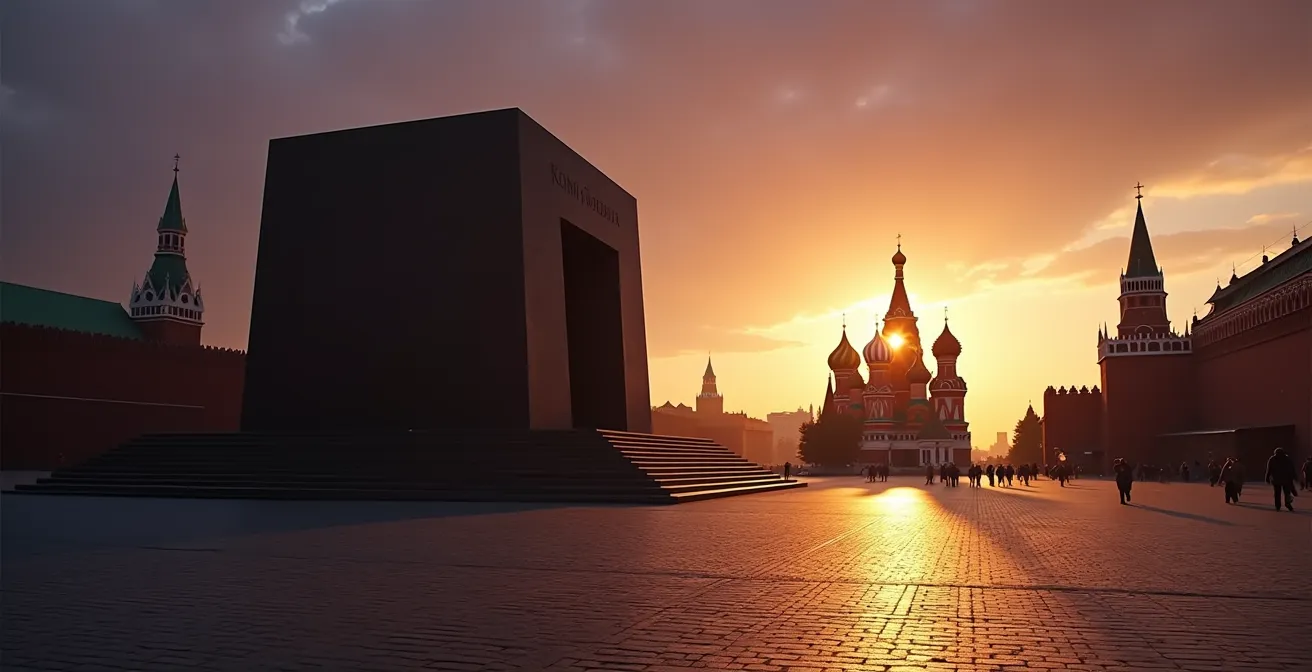
Despite the public lean towards burial, the state’s position remains firmly rooted in the status quo. The Kremlin understands the symbolic power of the Mausoleum as a political instrument. As Vladimir Putin has stated, Lenin’s presence on Red Square is a historical fact that cannot be easily undone without causing significant societal division.
There is no plan to remove Lenin from the mausoleum.
– Vladimir Putin, Statement to media in 2012
This official stance effectively tables the debate indefinitely. Removing Lenin would alienate the communist-leaning electorate and be seen as a capitulation to liberal critics. By leaving him in place, the state avoids a contentious decision while maintaining a powerful symbol it can deploy as needed. The preserved leader remains, for now, more useful as a political pawn than as a buried historical figure.
Tuesday or Thursday: Which Morning Has the Shortest Queue for Lenin?
While understanding the political symbolism of the Mausoleum is fascinating, the practicalities of the visit are just as important for any traveler. Navigating the queue and security efficiently can make the difference between a frustrating wait and a smooth, contemplative experience. The key is strategic planning, as visitor flow varies significantly depending on the day and season.
The most important piece of practical information is the location of the entrance. Do not attempt to join a queue directly on Red Square; the official entry point is through the security checkpoint at the Kutafiya Tower, which leads into the Alexander Garden. Once through security, you will be directed to the official line for the Mausoleum. Wait times can be unpredictable, but certain patterns have emerged. Tuesdays and Thursdays are generally the best days to visit, as they avoid the weekend swell of local visitors and the larger tour groups that often arrive on Wednesdays and Saturdays.
Here is a guide to planning your visit for the shortest possible wait:
- Best Days: As mentioned, Tuesday or Thursday mornings offer the best chance to avoid the largest crowds.
- Optimal Arrival Time: Aim to arrive around 9:45 AM. This allows you to miss the initial rush of people who line up before the 10:00 AM opening but gets you in before the bulk of mid-morning tour groups.
- Summer vs. Winter: Be prepared for a significant difference depending on the season. In the peak summer months, wait times can easily stretch to 1.5 hours or more. In the cold of winter, the queue can be as short as 15 minutes.
Finally, always check for closures before you go. The Mausoleum is typically closed to the public for one to two months each year, usually between mid-February and mid-April, for the extensive re-embalming procedures. Unexpected closures for public holidays or official events on Red Square can also occur, so a quick online check is always advisable.
When Is Lenin’s Mausoleum Actually Open (and Why Is It Free)?
The Mausoleum’s limited opening hours and free-entry policy are not arbitrary; they are deeply rooted in its ideological function. The site is generally open to the public on Tuesday, Wednesday, Thursday, and Saturday, from 10:00 AM to 1:00 PM. It remains closed on Mondays, Fridays, and Sundays. These restricted hours, combined with an annual closure for maintenance that can last anywhere from 45 to 60 days, reinforce its status as a special, state-controlled institution rather than a typical, always-accessible tourist attraction.
Perhaps the most surprising aspect for many visitors is that entry is completely free. This is a deliberate ideological choice dating back to its inception in 1924. To charge an admission fee would be to commercialize the experience, transforming what was conceived as a “secular pilgrimage site” into a simple commercial attraction. The state’s decision to bear the full cost of maintenance and public access positions the Mausoleum as a “gift to the people,” a piece of national heritage that transcends monetary value.
For a French visitor, this policy might recall France’s own state-sponsored cultural initiatives, such as free museum entry for EU citizens under 26. In both cases, free access is not merely an economic decision but a powerful political statement. It declares that certain cultural or historical touchstones are considered so fundamental to the national identity that access to them should be a right, not a transaction. By keeping the Mausoleum free, the Russian state subtly reaffirms Lenin’s place within the national narrative, insulating his legacy from the market forces that dominate modern Russia.
Is the Taganka Cold War Bunker Worth the €40 Entrance Fee?
For visitors interested in Moscow’s Soviet past, a common question arises: after seeing the authentic, solemn atmosphere of the Mausoleum, is it worth visiting a commercialized site like the Bunker-42 on Taganka? The contrast between the two experiences is stark and highlights a fundamental difference in how history is presented and consumed.
The Mausoleum is a genuine historical instrument, preserved in its original state and function. The experience is silent, controlled, and free, demanding reverence from the visitor. Bunker-42, a former secret military command post, has been transformed into a private museum and entertainment complex. As one analysis notes, the experience is vastly different.
The Bunker’s highly commercialized and dramatized experience contrasts sharply with the stark, silent authenticity of the Lenin Mausoleum visit.
– Moscow Tourism Review, Comparative analysis of Soviet heritage sites
Here, history is theatrical. For a fee of around €40, visitors can take part in interactive tours, play laser tag in the tunnels, or watch dramatized re-enactments of a nuclear launch. While the bunker itself is authentic, the experience is curated for entertainment rather than sober reflection. The choice between them depends entirely on what the visitor is seeking: authentic historical immersion or historical-themed entertainment. A direct comparison of the value propositions makes this clear.
| Experience | Cost | Duration | Authenticity Level |
|---|---|---|---|
| Bunker-42 Taganka | €40 | 90 minutes | Theatrical/Commercial |
| Lenin’s Mausoleum | Free | 10 minutes | Authentic/Solemn |
| Bunker-703 Alternative | €20 | 60 minutes | Engineering Focus |
| Cold War Museum | €15 | 2 hours | Educational/Artifacts |
Ultimately, Bunker-42 can be an enjoyable experience, but it should not be mistaken for the type of authentic, politically charged heritage that the Mausoleum represents. It is a product, while the Mausoleum remains a statement.
Key Takeaways
- Lenin’s Mausoleum is not a passive relic but an active political instrument used to shape Russia’s modern identity.
- The strict visitor rules are a choreographed ritual designed to enforce reverence and state control.
- The high cost of scientific preservation is a deliberate state investment in maintaining a powerful national symbol.
Where to Find Authentic Soviet Heritage Beyond the Red Square Crowds?
While Lenin’s Mausoleum is the symbolic heart of Soviet Moscow, the city is a living museum of that era, filled with architectural marvels, monumental art, and sites that tell the story of a 70-year ideological experiment. For the visitor wishing to continue their exploration, moving beyond the confines of Red Square reveals a wealth of authentic heritage that is often more integrated into the daily life of the city.
Case Study: The Moscow Metro as a Living Soviet Museum
The Moscow Metro is more than a transit system; it’s a series of underground palaces conceived as art galleries for the people. Each station on the original lines tells an ideological story. Mayakovskaya station, an icon of Art Deco elegance, features stunning ceiling mosaics by Alexander Deyneka depicting “24-Hour Soviet Sky,” celebrating aviation and progress. In contrast, Ploshchad Revolyutsii (Revolution Square) is populated by 76 larger-than-life bronze statues of Soviet citizens—soldiers, farmers, athletes, and students—frozen in heroic poses. Rubbing the nose of the border guard’s dog is a famous good-luck tradition. These stations were designed to be inspiring, showcasing the promise of the communist future to the masses who used them daily.
To truly understand the scale of the Soviet project, one must explore these other landmarks. Each offers a different perspective on the era, from its utopian architectural ambitions to the stark reality of its fallen monuments.
Your Action Plan: Auditing a Site for Authentic Soviet Heritage
- Identify Contact Points: List the different types of heritage to look for. Are you seeking monumental propaganda (statues, mosaics), revolutionary architecture (Constructivism), or sites of political power (KGB headquarters)?
- Collect On-Site Evidence: Inventory the specific Soviet symbols present. Look for original hammer and sickle emblems, red stars, socialist realist murals, or dedications to communist leaders.
- Assess Coherence and Narrative: Confront the site’s presentation with historical fact. Does it offer an objective view, or is it pure nostalgia? Look for signs of modern revisionism or a balanced perspective.
- Evaluate Mémorability and Uniqueness: Determine if the site is a generic example (like a standard Lenin statue) or a unique and influential landmark (like the Melnikov House or the Narkomfin Building).
- Create an Integration Plan: Prioritize your visits based on this audit. You might choose to dedicate a day to exploring Constructivist architecture or to tracing the ideological art through the Metro system.
Exploring these sites offers a richer, more nuanced understanding of the Soviet legacy, moving beyond the single, powerful symbol of Lenin to see how an entire society was reshaped by ideology.
Begin your own historical exploration of Moscow by using this guide to look beyond the monuments and engage with the city as a living document of a complex and fascinating past.