The €10 ticket for Malevich’s “Black Square” isn’t for a painting; it’s for an intellectual itinerary through 20th-century Russia’s artistic soul.
- Its value comes from its context: it is the destination of a journey that begins with 19th-century realism and ends with the fallen idols of the Soviet Union.
- The painting acts as an “artistic rupture,” a zero point that redefines art, a concept you can only grasp by seeing what came before and after it in the same museum complex.
Recommendation: Prioritize the New Tretyakov Gallery (Krymsky Val) to experience this unique historical and artistic narrative firsthand, transforming a simple visit into a profound exploration.
Standing before Kazimir Malevich’s “Black Square,” a common thought echoes in the quiet gallery: “It’s just a black square. Why is this considered a masterpiece, and how can its value be captured by a mere €10 museum ticket?” This skepticism is understandable. Most discussions about the work get lost in academic jargon about “Suprematism” or the “zero point of painting,” failing to connect with the visitor’s experience. They treat the painting as an isolated object, a sterile artifact to be revered without question.
The truth is, you are not paying €10 to see a black painting. You are paying for a key. This key unlocks a physical and intellectual journey through one of the most turbulent and creative centuries in human history. The real value of the “Black Square” is not on the canvas but in its unparalleled power to contextualize everything around it. It is the narrative climax of a story that begins across town with golden-hued portraits and ends just outside the gallery doors, among the toppled statues of a fallen empire. This guide will not just explain the painting; it will reveal its value as the epicentre of a complete artistic and historical itinerary.
By following this curatorial path, you will see how Russian art shattered its own traditions, creating a new visual language that continues to influence our world. We will navigate the essential choices a visitor must make, from which museum to prioritize to understanding the ideological shifts visible in the art itself. This is your guide to seeing the “Black Square” not as an object, but as an experience.
Summary: Unlocking the Code of the Black Square
- Lavrushinsky vs. Krymsky Val: Which Tretyakov should you visit first?
- Girl with Peaches vs. Worker with Hammer: The shift in 20th-century art
- Muzeon Park: How to see the fallen Soviet statues for free outside the gallery?
- The Tretyakov shop: Finding design gifts inspired by Constructivism
- Why you must book New Tretyakov tickets 3 days in advance for blockbusters?
- Tretyakov or Pushkin Museum: Which one should art lovers prioritize?
- The Demon Seated: How Vrubel’s obsession led to the birth of Russian Symbolism?
- Which 3 Moscow art galleries rival the Centre Pompidou in quality?
Lavrushinsky vs. Krymsky Val: Which Tretyakov should you visit first?
Your journey to understanding the “Black Square” begins with a fundamental choice that defines your entire Moscow art experience: which Tretyakov Gallery to visit? The State Tretyakov Gallery is split into two main buildings, each representing a different universe of Russian art. The historic building in Lavrushinsky Lane houses the definitive collection of Russian art from the 11th century to the early 20th, a world of gilded icons, epic historical canvases, and sun-drenched Impressionist portraits. It is the keeper of the traditional Russian Soul.
In contrast, the New Tretyakov Gallery on Krymsky Val is the home of the 20th-century avant-garde and beyond. Housed in a stark, Soviet Modernist building, it contains the revolution. This is where you find the “Black Square.” The New Tretyakov collection showcases art from the 1910s to the 2020s, covering over 110 years of Russian modernism. The architectural contrast between the two buildings is a powerful metaphor for the artistic rupture you are about to witness.
To truly grasp the shock of Malevich’s work, you must understand what it was rebelling against. Therefore, the ideal intellectual itinerary involves visiting both. However, if time is limited, the choice depends on your goal. For a French visitor familiar with classical traditions, prioritizing the New Tretyakov is essential. It offers a radical experience, a narrative of artistic upheaval unavailable in the halls of the Louvre or Musée d’Orsay. It is the destination where the value of the “Black Square” becomes clear.
Your Strategic Visit Plan for Moscow
- If you have only one afternoon, prioritize Krymsky Val (New Tretyakov) for its unique collection of avant-garde art, including Malevich’s original Black Square.
- For a full day, start at Lavrushinsky at 10 am to absorb the foundations of classical Russian art (allow 2-3 hours).
- Take a lunch break near Tretyakovskaya metro station to recharge (1 hour).
- Proceed to Krymsky Val for the 20th-century collection, dedicating 3-4 hours to the permanent exhibition.
- Conclude your visit with a contemplative walk in the adjacent Muzeon Park among the Soviet-era statues (free entry).
Girl with Peaches vs. Worker with Hammer: The shift in 20th-century art
The profound shift that culminates in the “Black Square” is best understood by contrasting the art that came before with the art that followed. At the Old Tretyakov, you can admire Valentin Serov’s “Girl with Peaches” (1887). It is a masterpiece of Russian Impressionism, bathed in soft light, capturing a fleeting moment of youthful innocence. The goal is beauty, realism, and emotion conveyed through a recognizable scene. This was the pinnacle of art as a mirror to the world.
Less than three decades later, Malevich hung his “Black Square” (1915) in the corner of a room, a space traditionally reserved for religious icons. This was not a mirror, but a void; not a depiction of life, but an announcement of a new reality. As Malevich himself positioned his work, it was an artistic rupture intended to liberate art from the “ballast of the objective world.” In his 1915 manifesto, he declared: ‘Up until now there were no attempts at painting as such, without any attribute of real life…’ His goal was to access “pure feeling” through non-objective form.
This radical idea was followed by another extreme: Socialist Realism, which forced art to serve the state, producing idealized images of workers and farmers. The “Black Square” stands as the absolute antithesis to both the romanticism of the 19th century and the propagandistic art that would soon dominate the Soviet Union. It is a statement of pure artistic autonomy.
| Art Movement | Key Work | French Parallel | Philosophical Stance |
|---|---|---|---|
| Russian Impressionism | Girl with Peaches (1887) | Renoir’s portraits | Beauty through light and color |
| Socialist Realism | Worker imagery (1920s-50s) | No equivalent | Art serves the state |
| Suprematism | Black Square (1915) | Beyond Cubism | Pure feeling in art |
Muzeon Park: How to see the fallen Soviet statues for free outside the gallery?
The “Black Square’s” value is magnified by its immediate physical context. The New Tretyakov Gallery is not an isolated building; it forms a single cultural complex with the adjacent Muzeon Park of Arts. This connection is not a coincidence but a crucial part of the narrative. Inside the gallery, you see halls dedicated to Socialist Realism—the official, state-sanctioned art of the USSR, filled with heroic depictions of Lenin, Stalin, and idealized workers. This art was created to project an image of immutable power and ideological purity.
Then, you step outside. In Muzeon Park, you encounter the very same figures—Lenin, Stalin, Dzerzhinsky—not on pedestals, but lying on the ground, gathered in a “graveyard” of fallen monuments. These are the statues torn down after the collapse of the Soviet Union. The park offers a powerful, melancholic coda to the story told inside. The ideological certainty of the paintings gives way to the cracked granite and weathered bronze of deposed idols. It’s a free, open-air museum that demonstrates the transience of the very power the art inside sought to immortalize.
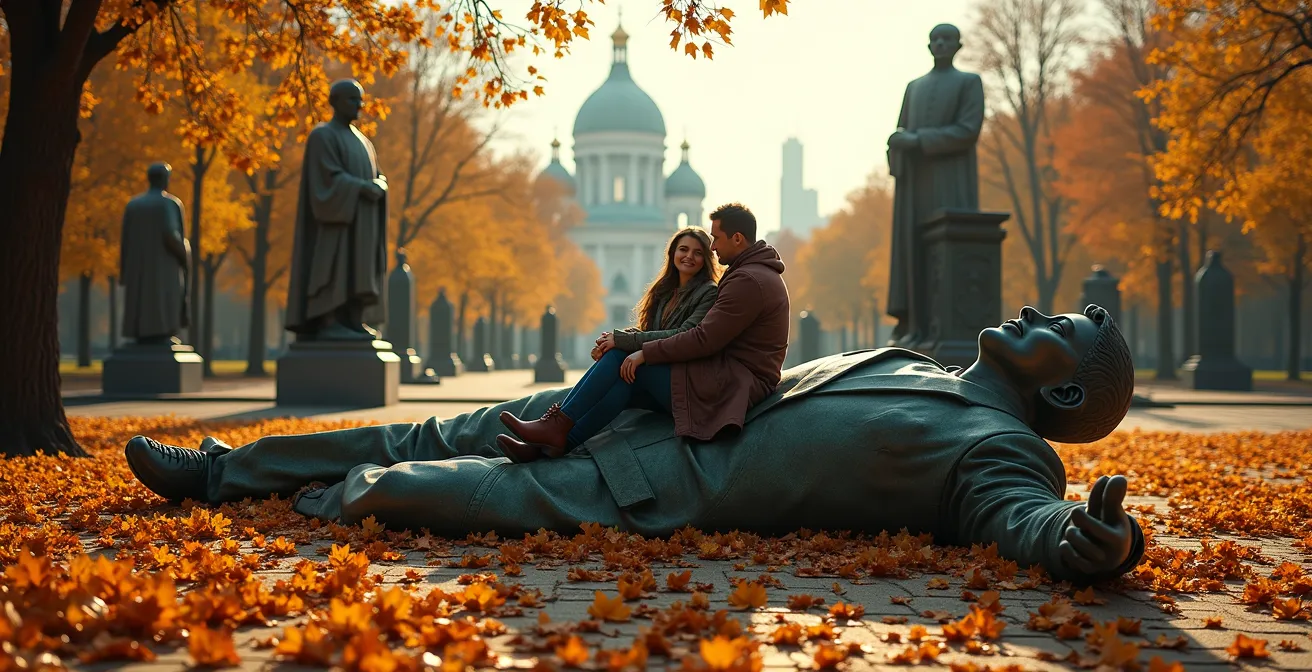
Walking through Muzeon Park after visiting the New Tretyakov transforms the art from a purely aesthetic experience into a profound lesson on history, ideology, and the rise and fall of empires. The “Black Square,” as the ultimate rejection of figurative, message-driven art, seems all the more radical and prescient when you witness the fate of the hyper-figurative, political art that followed it. Your €10 ticket grants you access not just to the painting, but to this entire, unforgettable dialogue between art and history.
- Start inside the New Tretyakov’s Soviet Realism halls to understand the original context of the statues.
- Exit through the main entrance and turn right towards Muzeon Park (free entry is available).
- Follow the main path to encounter deposed leaders like Stalin and Lenin, often arranged in historical order.
- Conclude at the contemporary sculpture section, which shows post-Soviet artistic responses to this legacy.
- Allow 45-60 minutes for a contemplative walk, which offers many unique photo opportunities.
The Tretyakov shop: Finding design gifts inspired by Constructivism
The legacy of the “Black Square” and the avant-garde movement it spawned is not confined to the gallery walls. It extends into the visual language of our modern world. The Tretyakov’s museum shop is more than a place for souvenirs; it’s a living gallery demonstrating how the radical ideas of Suprematism and Constructivism were absorbed into design and fashion. Artists like Varvara Stepanova, Alexander Rodchenko, and El Lissitzky, peers of Malevich, sought to apply these new artistic principles to everyday life, from textiles and posters to architecture.
As the Museum Design Curator for the Tretyakov Gallery Magazine notes, “The bold typography and geometric forms are the ancestors of much of today’s visual culture.” When you browse the items in the shop, you are seeing this legacy in action. The geometric patterns on a silk scarf, the minimalist typography on a poster, or the abstract forms of a piece of jewelry are direct descendants of the artistic revolution that Malevich initiated. This experience connects the high-minded theory of the avant-garde to tangible, beautiful objects.
For a visitor from Paris, the cradle of modern fashion and design, this is a particularly revealing experience. It highlights how a parallel and equally powerful design modernity emerged from Russia’s social and artistic upheaval. The shop offers an opportunity to take home a piece of this revolutionary aesthetic, transforming an abstract concept into a personal possession. This final step in the visitor’s journey—from historical art to modern design—completes the narrative, showing the enduring influence of the avant-garde.
- Silk scarves featuring Varvara Stepanova’s textile patterns (€45-80), a perfect addition to a Parisian wardrobe.
- El Lissitzky typography posters in museum-quality prints (€25-60), ideal for modern apartment décor.
- Rodchenko-inspired geometric notebooks and stationery sets (€15-35), offering functional art for daily use.
- Suprematist jewelry pieces based on Malevich’s forms (€50-150), a form of wearable avant-garde.
- Limited edition exhibition catalogs with essays by international scholars (€40-70), serving as intellectual souvenirs.
Why you must book New Tretyakov tickets 3 days in advance for blockbusters?
While the “Black Square” is the philosophical heart of the New Tretyakov, the gallery is also a major venue for blockbuster temporary exhibitions that draw huge crowds. This practical consideration is key to planning your visit. For the permanent collection, which includes Malevich’s masterpiece and the core of the avant-garde works, advance booking is generally not necessary, especially if you visit on a weekday. The entry fee is remarkably modest; 2025 museum pricing guides list standard entry at 500-600 RUB, which is approximately €5-6. The €10 figure in our question is a generous estimate, making the value proposition even more striking.
However, for major temporary shows dedicated to artists like Repin or Kuindzhi, which can generate queues for hours, booking online 3 to 5 days in advance is absolutely essential during peak season (May-September). These exhibitions are often held in separate halls but can impact the overall visitor flow in the building.
A smart strategy for the French tourist is to aim for a midweek visit to enjoy the permanent collection in relative calm. The gallery also has extended hours on Thursdays, Fridays, and Saturdays (until 9 pm), offering a wonderful opportunity for a more serene and contemplative experience. By purchasing tickets directly from the official gallery website, you can avoid third-party fees and ensure a smooth entry. This practical planning allows you to focus your energy not on waiting in line, but on immersing yourself in the profound artistic and historical narrative that the New Tretyakov so uniquely offers.
- Book online 3-5 days ahead for temporary exhibitions during the peak season (May-September).
- Note: Malevich’s Black Square is in the permanent collection, so no advance booking is typically needed for it.
- Visit on a Tuesday or Wednesday for the smallest crowds and avoid weekends if possible.
- Purchase tickets directly from the official website to avoid unnecessary third-party fees.
- Consider visiting during extended hours (Thursday-Saturday until 9 pm) for a calmer atmosphere.
Tretyakov or Pushkin Museum: Which one should art lovers prioritize?
For an international art lover in Moscow, especially one from France, another crucial choice arises: the Tretyakov or the Pushkin Museum? The Pushkin Museum is a world-class institution, often compared to a mini-Hermitage. Its deep collections of European art, particularly the incredible Shchukin and Morozov collections of French Impressionist and Post-Impressionist masters, are a major draw. For a visitor wanting to see how Russian connoisseurs collected Matisse and Picasso, the Pushkin is a must-see.
However, if your goal is to understand the seismic shift in 20th-century art through a uniquely Russian lens, the Tretyakov complex is the undeniable priority. The Pushkin shows you the world through Russian eyes; the Tretyakov shows you the Russian soul itself. The journey from the romantic realism of Lavrushinsky Lane to the abstract revolution at Krymsky Val is a narrative that no other museum in the world can offer. It is an internal dialogue within a nation’s art, a story of self-discovery and rebellion.
As one Art History Professor from the Moscow Museum Studies Guide memorably puts it: “If your goal is to understand the 20th-century revolution that birthed the Black Square, the New Tretyakov is non-negotiable.” Seeing French Impressionism is wonderful, but you can do that in Paris. You can only experience the full, devastating impact of the Russian avant-garde in its native home, contextualized by its own history.
| Aspect | Tretyakov Gallery | Pushkin Museum |
|---|---|---|
| Core Identity | The Russian Soul – art by Russians | The World Through Russian Eyes |
| For French Visitors | Discover unknown Russian masters | See French Impressionists collected by Russians |
| Unique Selling Point | Malevich’s Black Square original | Shchukin/Morozov collections |
| Time Needed | 4-5 hours for both buildings | 3-4 hours |
| Opening Hours | 10am-6pm (Thu-Sat until 9pm) | 10am-6pm typically |
The Demon Seated: How Vrubel’s obsession led to the birth of Russian Symbolism?
The “Black Square” did not emerge from a vacuum. It was the explosive culmination of a deep-seated spiritual and philosophical shift that began decades earlier. To find the origins of this rupture, one must look to the work of Mikhail Vrubel, the master of Russian Symbolism. His painting “The Demon Seated” (1890), a brooding, monumental figure composed of fractured, jewel-like brushstrokes, represents a pivotal moment. It marks the definitive turn away from depicting external, objective reality and towards exploring the internal world of the psyche, myth, and spirit.
Much like his French contemporary Gustave Moreau, Vrubel was less interested in what the world looked like and more interested in what it felt like. His work is charged with a psychological intensity and a rejection of pure realism that directly paved the way for the next generation. This exploration of the inner self provided the philosophical foundation for Malevich’s later leap into complete abstraction. If Vrubel opened the door to a world beyond realism, Malevich charged right through it. The case study on Vrubel’s ‘Demon’ highlights how this exploration of the inner psyche directly paved the way for Malevich’s abstraction 25 years later.
Seeing Vrubel’s “Demon” in the Tretyakov’s collection before approaching the avant-garde halls is essential. You witness the beginning of the crack in the edifice of 19th-century realism. The solid forms begin to dissolve into pure texture and colour; the narrative becomes ambiguous and psychological. It is here, in the melancholic gaze of the Demon, that the journey towards the “Black Square” truly begins. Vrubel’s turn towards a spiritual, inner world was the crack in the door that Suprematism would eventually kick wide open, and seeing his work provides a crucial piece of the puzzle.
Key Takeaways
- The value of the “Black Square” is contextual; it must be seen as part of a larger artistic and historical journey offered by the Tretyakov complex.
- The New Tretyakov Gallery (Krymsky Val) is the essential destination for understanding the 20th-century avant-garde, representing a complete artistic rupture from classical Russian art.
- The experience extends beyond the gallery walls into Muzeon Park, where the fate of Soviet-era art provides a powerful real-world epilogue.
Which 3 Moscow art galleries rival the Centre Pompidou in quality?
For the visitor whose taste is calibrated by the standards of the Centre Pompidou in Paris, Moscow offers a surprisingly robust and compelling contemporary art scene. While the New Tretyakov provides the historical backbone of the Russian avant-garde, several other institutions provide a window into today’s global and Russian art world. Understanding this ecosystem completes the intellectual itinerary and places the “Black Square’s” legacy in a modern context.
First and foremost, the New Tretyakov Gallery itself is the historical equivalent to the Pompidou’s modern collection. The floors dedicated to the 1900-1930s avant-garde represent a period of explosive creativity that is Russia’s unique and powerful contribution to modernism.
Second, the Garage Museum of Contemporary Art is Moscow’s true contemporary equivalent to the Pompidou. Housed in a stunning building redesigned by Rem Koolhaas, it features world-class international programming, cutting-edge exhibitions, and a deep engagement with contemporary Russian artists. It is the epicentre of Moscow’s current art dialogue.
Finally, the Winzavod Centre for Contemporary Art offers a different model, more akin to Paris’s dynamic Belleville gallery scene. This former wine factory has been converted into a vibrant art complex housing multiple independent galleries, artist studios, and workshops. It provides a ground-level view of the commercial and emerging art scenes. Visiting these three venues, as detailed in guides for contemporary art fans, offers a comprehensive picture of Moscow’s artistic landscape, from its revolutionary past to its globalized present.
Ultimately, the €10 entry fee is not a valuation of a piece of canvas but an access fee to a story. It is the price of an intellectual key that unlocks the dramatic, tragic, and exhilarating narrative of Russian art in the 20th century. To see the “Black Square” is to stand at the very zero point of a revolution and to be able to trace its origins and its aftermath, all within a few square kilometers. The next logical step is not to debate its price, but to undertake the journey yourself and witness how these artistic revolutions unfold on the walls of Moscow’s incredible galleries.