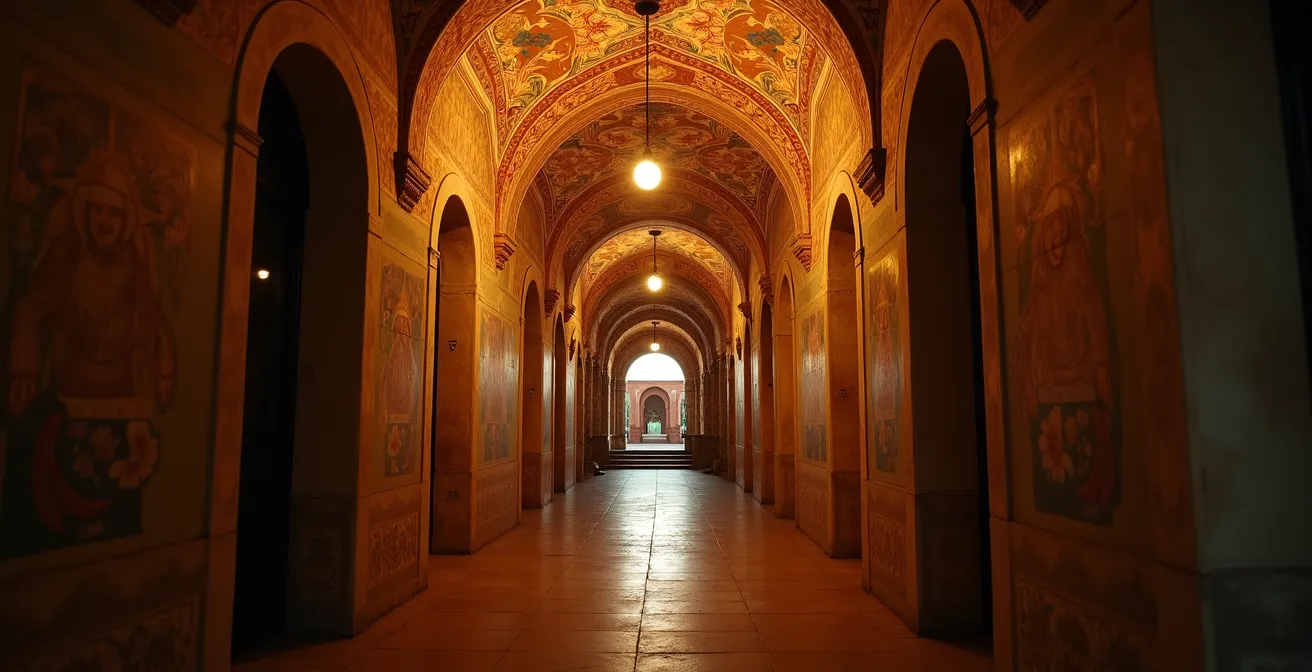
Contrary to the Western expectation of a grand, unified nave, Saint Basil’s Cathedral was never designed for large congregations. Its seemingly cramped interior is a deliberate architectural choice, representing a symbolic map of the Heavenly Jerusalem. The collection of small, separate chapels connected by narrow passages creates a spatial narrative, designed for an intimate, personal pilgrimage rather than collective worship.
The first glimpse of Saint Basil’s Cathedral on Moscow’s Red Square is a moment of pure architectural wonder. A riot of colour, pattern, and form, its fairytale domes promise an interior of equal grandeur. For many visitors, especially those accustomed to the soaring, unified naves of French Gothic cathedrals like Notre-Dame or Chartres, the reality inside comes as a shock. Instead of a vast, open space, you are met with a disorienting labyrinth of narrow, vaulted corridors, tiny chapels, and steep staircases. The immediate feeling is not of grandeur, but of confinement.
This cognitive dissonance is the key to understanding the building. The common explanation is that it’s simply a cluster of separate churches. While true, this fails to capture the genius of its design. Saint Basil’s isn’t a failed attempt at a Western cathedral; it is a perfect execution of a distinctly Russian spiritual and architectural philosophy. The interior isn’t meant to be seen all at once. It’s a spatial narrative, a pilgrimage path that unfolds as you move through it, revealing its secrets one small, richly decorated space at a time.
This guide decodes that maze. We will explore the purpose behind its cellular architecture, from locating hidden chapels and experiencing its unique acoustics to understanding the symbolism of its layered decorations. By shedding the expectation of a cavernous hall, you can begin to appreciate the interior for what it is: an intricate, walkable icon of a celestial city.
To navigate this unique structure, it’s essential to understand its layout and the stories embedded within its walls. This article breaks down the key features, myths, and practicalities of exploring one of the world’s most misunderstood architectural masterpieces.
Summary: The secrets of Saint Basil’s Cathedral interior
- How to find the Church of St. Cyprian hidden inside the cathedral complex?
- The Male Choir at Saint Basil’s: When to catch the impromptu performances?
- Saint Basil vs. Intercession Cathedral: What is the real name of the building?
- Are the narrow staircases of Saint Basil’s accessible for seniors?
- The floral motifs of 17th-century frescoes: Restored or original?
- Black, Gold, or Blue: What does the color of a dome signify?
- Why did Ivan the Terrible ban the construction of tent-roof churches?
- Did Ivan the Terrible really blind the architects of Saint Basil’s?
How to find the Church of St. Cyprian hidden inside the cathedral complex?
Stepping inside Saint Basil’s is not about entering a single room, but a complex of nine chapels built on a common foundation. Eight of these churches are arranged around the central, ninth Church of the Intercession. Finding a specific one, like the Church of Saints Cyprian and Justina, requires embracing the building’s logic. Forget searching for a large sanctuary; you are looking for an intimate, self-contained cell within the larger structure. In fact, even the largest central chapel covers only 64 square metres (690 sq ft), a scale that forces a personal and contemplative experience.
The journey to find this specific chapel is a perfect introduction to navigating the cathedral. You must follow a prescribed path through winding galleries, where every turn reveals another richly decorated surface. It’s a physical exploration that mirrors a spiritual discovery. To make this process tangible, follow this guide.
Action Plan: Locating the St. Cyprian Chapel
- Enter through the main western entrance on the Red Square side.
- Immediately after entry, follow the narrow, vaulted corridor that veers to your right.
- Look for the octagonal chapel and identify the blue and white striped dome above it from the outside if possible.
- Inside, notice the white columns adorned with bold murals depicting the lives of saints.
- Find the gilded, Classical-style iconostasis that features scenes from the Book of Creation, a key identifier for this particular chapel.
The Male Choir at Saint Basil’s: When to catch the impromptu performances?
The “cramped” nature of Saint Basil’s architecture, so jarring to the modern tourist, creates an unintended and breathtaking feature: immersive acoustics. The cluster of small, stone-walled chapels with their domed ceilings creates a series of unique sound chambers. Unlike a single, vast cathedral where sound dissipates, here it is contained, amplified, and enriched, wrapping the listener in a blanket of resonant harmony. This makes the experience of hearing live music within its walls profoundly intimate and powerful.
While the cathedral functions primarily as a museum, it is not a silent relic. Since 1997, it has returned to its original purpose with regular services. This offers a rare opportunity to experience the space as it was intended. The most accessible event for visitors is the Sunday service, as noted in historical records:
Weekly Orthodox Services at Saint Basil’s
Since 1997, Orthodox Christian services have been held regularly. Nowadays, a divine liturgy takes place every Sunday at 10 a.m. in Saint Basil’s church, accompanied by an Akathist to Saint Basil. The intimate acoustic environment created by the multi-chapel architecture offers visitors a unique immersive sound experience, radically different from the vast spaces of French Gothic cathedrals.
Even outside of official services, you may be lucky enough to witness an impromptu performance by a small male choir that often sings for visitors, demonstrating the chapel’s extraordinary sound quality. Their voices fill the tiny space, turning an architectural visit into a deeply moving sensory event.
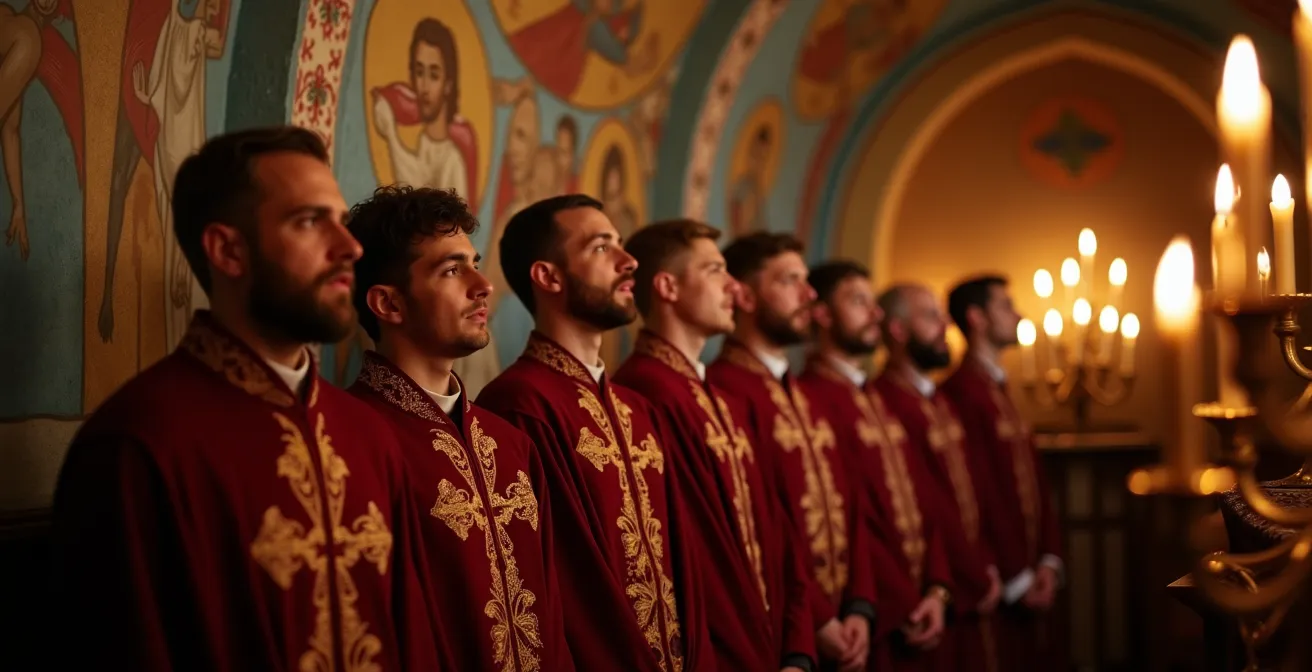
This auditory experience is a direct consequence of the cellular architecture. Each chapel acts as its own concert hall, proving that the design’s value lies not in its size, but in the quality of the experience it fosters within its confined walls.
Saint Basil vs. Intercession Cathedral: What is the real name of the building?
The confusion surrounding the building’s interior is mirrored by the confusion over its name. While the world knows it as Saint Basil’s Cathedral, this is technically incorrect and reveals a fundamental misunderstanding of its status and history. Its official, formal name is the Cathedral of the Intercession of the Most Holy Theotokos on the Moat. This name commemorates the military victory it was built to celebrate—the capture of Kazan on October 1st, the Feast of the Intercession.
The popular name, “Saint Basil’s,” came about later. St. Basil the Blessed was a “yurodivy,” or “holy fool for Christ,” a figure of great reverence in Russian Orthodoxy. He was buried in one of the chapels that was added to the main structure in 1588. His popularity was so immense that the entire complex gradually became known by his name. However, as scholars point out, this colloquialism is misleading:
The common Western translations ‘Cathedral of Basil the Blessed’ and ‘Saint Basil’s Cathedral’ incorrectly bestow the status of cathedral on the church of Basil, but are nevertheless widely used even in academic literature.
– Wikipedia Contributors, Saint Basil’s Cathedral Wikipedia Entry
The term “cathedral” itself implies it is the principal church of a bishop, which it is not. The original name, “Pokrov na Rvu” (Intercession on the Moat), refers to its location next to the defensive moat that once ran along the Kremlin’s eastern wall. Understanding this dual identity is crucial; it separates the building’s official, state-sponsored purpose from its popular, spiritual identity which ultimately won out in the public imagination.
Are the narrow staircases of Saint Basil’s accessible for seniors?
The historical authenticity of Saint Basil’s interior is one of its greatest assets, but it also presents significant modern challenges, particularly regarding accessibility. The building’s layout, with its narrow spiral staircases and tight corridors, was designed in the 16th century for processional movement, not for large crowds or individuals with mobility issues. The steps are often steep, worn, and uneven from centuries of use, making navigation difficult for many.
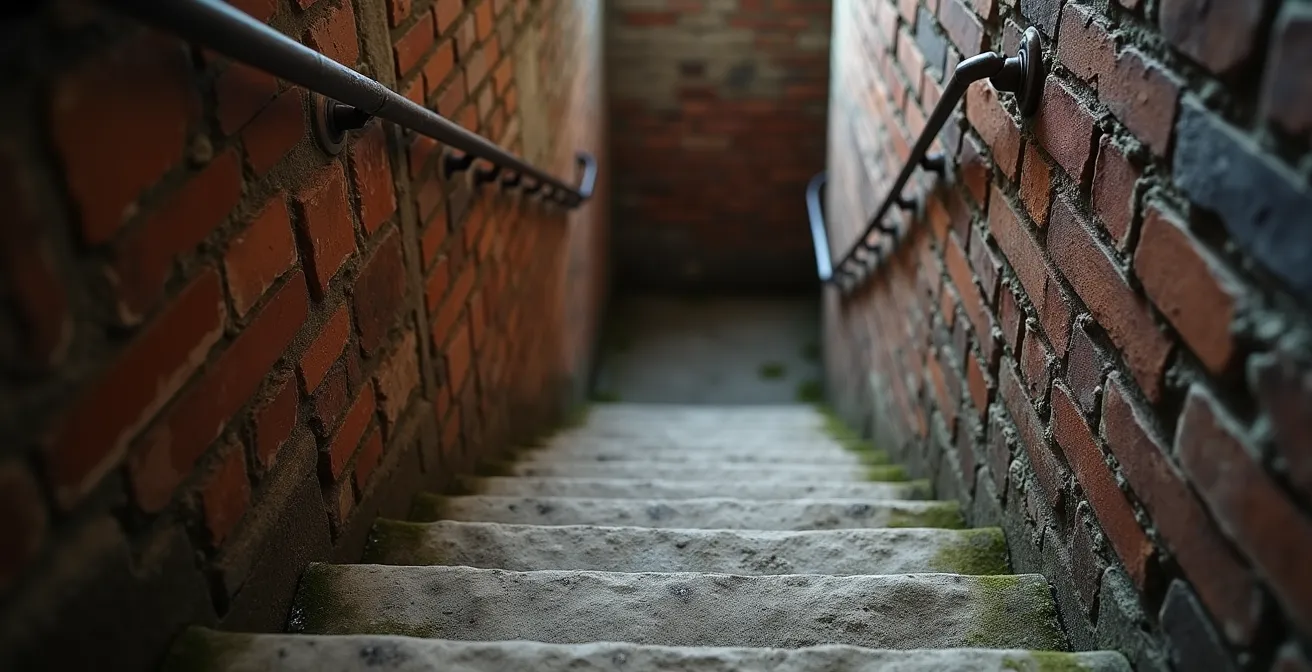
For visitors with mobility concerns, it is crucial to set realistic expectations. The structure has been preserved with minimal modern intervention. According to the State Historical Museum, which manages the site, the 16th-century monument has zero elevators or ramps. The second floor, which contains some of the most intricate galleries, is completely inaccessible to wheelchair users and can be a strenuous climb for seniors or anyone with difficulty walking.
However, this does not mean a visit is impossible. With careful planning, the experience can still be rewarding. The ground floor remains largely accessible and contains several of the main chapels. Here are some practical alternatives for visitors with mobility concerns:
- Focus the visit on the ground floor chapels, which are stunning in their own right and avoid the need for stairs.
- Utilize the benches located in the main entrance gallery and other ground-floor areas for frequent rest breaks.
- Consider visiting during off-peak hours (weekdays, early morning) to avoid crowds that make navigating the narrow spaces more difficult.
- The museum offers virtual tour options on its website, which can be an excellent way to see the upper floors without the physical strain.
The floral motifs of 17th-century frescoes: Restored or original?
One of the most overwhelming features of the interior is the sheer density of its decoration. Nearly every square inch of the walls and ceilings is covered in a vibrant “carpet” of floral and figurative murals. A common misconception is that this decorative scheme dates back to Ivan the Terrible’s era. In reality, the cathedral’s original 16th-century interior was far more austere, likely featuring simple whitewashed brick walls with minimal geometric patterns. The riot of color you see today is a layer of history added over a century later.
The major transformation occurred during a series of restorations from the 17th to the 19th centuries. It was during the repairs of 1761–1784 that the interior walls were first covered with the extensive floral ornamentation that now defines the space. This was a significant stylistic shift, reflecting changing tastes and a move away from the starkness of the original design. These layers of restoration and redecoration have been a constant throughout the cathedral’s history.
The following table, based on historical analysis, breaks down the evolution of the interior, distinguishing between the original 16th-century features and subsequent additions. This helps in reading the walls not as a single design, but as a historical document.
This layered history is detailed in a comparative analysis of the cathedral’s restorations, which helps distinguish original elements from later embellishments.
| Period | Original Features | Later Additions/Restorations |
|---|---|---|
| 16th Century (1555-1561) | Whitewashed brick walls, Simple geometric patterns | Basic structure and layout preserved |
| 17th Century | First floral frescoes added | Colorful dome paintings |
| 19th Century | Some Byzantine motifs retained | Oil paintings added, New iconostases |
| 20th-21st Century | Preserved 1580s decorations in select areas | Major restoration 1954-1955, Final restoration 2008 |
Black, Gold, or Blue: What does the color of a dome signify?
The iconic exterior of Saint Basil’s is defined by its nine unique domes, each with its own distinct color and pattern. In Russian Orthodox tradition, dome colors are not merely decorative; they are part of a rich symbolic code that communicates the dedication of the church or chapel beneath it. Understanding this code adds another layer of meaning to the visual experience of the cathedral.
While there are general conventions, Saint Basil’s takes this symbolism to an entirely new level. The standard color meanings provide a baseline for interpretation:
- Gold Domes: Represent Divine Glory and heavenly light, often used for cathedrals dedicated to Christ.
- Blue Domes with Stars: Dedicated to the Theotokos (the Virgin Mary), symbolizing the Star of Bethlehem.
- Green Domes: Symbolize the Holy Trinity or the Holy Spirit.
- Black Domes: Typically associated with monasticism and asceticism.
- Silver/Grey Domes: Often indicate a dedication to specific saints.
Saint Basil’s, however, is famous for its vibrant, multi-colored domes, which defy any single classification. This is a deliberate and unique choice, central to the cathedral’s identity as a representation of a divine city. As one expert source explains, this is an exception to the rule with a profound meaning:
The vibrant, multi-colored domes of St. Basil’s are an exception, symbolizing the beauty and diversity of the Heavenly Jerusalem, a concept of a divine city in the sky.
– Gallery Byzantium, Sacred Spaces: St. Basil’s Cathedral
This concept of the Heavenly Jerusalem is the ultimate key to the cathedral’s design, both inside and out. The complex, varied exterior and the maze-like, cellular interior are not flaws; they are a unified artistic vision of a perfect, celestial city brought down to earth.
Why did Ivan the Terrible ban the construction of tent-roof churches?
Saint Basil’s Cathedral is the pinnacle of a uniquely Russian architectural style: the tent-roof church. The soaring, octagonal towers of its central chapels are a defining feature of this 16th-century design. A persistent myth claims that Ivan the Terrible, after seeing the perfection of Saint Basil’s, banned all future construction of tent-roof churches to ensure it would remain unique. This dramatic story, however, is historically inaccurate.
The ban on tent-roof churches did happen, but it was issued nearly a century after the cathedral was completed and had nothing to do with Ivan the Terrible. The decree came from Patriarch Nikon in the mid-17th century. Nikon’s sweeping church reforms aimed to standardize Russian Orthodox practices with those of the broader Greek Orthodox world. He viewed the tent-roof style as a distinctly Russian, and therefore non-canonical, deviation. He mandated a return to the more traditional, Byzantine-style “cross-domed” church design.
Saint Basil’s, which was constructed between 1555-1561 on Ivan’s orders, therefore represents the zenith of this architectural movement, not its end. It was a “major innovation” for its time, a monumental stone church dedicated to a military victory, and its tent-roof design became an iconic symbol of Muscovite power and identity just before that style was suppressed for theological reasons.
Key takeaways
- Saint Basil’s interior is not one large hall but a complex of nine small, separate chapels, designed for personal pilgrimage.
- The cramped, stone-walled architecture creates exceptional, intimate acoustics, best experienced during Sunday services or choir performances.
- The famous floral frescoes are not original to Ivan the Terrible’s time; they were largely added in the 17th and 18th centuries over austere whitewashed walls.
Did Ivan the Terrible really blind the architects of Saint Basil’s?
Perhaps the most enduring and gruesome legend associated with Saint Basil’s is that Ivan the Terrible was so overwhelmed by its beauty that he ordered its architects, Postnik Yakovlev and Ivan Barma, to be blinded so they could never again create anything to equal it. This story perfectly encapsulates the Tsar’s reputation for brutal cruelty and has become an inseparable part of the cathedral’s lore. But like the ban on tent-roof churches, it is almost certainly a myth.
Historical records strongly refute this tale. While the architects’ identities were only confirmed in 1895, subsequent research has shown that at least one of them, Postnik Yakovlev, remained a highly active and sought-after architect for years after the completion of Saint Basil’s in 1561. This fact alone makes the story of his blinding impossible.
As documented evidence shows, his career continued to flourish:
Postnik Yakovlev’s Documented Career After Saint Basil’s
The legend of the blinding is a powerful one, but historical records contradict it. Far from being incapacitated, the architect Postnik Yakovlev went on to participate in major construction projects after 1561. Notably, he was involved in the construction of the Cathedral of the Annunciation in Moscow and was a key figure in building the walls and towers of the Kazan Kremlin. His documented activity continued at least throughout the 1560s, a clear indication that the story of his blinding is a dramatic fabrication.
This legend likely arose from a desire to create a powerful narrative about a mercurial tyrant and a building of unparalleled genius. While the story adds a layer of dark romance to the cathedral, the truth is a testament to the enduring skill of its creators. The building is not the final act of a blinded genius, but one spectacular highlight in a long and productive career.
By moving past the myths and the initial shock of its confined spaces, you can experience Saint Basil’s as its architects intended: not as a single room to be observed, but as a symbolic world to be explored.