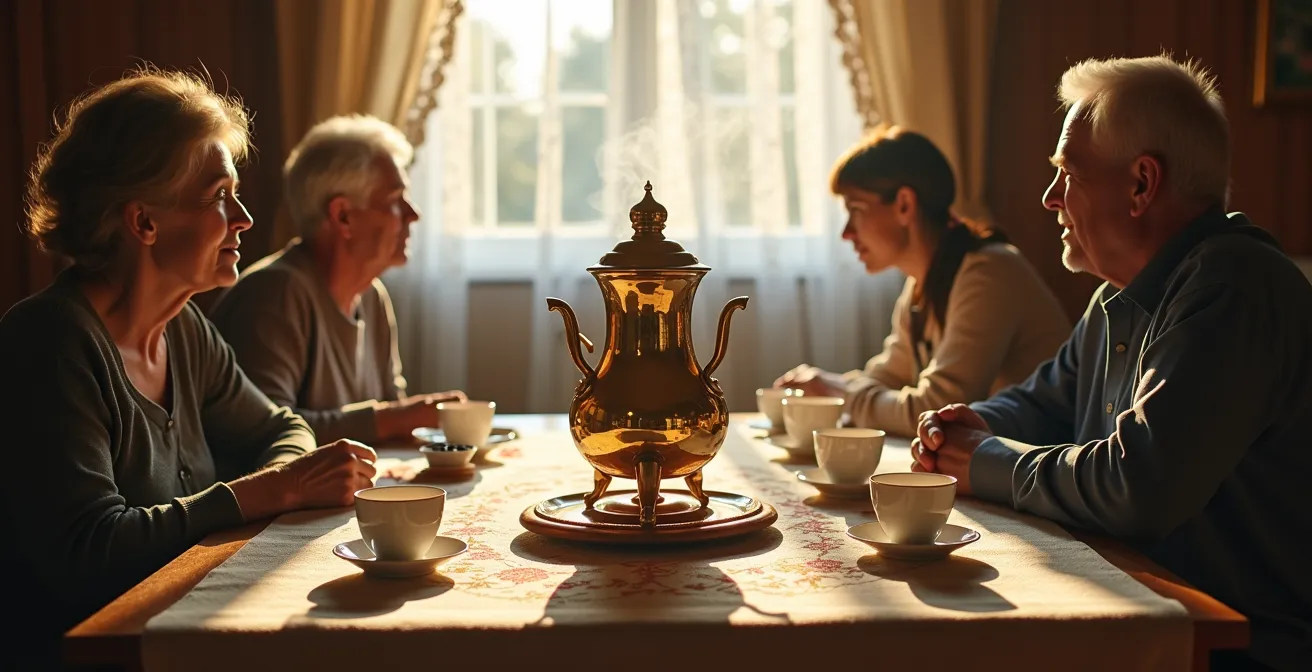
Contrary to the common belief that it’s merely about drinking a hot beverage, the Slavic tea ceremony is a profound cultural ritual. It acts as the central nervous system for a host of social traditions, from the intense heat of the banya to the communal joy of Maslenitsa. Understanding the tea ceremony isn’t just learning about a drink; it’s decoding a complex cultural language of hospitality, transition, and connection that fundamentally alters how you perceive your journey.
The image is iconic: a steaming, ornate samovar standing as the proud centerpiece of a table, surrounded by family and friends. For many cultural explorers, the Slavic tea ceremony seems like a charming, albeit straightforward, custom. You might think you understand it once you’ve learned about the zavarka (tea concentrate) and the podstakannik (glass holder). But this is like believing you understand the ocean by looking at a single wave.
The real power of this tradition lies not in the objects, but in its function as a liminal space—a sacred pause button in the rhythm of daily life. It is the social lubricant that fuels deep conversations, the temporal anchor that slows down time, and the invisible thread connecting a vast ecosystem of other fascinating Slavic rituals. To participate in a tea ceremony is to be given a key, one that unlocks a deeper understanding of everything from ancient superstitions to communal festivals.
This is where your travel perspective shifts. You stop being a mere observer of isolated curiosities and start seeing the interconnected web of a living culture. The tea ceremony becomes your entry point into a world of ritualized hospitality, a world where every shared cup is an act of community building. This guide will take you beyond the samovar and into the very heart of this cultural ecosystem, revealing how this single tradition is inextricably linked to the soul of Slavic life.
To fully grasp how this single ritual can redefine your travels, we will explore its connections to other core Slavic traditions. This journey will unpack the customs, tastes, and beliefs that orbit the central sun of the tea ceremony, providing you with a truly anthropological lens for your next adventure.
Summary: Why a Slavic Tea Ceremony is More Than Just a Drink
- How to survive your first Russian Banya experience without fainting?
- The 5 superstitions every Russian observes before a long journey
- Kvass or Kefir: Which fermented drink should you try for gut health?
- Where to buy authentic Khokhloma painting without paying tourist prices?
- Maslenitsa in Moscow: How to enjoy the pancake week like a local?
- Sweet or Savory: Which pancake filling is traditional for Maslenitsa?
- Why does authentic Borscht taste better the next day?
- Why do Russians burn a giant doll at the end of Maslenitsa week?
How to survive your first Russian Banya experience without fainting?
The Russian banya is not just a sauna; it is a ritual of purification and social bonding that is often bookended by a tea ceremony. The intense, humid heat of the *parilka* (steam room) is designed to cleanse the body and spirit, but it can be overwhelming for the uninitiated. The key to survival and enjoyment is gradual acclimatization and understanding its rhythm: short, intense periods in the heat followed by radical cooling and, crucially, long periods of rest and rehydration.
This is where tea plays a vital role. After a session of being gently beaten with a *venik* (a bundle of birch or oak branches) to improve circulation, you retreat to the relaxation room. Here, a steaming samovar awaits. Drinking hot, fragrant herbal tea helps to replace lost fluids and regulate body temperature from the inside out. This practice is deeply ingrained; a survey reveals that 94% of Russians drink tea every day, and in the context of the banya, it becomes a medicinal and restorative act. The experience is a cycle of extreme sensations—hot and cold, stimulation and relaxation—unified by the constant, calming presence of tea.

To navigate this intense but rewarding cultural experience, a structured approach is essential. The following steps provide a roadmap for your first visit, ensuring you enjoy the full therapeutic benefits without pushing your body too far.
Your Action Plan: 5 Essential Steps for Your First Banya Experience
- Preparation is Key: Start with a warm shower. This isn’t just about hygiene; it prepares your skin and circulatory system for the drastic temperature change to come, reducing the initial shock.
- Gradual Entry: Enter the steam room and begin on the lowest bench, where the air is coolest. Spend no more than 5-7 minutes here during your first round to let your body acclimate.
- Master the Venik: Don’t start flailing. Use the *venik* with gentle, tapping motions at first. The goal is to move the hot air around your body, not to strike it hard. Follow the lead of experienced locals.
- The Cold Plunge: When you feel overheated, exit for a cold plunge. This could be a cold shower, a dip in a pool, or even rolling in the snow. Limit this to 30 seconds to avoid excessive shock.
- Rest and Hydrate: This is the most important step. Rest in the antechamber for at least 15-20 minutes between steam room sessions. This is the moment for the tea ceremony, rehydrating with herbal infusions and socializing.
The 5 superstitions every Russian observes before a long journey
In Russian culture, a journey is never undertaken lightly. It is a transition fraught with uncertainty, and a web of superstitions exists to ensure a safe and successful passage. These are not just quaint folk beliefs; they are practiced rituals that reveal a deep cultural respect for the unknown. The most famous of these is “посидим на дорожку” (posidim na dorozhku), which translates to “let’s sit for the road.” Before leaving the house for a long trip, everyone who is departing, along with those seeing them off, sits down in silence for a minute.
This moment of forced stillness is a powerful liminal act. It’s a collective breath before the chaos of travel, a moment to calm one’s thoughts, remember any forgotten items, and mentally prepare for the road ahead. It is often during this quiet pause that last-minute thoughts or farewells are exchanged. While a full tea ceremony isn’t performed in this brief moment, the act of pausing and gathering reflects the same spirit: creating a deliberate, shared space before a transition. For a cultural explorer, especially one from France, observing these rituals offers a fascinating parallel to their own traditions.
This comparative table highlights how different cultures approach the universal need for luck and safety, showing the unique Russian emphasis on reflection and preserving forward momentum. The data, drawn from a deep dive into Russian cultural practices, provides context for these enduring traditions.
| French Tradition | Russian Tradition | Cultural Meaning |
|---|---|---|
| Touch wood (‘toucher du bois’) | Sit for the road (‘посидим на дорожку’) | Moment of reflection before chaos |
| Avoid number 13 | Never return home after leaving | Forward momentum preservation |
| Throw salt over shoulder | Look in mirror if forced to return | Breaking bad luck cycle |
| Cross fingers for luck | Empty suitcase means empty journey | Manifesting abundance |
| Bread and salt for new home | Whistle indoors loses money | Prosperity protection |
Kvass or Kefir: Which fermented drink should you try for gut health?
While tea dominates the hot beverage landscape, the Slavic world has an equally rich tradition of cold, fermented drinks: Kvass and Kefir. These are not simply refreshments; they are pillars of gut health and culinary heritage, often consumed for their probiotic benefits. Understanding them is another step into the authentic flavors of the region. Kvass is a tangy, slightly sweet, and mildly alcoholic beverage traditionally made from fermented rye bread. It’s the quintessential summer drink, sold from street carts and beloved for its thirst-quenching properties.
Kefir, on the other hand, is a fermented milk drink, similar to a thin yogurt, made with kefir “grains” (a symbiotic culture of bacteria and yeasts). It has a tart, creamy flavor and is renowned for its powerful probiotic content. Choosing between them depends on your preference: Kvass offers a lighter, bread-like flavor profile, while Kefir provides a rich, dairy-based tang. Both are an integral part of the traditional diet, balancing the hearty, often heavy, main courses.
For cultural explorers in France, finding authentic versions of these drinks can be a rewarding treasure hunt. While industrial versions are appearing in large supermarkets, the best flavors are found in specialty stores that cater to Eastern European communities. Here is a practical guide for your quest in France:
- Check Eastern European specialty shops, particularly in Paris’s 20th arrondissement, for a wide selection of imported Kvass and Kefir.
- Visit organic stores (‘magasins bio’) where you can sometimes find artisanal kefir grains to make your own at home.
- Look for ‘Monoprix Gourmet’ or similar high-end supermarket sections, which have started featuring imported Kvass as a niche beverage.
- Explore the markets near Russian cultural centers, such as those in Nice and Strasbourg, for seasonal and homemade products.
- Don’t hesitate to ask at ‘épiceries fines’; some carry specialty fermented beverages from across Europe.
Where to buy authentic Khokhloma painting without paying tourist prices?
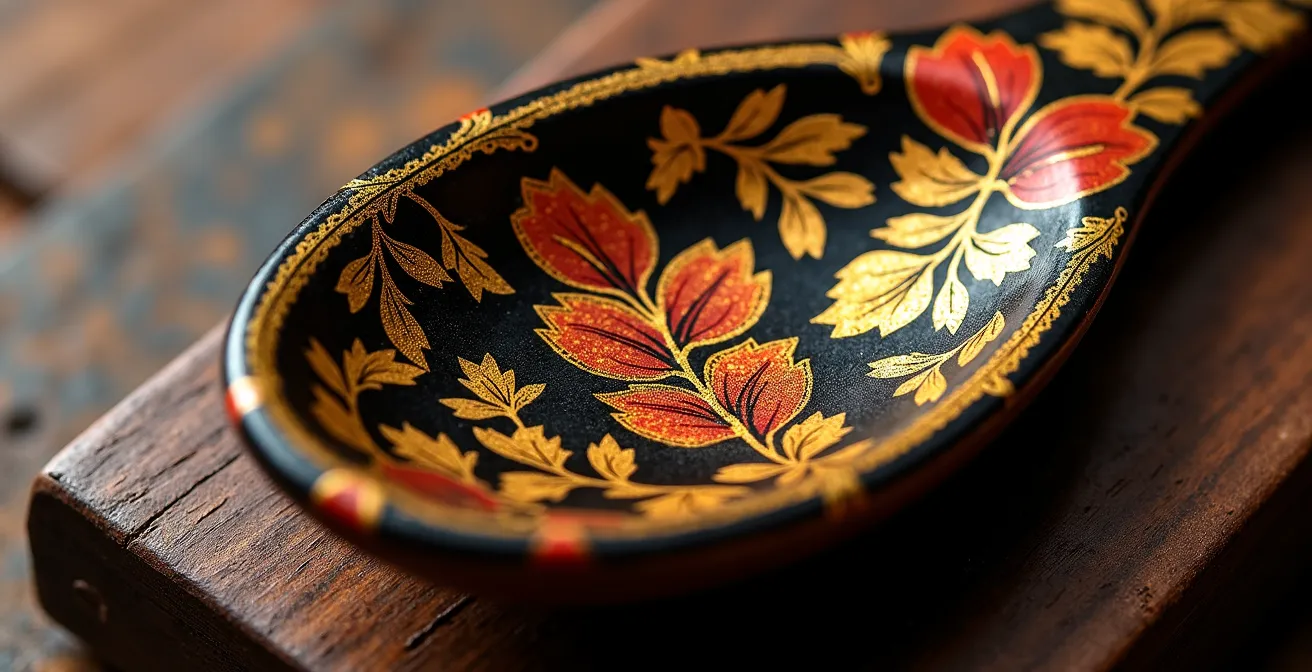
The beauty of the Slavic tea ceremony is not just in the drinking, but in the artistry of its tools. The gleaming samovar, the delicate porcelain, and the beautifully painted wooden spoons are all part of the aesthetic experience. Among these crafts, Khokhloma—a traditional wood painting style known for its vivid floral patterns on a golden or red background—is one of the most recognizable. However, buying authentic Khokhloma without falling for a tourist trap requires a discerning eye.
The key to authenticity is understanding its origin and purpose. True Khokhloma is not just decorative; it’s functional. The special lacquering technique makes it waterproof and heat-resistant, so bowls and spoons can be used for eating. When shopping, look for items that feel substantial and have a smooth, flawless lacquer finish. Avoid pieces that are garishly bright or have sloppy, rushed brushwork. The most authentic pieces are often found not in the main tourist thoroughfares, but in official factory stores or specialized artisan markets in cities like Nizhny Novgorod or Moscow’s Izmaylovo Market.
This quest for authenticity is central to the entire cultural experience, especially concerning the samovar itself. The city of Tula is to samovars what Bordeaux is to wine. As this case study shows, it’s the undisputed historical heart of this iconic craft.
Tula: The Historical Center of Russian Craftsmanship
In Russia, the first copper samovar was famously crafted in 1778 by the Lisitsyn brothers in Tula. This city quickly became the epicenter of production. Within just 70 years, the numerous samovar-makers in Tula were producing an astonishing 120,000 samovars every year. Today, Tula remains so synonymous with this craft that a famous Russian proverb says, “You don’t take your own samovar to Tula,” the equivalent of “carrying coals to Newcastle.” It signifies the folly of bringing something to a place that is the world’s foremost expert and producer of that very item.
Maslenitsa in Moscow: How to enjoy the pancake week like a local?
Maslenitsa, or “Pancake Week,” is a vibrant, chaotic, and joyous folk festival that marks the end of winter. It’s a week-long celebration of life, food, and community before the solemn fasting of Orthodox Lent begins. For a traveler, experiencing Maslenitsa in a city like Moscow is to witness the cultural ecosystem at its most exuberant. To enjoy it like a local, you must dive headfirst into its activities. This means eating an abundance of *blini* (thin pancakes), participating in outdoor games, and witnessing traditional fistfights (*koulachniy boy*).
Every day of the week has its own theme, from greeting “Lady Maslenitsa” on Monday to “Forgiveness Sunday,” where people ask forgiveness from one another. The celebration is a feast for the senses, with folk music, brightly colored ribbons, and the smell of buttery blini filling the air. The central idea is to indulge in all the things forbidden during Lent: dairy, eggs, and social festivities. The tea ceremony, of course, is the constant companion to the endless consumption of pancakes, providing a warm respite from the winter cold and a forum for family gatherings.
The tradition of large-scale public gatherings and feasting is deeply rooted in Russian history, flourishing during the golden age of trade routes that brought goods like tea to the masses. The cultural and economic peak of this era created the perfect environment for such elaborate traditions to thrive. In fact, historical records show that 1824 was the peak year for the Kiakhta tea trade, a period when the nation’s love for tea and communal celebration became inextricably linked. Participating in Maslenitsa today is tapping into this long history of collective joy.
Sweet or Savory: Which pancake filling is traditional for Maslenitsa?
During Maslenitsa, the question is not *if* you will eat blini, but *how* you will eat them. The answer to whether fillings should be sweet or savory is simple: both! The Russian blin is a versatile canvas, and the choice of filling often reflects the occasion and the host’s generosity. The most humble and traditional way to eat a blin is simply with a dollop of *smetana* (sour cream) or melted butter. This allows the simple, nutty flavor of the pancake itself to shine.
As you move up the scale, you find fillings like *tvorog* (a dry farmer’s cheese, which can be sweetened or left savory) and various kinds of *varenye* (fruit preserves). For truly festive occasions, savory fillings take center stage, culminating in the ultimate celebratory toppings: red caviar (*ikra*) and, for the most luxurious tables, black caviar. The type of filling served is a form of social language, communicating the importance of the gathering. A traveler in France can find familiar echoes in their own crêpe culture, but with a distinct Slavic hierarchy.
The following table, based on an analysis from tea culture experts at Path of Cha, breaks down the social significance of common Maslenitsa fillings, providing a cultural key for what’s on your plate.
| Filling Type | Social Significance | French Equivalent |
|---|---|---|
| Sour Cream & Butter | Humble, everyday | Crème fraîche nature |
| Tvorog (Farmer’s Cheese) | Traditional comfort | Fromage blanc |
| Varenye (Fruit Preserve) | Family gathering | Confiture maison |
| Red Caviar | Festive celebration | Œufs de saumon |
| Black Caviar | Ultimate luxury | Caviar Beluga |
One of the most unique sweet experiences involves *varenye*, which is enjoyed in a very particular way during a tea ceremony, as this testimony describes:
Varenye is essentially a fruit jam in loose form with whole fruits and lots of syrup. Guests would put a spoonful of jam in their mouth and sip tea through it. The whole fruits slowly melt under the heat and release sweetness and fruity aroma.
– Path of Cha, Drinking Tea in Russia
Why does authentic Borscht taste better the next day?
It’s a truth universally acknowledged in any Slavic household: borscht is always better on the second day. This is not a myth or an old wives’ tale; it’s a matter of simple food chemistry. Authentic borscht is a complex symphony of flavors, a hearty soup made with beetroot, cabbage, potatoes, and often meat. When it’s first cooked, the individual flavors are distinct and vibrant. However, as the soup cools and rests in the refrigerator overnight, magic happens.
The process is called flavor melding. The cell walls of the vegetables continue to break down, releasing more of their sugars and savory compounds into the broth. The acidity from ingredients like tomatoes or vinegar mellows, and the fats from the meat or smetana have time to emulsify and distribute evenly. The result is a soup that is deeper, richer, and more harmonious. The sharp edges of individual ingredients soften into a unified, complex whole. This culinary principle—that time and patience are essential ingredients—is a cornerstone of Slavic cuisine, a world away from the instant gratification of fast food.
This appreciation for depth and developed flavor is the same spirit found in the tea ceremony. It’s a culture that values slow, deliberate processes. It is this very richness that captivated foreign visitors for centuries, including the famous French author Alexandre Dumas, who was a great connoisseur of Russian culinary traditions. In his seminal work on cuisine, he made a bold declaration:
The best tea is drunk in St. Petersburg and in general across all Russia.
– Alexandre Dumas, Grand dictionnaire de cuisine
Key Takeaways
- Tea as a Social Ritual: The Slavic tea ceremony is not merely a beverage break; it’s a structured social institution for hospitality, conversation, and marking transitions.
- The Center of a Cultural Web: Understanding the tea ceremony provides a key to deciphering other traditions like the banya, travel superstitions, and Maslenitsa, which are all interconnected.
- A Shift in Traveler Perception: Engaging with this ritual moves a traveler from being a passive observer to an active participant, seeing a coherent cultural system rather than isolated curiosities.
Why do Russians burn a giant doll at the end of Maslenitsa week?
The climax of Maslenitsa week is a dramatic, fiery spectacle: the burning of “Lady Maslenitsa,” a giant straw effigy dressed in women’s clothing. To an outsider, this can look like a strange and even violent act. But for a cultural anthropologist, it is a powerful and ancient rite of passage, a symbolic funeral that gives birth to new life. This ritual is the very heart of the festival, representing the final, definitive farewell to winter.
The doll, or *chuchelo*, embodies the harshness, cold, and darkness of the winter season. Throughout the week, she is paraded, celebrated, and sometimes even blamed for winter’s hardships. Her immolation on Forgiveness Sunday is a deeply symbolic act of purification. By burning her, the community symbolically destroys winter and everything associated with it: death, stagnation, and gloom. The fire is a cleansing force, and the ashes from the effigy were traditionally scattered over the fields to ensure a fertile and bountiful harvest. It is a sacrifice to usher in the spring.

This grand, public ritual is the macrocosm of the small, intimate ritual of the tea ceremony. Both are about transition. The tea ceremony marks small transitions—from work to home, from stranger to guest. The burning of the doll marks the great, seasonal transition from death to rebirth. Seeing this connection is the final piece of the puzzle. You realize that the entire culture is built on these rituals, big and small, that help navigate the passages of life. This is the perspective change promised by the tea ceremony: you learn to see the world not as a series of random events, but as a structured, meaningful, and deeply human tapestry of rituals.
Now, armed with this deeper cultural context, you are no longer just a tourist. You are an explorer, ready to engage with these traditions not as a checklist of sights, but as a participant in a living, breathing cultural dialogue. The next time you are offered a cup of tea in a Slavic home, you will know you are being invited not just for a drink, but into the very heart of their world.